
Audio overview: Listen & Learn
Top 5 Solar Sales CRM Features Every Solar Company Need in 2026
If you are in the solar business, then investing in a Solar CRM might seem like an expense—but the right one can help you win more deals, double your profits by quarter’s end, and scale at the pace of the booming solar market.
Without it, staying competitive and keeping up may no longer be possible by managing customer data.
And here’s the truth: even if you're already using a CRM, if it doesn’t address the specific challenges of your solar business, such as complex project design, financing workflows, and mobile field teams, then you're simply spending money on a tool that won’t deliver returns.
Therefore, this blog walks you through the latest CRM trends, core features to look for, and how to find the best fit for your solar business.
5 Must-Have Sales CRM Features
A solar CRM remains central in 2026 for solar companies aiming to manage leads, streamline sales cycles, and scale operations efficiently. The right CRM helps automate lead capture, client communication, proposal generation, and financing workflows, eliminating manual bottlenecks and missed opportunities.
As solar demand and competition intensify, features like mobile access for field teams, real-time project tracking, design and financing integrations, and intelligent pipeline analytics become non-negotiable.
This guide presents the five core solar CRM features companies must prioritize today to stay ahead: automated lead management, integrated proposals and finance tools, mobile accessibility, robust workflow automation, and data-driven analytics.
Key Takeaways
- The Right CRM with suitable features brings a better conversion rate, improved customer relationships, and scalability growth for the business.
- A generic CRM isn’t enough; solar companies need specialized tools with features like tailored lead management, design integrations, financing solutions, and compliance tracking to keep up with the rapidly growing solar market.
- Sunbase has developed a robust solar CRM solution equipped with AI-powered predictive analytics, smart dashboards, and automation tools for lead management.
What is Solar Sales CRM and Why Does it Matter in 2026 to Solar Business?
Solar Sales CRM software is specialized software that assists solar companies throughout their sales journey.
The year 2026 has driven the need for Solar CRM to become a necessity! Let us see what makes the CRM software the go-to tool for the solar industry.
1. Meeting customer expectations:
To ensure customer satisfaction, it is important to deliver instant updates, real-time quotes, and personalized interactions across web, mobile, and messaging apps.
This is where solar CRM software helps. It offers an integrated solution that automatically surfaces next‑best actions and personalized offers based on historical data.
It also provides automated follow-ups, personalized engagement, and quick responses to create better customer experiences, engage potential clients, and convert leads into loyal customers.
2. Navigation of complex regulatory compliance:
Solar businesses must track and comply with constantly evolving regulations to meet industry standards.
2026 brings more frequent changes in interconnection rules, net‑metering policies, and storage incentives.
Therefore, a solar CRM with an in-built document storage and compliance tracking system ensures that all projects meet legal requirements, helping avoid unnecessary penalties and legal issues.
3. Elevate marketing campaign efforts for smarter lead targeting:
Solar CRM refines lead management by segmenting leads based on value to your solar business.
With AI‑driven segmentation, lookalike audiences can be bucketed for higher‑value solar and storage customers.
Additionally, data-driven insights and automated territory mapping help route sales reps to high-potential customers based on availability and optimized routes.
4. Tackling the skilled labor deficit:
With the rapid growth of the solar industry, the demand for solar-specialized professionals has skyrocketed, and the 2026 solar workforce increasingly needs digital and AI skills to keep up.
However, the shortage of skilled labor disrupts business operations, leading to project delays and burnout among the limited staff working around the clock.
Solar CRM helps bridge this gap with standardized playbooks and automated workflows that reduce dependency on a few key experts, empowering solar companies to achieve more and foster repeat business with fewer hands.
How Solar-focused CRM Outperforms Generic Tools in 2026?
You have two routes to take:
Generic Route: CRM software that handles basic sales processes, but you spend endless hours and dollars on customizing fields to manage complex solar projects, inaccurate lead tracking, and customer management, while also struggling with storage design, interconnection, and incentive workflows.
Smarter Solar Route: The solar CRM software that is built specifically for solar businesses. It streamlines workflow, automates tasks, and provides data-driven insights to drive sales growth and foster stronger customer relationships.
The choice is simple! It may cost you upfront, but it delivers long-term results that a generic route can never match!
Now, let's delve into the key features of the sales Solar CRM that make it a winning choice!
1. Tailored Lead Development
- Intelligent lead scoring by categorizing them as hot, warm, and cold to prioritize sales efforts.
- Automated follow-ups for a drip campaign while you rest, so that you never miss an opportunity.
- Auto-assign leads to the right sales reps with smart route optimization to save fuel and expand outreach, getting more deals.
2. Built-in solar design integrations
- Get customized solar proposals within minutes with accurate solar designs and cost estimates that quicken the sales process.
- Integrate and sync with solar design tools and other project management tools to gain a unified view of all project phases.
3. Financing tools to quote loans and apply instantly
- Central hub for financing options that tracks every loan application and stores all documents safely in one place.
- Automated and instant loan quotes that speed up approvals for pushing the number of installations to be more!
4. Mobile Accessibility and Offline
- Simple, user-friendly interface enables field reps to access and update the CRM on the go, anytime and anywhere.
- Real-time updates with offline sync guarantee accurate data and quicker responses, brightening solar sales performance.
Buyer's Guide to the Five Must-Have Features of Solar CRM
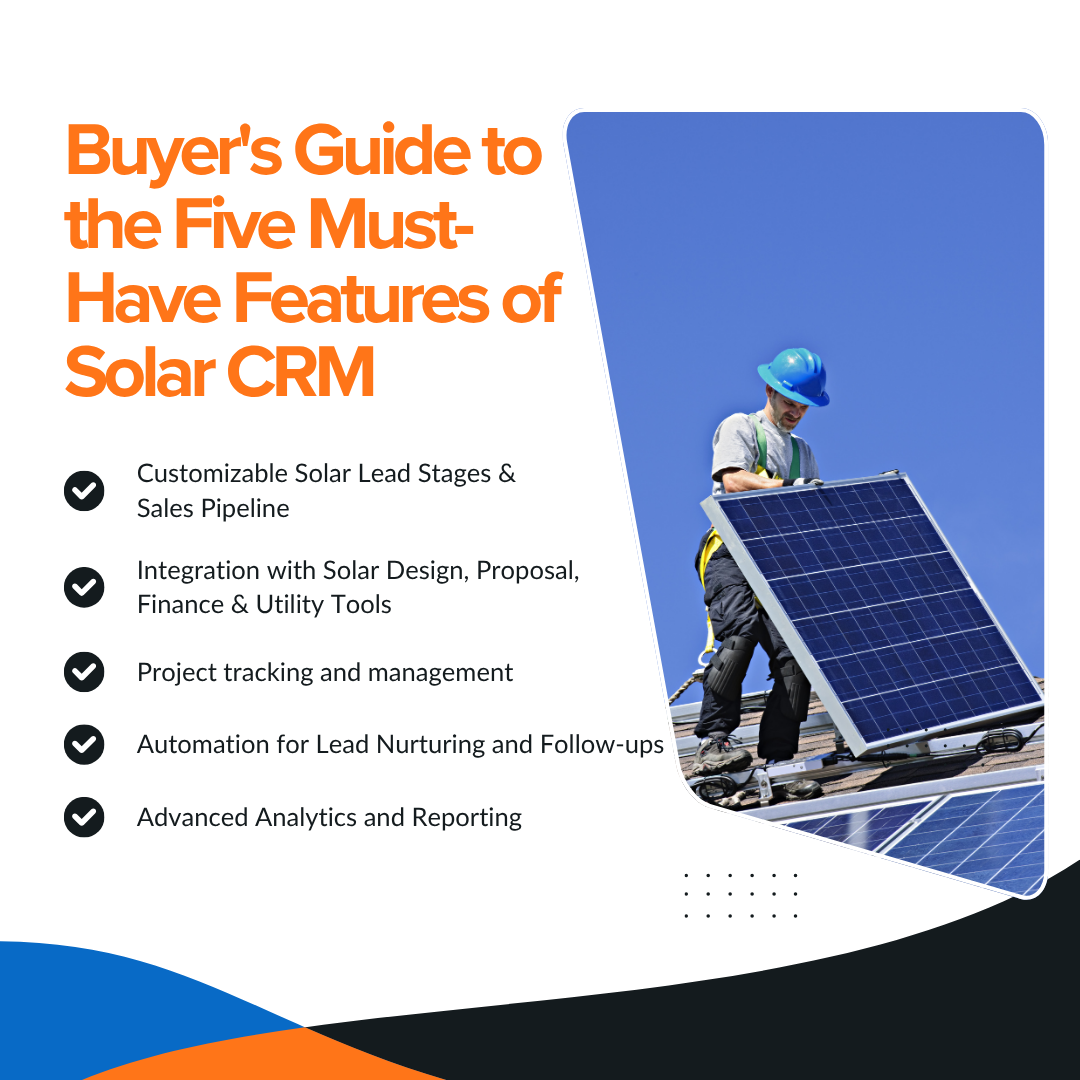
1. Customizable Solar Lead Stages & Sales Pipeline
Lead generation tools are customized to your business processes, capturing new leads from various sources such as referrals, social media platforms, and website forms.
The sales pipeline offers a clear visual of each sales stage from the initial contact to final deal closure, tracking every lead closely.
What to look for:
- Smart Lead Capture: CRM software must be able to pull leads from multiple channels into one unified hub that misses no opportunities and increases lead conversions.
- Automation: An intelligent tool that equips the task force to sync data between different platforms without manual efforts, while the sales team focuses on strategies that can close more deals.
2. Integration with Solar Design, Proposal, Finance & Utility Tools
Solar CRM integration capabilities to solar design software, proposals, and estimating apps are ideal to streamline the sales and technical workflow of the solar business.
What to look for:
- Proposal Templates: The CRM must come with pre-built professional templates that are accurate and professional, and the sales team can modify them to add-on features tailored to suit different customers.
- Utility function: The CRM software tools must tap into a real-time utility database to instantly create estimates. These estimates auto-fetch net meter rules and grid requirements to save on the bill and fasten the permit process.
- 3D design modelling: A tool that uses AI-generated design for solar panels to place the solar system that maximizes energy output optimally, customized to different roof sizes.
- Connection to financing platforms: CRM software must have integration to financing options that pre-qualify loans for quick approvals and display a payment cycle that brings seamless budget management for informed decision-making.
3. Project tracking and management
The CRM software should be like your personal assistant that reminds you of every follow-up, dials every lead towards closure, and sends proposals on time to grab every opportunity.
What to look for:
- Searchability: A CRM needs to have filter and search options to explore what you are looking for by cutting through the clutter and accessing critical information instantly.
- Appointment Scheduler: Software that transforms the automated calendars by seamlessly scheduling meetings, reviews, and follow-ups with smart reminders and alerts to keep all your projects on track.
4. Automation for Lead Nurturing and Follow-ups
The CRM must ensure that no leads slip away. Multiple channel communication to keep every lead warm or hot, and automated follow-ups maximize outreach that converts to sales.
What to look for:
- Drip Campaigns: The CRM needs to have automated and timely messages to all potential leads through multiple channels to move leads forward, while the sales team can turn to more strategic chores.
- Multi-channel communications tool: Leads are scattered, and CRM needs to capture them from multiple platforms through one unified platform that is bound to create impact.
5. Advanced Analytics and Reporting
Know every move that shapes your sales process with smart analytics that turn raw data into clear insights to devise your sales strategies to fuel growth.
What to look for:
- User-friendly: A CRM is the team's daily companion, so it has to be easy to understand, and your team should be able to navigate without technical expertise.
- AI-powered insights: CRM that turns into a data analyst by highlighting key strategies and automated notifications on stalled deals and roadblocks that you must not miss to stay ahead in the solar race.
Modern solar CRM like Sunbase offer these features in one place, helping teams move faster without multiple tools.
Real-World Cases: Solar CRM in real action
Let's stop just exploring the features and understand how these features benefit your solar operations.
Because here’s the truth: having features alone won’t solve your team’s challenges.
Enough Talk: Let's Enter the real-world impact of a powerful Solar CRM that helps you generate more leads, boost efficiency, and close deals- the real game-changer!
1. Sales Reps: Close Deals with Happy customers
The sales reps are in the field, and the sales manager pings them about a new lead nearby! Sales Reps wonder: Can I catch this prospect and turn them into a sale? But time is tight, and proposals are not yet ready! Will I miss the chance?
However, with a crm software, the sales reps can:
- Instant lead capture with automated alerts.
- Proposal generation is instantly customized to customer needs.
- Access to customer information for a personalized sales pitch.
- Mobile access on the go and instant upload, even when offline.
2. Installers: Streamline Operations
Let us shift our focus to the solar project installation, where the master coordinator oversees the construction of a new multi-phase project and:
- Instantly view and reschedule project timelines on the go with the mobile app.
- Real-time hail disruption alerts help with proactive planning to stay within the timeframe.
3. Marketing Managers: Convert campaigns into action
CRM is the wizard that turns leads into a sales pipeline, fuelled by automation.
- Segmenting leads to capturing high-potential clients
- Automated drip campaigns that nurture prospects while you rest
- Track campaign with real-time analytics to open strategic mind manipulation for marketing efforts
4. Project Managers: Keep the Project on Track
Project Managers are tough taskmasters, but a CRM turns them into calm masters as they can:
- Assign tasks and deadlines based on priorities.
- Monitor project phases in real-time with instant updates on delays and bottlenecks.
- Seamless collaboration with sales team, installers, financial teams, and others.
5. Financial team: Seamless integration of financing tools to maximize cash flow
Money moves fast, and CRM speeds up financial masters to take charge in a smarter and faster way!
- Automated invoices and instant approval sanction.
- Monitor project costs and cash flow in real-time to track and automate payment reminders.
Top Four Solar CRM Trends in 2026
1. AI-Powered Sales Automation
The Solar CRM uses Artificial Intelligence to act as a digital wizard, assisting with lead management, enhancing solar panel installations with accurate 3D design, and analyzing vast data to generate actionable insights.
2. Predictive Analytics & Smart Dashboards
Smart Dashboards with predictive analytics are new power tools of Solar CRM, turning complex data into real-time actionable insights to save time and costs.
3. Built-In Financing & Proposal Integrations
The modern CRM for solar companies has proposal generation within minutes using real-time utility data and built-in e-signatures that deliver precision and eliminate paperwork and delays.
Real Benefit: Companies using integrated solar sales and financing platforms have reported a 50% increase in sales cycle speed and a reduction in proposal preparation time.
4. Regulatory Compliance & Digital Document Handling
Modern CRM software is designed to protect you from costly legal penalties through built-in tracking and automated workflows.
This is achieved through compliance with legal permits and regulations, and through a centralized storage vault for all critical documents.
How to Evaluate the Best Solar CRM for Your Solar Company in 2026
Checklist of Questions you must ask!
1. Does it support the full solar sales lifecycle?
Solar CRM software must cover every phase of the sales funnel!
- Lead management to collect inbound leads, segment them, and capture high-potential clients.
- Instant proposal creations with accurate design and estimates.
- Manage solar financing with instant approvals.
- Automated follow-up for post-sales service enrichment.
2. Can it integrate with your existing tools and financing partners?
Solar CRM software must seamlessly integrate with design, finance, and project management tools. So, opt for software that.
- Real-time sync to other tools to eliminate double entry
- Smother workflow and a connected workspace
3. Is it built for mobile, field, and office teams alike?
Solar CRM must fit the job workflow for job site managers sitting at office desks to powering field reps on the move.
- Uninterrupted workflow with offline functionality that automatically syncs data when back online.
- User-friendly mobile app for on-the-go access.
Why Choosing the Right CRM Software Matters
1. Improved Customer Relationships
The Solar CRM, which consolidates customer information for personalized interaction, turns into a lasting connection to build trust and loyalty.
2. Improved Collaboration:
Shared knowledge with a real-time communication tool promotes collaboration and facilitates seamless communication to satisfy every client's needs.
3. Cost Savings:
CRM for solar must eliminate clutter and chaos, saving costs by automating tasks that enhance precision and efficiency, thereby driving down operational costs and reducing costly reworks.
4. Competitive Advantage:
The modern CRM for solar must strengthen customer relationships, enhance quality services, streamline the sales funnel process, and save costs to differentiate itself from others in the solar market.
Pitfalls you must avoid before onboarding the Solar CRM
1. Lack of a Clear Plan and Objectives:
Do not invest in a solar CRM without a clear blueprint of objectives that define your business success.
2. Insufficient User Training:
A robust CRM is only valid when your team knows how to use it; you must train them properly to enhance customer engagement, unlock its full potential, and maximize results.
3. Ignoring Integration Needs:
Failure to connect to existing tools brings data silos that disrupt seamless information flow.
4. Overlooking Security:
No security tool can pose major risks such as data breaches, loss of consumer data, and costly legal aftermath.
5. Rushing the Implementation:
The absence of a proper plan and inadequate user training for the Solar CRM integration poses a risk to workflow. This leads to user confusion, inconsistent usage, and underperformance of the CRM, which highlights a wasted investment.
Unlocking Higher Profits with the Right Solar CRM
Profit = (Lead Quality × Conversion Rate) ÷ Sales Cycle
1. Targets Qualified Leads
The right solar CRM not only stores leads but also sorts them into warm, hot, and cold categories.
It guides sales teams towards high-potential leads, maximizing ROI and minimizing efforts on disqualified leads.
2. Conversion Rate increases with Smarter Follow-Ups and Personalized Proposals.
Personalizing solar proposal generation and automated follow-ups ensures no leads slip away, and personalized proposals tend to turn interactions into contracts.
3. Sales Cycle closes fast with automation
Automated workflow to streamline all phases of the sales funnel, securing instant loan approval and e-signatures to close deals faster.
Let's understand why automation with crm is the profit maker!
Before CRM Automation:
Lead Quality: 70
Conversion Rate: 10%
Sales Cycle: 21 Days
Profit: (70 × 0.10) ÷ 21 = 0.33
After CRM Automation With Sunbase
Lead Quality: 80 (Automated lead management)
Conversion Rate: 18% (Smart follow-up)
Sales Cycle: 10 Days
Profit: (80 × 0.18) ÷ 10 = 1.44
Outcome: 4X Higher profit with Automated Solar CRM software.
How to Find the Right CRM: A 4-Step Buyer’s Guide
1. Assess business needs
- Define your business processes aligned to its short-term and long-term goals.
- Evaluate the current workflow to spot the gaps that the CRM must align with to bring efficiency
2. Must-have features for your business
- Every solar business has unique needs- explore the Solar CRM that has features built in to suit your needs.
- Tap into insights from your sales team to choose the most suitable CRM
4. Gain an understanding of the budget constraints
- Evaluate your budget to get the CRM that fits the bill and delivers value that does not drain your pocket.
- Plan to save unexpected costs that ruin the ROI.
5. Evaluation of CRM software options
- Compare the features, pricing structure, and scalability of a CRM that suits your business processes.
- Give the CRM providers the chance to impress you with a demo or trial before you sign the contract.
Best CRM for Solar Installers to Achieve Maximum Efficiency: Why is Sunbase the top choice?
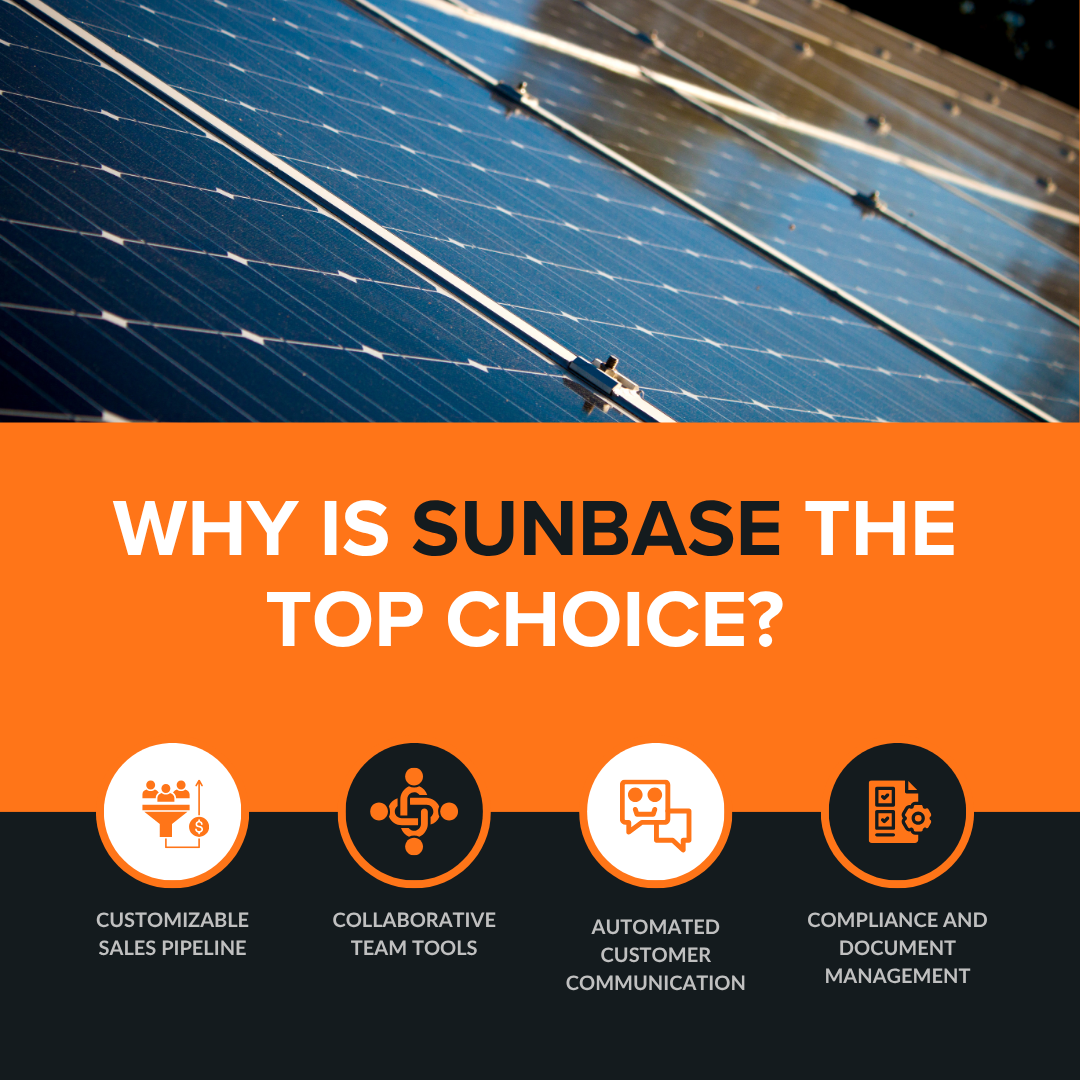
1. Customizable Sales Pipeline
It helps you with lead management to track and capture leads and tailor the sales process according to the unique needs of the business. It also helps you in tracking every phase in the sales funnel.
2. Collaborative Team Tools
Centralized platform to streamline communications from the office desk to the field with an in-built task manager, file sharing, and a chatting portal to keep all members in sync.
3. Automated Customer Communication:
Automated follow-up and appointment reminders that boost the level of customer relationship management.
4. Compliance and Document Management:
Simplified storage and tracking of legal permits, contracts, and other critical documents to be industry-compliant.
Summing It Up
The benefits the Solar CRM sparks satisfy every owner. It streamlines the sales process, fosters stronger customer relationships, and boosts overall performance.
In 2026, the right Solar CRM will empower solar businesses to improve lead management with intelligent scoring and automated follow-ups.
It will also integrate seamlessly with solar design and financing tools, providing mobile accessibility with offline capabilities, and ensuring compliance with evolving regulations.
So, what are you waiting for when Sunbase Solar CRM software can unlock the full potential of your team to work smarter and grow faster?
Want These 5 CRM Features in Your Sales Process?
Sunbase is built to match the exact capabilities recommended in this guide. No switching between tools, no manual follow-ups, just a streamlined sales workflow from lead to install. Book your demo today!
FAQs
1. What Are the Most Important Solar CRM Features in 2026?
The essential features include automated lead management, fast proposal generation, mobile access, workflow automation, and real-time analytics. These capabilities help solar teams close deals faster and manage higher lead volumes with less manual work.
2. How Does a Solar CRM Improve Sales Performance?
A solar CRM centralizes leads, automates follow-ups, speeds up proposals, and provides clear pipeline visibility. This reduces delays, increases response time, and helps sales teams convert more prospects into paying customers.
3. Do Small Solar Companies Need a Solar CRM?
Yes. A solar CRM helps small teams avoid missed leads, manage jobs better, and send accurate proposals quickly. Even small installers benefit from automation, improved organization, and faster communication.
4. What Should I Look for in a Solar CRM?
Prioritize automation, proposal tools, mobile usability, financing integrations, and project visibility. These ensure your team can work efficiently from the field to the office without switching between multiple tools.
5. Can a Solar CRM Help Reduce Manual Work?
Absolutely. A solar CRM automates lead routing, reminders, proposal steps, and documentation. This cuts repetitive tasks and allows teams to focus on selling and project execution instead of admin work.
6. How Does a Solar CRM Support Faster Proposal Creation?
A solar CRM speeds up proposals by using prebuilt templates, automated pricing, integrated product catalogs, and digital signatures. This reduces manual entry and allows sales teams to send accurate, professional proposals in minutes.
One Platform.
Zero Chaos.
Run Your Entire Business in One Platform
Sunbase replaces your CRM, proposals, scheduling, job tracking, and reporting tools — all inside one clean, connected platform.
About Sunbase
The All-In-One Platform to Run Your Entire Business
Sunbase helps you organize operations, streamline daily workflows, and manage everything - from first customer contact to final project deliver- in one connected system.
Our Mission
- Organize your business.
- Optimize your workflow.
- Automate your dailytasks
Why Businesses Choose Sunbase
One Connected Workflow
Replace scattered tools and manual processes with a single platform that brings together your team, tasks, customers, jobs, and performance data.
🌎 Global Presence
Serving the United States, Canada, India, LATAM, Australia, and 10+ international markets.
👥 11,000+ Users
Trusted by contractors, installers, project managers, sales teams, and field technicians.
🏗️ Built for All Sizes
From small contracting teams to fast-growing enterprises, Sunbase adapts to your workflow.
Stop Managing Your Business Manually. Automate It.
Sunbase automates workflows, reduces mistakes, and helps your team get more done - without hiring extra staff or juggling multiple tools.
Still Managing Your Business Across Multiple Tools?
Bring your CRM, proposals, projects, and operations into one platform built for contractors.

