
Audio overview: Listen & Learn
The Canadian solar energy market is forecasted to grow by USD 2.25 billion by 2029, at a CAGR of 23.9%. These eyebrow-raising figures highlight the stark reality.
But the real question is: Are you keeping up with the increased demand, or are you still struggling with generic platforms that cannot tell the difference between Ontario tariffs and California solar taxes?
If you are fed up with tools that just don’t fit, you are exactly where you need to be.
This blog will guide you through the ideal solar project management software you need to handle Canadian codes, climate, and customers with confidence.
Choosing the Right Solar Software: What Canadian Installers Actually Need
Canadian solar installers need software that handles cold-climate performance, accurate snow/shadow shading analysis, and local, province-specific Net Energy Metering (NEM) or Time-of-Use (TOU) rates.
Ask yourself: A windbreaker might be perfect for strolling the streets of San Diego, but would you wear it for a site visit in Saskatoon through snow-covered streets? Of course not.
The same logic applies to solar software. Generic tools fall short in Canada, offering no protection against real-world factors like utility rates, weather conditions, permitting rules, and federal tax structures, which vary across the provinces.
Now, let us move on to explore what really matters in solar software to succeed in the Canadian market.
Key Takeaway
- The Canadian solar market is booming, and the right software is key to handling provincial rules, bilingual requirements, utility regulations, and extreme climate conditions.
- Generic tools fall short when it comes to designing and operating solar projects based on local rates, weather, and permitting.
- All-in-one platforms like Sunbase can solve these challenges by providing features that support Canadian operational requirements, enabling faster installations and better team collaboration.
Power Up Your Solar Launch in Canada
Explore Sunbase, built to manage Canadian solar projects with tools designed to meet the country’s unique provincial weather and utility requirements across regions
Upgrade to solar software built for Canada and streamline design, permitting, and operations from one powerful platform.
Why Global Solar Software Falls Short for Canadian Installers?
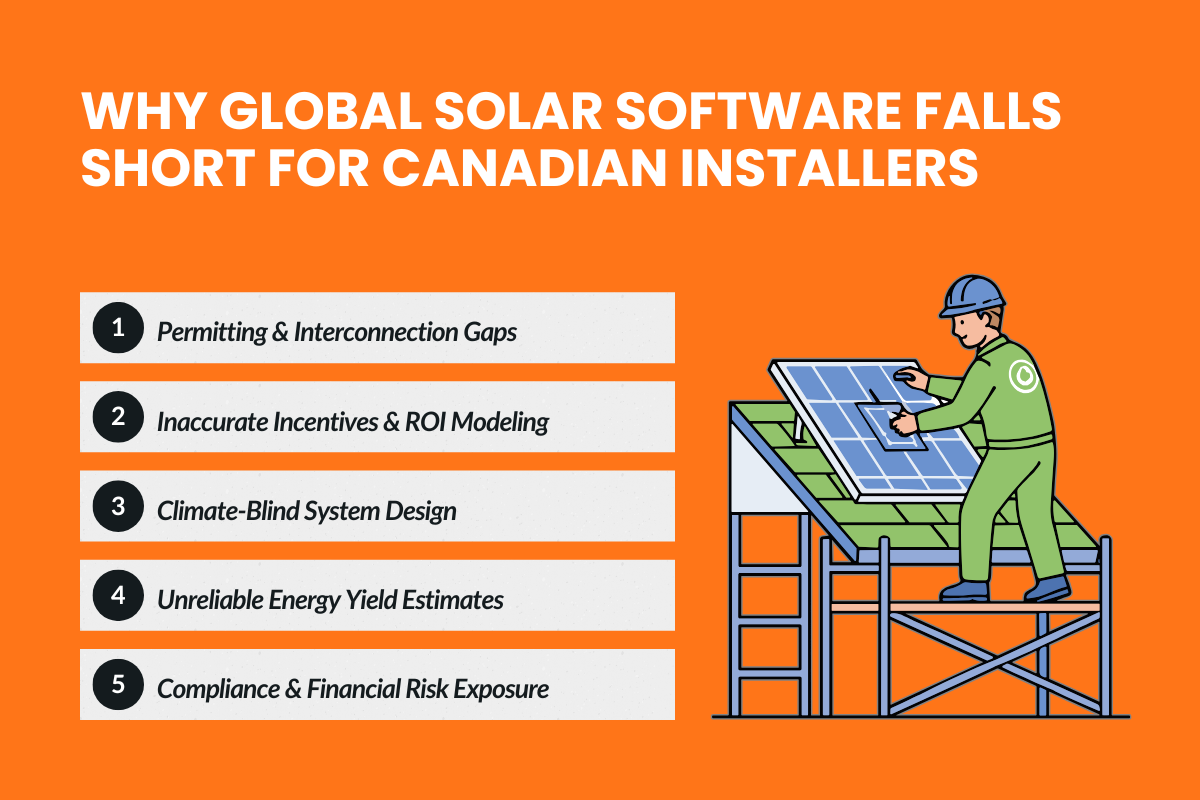
Many U.S.-based solar software companies expand their services into Canada but fail to account for the critical regulatory differences that define the Canadian solar market.
Here is the list of the business risks:
- Permitting & Interconnection Gaps: Lacks native support for Canadian permitting and utility interconnection workflows, increasing permit rejections for new solar system designs.
- Inaccurate Incentives & ROI Modelling: Miscalculates incentives, net metering, and TOU rates across provinces, resulting in incorrect ROI projections and loss of customer trust.
- Climate-Blind System Design: Ignores Canadian climate factors such as low winter sun and snow load, leading to incorrect panel sizing and system underperformance.
- Unreliable Energy Yield Estimates: Fails to deliver accurate energy yield estimates for Canadian conditions, causing unmet expectations, dissatisfied customers, and reputational damage.
- Compliance & Financial Risk Exposure: Creates compliance gaps that lead to delays and rework, ultimately increasing project costs and long-term financial risk.
What Makes the Canadian Solar Market Uniquely Complex?
Designing solar systems in Canada is not just about assembling solar panels. It is a challenge for the engineering team to withstand harsh winters with heavy snow, low winter sun irradiance, varying provincial rules, and federal incentives that create compliance friction, all while delivering high-performing renewable energy services.
1. Provincial Regulations Change Software Requirements
Building software for the Canadian market is not a single checkbox that needs to be checked. Most platforms fail to handle the 13 different provincial regulations across ten provinces and three territories, each with its own distinct set of rules.
The failure to incorporate the regulations increases the risk of errors, project delays, and costly compliance issues.
Here is what each province wants, and how the software must deliver:
| Canadian Province | Provincial Difference | Software Requirements |
|---|---|---|
| Ontario | ESA permits and strict net-metering | ESA-aligned workflows combined with net-metering validation checks |
| Alberta | Micro-generation with deregulated utility portals | Utility-specific portals and flexible field data with real-time insights to changing rules |
| British Columbia | Embedded codes that need CSA-certified equipment for solar systems | Multi-code validation with CSA compliance checks documents support |
2. Incentives & Rebates Break Most Solar Software Setups
Provinces like Alberta, Ontario, and Quebec offer solar incentives, tax credits, and rebates that help sales teams close more deals faster:
- British Columbia gives up to $5,000 for battery storage with solar hookups.
- Manitoba offers $0.50 per watt, up to $5,000 per home.
- Ontario gives out $10,000 covering 30% of energy-efficiency upgrades.
CRM and design tools that don’t talk to each other lead to inaccurate quotes, shaking off customer trust, and lost deals.
3. Weather & Latitude Impact System Design Accuracy
A solar design in Canada needs to fit the country’s unique climate personality. For example, snow and winter shading in provinces like Alberta or Ontario can cut solar output by 20–30%, and heavy rain can slash efficiency by up to 25%.
- Heavy snowfall blocks sunlight, halting power generation from covered panels and reducing battery efficiency.
- Large hailstones can create microcracks on solar glass panels, lowering efficiency over time.
- Heavy rainfall cuts solar panel grids' efficiency by up to 25% as dense clouds reduce irradiance.
- Low winter irradiance lowers sunlight intensity on panels, especially for fixed mounts, reducing overall efficiency.
When solar software fails to adapt to Canadian climate, compliance, and conditions, the solar system's safety and efficiency dip.
What Should Solar Software Built for Canada Actually Do?
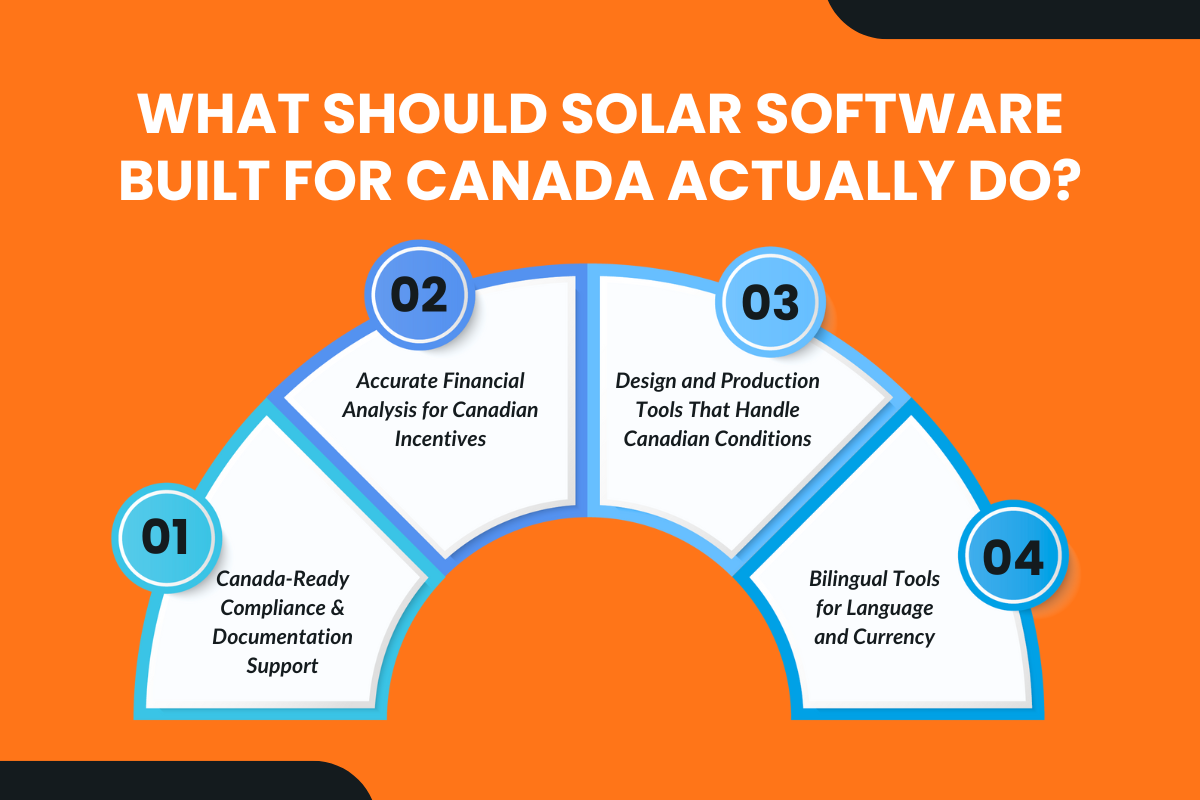
The best Solar Software helps project managers run solar projects smoothly while navigating Canadian regulations and harsh climate conditions.
Let us explore the non-negotiable features of the solar software:
1. Canada-Ready Compliance & Documentation Support
Solar proposal tools must incorporate documents and compliance checks aligned to government policies, safety standards, net metering rules, utility permit checklists, and grid connection regulations for EPC firms.
The Software is useful to:
- Track approvals and compliance for every solar design.
- Automate alerts for any design or utility rule violations.
- Ensure a smooth flow from design to proposal to installation.
2. Accurate Financial Analysis for Canadian Incentives
Solar software must support feasibility studies for financial analyses that present accurate financial forecasts and precise quotes.
Financial tools for solar development projects are helpful for:
- Accounting for installation costs, incentives, tax credits, and revenue projections.
- Visually presenting transparent payback periods and ROI insights.
- Strengthening customer trust while giving managers more control over financial matters.
3. Design & Production Tools That Handle Canadian Conditions
Modern solar software incorporates factors like snow, hailstorms, low irradiance, long winter sun, shading, and elevation to size batteries and design PV systems to perform the best even in Canada’s harshest climates.
Solar Design Software equips installers to:
- Calculate solar energy availability in a given area to adjust panels for maximum sunlight in dynamic temperatures.
- Identify shadow-free regions suitable for solar PV installations.
- Design PV systems to produce maximum solar energy.
- Present 3D-engineered models to generate accurate quotes and proposals.
4. Bilingual Tools for Language and Currency
Minute details like currency format, date notations, number formatting, and language can disrupt workflow in the solar industry.
Top solar solutions need to adapt to Canadian localization needs, such as a French-language interface for Quebec, where French is legally required for sales and permitting.
Solar software can help by:
- Supporting Canada’s bilingual nature with a dual-language interface in English and French.
- Handling billing and invoicing in USD and automatically converting to CAD for Canadian regions, taking into account foreign exchange rate fluctuations for several imported pieces of equipment
- Localized proposal tools with editable templates, with CAD Pricing and local taxation mandates.
Top Solar Software Platforms for Canadian Installers
1. Sunbase
Sunbase is an all-in-one solar design, proposal, CRM, and project management platform built to handle regulatory, financial, and climate complexities across provinces.
Why It Matters Most for Canadian Installers
Unlike design-only or proposal-only tools, Sunbase integrates compliance automation, provincial rate structures, bilingual workflows, financial modeling, and project management into one centralized system.
Key Features
- Provincial Rate Structure Automation: Automatically applies province-specific NEM, TOU, and rebate calculations to ensure accurate quotes.
- Cold-Climate Optimized Design Tools: Incorporates snow load, winter irradiance, and shading factors into layout calculations.
- Compliance Guardrails & Permit Tracking: Aligns designs with ESA, CSA, and interconnection workflows to reduce rejection risk.
- Bilingual Proposal & Currency Support: Supports English/French interface and CAD pricing localization.
- Unified CRM + Operations Platform: Connects sales, engineering, permitting, and installation teams in one workflow.
Pricing: Custom SaaS pricing based on team size and modules. Demo-led implementation.
2. Solargraf
Solargraf is a cloud-based solar design and proposal software platform primarily built for residential installers in North America. It combines remote system layout tools with proposal generation and basic CRM capabilities to help small-to-mid-sized solar companies streamline their sales process.
Why It Matters for Canadian Installers
For smaller Canadian residential installers, speed and simplicity often matter more than engineering depth. Solargraf can help teams quickly generate visually appealing proposals and savings summaries without relying on multiple disconnected tools.
Key Features
- Remote Solar Layout Tool: Solargraf enables rooftop system layouts using satellite imagery, reducing the need for immediate site visits during the early sales stage.
- Savings & Incentive Calculations: The platform generates customer-facing savings projections based on entered utility rates and incentive inputs.
- Integrated CRM Workflow: Solargraf includes basic lead tracking and proposal management tools, allowing teams to monitor customer communication and deal progression within the same system.
- Financing Integration: The software supports financing comparisons, helping installers present loan options alongside cash purchase scenarios.
Pricing: Solargraf Pricing Plans (Annual Subscriptions)
- Starter – $2,799 USD per year - Includes 240 project credits and access for 2 users; additional projects cost $11 each.
- Small Business – $4,799 USD per year- Covers 480 project credits with 4 user licenses; additional projects cost $10 each.
- Teams – $6,399 USD per year- Offers 720 project credits and 6 user licenses; additional projects cost $9 each.
- Enterprise – $12,999 USD per year- Provides 1,500 project credits and unlimited user access; additional projects cost $9 each.
3. Helioscope
HelioScope is a web-based solar design and energy modeling platform focused primarily on commercial and industrial PV systems. It is widely used by engineering teams for performance simulation and layout validation.
Why It Matters for Canadian Installers
In provinces with variable irradiance and strict engineering validation requirements, accurate performance modeling is critical. HelioScope helps engineering teams simulate production outputs under different shading and layout conditions.
It is particularly relevant for installers handling mid-size to large commercial projects that require feasibility validation before procurement.
Key Features
- Advanced Energy Modeling: Simulates energy production based on irradiance data, module selection, and system configuration. This supports financial feasibility assessments and lender-grade documentation.
- Detailed Stringing Configuration: Allows precise inverter and string configuration to ensure system performance aligns with electrical constraints.
- Layout Optimization Tools: Helps optimize module placement to reduce shading losses and maximize output.
- Bankability-Grade Reports: Generates performance reports that can support financing and stakeholder approvals.
Pricing: HelioScope Pricing Plans (per license)
- Basic Plan: $159 USD per month, includes 1 user and up to 10 projects per month, foundational design and modeling tools.
- Pro Plan: $259 USD per month, includes all Basic features plus LIDAR-assisted modeling, AI obstruction detection, financial modeling, and proposal tools.
- Enterprise Plan: Custom pricing- includes unlimited users, single-axis trackers, API access, SSO, and support for larger design capacities.
What Questions Canadian Installers Should Ask To Evaluate Solar Software (A Practical Checklist)?
Canadian Installers must evaluate the features of the software that need to match the real workflow of the region by asking these questions:
1. Does the Software Support Multi-Province Operations?
Solar software needs to handle Canadian bilingual needs, varied permits, provincial rules, different NEM and TOU designs, and climate-supportive smart solar layout designs.
2. Can It Scale From Small Installers to Growing EPCs?
Software must be designed with power-packed features that support small installers and growing EPC firms to handle basic residential designs to complex commercial projects.
3. Does It Integrate Sales, Design, and Operations?
Solar software must be a unified platform that streamlines the sales process through implementation, with real-time visibility to spot hiccups that cause delays or rework.
4. Is There a Structured Audit Trail for Permits and Interconnection?
A Canada-ready platform should track documentation, approvals, inspection milestones, and interconnection submissions within the workflow. This reduces compliance exposure and prevents last-minute submission errors.
Where Most Solar Software Evaluations Go Wrong in Canada?
Many Canadian solar companies evaluate software the same way they evaluate hardware: by comparing feature lists. That approach works for panels and inverters. It does not work for workflow systems.
Therefore, make the right decision in three simple steps:
Step 1: Perfect Fit over Features
Feature-rich software is not the same as workflow-ready software. Many platforms advertise advanced 3D modeling, AI shading, or automation, but fail to align with:
- Provincial permitting processes
- ESA/CSA compliance requirements
- Canadian net-metering structures
- Multi-utility TOU modeling
- Snow-load and cold-climate design adjustments
Instead of asking, “How many features does it have?”
Ask, “Does it match how we actually operate in Ontario, Alberta, BC, or Quebec?”
A smaller feature set that is Canada-aligned will outperform a global tool that requires workarounds.
Step 2: Train your Team to Gain
The most overlooked cost in software adoption is poor onboarding. Even powerful systems fail when:
- Sales teams don’t trust the financial modeling.
- Engineers don’t rely on automated design outputs.
- Field crews can’t access permits or layouts on-site.
- Managers don’t use dashboards for forecasting.
Canadian installers operating across provinces require:
- Structured onboarding sessions
- Province-specific configuration setup
- Role-based training (sales, engineering, operations)
- Clear SOP integration
If adoption is weak, teams revert to spreadsheets and disconnected tools. At that point, the software becomes an expense instead of a multiplier. Proper training turns automation into margin protection.
Step 3: Choose Regional Needs over Reputation
Many globally popular solar platforms were built primarily for U.S. regulatory structures. Expanding into Canada does not automatically make them Canada-ready.
Ask:
- Does the platform handle 13 provincial regulatory variations?
- Does it support bilingual documentation for Quebec?
- Does it apply CAD pricing and tax logic accurately?
- Does it incorporate snow load and high-latitude irradiance modeling?
- Does it automate Canadian interconnection workflows?
A tool may be globally respected yet still misaligned with Canadian realities. Canadian installers do not need the most famous software; they need the most regionally intelligent software.
What Does a Canada-Ready Solar Software Stack Look Like in Practice?
1. From Lead to Proposal: Faster, Compliant Sales Workflows
The process begins at the sales stage, where speed and accuracy determine whether a deal moves forward or stalls. A Canada-ready platform embeds provincial regulations, net-metering rules, Time-of-Use rates, and incentive structures directly into the quoting engine.
Instead of manually verifying rebate eligibility or calculating tax impacts, the system automatically applies the correct provincial logic.
2. From Design to Install: Fewer Revisions and Less Rework
Once a deal progresses, the design must withstand Canada’s environmental realities. Snow load requirements, winter irradiance shifts, shading from seasonal sun angles, elevation factors, and local building codes must all be reflected in the layout and system sizing.
A properly configured software stack integrates these variables directly into the design engine. When sales inputs move into engineering workflows, there is no need to rebuild or correct assumptions.
3. From Install to Interconnection: No Last-Minute Surprises
The final phase is where many projects encounter avoidable setbacks. Utility interconnection approvals, inspection documentation, and compliance validations must align precisely with provincial requirements. Missing forms or incorrect documentation can delay commissioning and increase costs.
A Canada-ready system maintains a structured audit trail from design through installation. It stores permits, tracks inspection milestones, and validates compliance before submission.
How Modern Solar Software Becomes a Compliance Partner in Project Management (Not Just a Tool)?
Canadian solar installers need a system that actively reduces compliance risk, enforces provincial logic, and supports operational execution across changing regulations and harsh climate conditions.
Modern solar software becomes a compliance partner when it embeds Canadian regulatory, financial, and climate intelligence directly into daily workflows rather than leaving teams to validate everything manually.
1. Provincial Rate Structure Automation
The platform automatically applies province-specific rate structures, including NEM and TOU variations. This reduces manual tariff calculations and prevents quoting errors that could distort ROI projections.
2. Built-In Compliance Guardrails
Designs and proposals are aligned with local incentive programs, interconnection rules, and documentation requirements. Automated checks reduce the risk of incomplete permit submissions or regulatory oversights.
3. Real-Time Performance Monitoring
For active projects, performance visibility allows teams to identify irregularities early. Monitoring supports operational transparency and strengthens long-term system reliability.
4. Mobile Access for Field Crews
Technicians can access layouts, compliance documents, photos, and project updates directly from mobile devices. This ensures installation teams work from the latest approved designs and documentation.
5. Seamless Integrations
Integration with accounting platforms, CRM systems, and communication tools prevents data silos and eliminates duplicate entry. A connected workflow improves coordination between sales, engineering, and operations.
6. Advanced Performance Analytics
Analytics provide insight into production accuracy relative to Canadian climate conditions and regional utility requirements. This supports forecasting, reporting, and long-term performance validation.
7. Centralized Communication Platform
All project communication, documentation, and milestone tracking remain within one structured system. This reduces confusion, version conflicts, and information loss.
8. Dedicated Customer Support
Access to knowledgeable support teams familiar with Canadian solar workflows ensures faster issue resolution and smoother onboarding across provinces.
Is Sunbase the All-in-One Solar Platform Canadian Installers Actually Need?
Sunbase is a unified solar sales and operations platform designed to bring structure to the entire project lifecycle from first enquiry to final installation.
Instead of relying on separate tools for CRM, design, quoting, contracts, and project tracking, Sunbase connects these functions into a single operational environment.
Here is what the Sunbase Solar Software brings to the table to impress every Canadian Solar Installer:
1. Automated Canadian Compliance Checks
Sunbase supports structured compliance tracking aligned with Canadian permitting and inspection requirements. Installers can manage provincial documentation, net-metering submissions, and inspection checkpoints within predefined workflows.
2. Incentive & Tax-Aware Financial Modelling
The platform incorporates Canadian pricing structures, federal and provincial incentives, and applicable tax considerations directly into proposal calculations.
Installers can generate accurate ROI projections that reflect region-specific rebates and financing programs, helping customers understand true payback timelines without relying on external spreadsheets.
3. Climate-Adjusted System Design
Design tools account for high-latitude solar exposure, seasonal production variability, and snow-load considerations common in many Canadian provinces.
Yield estimates are aligned with regional irradiance patterns, enabling more reliable production forecasting and more accurate proposal presentations.
4. Integrated Proposal-to-Installation Workflow
Approved proposals transition directly into operational workflows without re-entering data. Material requirements, installation scheduling, and project milestones are automatically linked to the signed contract, reducing administrative overhead and minimizing execution errors.
5. Role-Based Access & Multi-Branch Control
For installers operating across multiple provinces, Sunbase supports structured permissions and branch-level visibility.
Leadership teams gain centralized reporting while maintaining local operational control, improving oversight without increasing management complexity.
6. Real-Time Reporting & Forecast Visibility
Dashboards provide visibility into pipeline value, stage-wise conversion rates, installation backlogs, and revenue projections. This enables Canadian installers to make informed decisions about hiring, procurement, and regional expansion based on reliable operational data.
Final Takeaway: Why Canadian Solar Companies Need Purpose-Built Software
Canada has a unique personality with fluctuating extreme temperatures, diverse provincial regulations, remote project sites, bilingual regions, and distinct infrastructure. All of this turns solar development into a complex maze in the country.
Generic Solar tools often hit dead ends. Solar software designed specifically for Canada shows the right way to reduce risk, improve profit margins, and help teams scale their operations.
Navigating through the Canadian Maze needs a smarter tool. Book a personalized 15-minute Demo to see how Sunbase can be the ideal Canada-ready solar Software Solution.
FAQs
1. Which is the Best Solar Software Canadian Installers Can Rely On?
Canadian installers need solar software that can accurately design systems, generate proposals and precise quotes, manage projects, track finances, and ensure compliance based on local irradiance patterns and utility rates across Canada’s provinces to maximize productivity.
2. Which Is the Best Solar Software Canada Installers Should Use in 2026 for Long-Term Success?
There are several solar software options available to suit Canadian teams: Aurora Solar for accurate system design, Solargraf for CRM and proposal generation, PVcase for commercial and utility-scale projects, and OpenSolar or Sunbase for all-in-one project management. Each offers powerful features specifically tailored to the Canadian market.
3. Why Should Canadian Installers Switch to a Unified Solar Platform Instead of Using a Multi-Tool Workflow?
The Canadian installers must use unified solar project management software instead of relying on multiple disconnected tools, which fragment activities and increase errors, disrupting communication among team members. A unified platform boosts workflow efficiency, accelerates project completion, and enhances the customer experience.
4. How Can Solar Management Software Help Reduce Compliance Risk?
The solar tech stack automatically monitors local, provincial, and federal regulations, such as NEM and TOU, using real-time data to send alerts for new mandates and upcoming deadlines. It simplifies permitting, securely stores documents in the cloud for audit trails, and reduces the risk of missing regulatory deadlines or facing penalties, making inspections smooth and seamless
5. Can Choosing the Wrong Solar Software Impact Financial Feasibility?
Using software that doesn’t account for Canada-specific regulations and local conditions risks inaccurate energy yield estimates and poorly designed systems, which can lead to project failures, increased financial losses, and reputation damage that ultimately loses deals.
One Platform.
Zero Chaos.
Run Your Entire Business in One Platform
Sunbase replaces your CRM, proposals, scheduling, job tracking, and reporting tools — all inside one clean, connected platform.
About Sunbase
The All-In-One Platform to Run Your Entire Business
Sunbase helps you organize operations, streamline daily workflows, and manage everything - from first customer contact to final project deliver- in one connected system.
Our Mission
- Organize your business.
- Optimize your workflow.
- Automate your dailytasks
Why Businesses Choose Sunbase
One Connected Workflow
Replace scattered tools and manual processes with a single platform that brings together your team, tasks, customers, jobs, and performance data.
🌎 Global Presence
Serving the United States, Canada, India, LATAM, Australia, and 10+ international markets.
👥 11,000+ Users
Trusted by contractors, installers, project managers, sales teams, and field technicians.
🏗️ Built for All Sizes
From small contracting teams to fast-growing enterprises, Sunbase adapts to your workflow.
Stop Managing Your Business Manually. Automate It.
Sunbase automates workflows, reduces mistakes, and helps your team get more done - without hiring extra staff or juggling multiple tools.
Still Managing Your Business Across Multiple Tools?
Bring your CRM, proposals, projects, and operations into one platform built for contractors.

