
Installing solar in Canada comes with its own personality because one day you’re dealing with snow-packed roofs, the next you’re trying to model a system under weeks of low winter sun.
And on top of that, every province seems to have its own version of NEM and TOU rules, none of which stay still for long. Most generic solar tools don’t understand any of this, as they weren’t built for frost, heavy snow loads, or the way irradiance drops off a cliff in January.
That’s why you need solar software made for Canada so you can handle the Canadian winter, simplify compliance, and design systems that actually perform when temperatures hit –20°C.
The Best Solar Software Canada Installers Need for NEM, TOU & Winter Performance
For Canadian solar installers, must-have software includes platforms like Sunbase, Aurora Solar, and potentially specialized tools for advanced modeling like PVsyst, focusing on features for cold-climate design (shadow analysis, weather data), efficient NEM/TOU modeling (utility-specific reports), CRM, and mobile access for vast geography, ensuring local compliance and faster sales cycles.
But even leading solar companies struggle when their software can’t keep up with Canada’s climate or regulations.
What teams need now is a comprehensive solution that accurately models winter performance, stays aligned with provincial NEM/TOU updates, and keeps projects moving without extra guesswork.
Key Takeaways
- The software features that matter most for Canadian installers become clear when you look at how snow load, shading, and low-irradiance conditions affect real project performance.
- Cold-climate accuracy, provincial NEM/TOU automation, and reliable winter modelling separate everyday tools from genuinely Canada-ready platforms.
- Strong project management, real-time visibility, and cloud-based coordination are key to keeping installs on track across regions and weather conditions.
- Comparing industry tools through a Canadian lens makes it easier to choose platforms that support growth, better proposals, and more consistent project outcomes.
Before the next proposal or winter install season arrives, it’s worth seeing how modern solar software actually handles Canadian realities in practice.
Why Do Most Solar Design Tools Fail in Canadian Conditions?
Low winter sun can dramatically cut expected output, and even small miscalculations can show up on customer bills later.
That’s why solar project planning here requires a higher level of accuracy than most global platforms were originally built for.
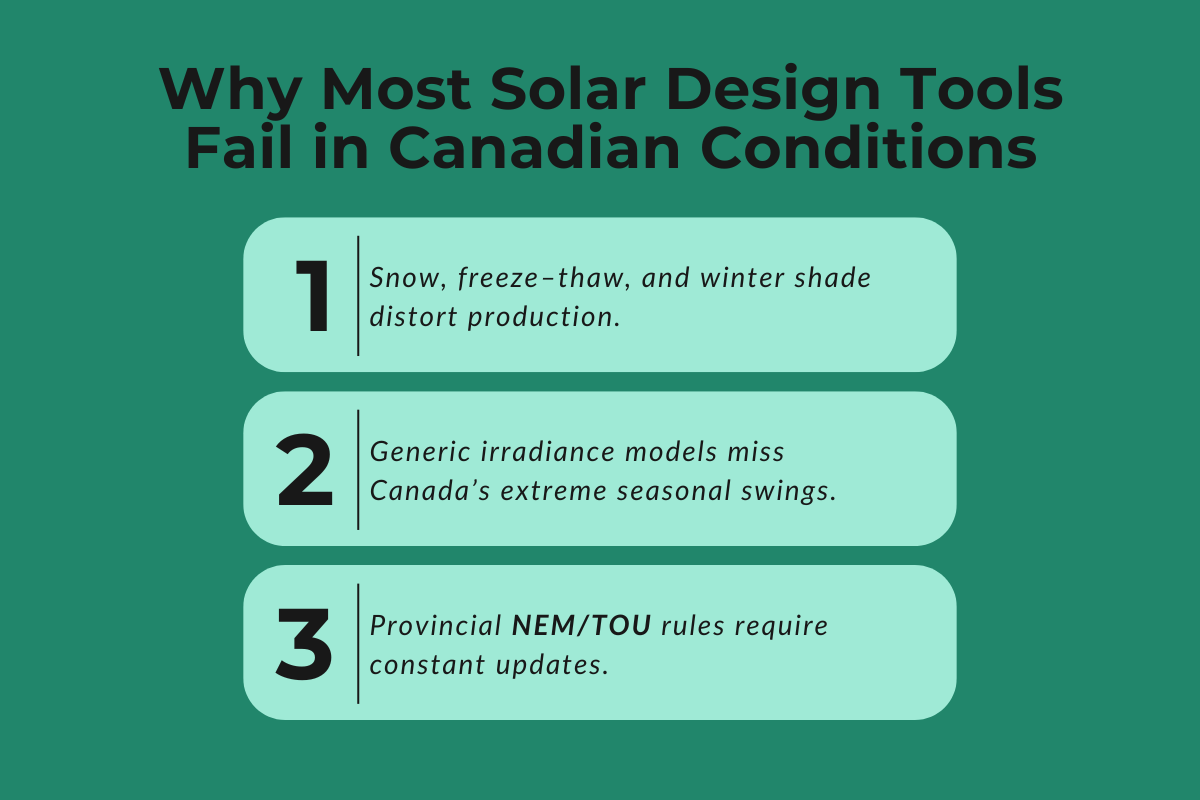
1. Cold Climate Creates Design Blind Spots
Snow not only covers panels but also changes weight, angles, and how the system behaves for weeks at a time.
Most tools don’t account for how freeze–thaw cycles or shifting winter shade can distort actual production. These gaps add up fast when your entire design depends on accurate data.
2. Generic Tools Miss the Canadian Context
Many global platforms are built around consistent sunlight and predictable seasons, but Canada offers the opposite.
Irradiance swings, reflective snow glare, and steep winter losses often fall outside what the average modelling engine expects, leaving installers with projections that don’t match reality.
3. Regulations Add Another Layer of Complexity
Each province runs on its own version of NEM and TOU rules, and the details change more often than most platforms update.
Without built-in provincial logic, installers spend hours on manual checks that should’ve been automated. This slows down both design and approvals.
>> The Real Impact of These Challenges
These small inaccuracies compound across timelines, proposals, and expectations, showing up as callbacks, redesigns, and systems customers don’t fully trust.
Project Management Software Built for Canadian Solar Projects
As you might already know, managing solar work across Canada is unpredictable. Timelines are unpredictable, and your sales teams move between sites that rarely share the same rules.
To walk this tight rope, your business needs project management software built for Canada.
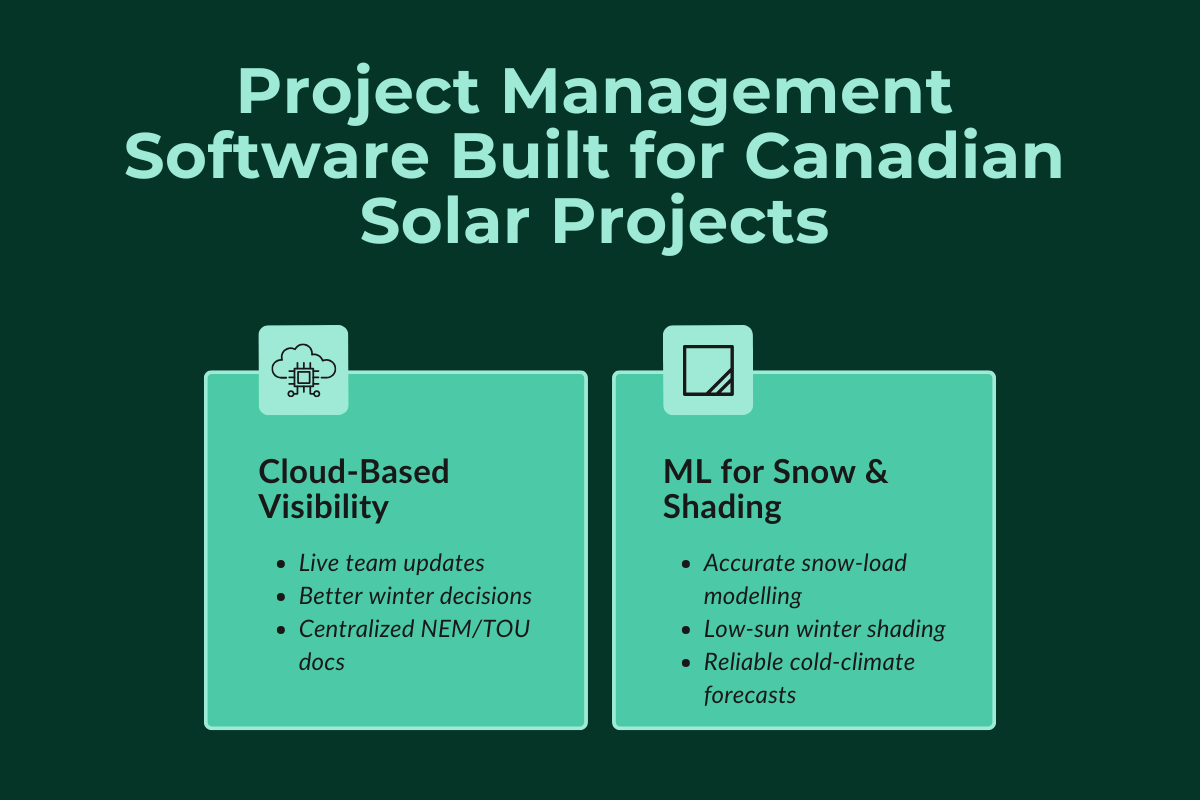
1. Cloud-Based Platforms for Real-Time Solar Project Visibility
Real-time updates help teams stay aligned when weather or distance gets in the way. Below are some of the ways this helps:
a) Real-time coordination across teams
Cloud-based platforms let Canadian installers keep all project data in one system that updates instantly.
Designers, project managers, and field crews see the same information simultaneously, reducing errors when schedules shift or utilities request additional documents. This matters especially during winter, when travel, site access, and timing become unpredictable.
b) Smoother decision-making during winter delays
When weather changes project timelines, real-time visibility helps managers decide quickly whether to adjust crew schedules, reorder tasks, or request updated approvals.
Instead of relying on manual status checks or waiting for field updates, the platform provides immediate clarity on what can move forward and what needs to pause, essential for staying productive in the coldest months.
c) Fewer gaps in communication and compliance
Cloud platforms also centralize documentation: site photos, permit files, utility forms, inspection updates, and change requests. This prevents information from getting stuck in email threads or personal devices.
Audit trails automatically capture who updated what and when, supporting compliance checks for provincial NEM/TOU programs and reducing the risk of missing required steps during busy periods.
Read about Project Management in depth: The Future of Solar Project Management in Canada.
2. Machine Learning Models for Accurate Snow & Shading Predictions
Snow and shade behave differently in winter, and ML-driven modelling gives installers a clearer picture of what to expect. Below are some of the ways this improves design accuracy:
a) Smarter snow load forecasting
Machine learning models can analyze historical snowfall patterns, roof tilt, and temperature data to estimate how long panels might remain covered and how snow will affect structural load.
This is useful because Canada’s snow patterns vary widely by region, and traditional design engines often assume clear-sky conditions.
Better snow forecasting helps installers set realistic performance expectations and select mounting strategies suited to local winter behaviour.
b) More accurate winter shading behaviour
Winter sun paths, low solar angles, and reflective surfaces create shading conditions very different from those in summer.
ML-powered shading engines use a large dataset, including 3D structures, terrain, and historical irradiance measurements, to model how shadows move throughout the winter months.
This improves the accuracy of production estimates in regions where shading changes dramatically with snow accumulation or shorter daylight hours.
c) Better decisions through stronger modelling
When your solar design software can more reliably predict winter performance, installers can make informed choices about panel placement, tilt adjustments, stringing decisions, and inverter loading.
It reduces the gap between theoretical production and actual winter output. For customers, it means clearer expectations and fewer disputes over seasonal performance dips.
Essential Cold-Climate Features Every Canadian Solar Business Needs
Winter introduces variables that don’t appear in standard modelling workflows, which is why cold-climate features matter as much as design accuracy.
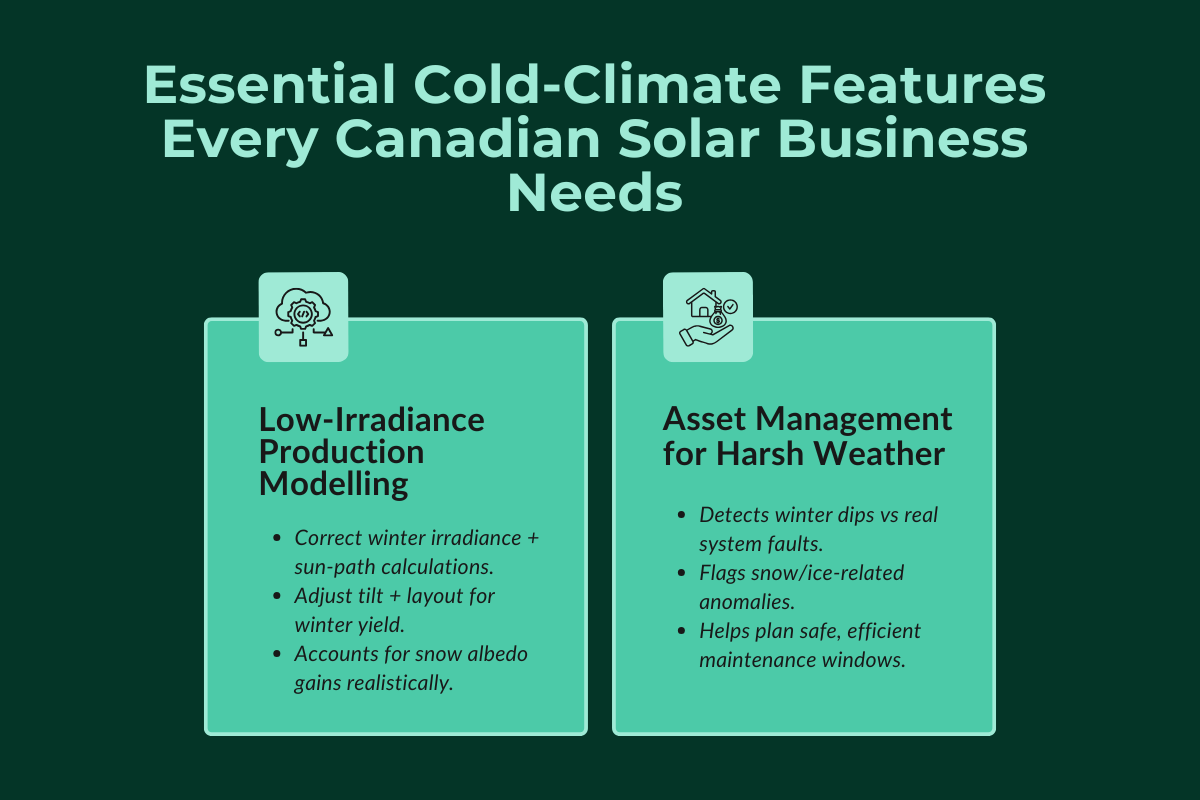
1. Low-Irradiance Production Modelling for Winter Months
Canada’s darker months change how solar systems behave, shift expected renewable energy output, and alter how long solar panels stay productive on any given day. The right tools account for these conditions instead of assuming clear-sky performance.
a) Accurate tilt and layout decisions
Winter irradiance in Canada is much lower than in summer, and the performance gap can span several months.
Software that includes seasonal irradiance data allows installers to evaluate tilt angles and layout adjustments with a realistic understanding of what winter production will look like, rather than relying on averaged or summer-biased models.
b) Handling reduced daylight hours
Shorter days and lower sun angles significantly decrease midday generation. Tools that incorporate winter sun paths, horizon obstruction, and local irradiance measurements can estimate how much energy the system can actually produce during peak winter weeks.
This avoids overpromising and helps customers understand why seasonal performance shifts occur.
c) Reflectivity and albedo considerations
Snow-covered ground can sometimes boost production through reflected light, but only under specific conditions.
Software that accounts for these albedo changes produces more accurate winter models by balancing gains in reflected radiation with expected reductions in snow coverage.
2. Tools for Asset Management and Solar Operations in Harsh Weather
Winter limits how often crews can reach a site, so operations tools need to distinguish normal seasonal dips from real system faults. The goal is simple: track performance accurately, plan maintenance wisely, and avoid unnecessary trips in harsh conditions.
a) Monitoring performance under freezing conditions
Cold temperatures affect component behaviour, inverter efficiency, and overall system stability.
Solution: Asset management tools that monitor temperature-driven fluctuations help identify whether energy production drops are due to winter conditions or to system faults requiring service.
b) Detecting winter-specific faults
Snow buildup, ice formation, and moisture intrusion can trigger issues that don’t appear in warmer months.
Solution: Platforms that distinguish between weather-driven losses and actual equipment anomalies help installers decide when intervention is really needed and when the system is performing normally for the season.
c) Planning maintenance when access is limited
Winter restricts how often crews can reach a site.
Solution: Software that consolidates operational data, from inverter alerts to shading changes, helps teams plan visits more strategically. This reduces unnecessary trips and ensures issues are addressed during safe weather windows rather than during reactive emergencies.
NEM + TOU Compliance: Software That Reduces Risk
The differences between provinces force installers to switch between calculators, spreadsheets, and outdated templates just to keep proposals accurate. That's where Compliance tools reduce friction by automating provincial logic and minimizing the guesswork that slows projects down.
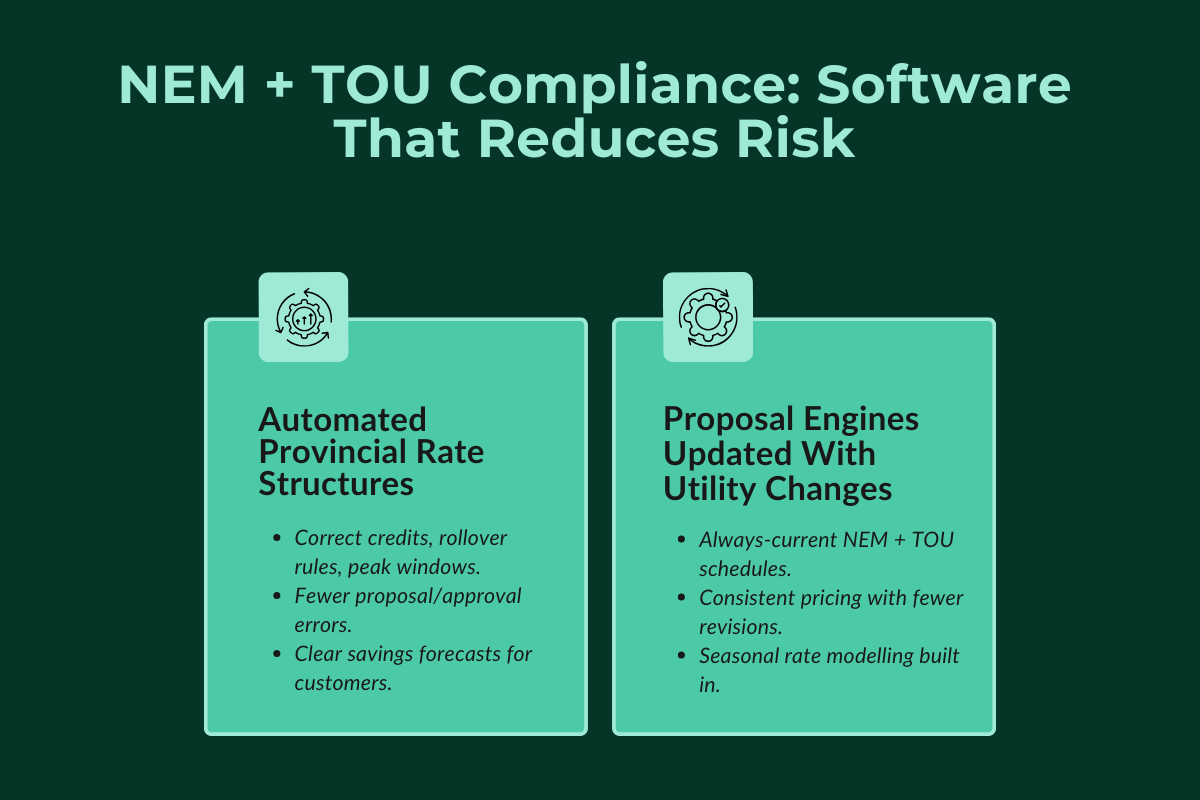
1. Software That Automates Provincial Rate Structures and Credits
a) Built-in logic for regional utilities:
Accurate proposals depend on understanding how each utility handles credit rollover, seasonal adjustments, and TOU billing.
Software that includes provincial rate structures removes manual calculations and reduces the chance of sending customers estimates that won’t match their bills.
b) Fewer errors during design and approval:
When rate details are automated, designers don’t need to cross-check schedules, credit percentages, or peak-hour windows.
This reduces revisions during the approval process and helps teams move projects forward without repeated back-and-forth.
c) Clearer expectations for homeowners:
Automatic NEM/TOU modeling gives customers a clearer picture of what their system will save and how credits apply throughout the year. This transparency prevents misunderstandings once the system is operating under real utility rules.
2. Proposal Engines That Stay Updated With Utility Billing Changes
a) Up-to-date NEM and TOU schedules:
Utilities across Canada adjust their rate structures on variable timelines. Built-in solar proposal software that update these changes in the background keep teams from relying on old data or outdated templates.
b) Consistent pricing and fewer revisions:
Accurate rate inputs ensure proposals don’t need to be recalculated or reissued later. This keeps the sales process smoother and avoids eroding customer trust with last-minute corrections.
c) Better planning during seasonal rate shifts:
Tools that reflect seasonal billing let installers align production and savings estimates with changing winter and summer rate windows.
Which Platforms Truly Handle Canada’s Climate?
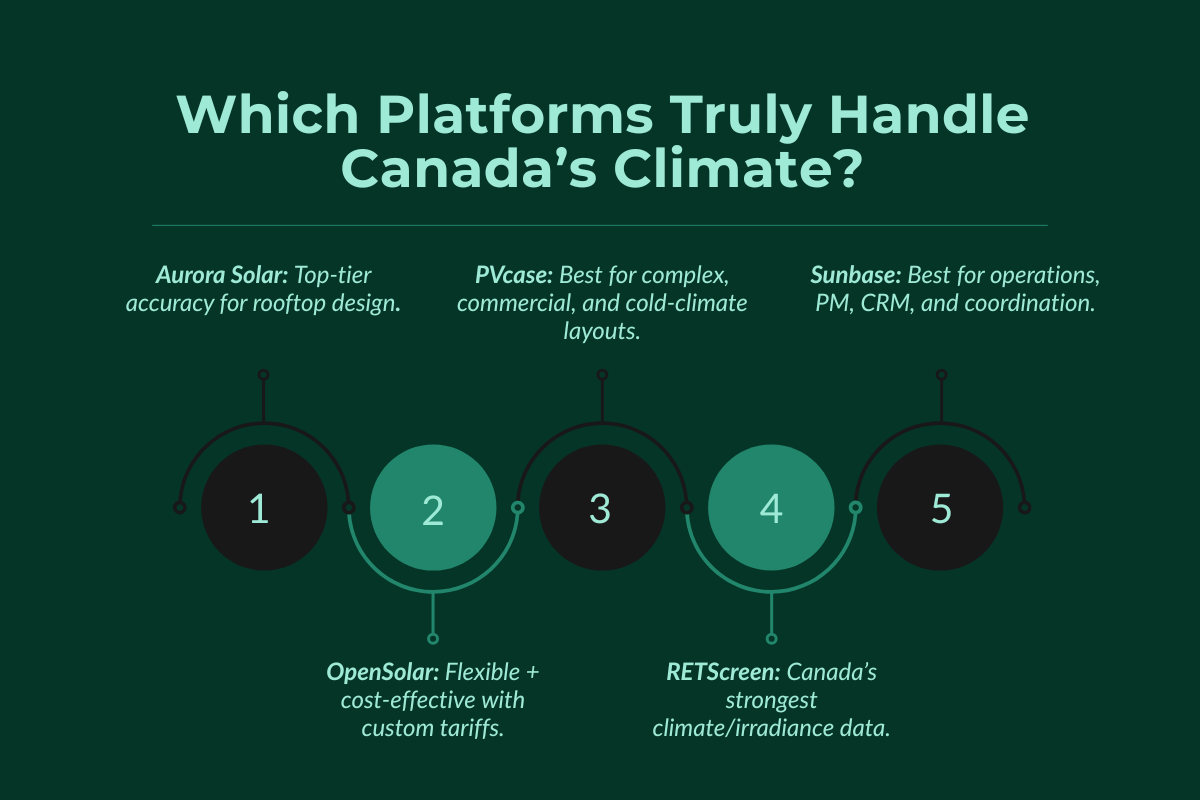
Canadian installers don’t just need design tools; they need software that can handle local irradiance patterns, shifting shade profiles, and utility rules that change from province to province.
Here’s how the most commonly used platforms stack up in Canadian conditions.
1. Aurora Solar: Best for High-Accuracy Rooftop Design
Aurora’s strength is precision. Its 3D modelling, shading analysis, and irradiance engine give installers a reliable starting point for rooftop design in any region.
For teams that prioritize precise layouts and production estimates, Aurora offers one of the most mature design environments on the market. It supports proposals and financing, making it easy for sales teams to move from design to presentation without leaving the workflow.
Best for: Teams focused on design accuracy and polished sales proposals.
Tip: Pair Aurora with local rate templates or external billing tools to complete the whole project picture.
2. OpenSolar: Best for Cost-Conscious Teams That Need Flexibility
OpenSolar combines free design software with customer proposals, payment options, and an end-to-end sales workflow.
Its modelling tools cover the essentials for most residential jobs, making OpenSolar a strong entry point for growing teams or small operations transitioning into digital proposals.
Best for: Installers who want professional proposals and customizable modelling without the overhead of premium tools.
Tip: You can build their own tariff structures, including TOU schedules, which provide the flexibility to model Canadian utilities even without built-in templates.
3. PVcase: Best for Complex Sites and Engineering-Level Layouts
PVcase specializes in engineering-grade layout design. Its terrain modelling, automated row layout, and shading analysis make it well-suited for utility-scale, commercial, and complex ground-mounted projects. The mounting calculator, which incorporates snow and wind load values, is handy in regions with heavy winter conditions.
While PVcase is not a proposal engine, it integrates nicely into multi-tool workflows that require detailed engineering inputs.
Best for: Engineering teams, EPCs, and installers handling large or irregular sites.
4. RETScreen: Best for Climate-Based Energy & Financial Analysis
Developed by Natural Resources Canada, RETScreen offers one of the most complete climate and irradiance datasets for Canadian locations. It is designed for long-term energy modelling, feasibility studies, and financial analysis, not for design or proposals.
Teams often use RETScreen to validate expected performance and investment metrics before committing to a project. It excels in lifecycle evaluation and climate-specific yield assessments.
Best for: Installers who want climate-accurate performance validation or detailed financial modelling.
5. Sunbase: Best for Operations and Customer Management
Sunbase serves the operational side of solar companies: scheduling, project coordination, built-in CRM, and communication. It helps teams manage timelines, customer follow-ups, inspections, and post-installation touchpoints.
It’s not built for design or performance modeling, but it fits naturally into companies that want a centralized place to manage installations, tasks, and customer interactions.
Best for: Teams who want stronger project coordination and customer management workflows.
All-in-One Platform vs. Multi-Tool Tech Stack
a) All-in-One Platforms
An all-in-one system reduces tool switching, centralizes data, and creates a smooth workflow from design to proposal to customer communication.
Using one platform helps smaller teams move faster and keeps processes consistent across users.
Best when the priority is:
- predictable workflows
- simplified onboarding
- minimal tool maintenance
b) Multi-Tool Tech Stacks
Larger teams or those operating across multiple provinces often prefer a specialised tech stack.
Combining tools, for example, using PVcase for detailed layout design and Sunbase for operational coordination, can give you more control over each stage of the workflow. This setup improves on-site accuracy while streamlining communication, scheduling, and customer management.
Best when the priority is:
- higher modelling accuracy
- engineering-level detail
- flexible process configuration
How Better Software Unlocks Faster Proposals & More Deals?
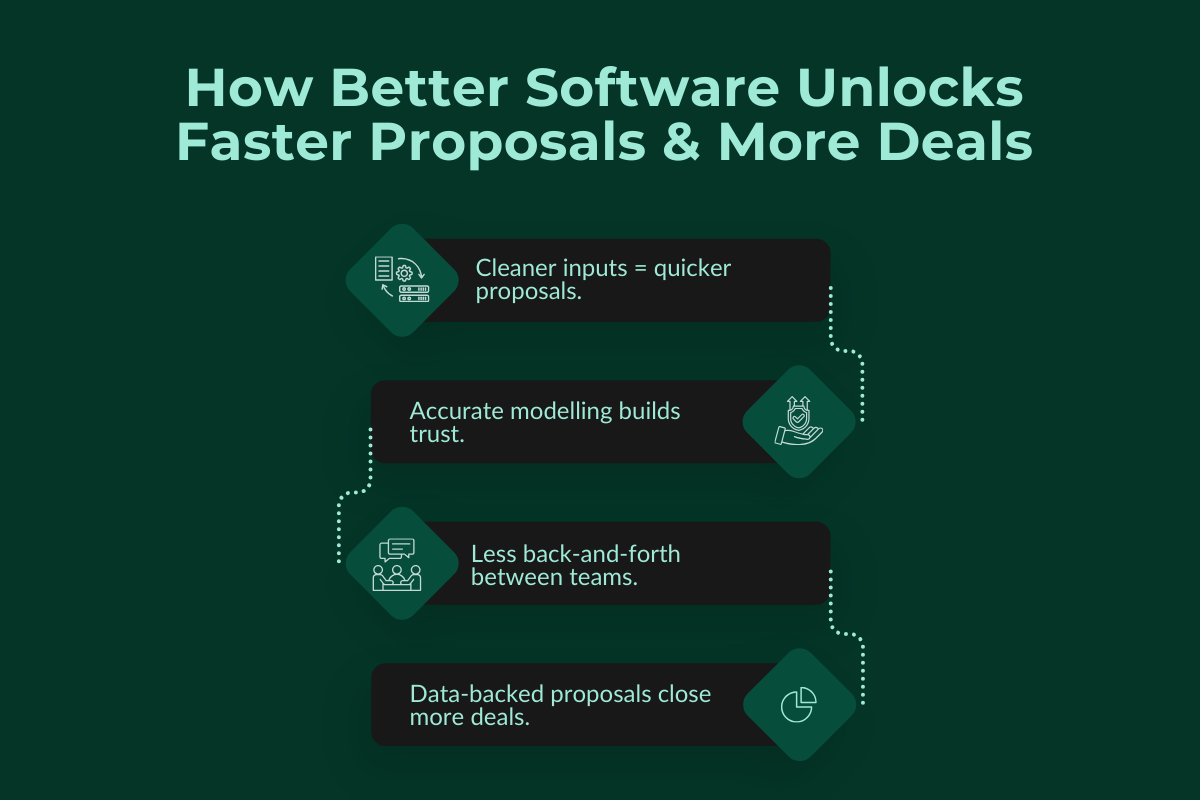
Fast, accurate proposals make it easier for teams to move quickly and build trust from the first conversation. Below are a few ways better software helps:
1. Faster Proposals Start With Cleaner Inputs
When customer details, designs, and utility data stay organized in one workflow, proposals don’t slow down. Teams can move quickly because they’re not rebuilding information or searching for missing pieces.
2. Accuracy Creates Trust
Clear modelling makes it easier to explain why estimates look the way they do. When numbers feel realistic, customers feel more confident moving forward.
3. A Smoother Sales Experience
Less back-and-forth between teams reduces friction. Sales can answer questions more quickly, respond with clarity, and maintain momentum throughout the conversation.
4. Data-Backed Proposals Close More Deals
Up-to-date modelling helps installers demonstrate real value rather than ideal scenarios. So proposals reflect each roof, rate, and climate more realistically.
Cost Savings, Lower Risk & Long-Term Success
Fewer mistakes and fewer surprises directly improve margins, especially when projects span different climates and utilities. Below are a few ways better software supports long-term performance.
>> Reduced Operational Costs
Better modelling and cleaner workflows cut down on redesigns, unnecessary truck rolls, and repeated checks, the hidden costs that slow teams down. When production estimates align with reality, fewer adjustments are needed later.
>> More Stable Workflows Across Teams
Tools that organize communication, schedules, and documentation, including reliable project management software, keep installations aligned. Less friction means fewer delays and more predictable outcomes.
Conclusion:
Choose solar software that understands Canadian grids and climate. Canada’s climate and utility rules make solar work more complex than most global tools account for.
Accurate modeling, realistic winter performance estimates, and clear NEM/TOU logic are essential for reliable solar projects and consistent renewable energy output.
The simplest path is choosing software, including dependable project management software, that’s built for Canada’s conditions.
When the tools match the environment, installs run smoother, and customers get results they can trust.
Make the switch to tools that won’t break under Canadian winters or billing complexity. Choose software built for your climate, your grid, and your customers. Get a quick walkthrough with us to learn more!
FAQs
1. What features should solar software Canada installers look for in 2026?
Look for winter-ready performance modelling (snow, low sun, shading), built-in or customizable provincial NEM/TOU logic, and platforms that link design, proposals, and operations, so teams work faster and stay compliant.
2. Can solar modelling software account for heavy snow loads and low-irradiance zones in Canada?
Yes, certain platforms support terrain and load modelling specifically for cold climates. For the best results, make sure the tool includes region-specific weather/irradiance data and allows you to adjust tilt/downsize for winter performance rather than relying on generic assumptions.
3. How does managing NEM/TOU rules affect solar software choices in different Canadian provinces?
Because provinces apply different net-export credits, TOU windows, and billing logic, and these change, software that integrates these rules reduces manual calculations and errors and keeps proposals aligned with each utility.
4. Is an all-in-one solar platform better than a mix of specialized tools for Canadian installers?
It depends on your size and complexity. All-in-one platforms like Sunbase solar software reduce switching and speed up residential workflows, while a specialised stack (design, climate modelling, operations) offers more control and accuracy for larger or multi-province teams.
5. How does better solar software lead to fewer callbacks and better project outcomes?
When software models winter performance and utility rates accurately, designs and proposals align with actual output and bills, reducing surprises, disputes, and callbacks.
One Platform.
Zero Chaos.
Run Your Entire Business in One Platform
Sunbase replaces your CRM, proposals, scheduling, job tracking, and reporting tools — all inside one clean, connected platform.
About Sunbase
The All-In-One Platform to Run Your Entire Business
Sunbase helps you organize operations, streamline daily workflows, and manage everything - from first customer contact to final project deliver- in one connected system.
Our Mission
- Organize your business.
- Optimize your workflow.
- Automate your dailytasks
Why Businesses Choose Sunbase
One Connected Workflow
Replace scattered tools and manual processes with a single platform that brings together your team, tasks, customers, jobs, and performance data.
🌎 Global Presence
Serving the United States, Canada, India, LATAM, Australia, and 10+ international markets.
👥 11,000+ Users
Trusted by contractors, installers, project managers, sales teams, and field technicians.
🏗️ Built for All Sizes
From small contracting teams to fast-growing enterprises, Sunbase adapts to your workflow.
Stop Managing Your Business Manually. Automate It.
Sunbase automates workflows, reduces mistakes, and helps your team get more done - without hiring extra staff or juggling multiple tools.
Still Managing Your Business Across Multiple Tools?
Bring your CRM, proposals, projects, and operations into one platform built for contractors.