
Across India, the solar industry is no longer just about panels. It’s about precision, speed, and customer trust.
Small solar companies have grown into large-scale players handling complex projects, multiple vendors, and clients who expect instant quotes and updates. Yet many still rely on outdated CRM systems, never built for solar. Sales teams use one tool, engineers another, and field teams depend on WhatsApp, leaving data scattered and follow-ups missed.
In 2026, success isn’t defined by price or product alone. It’s about how efficiently you manage operations, sales, and customer experience.
That’s why solar CRM software is transforming the game, uniting leads, design, project tracking, and customer communication in one seamless system built for solar growth.
Why Solar Companies in India Are Upgrading to Smarter Solar CRM Software in 2026
Ever wondered why some solar teams move faster, stay organized, and close deals with ease, while others get buried in spreadsheets and missed updates? It’s not luck. It’s a better system.
India’s solar industry is scaling fast. Bigger projects, higher client expectations, and tighter competition mean old CRMs and scattered tools just don’t cut it anymore. If your team’s juggling data instead of driving growth, it’s time to rethink your workflow.
In this guide, we’ll uncover how modern solar CRM software unites sales, design, proposals, and project tracking, helping Indian solar businesses save time, close faster, and deliver smoother experiences.
So, if you are curious about how the leading solar teams are doing it, you need to explore our guide ahead on modern solar CRMs and see how unified tools can transform your team’s efficiency.
Key Takeaways
- A unified Solar CRM + Design + Proposal system helps teams work faster, track leads in real time, and close more deals.
- The right CRM software for solar businesses includes automation, reporting, and integration with design tools for seamless management.
- Modern platforms like Sunbase are transforming how solar companies operate, collaborate, and deliver exceptional customer experiences.
Why Are Indian Solar Companies Rethinking Their Tech Stack Right Now?
India’s solar industry is evolving faster than ever. From MSME rooftops to large-scale commercial installations, the market has expanded, but many solar teams are still stuck using tools that weren’t built for solar workflows.
As projects scale, managing sales, designs, and site updates across multiple tools creates chaos, not clarity. As a result, missed follow-ups, version mismatches, and scattered communication cost teams valuable hours every week.
In 2026, efficiency is the new competition. Solar companies that rely on outdated CRMs are not just slower; they’re losing deals to teams that quote faster, collaborate better, and deliver with precision.
What’s Driving the Shift in India’s Solar Market?
According to the Ministry of New and Renewable Energy (MNRE), India installed about 23.83 GW of solar capacity in FY 2024-25, which is a significant increase over the previous year’s figure of around 15.03 GW, and commercial installations are growing at record speed.
But with this boom comes tighter delivery schedules, multiple stakeholders, and clients who expect quick quotes and constant updates. That’s where modern solar CRM software steps in, unifying leads, design data, and project workflows in one place.
With features like real-time lead tracking, automated quoting, and site survey integrations, companies can respond in minutes, not days.
Teams using unified solar CRMs have reported up to 30% faster deal closures, a clear edge in a market where every hour counts.
What Happens When Solar Teams Still Use Outdated CRM Systems?
Many solar teams still juggle spreadsheets, WhatsApp chats, and separate tools. It works until growth and sales hit, then things start slipping.
Today’s solar customers are informed and online, and they expect speed, clarity, and transparency. They compare quotes, track project progress, and want updates in real time.
But manual tools and scattered systems slow teams down and cost trust. A solar-specific CRM fixes that by automating quotes, follow-ups, and project tracking, helping you meet expectations effortlessly.
Because in 2026, speed wins deals, and trust keeps them. Every time your team switches between tools, you lose momentum, and sometimes, sales process opportunities.
1. The Hidden Costs of Sticking to Old Tools
- Outdated CRMs don’t just slow down work; they affect morale, accuracy, and growth.
- Manual updates lead to errors in project timelines.
- Salespeople struggle to track multiple leads from different sources.
- Managers can’t get clear visibility into what’s happening across departments.
- All of this adds up to slower sales cycles and missed revenue potential. More importantly, it impacts your team’s confidence and your customers’ trust.
When technology holds your team back, even the best strategy can’t perform at its full potential.
2. Why a Modern Solar CRM Software Makes a Difference
Modern CRM software for solar-specific companies is built to align with your real workflows, from capturing leads to managing site data, sending automated proposals, and tracking installation progress. Everything happens in one place, giving you full visibility and control.
You can monitor performance in real time, assign tasks instantly, automate reminders for follow-ups, and generate reports with a few clicks.
Whether you’re managing residential solar project rooftops or large commercial solar projects, this kind of system keeps your sales, design, and project teams connected, and that’s where the real efficiency begins.
Also read: Top 5 Challenges for Solar Installers in 2025 (and How Software Helps)
What Does a Modern Solar Stack Actually Look Like?
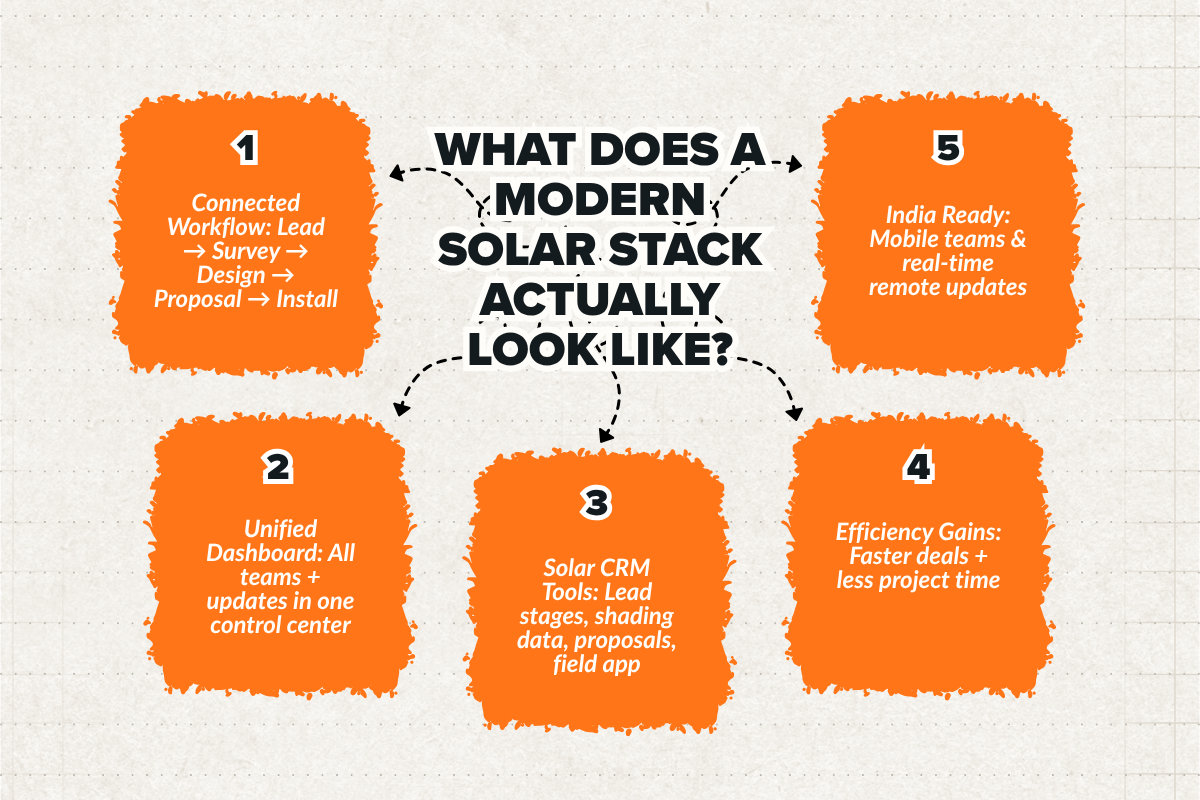
A modern solar stack isn’t just software, it’s your team’s control center. It connects sales, design, proposals, and installations so everyone moves in sync.
There's no missed leads, no update chaos, just faster deals and happier clients. That’s what working with clarity feels like.
1. How Does an Integrated CRM + Design + Proposal Workflow Work?
Here is how a single connected journey would look:
Lead enters your CRM → site survey scheduled → data automatically feeds into the design tool → instant proposal generated → approved → installation scheduled → project completed.
That’s what a true solar CRM and design integration looks like. No back-and-forth emails. No lost attachments. No manual updates.
Every step lives in a unified system, where your sales, field, and project management teams collaborate seamlessly. You can track progress in real time and take action instantly, all in one ecosystem.
Your solar team stays connected, your data stays organized, and your customer experience feels effortless.
2. What Features Should a True Solar CRM Include?
A real CRM for solar businesses goes far beyond contact management. It’s tailored to how solar teams actually work, out in the field, across rooftops, and in fast-moving sales cycles.
Here’s what you should expect:
- Solar-specific lead stages that reflect real sales progress.
- Built-in shading and site data capture for accurate proposals.
- Smart proposal templates with pricing and finance calculators.
- Field app to upload survey data and images directly from the site.
- Real-time dashboards for visibility across your sales team.
- Communication tools that keep customers and your team updated.
This combination turns your CRM into a true command center, where your team can manage leads, tasks, and projects all in one place. As every tool in your tech stack should work for you, not make you work harder.
3. How Much Efficiency Can This Really Bring?
Numbers don’t lie. Studies show that solar companies using integrated CRM software have seen a 30–50% reduction in project management time and deal closures up to 25% faster.
When your team eliminates tool-switching, automation takes over repetitive tasks like reminders, lead follow-ups, and reporting. The result? Each team member saves 8–10 hours a week, time that can go straight into more leads and more deals.
Faster response times translate directly into higher conversion rates and stronger margins. Over time, that efficiency compounds into consistent growth and happier customers.
4. Why Is India’s Solar Market Perfect for This Change?
India’s solar landscape is one of the most diverse in the world, from rooftop MSME projects to massive commercial and industrial setups. As government incentives, policies, and net-metering rules evolve, flexibility becomes the biggest strength a solar business can have.
A modern CRM with mobile access ensures your teams, even those in remote locations, stay connected, report updates in real time, and handle projects without delay.
When your solar CRM software adapts as fast as the market, you stay ahead of change rather than reacting to it. The next leap for Indian solar companies won’t come from price wars; it’ll come from smarter, connected workflows.
How Are Real Indian Solar Firms Making the Shift?
Let’s take a look at how real businesses are transforming their operations with smarter tools built for solar companies, not generic CRMs that were never meant for field-heavy industries.
A few years ago, most Indian EPCs and installers worked the same way:
Leads came in through forms or WhatsApp in your business, design teams used separate CAD software, and project updates were tracked on spreadsheets. It worked only until growth happened. Suddenly, there were more leads, more projects, and less clarity.
Take a deeper look at: Adapting Solar CRM Software for the Indian Market
How Can You Choose and Implement the Right Solar Stack in 2026?
Choosing the right solar CRM software can feel like standing in front of too many panels on a rooftop; they all look similar until you know what to look for.
The truth is, most CRMs weren’t built for solar. They’re made for generic sales teams, not for businesses managing site surveys, design workflows, and multi-phase installations.
So before you invest in any platform, take a step back and think about what actually moves the needle for your solar business: visibility, speed, and simplicity.
1. What Questions Should You Ask Before Choosing a CRM?
When evaluating a new system, these are the questions every solar business owner or project manager should be asking:
- Is the CRM built specifically for solar workflows, or is it a one-size-fits-all sales tool?
- Does it truly integrate design and proposal tools, or just claim to?
- Can it manage Indian market needs like GST, DISCOM requirements, and local incentive tracking?
- Does it provide real-time mobile access for field teams on the go?
- How strong are its analytics and reporting tools for sales performance tracking?
A platform that checks all these boxes makes sure your sales, design, and project teams stay aligned at every stage of the job. If your CRM can’t adapt to your solar workflows, it’s slowing down your growth, not supporting it.
2. How Should You Plan a Smooth Implementation?
The best systems fail when teams aren’t ready for them. Implementation isn’t just about installing software; it’s about aligning people, processes, and purpose.
Here’s a simple way to roll out your CRM for solar companies effectively:
1. Map your current workflow: Identify repetitive tasks, double data entry, and delays.
2. Start with a pilot group: Choose one team or region to test before a full rollout.
3. Train early: Focus on how this tool makes their job easier, not just how it helps the company.
4. Migrate clean data: A clutter-free CRM means faster adoption and fewer errors.
5. Track early results. Measure time saved, leads converted, and response speed.
Small wins build confidence, and confidence drives company-wide adoption.
3. How Do You Manage Team Resistance and Change?
A smooth transition isn’t about rushing. It’s about making sure every team member feels empowered, not replaced. Even the best CRM software for solar businesses can face resistance if your team feels overwhelmed or unheard. Change can be uncomfortable, especially for field teams used to doing things their way.
Here’s what works:
- Communicate clearly: Explain how the new system will make their day easier.
- Show quick wins: Highlight faster follow-ups, fewer errors, and reduced paperwork.
- Encourage feedback: Let users share their experiences and suggestions openly.
- Celebrate success: Recognize team members who adopt and win the change.
Once your team sees how effortless lead management, project tracking, and customer updates can be in one place, they’ll never want to go back.
What’s the ROI of Upgrading Your CRM + Design + Proposal Stack?
A modern solar stack doesn’t just organize your operations; it directly impacts your bottom line. By bringing CRM, design, and proposals into one connected system, solar companies see measurable improvements in speed, accuracy, and revenue.
Key ROI Highlights:
- 10 hours saved weekly per team: less time juggling tools, more time focusing on new leads and client relationships.
- Faster proposals = more conversions: quick responses and transparent quotes help close deals faster, boosting revenue.
- Fewer errors, smoother workflows: automated data flow between sales, design, and execution reduces costly mistakes.
- Better customer experience: real-time updates and professional proposals strengthen your brand credibility.
- Proven performance: solar CRMs have driven up to 30% more deal closures (based on industry benchmarks).
Why It Matters for Indian Solar Firms
- As projects and policies evolve rapidly, efficiency directly determines growth potential.
- A unified CRM stack helps businesses scale faster, adapt quicker, and stay profitable in a competitive landscape.
- In India’s expanding solar market, operational efficiency isn’t a bonus; it’s the difference between growth and stagnation.
Why Sunbase Is Emerging as India’s Modern Solar Stack
India’s solar sector is growing faster than ever, and businesses need more than just tools; they need a unified system to manage every part of solar operations in one place.
Sunbase is that modern solution, a single stack built to help you connect sales, design, proposals, and project tracking with unmatched simplicity.
Unlike generic CRMs, Sunbase understands the reality of solar businesses in India, from handling regional policies to keeping customer communication effortless and on time.
1. Built for Solar. Built for India.
Sunbase is purpose-built for Indian solar teams who need more than a one-size-fits-all CRM. It’s designed as your all-in-one solar management system, helping every department work smarter and stay connected.
Here’s how it’s made to fit your solar business:
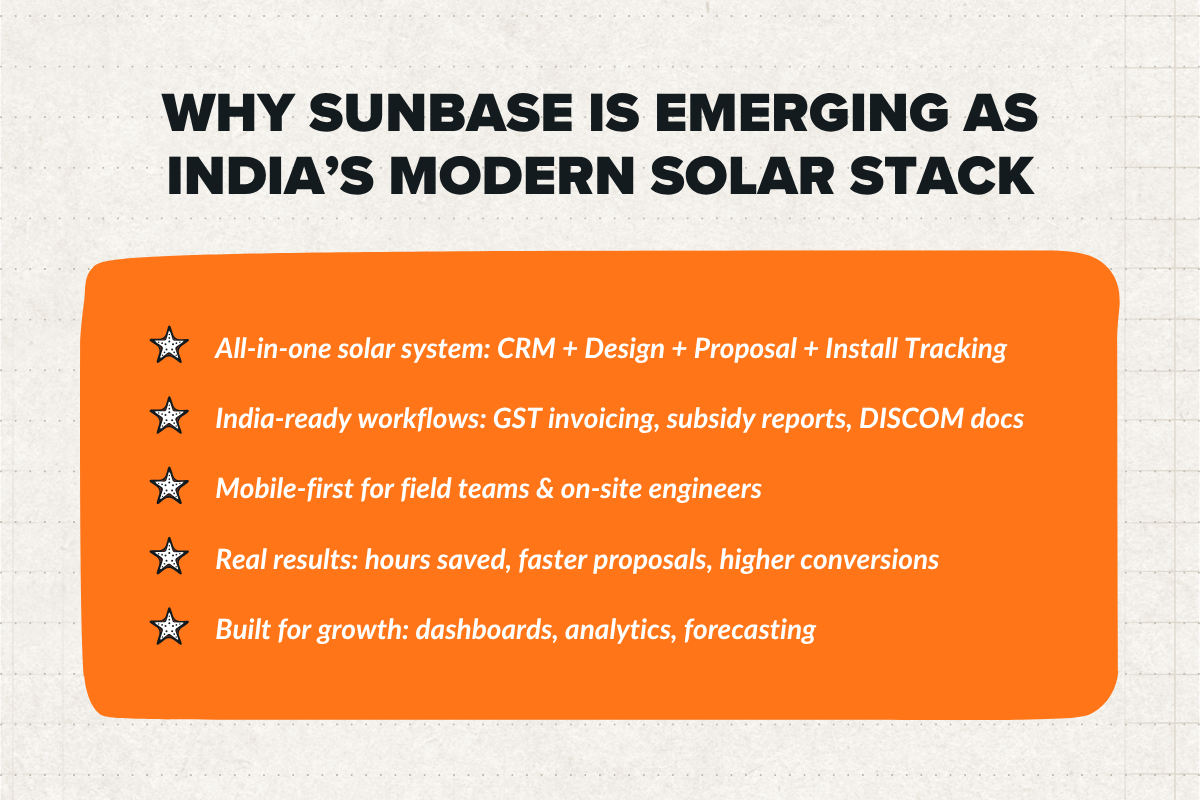
- Integrated CRM + Design + Proposal + Install Tracking, everything to manage your solar sales, field teams, and customers in one place.
- Localized workflows such as GST invoicing, subsidy reports, and DISCOM documentation for smoother operations.
- Mobile-first design to empower your on-site engineers and survey teams.
- Customer relationship tracking built specifically for solar, ensuring every lead, proposal, and update stays linked in real time.
- Central document management for site layouts, drawings, approvals, and proposals to avoid file confusion and missed updates.
- Real-time status tracking so sales, operations, and installation teams always know what’s happening on every project.
- Task assignment and activity logs to help managers track progress without chasing teams on calls or WhatsApp.
- Performance visibility across leads, conversions, and installations to support better planning and decision-making.
2. Real Results That Matter
Sunbase doesn’t just organize, it transforms how your solar team works. Solar companies using Sunbase have achieved visible results across the globe:
- Saved up to 10+ hours weekly by automating tasks and reducing manual follow-ups.
- Enhanced customer relationship management through quick proposals and instant updates.
- Improved deal conversions with accurate design collaboration and automated reporting.
- Simplified coordination across the sales and project teams, minimizing delays and confusion.
3. Designed for Growth, Not Just Management
Sunbase gives you real-time insights to manage your solar business as your team grows. With visual dashboards, analytics, and built-in forecasting, you can track sales performance, monitor projects, and make better data-driven decisions.
How Can You Start Upgrading Your Stack This Quarter?
Transitioning to a smarter solar stack doesn’t need to be complex; a structured plan ensures smoother adoption and faster ROI.
Your 5-Step Upgrade Plan
1. Audit your current workflow and tools: Identify what’s working and what’s slowing you down.
2. Spot time-draining gaps: Focus on repetitive tasks, data entry issues, and delays in approvals.
3. Shortlist solar-specific CRMs: Prioritize platforms like Sunbase that combine CRM, design, and proposals.
4. Pilot and measure results: Test with a small team and track time saved, faster deals, and better collaboration.
5. Scale confidently: Roll out organization-wide once results prove efficiency, and build data-driven habits.
What Happens If You Don’t Modernize in 2026?
The solar market in India is accelerating fast. Companies that fail to modernize risk falling behind, not because of poor products, but because of poor systems.
The Real Costs of Staying Stuck:
- Missed leads: slower response times mean losing deals to faster competitors.
- Poor customer experience: outdated proposals and unclear communication hurt credibility.
- Scattered data: fragmented tools make it difficult to make informed decisions.
- Scaling challenges: manual processes can’t keep up as project volumes increase.
Final Take: Why 2026 Belongs to Connected Solar Teams
India’s solar industry is entering a new growth phase. Technology will define which companies scale and which stall. The Path Forward 2025 will belong to connected solar teams that unify their CRM, design, and proposal systems.
Collaboration, automation, and speed will be the new growth engines for every successful EPC or installer. The true cost of not modernizing isn’t the software investment; it’s the daily opportunities lost.
It’s not just about software, it’s about building a smarter, happier solar team that wins every time.
About Sunbase
Sunbase is India’s all-in-one purpose-built solar business platform that unifies CRM, design, proposals, and installation tracking into one seamless system.
It’s built for Indian solar companies who want to grow faster, work smarter, and deliver better experiences to every customer.
Explore how Sunbase can help you unify your CRM, design, and proposal stack, and experience what smarter solar management feels like. Why the wait? Start your solar success journey. Take a demo today!
FAQs
1. How long does it take to implement a solar CRM?
Most teams can start using the system within days. Full adoption usually takes a few weeks, depending on data migration, training, and team size.
2. Is Sunbase suitable for small or mid-size EPCs?
Yes, it scales easily. Many mid-size Indian EPCs have adopted Sunbase to simplify operations and reduce costs.
3. Does Sunbase support GST and Indian market integrations?
Absolutely. It supports GST, regional incentive tracking, and DISCOM-specific compliance features.
4. Can Sunbase help remote teams?
Yes. With mobile-friendly access, teams in the field can upload site data, images, and status updates instantly.
5. How does a solar CRM improve coordination between sales, design, and field teams?
All teams work from the same data. When sales updates a lead, design receives it instantly. When engineers upload site data, proposals update automatically, which eliminates version issues and confusion across departments.
One Platform.
Zero Chaos.
Run Your Entire Business in One Platform
Sunbase replaces your CRM, proposals, scheduling, job tracking, and reporting tools — all inside one clean, connected platform.
About Sunbase
The All-In-One Platform to Run Your Entire Business
Sunbase helps you organize operations, streamline daily workflows, and manage everything - from first customer contact to final project deliver- in one connected system.
Our Mission
- Organize your business.
- Optimize your workflow.
- Automate your dailytasks
Why Businesses Choose Sunbase
One Connected Workflow
Replace scattered tools and manual processes with a single platform that brings together your team, tasks, customers, jobs, and performance data.
🌎 Global Presence
Serving the United States, Canada, India, LATAM, Australia, and 10+ international markets.
👥 11,000+ Users
Trusted by contractors, installers, project managers, sales teams, and field technicians.
🏗️ Built for All Sizes
From small contracting teams to fast-growing enterprises, Sunbase adapts to your workflow.
Stop Managing Your Business Manually. Automate It.
Sunbase automates workflows, reduces mistakes, and helps your team get more done - without hiring extra staff or juggling multiple tools.
Still Managing Your Business Across Multiple Tools?
Bring your CRM, proposals, projects, and operations into one platform built for contractors.

