
As someone working in the Indian Solar Industry, you might already be buying your panels from one vendor, inverters from another, structure from a third, and AC/DC wiring from a local supplier.
It might even be manageable at first, but before you realise it, you’re spending more time finding the right message than actually moving the project forward.
This is the point at which most EPCs begin to feel the limitations of running operations through separate tools and the need to buy solar software.
Choosing the Right Solar Business Software in India (2026 Guide for EPCs)
In 2026, EPCs in India should prioritize solar business software with advanced features like AI-driven optimization, 3D modeling, and hybrid/storage integration to improve efficiency and accuracy. Key software functions should include automated proposal generation, permit-ready documentation, cloud collaboration, and full lifecycle analytics.
As your operations grow, the need for predictable, organised workflows becomes impossible to ignore.
That's what this blog will help you understand in detail: what to look for when choosing solar software, how to tell platforms apart, and what actually matters for Indian EPC workflows.
Key Takeaways
- Choosing solar software is more about what fits your workflow than fancy features.
- Understanding the differences between design tools, CRMs, and full-stack platforms helps you avoid paying for systems you don’t need.
- Indian EPCs benefit most from software that consolidates communication and aligns all teams on a single track.
- A clear evaluation process makes it easier to pick a platform that supports both day-to-day operations and long-term growth.
Ready to Review Your Current Setup?
If you’re evaluating platforms this year, it’s a good time to book a quick personalized demo with Sunbase and learn how your solar business in India can scale with ease.
Why Choosing the Right Solar Business Software Matters in 2026
The solar energy industry in India is expanding rapidly, and as a solar professional, you may feel pressure to deliver faster, remain accurate, and keep customers informed.
As more players enter the market, the margin for operational mistakes becomes thinner.
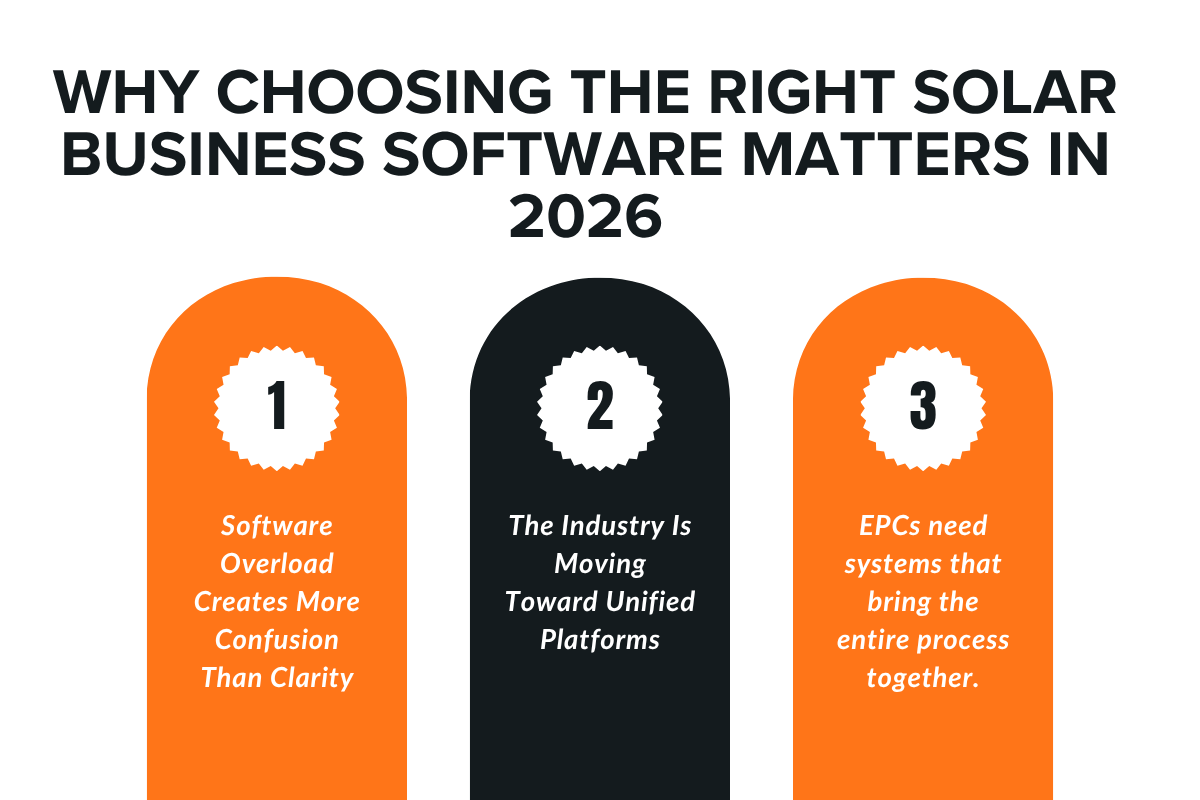
1. Software Overload Creates More Confusion Than Clarity
Most teams now use a mix of tools without a clear sense of ROI. One app handles leads, another manages drawings, and a different system tracks tasks.
It solves problems in isolation but makes daily execution harder to control. This is where choosing the right solar software platform in India starts to matter.
2. The Industry Is Moving Toward Unified Platforms
Instead of running every stage on a different tool, many EPCs are now looking for systems that bring more of the work under one roof.
The trend is clear: fewer point solutions, more connected systems. Platforms like Solar Ladder and Arka 360 reflect this transition, each expanding the capabilities of a single dashboard.
> Why This Matters for 2026
As projects become increasingly complex and teams become more distributed, there is a need for a single place to plan, coordinate, and deliver projects end-to-end.
Solar design software will continue to be important, but EPCs increasingly need systems that bring the entire process together.
> Where Software like Sunbase Fits In
Sunbase enters at this point as a unified Indian platform built to streamline operations, rather than adding more tools to the mix. It reflects where the market is heading and what EPCs will expect from modern software in 2026.
What EPC Teams in India Actually Need
For many EPCs, the challenge isn’t choosing software, it’s knowing where to start. As a senior manager, you may see the need for structure, but the team often feels the pain at different stages.
Sales needs a way to track leads, engineering requires accurate design handovers, and project teams require updates that arrive on time. Without clarity, the entire workflow stays reactive instead of efficient.
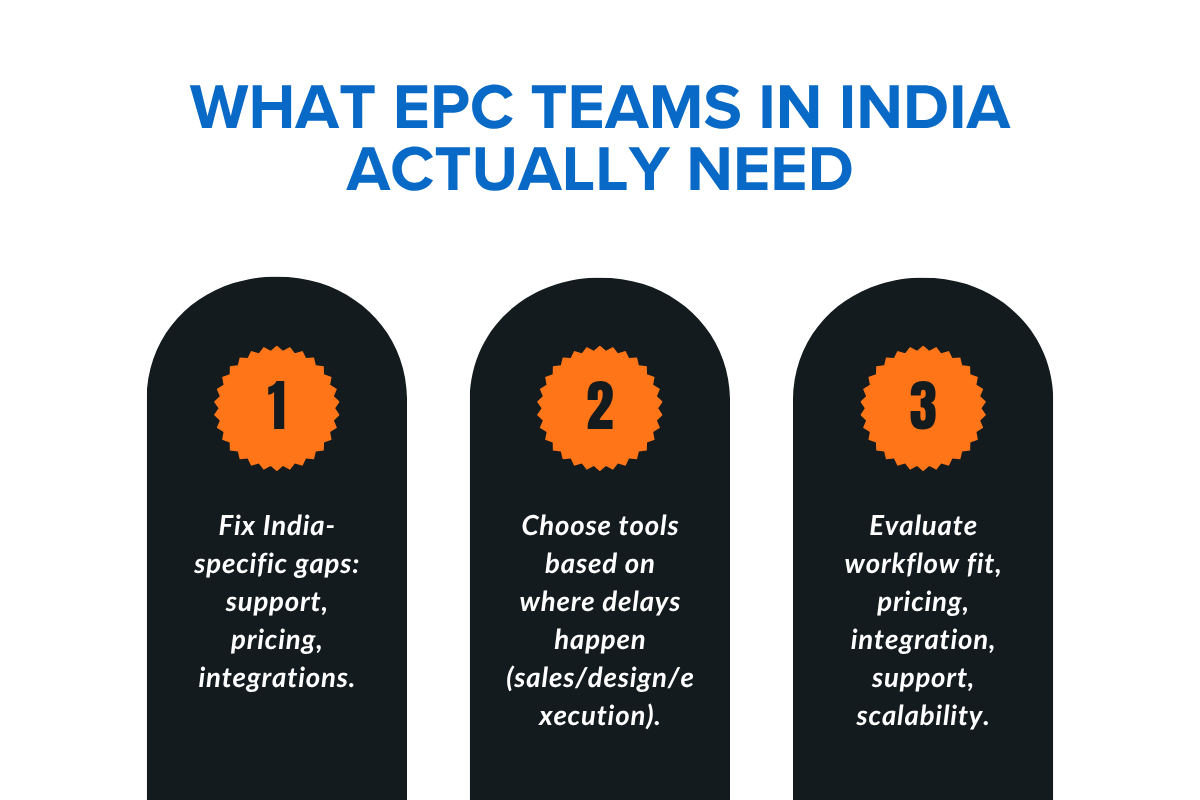
1. India-Specific Gaps That Slow Teams Down
Most EPCs struggle with the same issues: limited local support, rising software cost, and tools that don’t integrate well with the systems they already use.
This creates information gaps that affect everything from planning to customer experience. When data is everywhere, it becomes challenging to gain insights that accurately reflect the actual state of the work.
2. Understanding What Tools You Actually Need
Some teams assume they should start with a CRM. Others focus on solar design or jump straight to project management.
There isn’t one correct entry point, as the right starting point depends on where delays and errors occur most frequently for your business; perhaps it's during the sales stage, during handovers, or during execution on-site.
3. A Simple Framework to Avoid Overbuying Software
A practical way to make this decision is to look at five areas:
- Workflow Fit: Does the tool align with how your team currently works?
- Pricing: Does the cost make sense for your stage and project volume?
- Integration: Can it connect with the tools you already rely on?
- Local support: Will someone be available to assist you when issues arise in the Indian context?
- Scalability: Can it handle more projects without hurting performance?
This helps you evaluate tools based on your current needs while preparing for the next level of growth.
Also read: Solar Incentives & Financing in India: CRM Strategies
Types of Solar Business Software EPCs See in India (2026 Landscape)
The tools available today fall into a few clear categories, each solving a different part of the workflow. Understanding these options makes it easier to decide what your team should adopt now, and what to avoid until you’re ready for it.
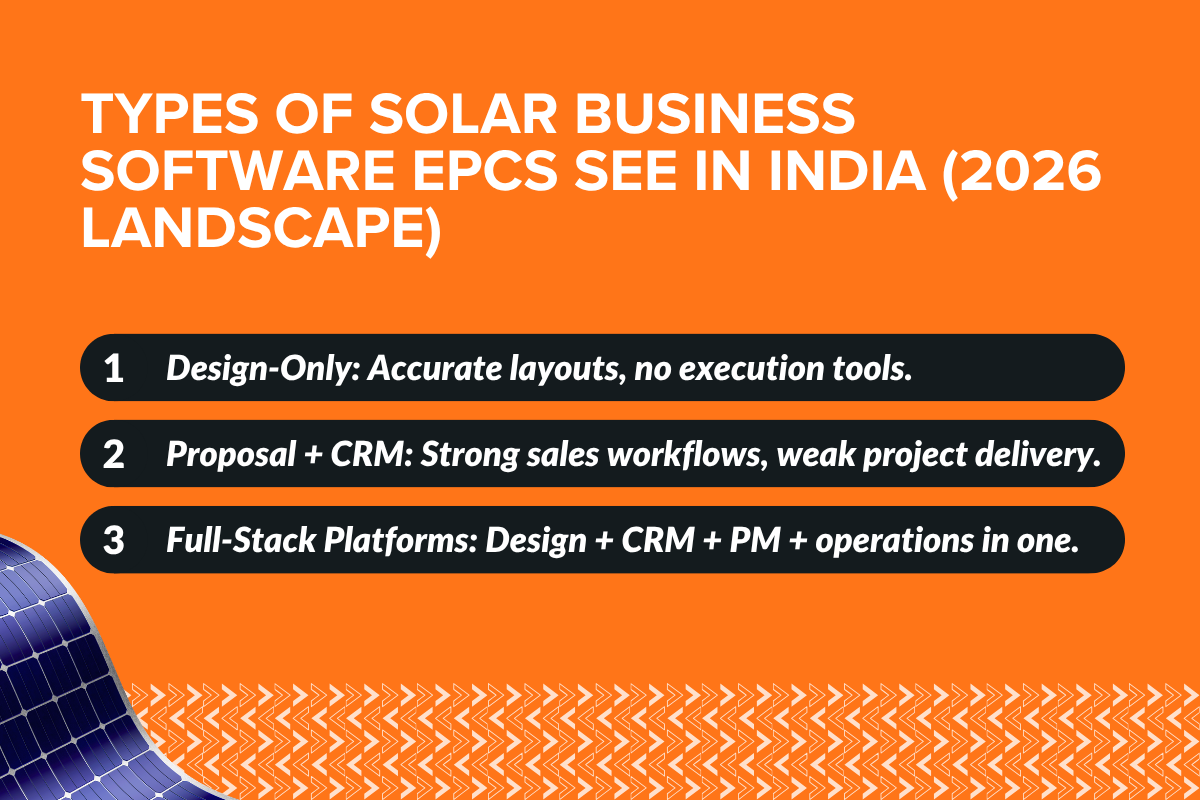
1. Design-Only Tools
These platforms focus on engineering accuracy. Solar design software handles 3D layouts, shading analysis, and solar radiation calculations. They help teams produce precise drawings, but don’t manage the rest of the workflow.
2. Proposal + CRM Platforms
These tools support sales teams by bringing structure to the sales process. They assist with lead capture, proposal creation, customer follow-ups, and tracking each stage until the project is completed. They’re effective for selling but don’t cover execution or project delivery. Example: Zoho CRM.
3. Full-Stack Solar Management Platforms
This category integrates design, CRM, project management, operations, and reporting into a single system. Instead of switching between apps, EPCs can manage the entire process from one place. It’s the direction the Indian market is steadily moving toward. Example: Sunbase.
Comparison at a Glance
Below is a simple comparison of the three categories most EPCs evaluate. It helps you see where each type fits and what you can realistically expect from it.
| Category | What It Does Well | Where It Falls Short | Who Uses It Most | Examples |
|---|---|---|---|---|
| Design-Only Tools | Accurate layouts, shading analysis, solar radiation data, and quick engineering checks. | Doesn’t support sales, project management, or team coordination. | Engineering teams, designers, freelancers. | HelioScope |
| Proposal + CRM Platforms | Helps sales teams manage leads, standardise the sales process, track performance, and capture enquiries properly. | Good for selling, but doesn’t manage the actual project execution or site work. | Sales teams, business development, and senior manager-level oversight. | SolarLabs (proposal-focused), GoSolar CRM |
| Full-Stack Solar Management Platforms | Brings design, CRM, project tracking, documentation, and operations into one place. Reduces the need for multiple tools and improves efficiency for growing teams. | Requires onboarding and workflow setup, but pays off once adopted. | Mid-sized and scaling EPCs managing multiple sites. | Solar Ladder, Sunbase |
Key Features EPCs in India Should Prioritize in 2026
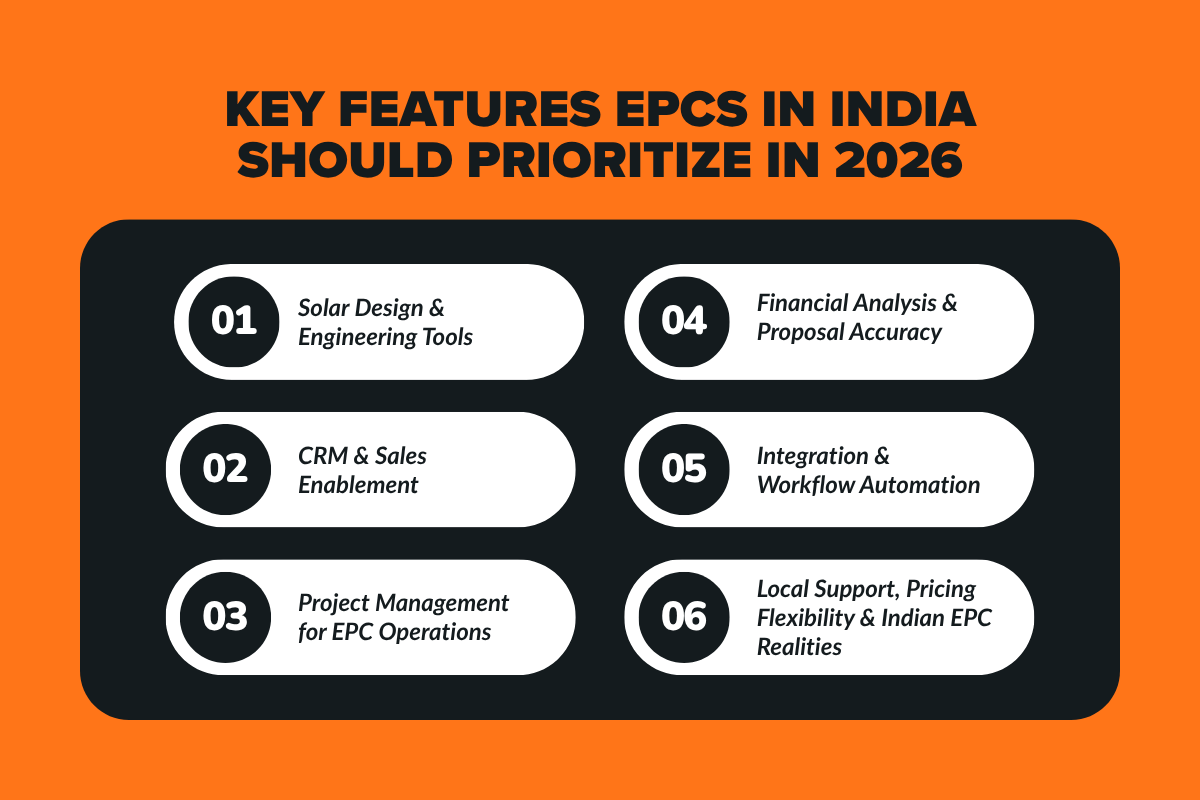
This section breaks down the features that matter most for Indian EPCs in 2026, so you can evaluate software based on what actually improves your workflow, not what looks good on a feature list.
1. Solar Design & Engineering Tools
Engineering accuracy still sits at the core of a reliable solar project. EPCs require solar design software that handles shading analysis, delivers consistent solar PV accuracy, and supports both residential and commercial sizing without slowing down their teams.
Tools should also use Indian irradiance and solar radiation data so the estimates you present match ground reality. A well-designed workflow reduces rework, provides your engineers with clarity, and helps you transition from quote to installation with fewer corrections.
2. CRM & Sales Enablement: Managing the Complete Sales Process
Manual CRM methods are one of the first things to break when enquiry volume picks up. Leads get lost, follow-ups get missed, and proposals end up lost across chats and PDFs. That’s where a structured solar CRM becomes useful.
Lead capture, proposal creation, tracking, and a standardized sales process help teams operate in real-time and sell with more consistency. It keeps your pipeline organised and prevents the back-and-forth that slows revenue down.
3. Project Management for EPC Operations
This is where most day-to-day work happens. Strong project management tools help your team stay aligned across solar project tasks, documentation, compliance checks, site surveys, and scheduling.
When your process is streamlined, everyone knows what’s happening, who’s responsible, and what needs to move next. It reduces bottlenecks, improves tracking, and gives the team more control over timelines.
4. Financial Analysis & Proposal Accuracy
In 2026, clients expect clarity before committing. EPCs need tools that can perform financial analysis, show ROI, calculate budgets, and assess overall project cost accurately.
Building proposals that stay consistent prevents last-minute adjustments and speeds up decision-making for both sides. It also builds trust, because your numbers hold up from design to commissioning.
5. Integration & Workflow Automation
Running separate systems for CRM, design, PM, and finance makes daily work harder than it needs to be. Integrations reduce duplicate entries, create smoother handovers between teams, and keep information updated automatically.
A connected workflow enhances efficiency and provides everyone with real-time visibility, particularly when projects overlap.
6. Local Support, Pricing Flexibility & Indian EPC Realities
EPCs in India need more than software; they need reliable support. That means a mix of on-site and remote assistance, fast resolution, and pricing models that adjust to team size.
Flexible user-based pricing makes scaling easier, and regional support helps you navigate local requirements without slowing operations down.
Check out: Adapting Solar CRM Software for the Indian Market
How to Evaluate Solar Software Platforms (Checklist)
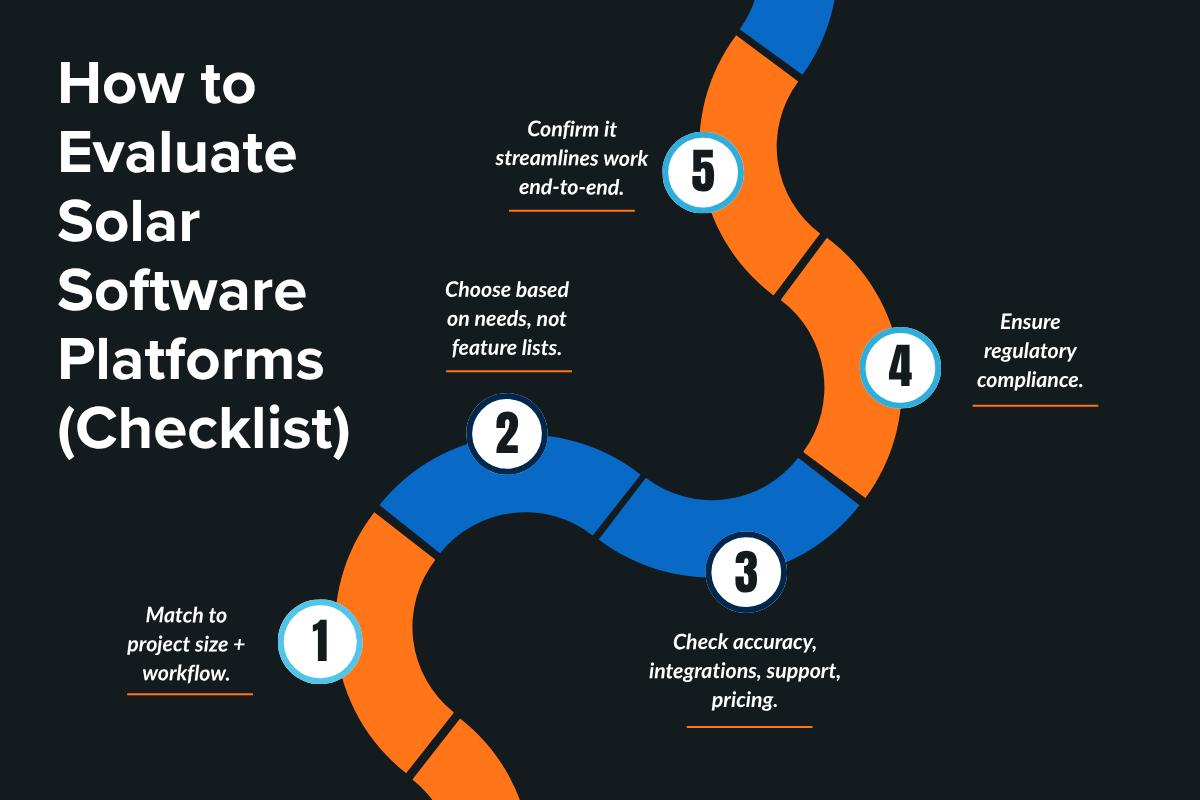
Choosing the right platform becomes much easier when you know what to look for. This checklist keeps the process grounded and helps you focus on what actually matters for long-term stability.
- Align the software with your current and future project sizes so you’re not forced to switch tools every time you scale.
- Match the platform to your specific needs, whether it's sales, design, execution, or full-stack operations.
- Assess accuracy, integrations, support, and budget instead of choosing based on features alone.
- Verify compliance with regulatory authorities and industry standards to avoid delays later.
- Ensure the tool helps your team streamline work, optimize workflows, and drive success across every stage of the project.
Common Mistakes EPCs Make When Choosing Solar Tools
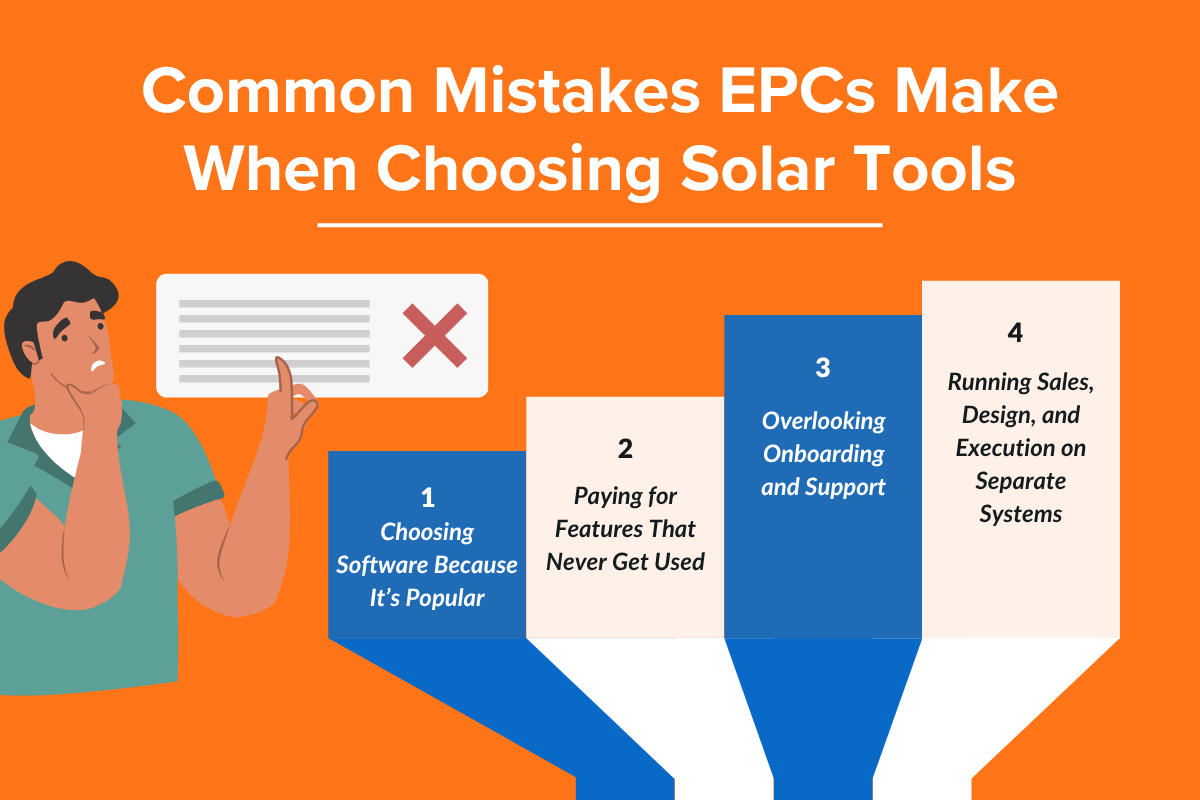
Choosing software becomes easier when you understand what to avoid. This section highlights the common mistakes that quietly slow teams down.
1. Choosing Software Because It’s Popular
Many teams choose platforms based on what others are using, rather than selecting one that best fits their own workflow. It feels safe at the time, but the gaps show up later when everyday tasks start taking longer than expected.
2. Paying for Features That Never Get Used
Demos often highlight features that appear impressive but don’t translate into real-world value. This leads to tools that feel heavy, complicated, and more expensive than they need to be.
3. Overlooking Onboarding and Support
Even good software can slow a team down if not properly onboarded. Skipping training or not checking the quality of support becomes a bottleneck once the work starts moving.
4. Running Sales, Design, and Execution on Separate Systems
Working across multiple apps makes it easier for updates to slip through. Versions get mixed, data becomes unreliable, and teams spend extra time fixing avoidable errors, leading to inefficiencies that often go unnoticed until they stack up.
Why Indian Solar EPCs Are Moving Toward Unified Platforms
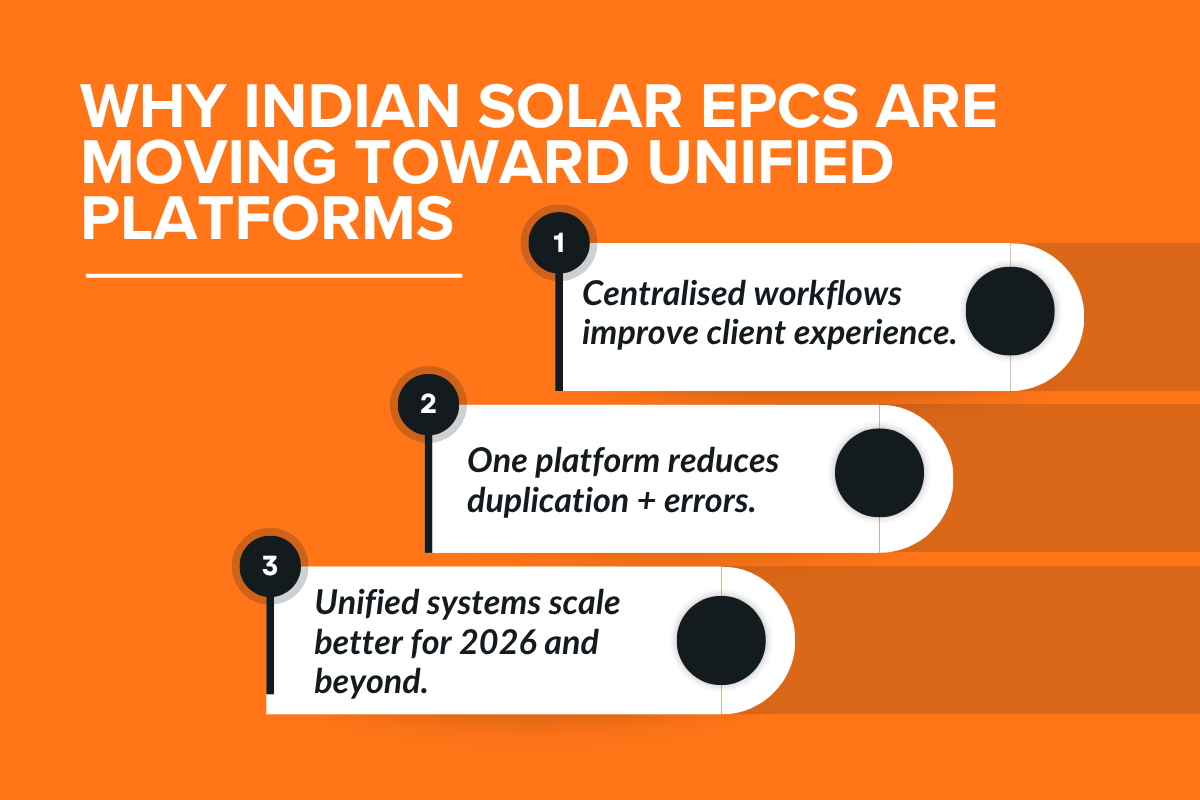
Each system solves one problem, yet together they start creating friction. Below are some of the reasons why unified platforms enhance productivity.
1. Centralised Operations Improve the Customer Experience
Clients don’t want to chase five different people for updates. When sales, design, and project execution run from one place, customers get clearer timelines and faster responses. It strengthens trust and reduces the number of follow-ups your team needs to handle.
2. Unified Platforms Are Becoming a Game Changer
Indian EPCs are realising that scattered workflows cost more than integrated ones. A single platform that handles design, CRM, project management, documentation, and execution creates consistency across all solar installations, bringing predictability to every step.
> Why This Shift Matters Going Forward
As the market becomes more competitive, EPCs need software that keeps pace with their work. Unified platforms reduce duplication, minimize errors, and provide teams with the structure they need to scale smoothly.
That’s why the shift is happening now, and why it’s shaping the future of the Indian solar industry.
Also read: How Solar CRM Software Can Help You Win More Projects
How Unified Platforms Such as Sunbase Align with EPC Needs
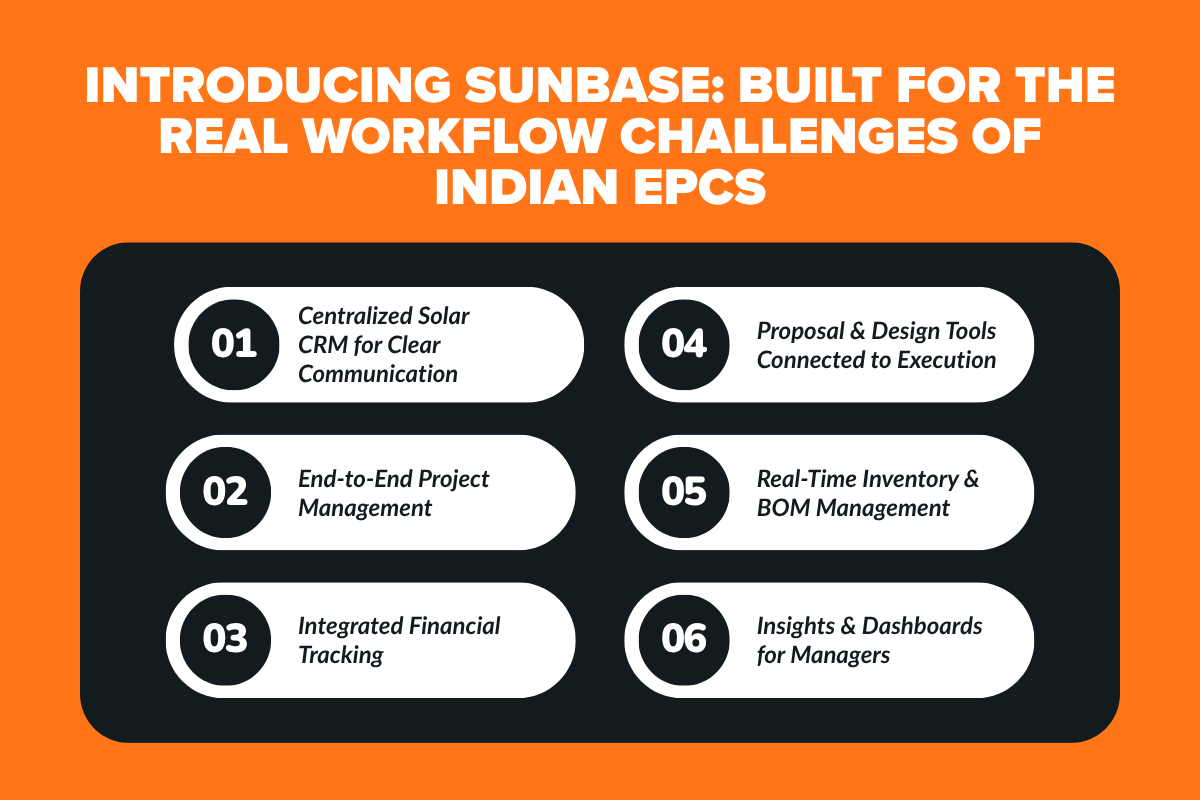
Sunbase brings the essential parts of an EPC’s day-to-day into one place. Here are the core features that directly support how Indian solar businesses actually work:
- Centralized Solar CRM for Clear Communication: All leads, follow-ups, tasks, and client updates are stored in a single system, ensuring teams stay aligned.
- End-to-End Project Management: From site survey to installation, everything is managed through a single workflow. Milestones, scheduling, field updates, and handovers are all tracked without the need for separate tools.
- Integrated Financial Tracking: Invoices, payments, profitability, and job-level financials are centralised, giving EPCs better control over cost and cash flow from start to finish.
- Proposal & Design Tools Connected to Execution: Proposals, designs, BOMs, and client approvals remain linked to the actual project, reducing rework and keeping engineering and field teams aligned.
- Real-Time Inventory & BOM Management: Panels, inverters, wiring, and accessories can be tracked as they move through procurement and installation, preventing last-minute surprises at the site.
- Insights & Dashboards for Managers: Senior managers get a clear view of sales performance, project progress, team workload, and financial health without asking for updates or hunting for data.
Conclusion
Choosing the right software comes down to selecting a system that supports how your EPC currently operates and where you want it to go.
With more sites running in parallel and more teams involved at each stage, relying on separate tools will only hold you back. A unified platform gives you cleaner workflows, clearer visibility, and fewer moving parts to manage.
As you evaluate your options, focus on what improves execution, reduces friction, and helps you scale without adding unnecessary complexity.
Next Step for EPC Teams
Before committing to another tool, take a closer look at Sunbase.
Book a demo- this single demo can show you whether one platform can replace the multiple systems slowing you down.
FAQs
1: How do I know if my EPC actually needs solar software India tools?
If your team is managing updates across multiple apps, losing track of tasks, or relying too heavily on WhatsApp for coordination, that’s usually the first sign you’ve outgrown manual workflows. Software becomes useful the moment visibility starts slipping.
2: Can a unified platform really help with solar energy projects of different sizes?
Yes. A unified system keeps your sales, design, procurement, and execution teams aligned, whether you’re handling a single residential job or multiple commercial installations at once. The goal is consistent, predictable delivery.
3: How does software support long-term management of solar assets?
A good platform gives you a central record of installation data, warranties, maintenance history, and site documentation. This makes follow-ups easier and helps your team handle service requests without searching through older messages or files.
One Platform.
Zero Chaos.
Run Your Entire Business in One Platform
Sunbase replaces your CRM, proposals, scheduling, job tracking, and reporting tools — all inside one clean, connected platform.
About Sunbase
The All-In-One Platform to Run Your Entire Business
Sunbase helps you organize operations, streamline daily workflows, and manage everything - from first customer contact to final project deliver- in one connected system.
Our Mission
- Organize your business.
- Optimize your workflow.
- Automate your dailytasks
Why Businesses Choose Sunbase
One Connected Workflow
Replace scattered tools and manual processes with a single platform that brings together your team, tasks, customers, jobs, and performance data.
🌎 Global Presence
Serving the United States, Canada, India, LATAM, Australia, and 10+ international markets.
👥 11,000+ Users
Trusted by contractors, installers, project managers, sales teams, and field technicians.
🏗️ Built for All Sizes
From small contracting teams to fast-growing enterprises, Sunbase adapts to your workflow.
Stop Managing Your Business Manually. Automate It.
Sunbase automates workflows, reduces mistakes, and helps your team get more done - without hiring extra staff or juggling multiple tools.
Still Managing Your Business Across Multiple Tools?
Bring your CRM, proposals, projects, and operations into one platform built for contractors.

