
Let's begin with: Two solar EPCs. Same city. Same expertise. Same number of projects, at least until last year. Fast-forward to today… one is scaling rapidly, taking on bigger C&I clients. The other is drowning!
What changed? Not panel prices, they source from similar suppliers. Not installation quality, both have excellent technical teams. Not even a marketing budget! So, the real difference? Their software stack. One upgraded. The other… didn’t.
If you’re an EPC in India right now, you already feel it; this is the biggest solar surge the country has ever seen. Costs are dropping, demand is rising, and expectations? Higher than any rooftop you’ll ever climb.
And somewhere in the middle of all this, every EPC is asking the same question: Which solar software actually works for Indian conditions?
How To Choose the Best Solar Software for Indian EPCs: What Works & What Doesn’t
Choosing the right solar software in India has never been more challenging or more confusing. With EPCs handling tighter deadlines, complex C&I demands, and clients expecting near-instant proposals, not every tool can keep up.
This is the year EPCs are ditching ancient methods, spreadsheets, and “almost accurate” design tools. Because you need software that works as fast as your sales team, adapts as quickly as your engineers, and scales to the level your business is aiming for.
In this guide, we break down what’s actually working in the world of solar software India, what’s falling short, and which platforms truly support Indian EPC workflows.
Key takeaways
- India’s Solar EPC market is unstoppable, but rapid growth has exposed major tech gaps; outdated tools can no longer keep up with rising project speed, complexity, and client expectations.
- Global tools fall short in addressing Indian realities such as DISCOM approvals, state-wise subsidies, and region-specific tariff rules.
- Unified, India-specific software stacks are winning. EPCs using integrated CRM, Design, Proposal, and Project Management platforms are delivering projects faster and scaling more smoothly.
- The best-performing EPCs in 2026 aren’t the biggest; they’re the most technologically optimized, leveraging automation for design accuracy, workflow speed, and project tracking.
- The top solar software used by Indian EPCs includes Sunbase, ARKA 360, Solar Ladder, and Open Solar Software.
Before we get started! Go Back in Time (Sort Of)
Remember when you first started your EPC? Everything fits in your head. You knew every client, every project status, and every pending task. Life was simpler. Then you grew. And suddenly, you needed systems to remember what you once knew.
Sunbase gives you that clarity back, but at scale. One dashboard showing everything. One platform with all information. One system your entire team relies on. See how your current workflow compares to Sunbase. Book a quick walkthrough and identify where time, data, and deals are slipping.
India’s Solar EPC Landscape in 2026 and Beyond: Bigger Market, Bigger Tech Gaps
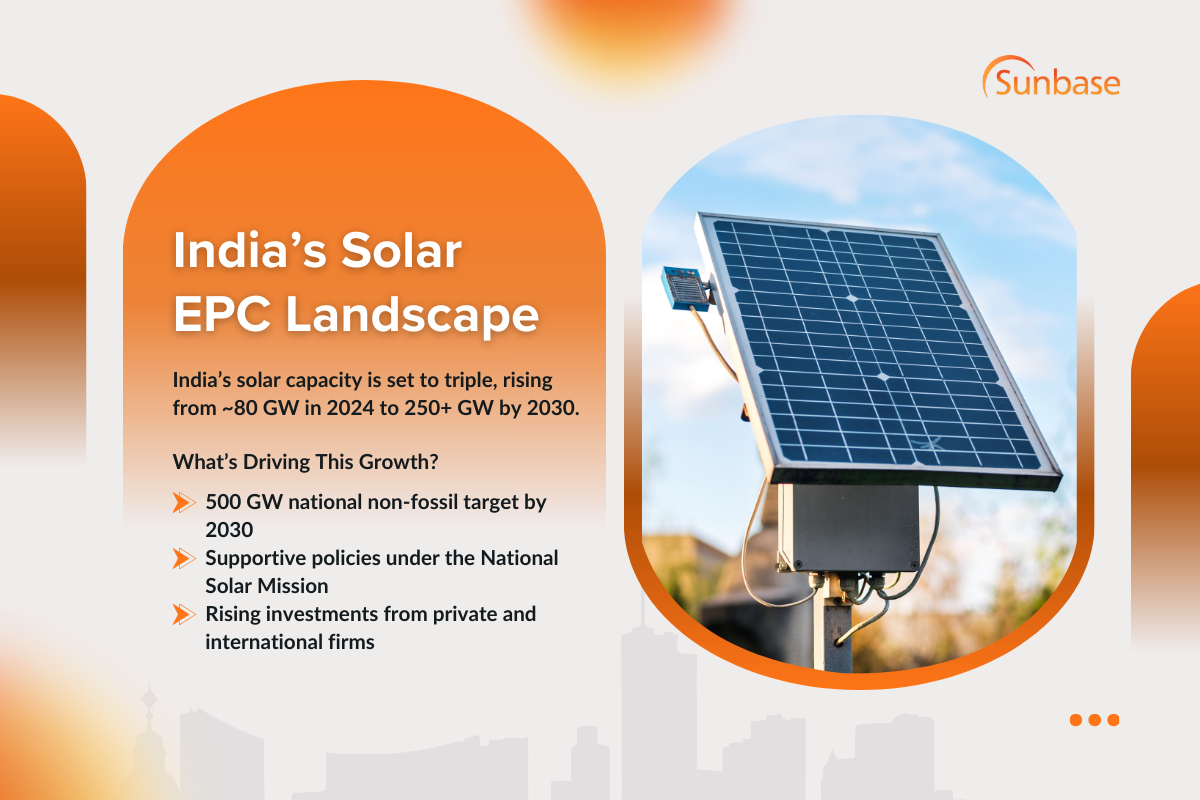
India’s solar capacity is set to triple, rising from ~80 GW in 2024 to 250+ GW by 2030. India isn't just participating in the global solar revolution; we have been leading it in ways that would've seemed impossible a decade ago.
But, What’s Driving This Growth?
- 500 GW national non-fossil target by 2030
- Supportive policies under the National Solar Mission
- Rising investments from private and international firms
The PM Surya Ghar scheme alone aims to reach 10 million households with rooftop solar. Commercial and industrial (C&I) installations are also on the rise.
And if you're dealing with financing, Solar Incentives & Financing in India is worth bookmarking.
Every factory, every IT park, and every warehouse sees solar energy not just as a "green initiative" but as smart business sense. When your electricity bill rivals your rent, solar becomes a no-brainer.
So EPCs should be doing well, right? Well, yes and no.
> The Problem Hiding Behind the Growth
Here's the secret of India's solar industry: while project sizes and volumes have multiplied, the tools EPCs use to manage them haven't changed much.
Walk into most solar EPC offices today, and you'll see:
- One design tool (because that's what the client expects to see)
- Generic CRM (to track those 27 leads that came in this week)
- WhatsApp for project coordination (let's be honest, it's where actual work happens)
- Excel for... everything else (proposal templates, BOMs, project tracking, profit calculations, team schedules, and that one necessary sheet only one person understands)
It works. Barely. Until it doesn't.
> The India-Specific Tech Gap
Here's what makes this particularly painful for Indian EPCs: most solar software is built for Western markets and then "adapted" for India.
That means:
- Pricing tools that assume consistent supply chains (adorable)
- Design systems that've never encountered the architectural creativity of Indian buildings
- Support teams that don't understand why you need a quote generated in multiple formats
The market has grown 10x. The complexity has grown 10x. But the tools? They've maybe grown 2x.
> What This Means for EPCs in 2026 and Beyond?
The gap between market opportunity and technological capability continues to grow wider. As India races toward that 500 GW target, EPCs face a choice:
- Option A: Keep using multiple disconnected tools, hiring more people to fill the gaps, and hoping your systems don't break during crunch time.
- Option B: Find integrated software solutions that actually understand Indian market realities, or build workflows that bridge these tools effectively.
The EPCs winning in 2026 aren't necessarily the ones with the biggest teams or the longest track records. They're the ones who've figured out how to leverage technology that works with Indian complexity, not against it.
Because in a market this competitive, your software stack isn't just a back-office concern. It's your competitive advantage or your disadvantage.
So what software should Indian EPCs actually be using? Let's break down what's working, what's overhyped, and what's worth your money.
Why Solar EPCs in India Need a Different Kind of Software?
If you’ve ever tried using global solar tools in India, you already know the truth: they’re not built for the way Indian EPCs actually work. You realize this:
Until your designer creates a layout that procurement can’t source materials for, or until your CRM integrates with your project management tool, you’ll be manually updating the same data three times, risking losing a deal because your competitor submitted their proposal two days earlier.
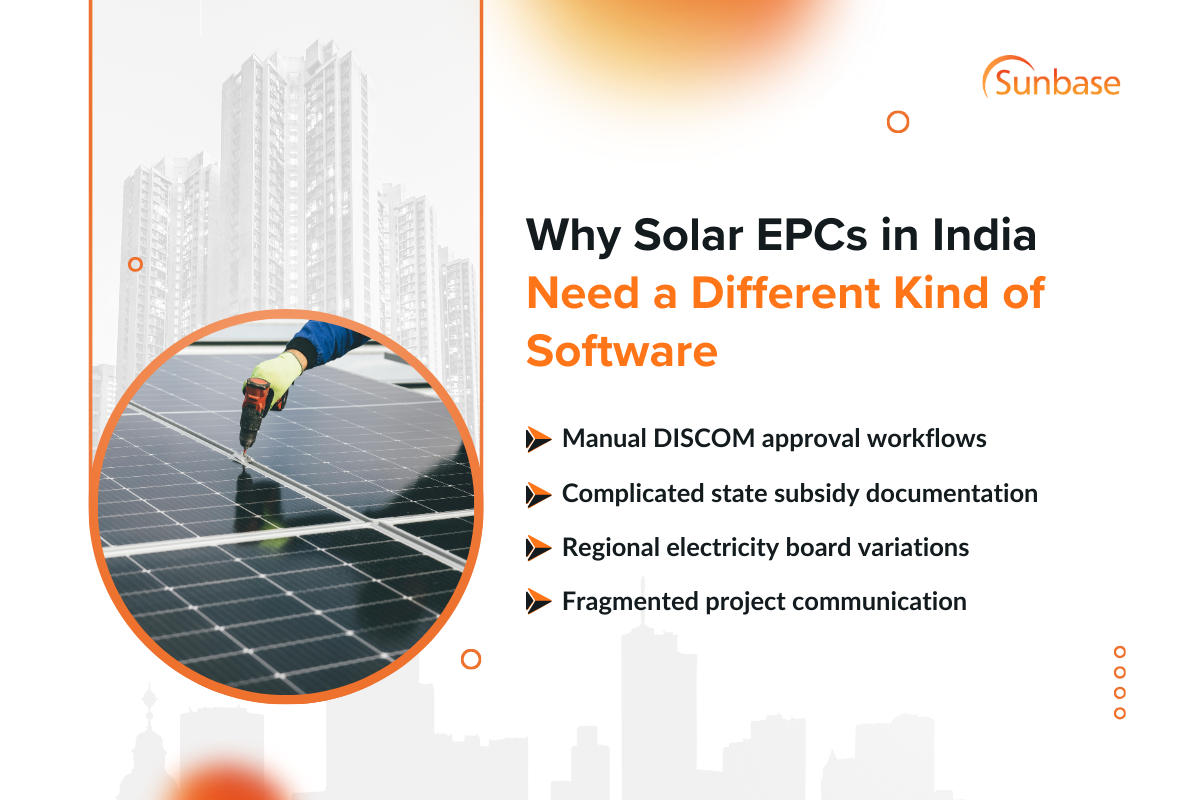
Here’s why Indian EPCs need software designed for Indian realities:
- Manual DISCOM Approval Workflows:
Every state, and sometimes each district, follows its own approval cycle. You end up manually tracking application counts, follow-ups, and inspectors, which global tools don’t even support. - Complicated State Subsidy Documentation:
From rooftop subsidies to net-metering photo logs, the paperwork is boring. Most software doesn’t offer templates, automated checklists, or compliance workflows tailored for India. - Regional Electricity Board Variations:
Uttarakhand asks for one thing. Maharashtra wants another. Rajasthan has an entirely different format. Global platforms operate under universal rules, something Indian EPCs lack. - Fragmented Project Communication:
WhatsApp groups, Excel sheets, Google Drive folders, email threads, this is the operational reality. Without a unified communication, things go missing, clients panic, and timelines get delayed.
All of this raises one question for every EPC: Why isn’t there a single platform for all this? And that leads us to the next big conversation...
What’s Working in Solar Software for India in 2026?
The Indian solar software landscape is finally catching up to the realities of how EPCs operate. While not perfect, several promising advancements are reshaping efficiency and project speed for both rooftop and C&I installers.
1. Growing Focus on India-Specific Integrations
Software providers are developing tools that directly integrate with MNRE guidelines, DISCOM submission formats, and state-level subsidy workflows.
Localized datasets, such as irradiance for tier-wise climate zones and region-specific net-metering conditions, are making system sizing and performance calculations far more reliable for Indian rooftops.
2. Simplified Rooftop Design Tools with Auto-Shading & 3D Models
Fast proposal cycles are everything in India. EPCs need to submit designs as soon as possible, and modern tools are stepping up with auto-shading detection, Google Maps–based layouts, and quick 3D modeling.
These features help teams generate accurate residential and C&I rooftop proposals faster, improving win rates in competitive markets.
3. Rise of Unified Platforms (CRM + Proposal + Design in One Place)
Instead of juggling multiple software tools, many EPCs are shifting to consolidated platforms that manage leads, proposals, designs, and project workflows under one roof.
A growing trend indicates that teams using unified software experience up to 30% faster project delivery, because of reduced back-and-forth and fewer manual steps.
Platforms like Sunbase are gaining attention for offering an integrated ecosystem specifically aligned with Indian EPC processes, a feature previously lacking in the market.
Now, let's find out...
What’s Not Working (And Why EPCs Are Still Struggling)
Despite major progress, the Indian solar EPC ecosystem still faces several frustrating gaps, and most of them come from tools that were never designed for India in the first place. Here’s what continues to slow teams down.
1. Global Software Missing Indian Localization
Popular global tools offer impressive features, but they often fail to align with India’s daily realities.
There’s no native support for Indian tariff categories, DISCOM documentation formats, or state-specific policy templates.
As a result, EPCs spend the majority of their time manually tweaking foreign layouts, translating policy text, and adjusting assumptions, all of which adds unnecessary friction.
2. Limited CRM and Project Tracking
Most design-focused tools stop right after a proposal is generated. But Indian EPCs don’t.
They need lead management, client follow-up, document sharing, installation tracking, and approval coordination, none of which are well covered by global design platforms.
This forces teams into a patchwork workflow: 10 tabs and somehow keep it all in sync. The result? Lost context, slower execution, and overwhelmed project managers.
When software fails to adapt to Indian realities, EPCs adjust their workflows instead (inefficiently). It doesn't have to be this way. Here's what proper Indian market adaptation looks like in software.
3. Disconnected Workflows and Lost Efficiency
When design tools don’t talk to CRM systems…when CRM doesn’t talk to invoicing…and invoicing doesn’t talk to project tracking… Every. Single. Project.
Now multiply that by 50 active projects. See the problem?
Fragmented systems lead to miscommunication, duplicated data entry, and delayed client updates, the exact opposite of what fast-growing EPCs need.
4. Lack of Scalability for Growing EPCs
Here's the trap ambitious EPCs fall into:
You start small. Five projects a month. Your current setup, which includes some software for design, a basic CRM, and lots of Excel, works fine. You and your two teammates are familiar with the layout. Communication happens naturally. Okay, good!
Then you grow. Ten projects become twenty. You hire more designers, more project managers, more salespeople. Suddenly, your "system" shows its true colors.
The software that got you to 10 projects a month can't get you to 100. So, what do you need?
Best Solar Software EPCs in India Are Currently Using
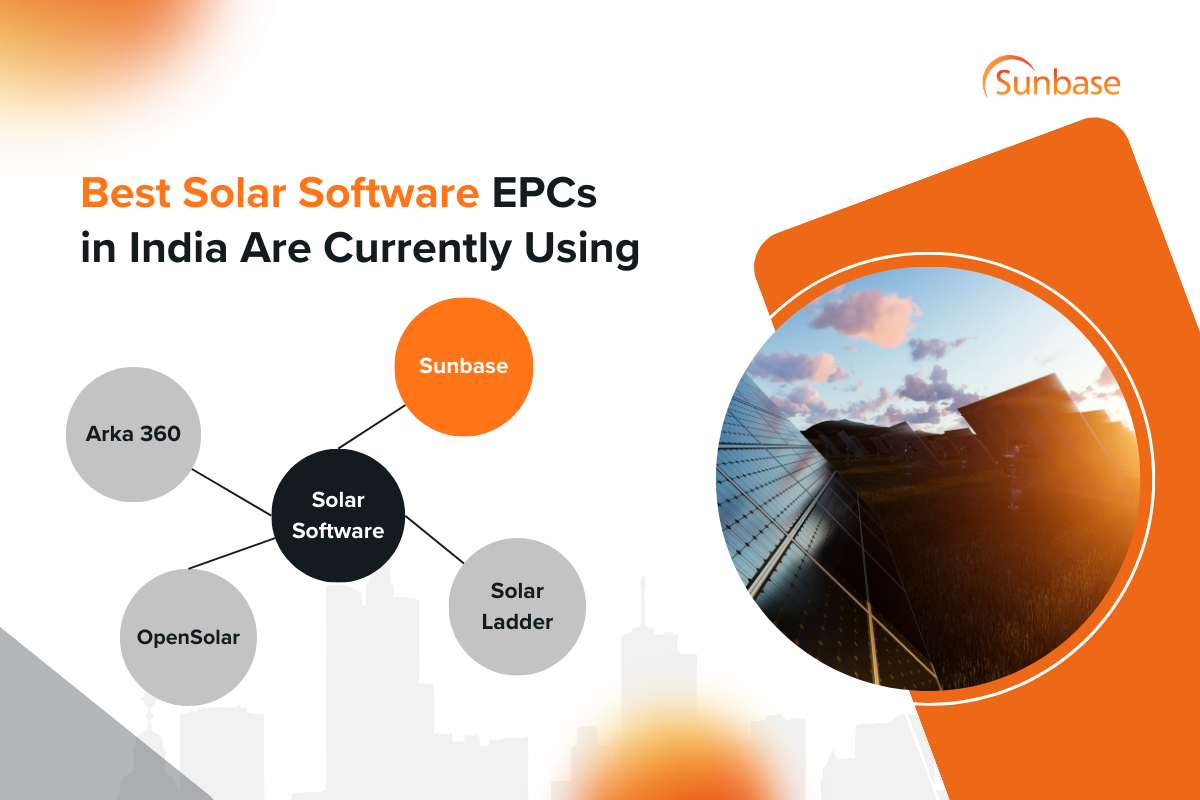
Sunbase, ARKA 360, Solar Ladder, and Open Solar Software are among the best solar software solutions Indian EPCs are currently using. Let's find out more about them:
1. Sunbase Solar Software (India-Ready, All-in-One Solution)
Trusted by 1.5k solar businesses, Sunbase is an all-in-one software solution for solar companies that simplifies every step of the journey from the first lead to the last milestone of your solar project. It brings all your data and operations together, enabling you to run your entire business hassle-free.
Core features:
- Solar CRM: Manages customer records and interactions, automates sales processes, and provides real-time data for better financial analysis.
- Solar Design Software: Creates precise PV array layouts, conducts site assessments, and estimates energy production to enhance accuracy and decrease costly rework.
- Proposal Generation: Generates professional web proposals with customized designs and financial options, featuring e-signature functionality.
- Project Management: Oversees the installation process with an automated workflow, including inventory and billing tools for product tracking and payment management.
- Canvassing Software: Offers tools for lead management, enabling businesses to capture and nurture leads effectively.
Review:
"We cannot express enough how positive our experience has been working with Sunbase. Truly a team that sticks to their word and focuses on making their product work for you." - MonoLuxeSolar
2. Arka 360
It is a cloud-based design engine for solar teams seeking speed, accuracy, and automation on the go. Its AI-driven layouts, 3D models, and proposals help you visualize every solar project in real-time, blending creativity with solar intelligence to deliver a seamless management and sales experience.
Core features:
- Sales and lead management: Automates tasks such as lead capture, sending personalized site surveys, and handling client follow-ups.
- 3D design and visualization: Provides precise 3D simulations and links to visualize the site and solar installation for customers.
- Shading and obstruction analysis: Identifies potential shading issues to optimize panel placement for maximum efficiency.
- Project management: Includes tools for managing tasks, reminders, and tracking project progress.
- Financial analysis: Creates detailed models, including cost estimates, ROI, and financing options such as loans, PPAs, and leases, for compelling proposals.
Review:
"I am loving the platform, it's easy to use and keeps everything organized in one space." -G2
3. Solar Ladder
Solar Ladder is an Indian software solution for a truly end-to-end operating system for solar EPCs. It unifies sales, procurement, and project tracking of the solar lifecycle, giving teams the tools to manage everything effortlessly in real time using centralized data and automation.
Core features:
- CRM: A solar-specific CRM to manage customer relationships, track sales cycles, and view the total kilowatt hours on each sale.
- Proposal generation: Automated, personalized proposals with savings calculations and visual graphs. Include your brand and showcase the brands you use for components.
- Project management: A tool to manage and track project activities, from the initial sales lead to final installation and beyond.
- Procurement: A service that connects EPCs with distributors to facilitate product discovery and deals on components like modules and inverters.
- Operations and Maintenance (O&M): Features for scheduling and managing O&M tasks, including automated alerts for cleaning or low output.
Review:
"Solar Ladder's CRM and 3D design features have been a game-changer for our business. Managing projects has never been this efficient." - Eco Wave Power
4. OpenSolar
OpenSolar is a free, cloud-based design platform for solar installers who want precision without the price tag. It delivers clean proposals, smart layouts, and smooth planning on the web, making the early stages of the solar project simple, visual, and efficient with real-time solar design tools.
Core features:
- Design tools: 3D design functionality provides immersive visualization of systems on specific properties
- Interactive proposals: Customer proposals have built-in payment processing, multiple financing options, e-signature capabilities, and white-label branding.
- Built-in CRM: OpenSolar offers a built-in CRM for managing customers and businesses, or it can be integrated with existing CRMs via API, enabling seamless communication and scheduling.
- Project Management: Helps manage projects, tasks, and team members effectively with customized assignment and permission features.
Review:
"Open Solar, a functional application for the design, presentation, and sale of photovoltaic energy" - G2
Comparing the Top Solar Software for India: Which fits your needs?
| Platform | Ideal For | Should Indian EPCs Choose It? |
|---|---|---|
| Sunbase | Small to large EPCs need an all-in-one (CRM + Design + Proposal + Project Management) system. | Yes. Best all-round choice; built for Indian EPCs. |
| ARKA 360 | EPCs are prioritizing advanced design and 3D modeling. | Suitable for design, but needs other tools for full EPC ops. |
| Solar Ladder | Small to mid EPCs focusing on operations, procurement & task management. | Good operations add-on, not a complete EPC solution. |
| OpenSolar | Freelancers & small EPCs wanting a free design/proposal tool. | Suitable for beginners, not scalable for Indian EPCs. |
What Indian EPCs Should Look for in Solar Software in 2026?
Here’s exactly what a solar business should look for:
Must-Have Features Checklist
Before committing to any of the solar software, Indian EPCs should make sure it checks these essential boxes:
- Indian tariff and subsidy mapping:
Automatically supports DISCOM rules, state-wise subsidy formats, and regional tariff categories, it should eliminate the need for manual customizations. - End-to-end design, proposal, and CRM integration:
A single platform to handle the entire workflow: design → proposal → follow-up → project execution. - Mobile access for field teams:
On-site teams need to be able to upload photos, update tasks, and access client or project information from literally anywhere. - Team collaboration & document management:
Centralized storage for drawings, approval documents, permits, and communication helps keep teams and clients aligned. Not to mention: 1 paper missed is equal to 1 hour of search or luck. - Real-time client tracking and referral tools:
Automated updates, milestone visibility, and referral sharing boost customer trust and lead generation.
> Bonus: Smart Analytics and Reporting
In 2026 and beyond, EPCs need more than operational tools; they need insights for the future.
Modern solar platforms should offer:
- Project cost analysis to understand profitability and prevent budget overruns.
- Team performance metrics to improve execution speed and accountability.
- ROI tracking for residential and C&I clients.
- Forecasting that includes: Accurate energy output predictions, optimized system sizing, and automated cost estimation
This is precisely why understanding your actual requirements is more important before choosing a software. Here's our checklist for defining those requirements: Solar EPC Firms: Key Software Features to Look For.
Future Trends in Solar Software India EPCs Should Watch
If you think the solar software landscape is upside-down now, buckle up, 2026 is just the beginning.
1. AI-Powered Site Assessments
Artificial intelligence is redefining how EPCs evaluate and design solar projects. Expect rapid adoption of:
- Drone and LiDAR-based site surveys that automatically generate ultra-accurate 3D terrain models.
- AI-driven layout optimization that chooses the best panel angles, spacing, and placement for maximum kWh generation.
What once took hours (or days) will soon take minutes, with far fewer errors.
2. IoT-Based Performance Tracking
Here's the gap most EPCs don't think about until it's too late: You design a system. You install it. You commission it. You hand over monitoring credentials to the client.
And then... Your solar installers have no idea how it's actually performing unless the client complains. Well, that's about to change fundamentally. Future-ready software will integrate tightly with IoT devices to deliver:
- Live system performance data at the inverter, string, and panel level.
- Predictive maintenance insights for C&I and large utility-scale systems, allowing EPCs to detect faults before they escalate.
This improves plant uptime, reduces service costs, and boosts long-term customer satisfaction.
3. India-Specific Financial Tools
This might be the most important trend and the most overlooked. The next generation of solar software in India will include:
- Loan eligibility calculators
- Dynamic net-metering tools
- APIs connected to government policies
These tools will help EPCs give clients faster, more accurate financial projections, something competitors using generic software won’t match.
Final Verdict: Choose wisely. Test thoroughly. Adapt continuously.
Here's something nobody tells you when you start a solar EPC: You didn't get into this business to become a software expert. You got into it because you believed in clean energy, saw a massive market opportunity, or wanted to build something meaningful in India's energy transition. Maybe all three.
But somewhere between your first residential rooftop and your fiftieth commercial project, you realized something uncomfortable: the companies winning aren't always the ones with the best technical expertise or the lowest prices.
They're the ones who can move faster, scale smarter, and deliver experiences clients actually enjoy. And that increasingly comes down to the technology choices you make.
Sunbase: Test Drive India's Most Complete Solar Software
Still skeptical? Good. You should be. You've probably tried "game-changing" software before. It wasn't. You've sat through demos that promised everything. They only delivered half. You've invested in tools your team never adopted. Money wasted!
So yeah, be skeptical of Sunbase too.
But here's what we're willing to do about your skepticism: Book a quick 15-minute demo and talk to our solar experts, and compare your current process to Sunbase!
FAQ's
1. Which is the best design software for solar EPC companies in India in 2026?
The best option depends on your workflow, but most EPCs prefer platforms with robust compliance tools and end-to-end project management. So, tools like Sunbase and Solar Ladder bring everything on solar projects together without switching apps, making it easier to deliver proposals to our clients faster.
2. Which features should Indian EPCs look for in a software for solar project execution?
EPCs should look for tariff mapping, proposal branding with a logo, and integrated CRM in the solar industry. Robust tools include a complete renewable energy workflow that covers design, documentation, and monitoring for solar sites, improving project execution.
3. How is Sunbase different from Arka 360 or Solar Ladder?
Sunbase is more than a design tool or project tracker; it’s a comprehensive business management system for Indian EPCs. Unlike ARKA 360, which focuses on design and proposals, and Solar Ladder, which supports operations and supply chain, Sunbase integrates all these features into a single platform.
4. Is free solar software good enough for EPC work?
For quick sketches, maybe. For serious EPC-scale accuracy? Not so much. Indian EPCs need precision, proposal-ready, client-ready, and installation-ready outputs. Free tools rarely offer that level of reliability.
5. What are the biggest issues with solar software that aren’t working in 2026?
Slow interfaces, outdated shading tools, complicated workflows, poor support, and tools that crumble the second your internet hiccups. In India, reliability is king.
One Platform.
Zero Chaos.
Run Your Entire Business in One Platform
Sunbase replaces your CRM, proposals, scheduling, job tracking, and reporting tools — all inside one clean, connected platform.
About Sunbase
The All-In-One Platform to Run Your Entire Business
Sunbase helps you organize operations, streamline daily workflows, and manage everything - from first customer contact to final project deliver- in one connected system.
Our Mission
- Organize your business.
- Optimize your workflow.
- Automate your dailytasks
Why Businesses Choose Sunbase
One Connected Workflow
Replace scattered tools and manual processes with a single platform that brings together your team, tasks, customers, jobs, and performance data.
🌎 Global Presence
Serving the United States, Canada, India, LATAM, Australia, and 10+ international markets.
👥 11,000+ Users
Trusted by contractors, installers, project managers, sales teams, and field technicians.
🏗️ Built for All Sizes
From small contracting teams to fast-growing enterprises, Sunbase adapts to your workflow.
Stop Managing Your Business Manually. Automate It.
Sunbase automates workflows, reduces mistakes, and helps your team get more done - without hiring extra staff or juggling multiple tools.
Still Managing Your Business Across Multiple Tools?
Bring your CRM, proposals, projects, and operations into one platform built for contractors.

