
Solar sales performance is shaped less by demand and more by systems. A well-architected sales tech stack, the integrated set of tools that manage lead capture, design, quoting, follow-ups, and contract execution, determines whether a solar business scales predictably or stalls under operational pressure.
In practice, modern solar sales rely on rapid response, precise quotes, and complete visibility into the field. For example, studies show that contacting a new lead within 5 minutes can make you 100× more likely to convert them versus waiting 30 minutes. In fact, 78% of buyers pick the first company to respond, regardless of price.
Yet many solar teams are still using outdated workflows. They patch together CRMs, quoting tools, email, and even WhatsApp, leaving data fragmented and follow-ups missed.
How Top Solar Teams Simplify Their Sales Stack With Solar Sales Software?
Today’s most effective solar teams use solar-specific sales platforms that manage leads, quoting, contracts, and analytics in a single solar system. Instead of using six disconnected apps, they have a single, end-to-end solution designed for solar sales workflows and solar contractors.
The result: they respond faster, boost sales, and gain complete pipeline visibility. For example, solar companies that switch to a unified solar CRM report up to 30% faster deal closures than teams using different tools.
In contrast, teams sticking to generic CRMs or spreadsheets are losing profit margins to competitors who can quote instantly and coordinate across departments.
Therefore, in this blog, we'll understand how top solar teams simplify their tools with integrated sales software, highlight common pitfalls of disjointed systems, and outline the core components and strategies that high-growth companies use.
Key Takeaways:
- A dedicated solar sales platform accelerates response times and provides accurate data.
- Proven tech stacks favor simplicity. Well-integrated tools see higher adoption and far less data friction than fragmented setups.
- One connected platform beats a messy tool. Fragmented data drains business productivity.
- The right solar sales stack turns operations into a selling point that cuts costs through efficiency.
- Centralized dashboards and analytics sharpen industry forecasting and pipeline management.
Watch Sunbase simplify your sales workflow in just a few clicks! Schedule a call with our expert to know more.
Why Disconnected Tools Hurt Solar Sales Performance in 2026?
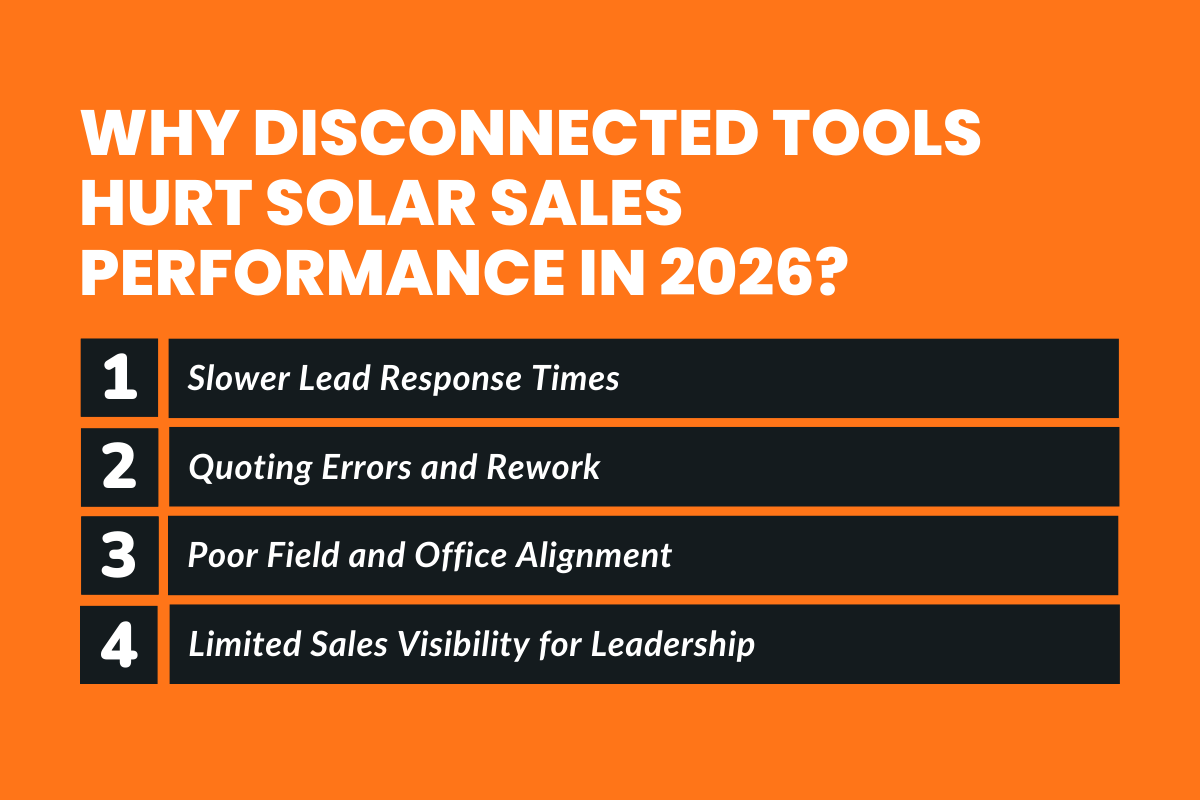
Most solar teams would agree: slow follow-ups and messy data cost deals. Below are four ways disjointed sales tools undermine performance:
A. Slower Lead Response Times
Leads shouldn’t fall into black holes. With disconnected tools, new inquiries often linger until someone manually grabs them.
Every minute matters; research shows field sales reps are 60× more likely to qualify a lead if they respond within one hour rather than letting it sit for a day. Worse, waiting more than 5 minutes can reduce your odds of qualifying a lead by up to 80%. [Source]
A connected stack can instantly assign a lead to the right rep, trigger follow-up reminders, and easily engage customers.
B. Quoting Errors and Rework
Manually copying product specs and prices across systems is high-risk and open to mistakes. When your sales rep drags equipment info from a pricing sheet into a proposal PDF (often on a different computer), typos and outdated data ruin the efficiency and accuracy rate of your business.
A small pricing error on a solar panel or an inverter can blow margins or even cost a deal to the competition. Top solar teams eliminate this risk with automation.
An integrated automation tied to the CRM ensures every quote is based on live data. An automated, unified quoting engine eliminates back-and-forth with change orders. It lets reps send instant, accurate proposals that homeowners appreciate, and that help you increase close rates in less time.
C. Poor Field and Office Alignment
Solar sales focuses on both the office and the field. Reps on rooftops use mobile apps and tablets, while office staff may rely on desktop CRMs or spreadsheets to track leads and keep an eye on sales activities.
Without one shared system, teams are out of sync. For example, a salesperson might send a text message or email a PDF quote to a client, while the office team never logs that data into the CRM.
The lack of a common source of truth makes it impossible to know what’s really happening on each deal.
D. Limited Sales Visibility for Leadership
Disconnected tools mess up the reporting. When sales data is scattered across email, CRM, and spreadsheets, leadership gets only fragments of the picture. Forecasts become guesswork because some deals “don’t exist” in the pipeline view.
Incomplete reporting leads to missed targets: a full pipeline may hide that deals are actually stalled or inflated by dead leads. In contrast, integrated analytics reveal bottlenecks and enable accurate forecasting.
As one sales operations guide states, tracking the right pipeline metrics provides “a clearer picture of whether revenue targets are truly within reach” and highlights which deals will close.
Without updated data, CFOs and VPs have no reliable information. They may overstaff a false pipeline or scramble at the last minute to fill missing jobs.
By merging quotes, contracts, and project statuses into a single system, leadership gains up-to-the-minute insights. It helps you automate follow-ups, saving time and reducing costs to close deals.
What Does a High-Performing Solar Sales Tech Stack Actually Look Like?
I. It Starts With One Connected System
A high-performing solar sales tech stack replaces multiple disconnected tools with one unified platform. The real advantage comes from connection, not volume. Top solar companies focus on how systems work together rather than how many tools they use.
- One system instead of five or six scattered applications
- No switching between dashboards to complete one task
- Shared data across sales, operations, engineering, and leadership
- Fewer handoffs and fewer mistakes
This structure creates speed, clarity, and consistency across the entire sales process.
II. Workflows Built Around Flow, Not Features
Strong solar sales stacks are designed around workflow continuity. Each step moves automatically without manual effort from the team.
- Leads move forward without manual reassignment
- Sales actions trigger the next operational step
- Data flows once and stays accurate
- Teams focus on selling instead of updating systems
Instead of reacting to disconnected alerts, teams operate inside one continuous sales flow.
What are the Core Components Every High-Performing Solar Sales Stack Includes?

A world-class solar sales stack includes a few essential building blocks. Each core component solves a pain point and ties into the others:
1. Lead Management & CRM:
The foundation is a centralized system to capture and assign leads. A solar-specific CRM designed for solar design or solar energy projects captures inquiries (web forms, calls, etc.) and routes them instantly.
It records every interaction, so nothing slips through. With one person clearly owning each lead from start to finish, accountability increases and helps boost efficiency.
In practice, this means an office dashboard where all new leads appear with real-time status, and reps see all their appointments, contacts, and tasks in a single timeline.
2. Solar Quoting & Proposal Software:
Next comes an integrated CPQ or proposal tool. It automatically pulls system sizing and pricing data (based on house location, panel count, financing options, etc.) from the CRM to generate instant quotes. No rep is left to figure out math or copy-and-paste equipment lists.
The right system ensures quotes are accurate on the first try. Prospects get professional, error-free proposals immediately, and reps save time on rework.
3. Contract and Document Management:
Once a proposal is approved, a frictionless contract process keeps the momentum going. High-performing teams use built-in e-signature and document workflows so customers can sign documents digitally.
Rep and client can access and sign from any device, and the signed contract automatically links back to the deal record.
4. Sales Team Performance Tracking & Analytics:
A unified software helps the analytics team to discover the updates on time. Rather than piecing reports from multiple systems, leaders get dashboards driven by accurate data.
Good solar sales software will automatically log rep activities (calls made, appointments set, proposals sent) and track pipeline metrics. With this data, managers can spot future trends and coach effectively.
How to Evaluate and Choose the Right Solar Sales Tech Stack?
Selecting a solar sales tech stack should be treated as a strategic operational decision, not a software purchase.
The right stack strengthens process control, forecasting accuracy, and team productivity. The wrong one adds friction, increases administrative work, and creates hidden scalability limits.
1. Audit Your Current Operational Bottlenecks
Before evaluating vendors, examine how your existing sales process performs in practice. Identify where delays occur, where data is re-entered manually, and where deals typically stall.
If proposal turnaround is slow or forecasting feels unreliable, those are system-level issues that need to be solved. A clear internal audit prevents you from buying tools that look impressive but fail to address real workflow gaps.
2. Define Integration as a Core Requirement
Integration should not be an afterthought. Every system in your sales stack must communicate cleanly with others, especially CRM, proposal software, accounting tools, and project management platforms.
When integration is weak, teams compensate with manual exports, spreadsheets, and workarounds. Evaluating integration capability early ensures that data flows automatically across departments without duplication or loss.
3. Test Real-World Workflows Instead of Feature Lists
Feature checklists rarely reveal operational friction. Instead, simulate actual sales scenarios during evaluation. Create a lead, assign it, generate a proposal, move it through approval, and transfer it into project tracking.
The experience should feel continuous and intuitive. If the workflow requires excessive clicks, manual updates, or switching between modules, that friction will multiply as lead volume increases.
4. Evaluate Reporting and Forecasting Logic
Leadership decisions depend on accurate pipeline visibility. A strong solar sales stack should provide stage-based forecasting, conversion tracking, and real-time dashboards without requiring spreadsheet exports.
If forecasting relies heavily on manual input or subjective rep estimates, the system will struggle to support predictable growth. Reporting depth often reveals how mature the platform truly is.
5. Assess Scalability Beyond Current Lead Volume
Many tools function adequately at low volume but break under operational pressure. When evaluating a stack, consider whether it can support multiple teams, geographic expansion, approval hierarchies, and increased proposal generation.
Choosing software that only fits your current size often leads to costly migrations within a few years.
6. Consider Implementation and Change Management
Adopting a new sales stack affects workflows, team habits, and active deals. Implementation should be structured, with clear migration planning, onboarding support, and leadership alignment.
Companies that treat software adoption as a process redesign rather than a simple installation achieve stronger long-term results and higher team adoption rates.
7. Calculate Total Operational Impact, Not Just Subscription Cost
Software pricing alone does not determine value. Consider the time saved from reduced administrative work, fewer quoting errors, improved lead response speed, and more reliable forecasting. A slightly higher subscription cost may deliver meaningful gains in revenue predictability and operational efficiency.
Choosing the right solar sales tech stack requires discipline and clarity. The goal is not to accumulate tools but to build a connected system that supports speed, accuracy, and controlled growth as demand increases.
What Solar Sales Tech Stack Models Are Winning in the US Right Now?
| Company Type | Typical Stack & Tools | Key Focus |
|---|---|---|
| Local/Regional Installers | Lean CRM, a solar quoting app, and basic accounting. Few integrations (often just email + calendar). | Speed & efficiency. Use minimal software; prioritize fast lead response and simple quoting. Often owner-driven. |
| Multi-State Companies | Complete CRM, integrated CPQ, marketing automation, and simple field app (e.g., mobile inspector). Standard templates and APIs between systems. | Consistency & growth. Standardize workflows across regions, ensure end-to-end data flows, and automate for scale. Forecasting & reporting become important. |
| Large EPCs / Enterprise | Comprehensive ERP-style solution: solar CRM + CPQ + project management + inventory modules. Advanced analytics/BI, AI lead scoring, multi-branch support. | Volume & control. Handle complex quotes & approvals. Focus on granular forecasting, compliance, and efficiency at scale, multi-tier pipelines, and governance. |
Common Mistakes Solar Businesses Make When Building Their Sales Stack
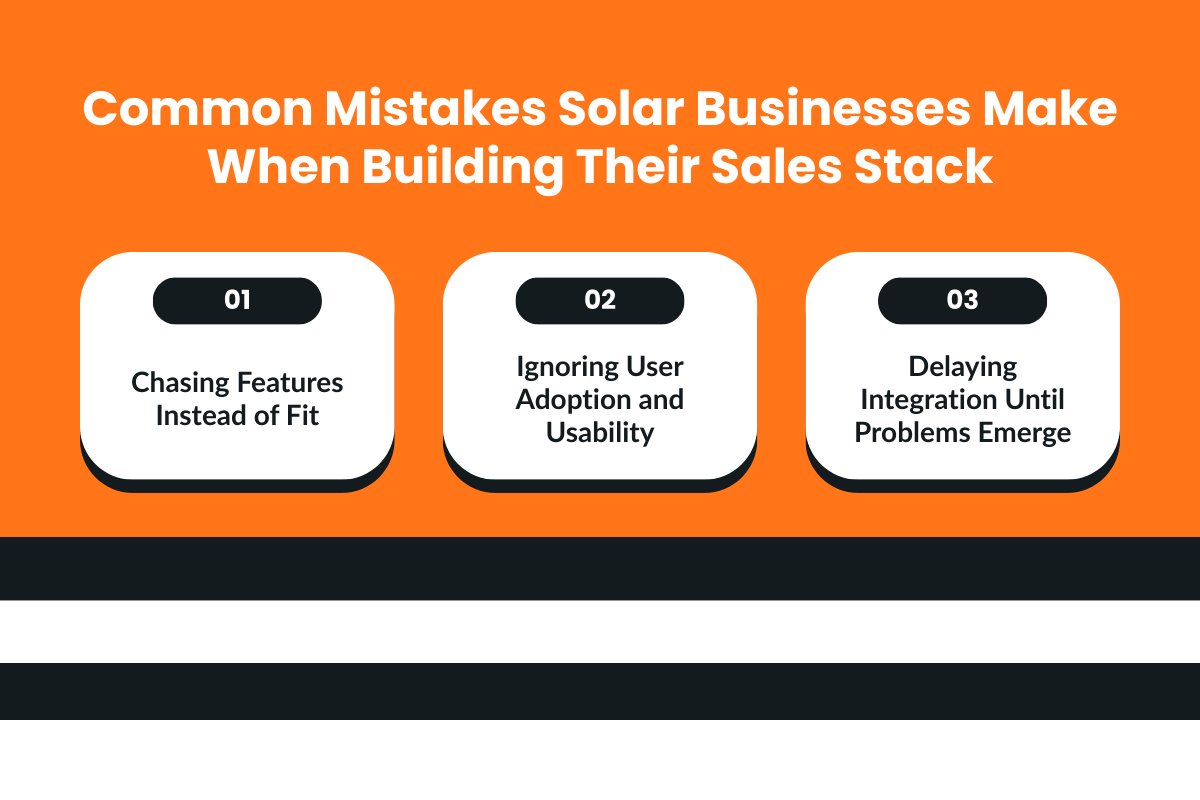
A. Chasing Features Instead of Fit:
It’s tempting to pick tools with flashy features, but if they don’t align with your workflow, adoption will be low. Top-performing teams avoid this by defining their sales processes first.
One framework recommends creating a prioritized requirements matrix (must-haves vs. nice-to-haves) that focuses on solving actual pain points. Without this discipline, companies end up with tools that no one uses effectively.
B. Ignoring User Adoption and Usability:
Even the most advanced sales tech stack fails if the team does not use it consistently. Many solar leaders focus heavily on features and pricing while underestimating the role of change management and day-to-day usability.
When systems feel complex, slow, or disconnected from real workflows, usage drops and teams revert to spreadsheets or informal communication channels.
C. Delaying Integration Until Problems Emerge:
Many solar companies treat integration as a secondary concern, addressing it only after data inconsistencies, reporting gaps, or workflow delays begin to surface.
By that stage, the organization is already absorbing the cost of duplicate data entry, inconsistent records, and manual reconciliation between systems.
A more disciplined approach is to design the tech stack around integration from the beginning. Every tool should be evaluated not only for features, but for how well it connects with the rest of the ecosystem.
API flexibility, native integrations, and bidirectional data sync capabilities determine whether information flows cleanly across sales, design, and operations. By ignoring this, companies waste huge amounts of time on manual work.
Conclusion: Leverage Growth by Using the Best Solar Sales Technology Stack
When all components of a tech stack are connected and work together, sales will move more quickly, quotes will remain accurate, and services will no longer break down. All leads will be followed up with attention, all proposals will be based on real-time data, and all deals will progress in a transparent manner.
What makes a solar company successful is its ability to keep things simple. Companies remove unnecessary components of their tech stack, automate many tasks, and build around how their teams actually work in real-world workflows.
About Sunbase
Sunbase is an example of the all-in-one approach in action. It positions itself not as another tool, but as a specialized platform for solar sales operations.
It provides a single platform for lead management, system design, proposal generation, contract e-signing, and performance tracking.
Because it ties all these together, teams spend far less time reconciling data. For instance, instead of toggling between a CRM, a separate proposal tool, and a document repository, a Sunbase user does everything in one interface.
To explore how industry leaders streamline their solar sales process, consider scheduling a demo with Sunbase. A modern, unified platform can replace those disconnected tools and give your team the speed and clarity to win more deals. Schedule a demo today.
FAQs
Q.1 How much should a solar company spend on its sales tech stack?
There’s no fixed number, but most growing solar companies allocate a small percentage of projected revenue toward sales infrastructure. A well-integrated stack should pay for itself through faster deal cycles and higher close rates.
Q.2 How much do solar salesmen make per sale?
The commission for a solar salesman can depend on the sales price of the product, how the company's commission structure is set up, and where the sales representative is located. The solar sales commission can range from $3000 to $10000 per sale ($3000-$10000/deal).
Q.3 Should small solar installers use an all-in-one platform or separate tools?
For small or regional installers, an all-in-one platform is often more practical because it reduces integration complexity and improves team adoption. Separate best-in-class tools can work, but only if the company has the technical capacity to manage integrations and maintain data consistency.
Q.4. What signs indicate that our current sales stack is limiting growth?
Common warning signs include increasing lead response times, frequent pricing errors, unreliable forecasting reports, heavy spreadsheet use, and unclear ownership of deals. If leadership cannot confidently answer “What will close this month?” the stack likely needs restructuring.
Q.5. Can switching sales software disrupt active deals?
It can, if not planned carefully. The safest approach is phased migration — keeping active deals in the existing system while onboarding new leads into the new stack. Proper planning and data mapping minimize disruption.
One Platform.
Zero Chaos.
Run Your Entire Business in One Platform
Sunbase replaces your CRM, proposals, scheduling, job tracking, and reporting tools — all inside one clean, connected platform.
About Sunbase
The All-In-One Platform to Run Your Entire Business
Sunbase helps you organize operations, streamline daily workflows, and manage everything - from first customer contact to final project deliver- in one connected system.
Our Mission
- Organize your business.
- Optimize your workflow.
- Automate your dailytasks
Why Businesses Choose Sunbase
One Connected Workflow
Replace scattered tools and manual processes with a single platform that brings together your team, tasks, customers, jobs, and performance data.
🌎 Global Presence
Serving the United States, Canada, India, LATAM, Australia, and 10+ international markets.
👥 11,000+ Users
Trusted by contractors, installers, project managers, sales teams, and field technicians.
🏗️ Built for All Sizes
From small contracting teams to fast-growing enterprises, Sunbase adapts to your workflow.
Stop Managing Your Business Manually. Automate It.
Sunbase automates workflows, reduces mistakes, and helps your team get more done - without hiring extra staff or juggling multiple tools.
Still Managing Your Business Across Multiple Tools?
Bring your CRM, proposals, projects, and operations into one platform built for contractors.

