
India's solar market is growing, but project execution is complex due to irregular rooftops, urban shading, and site constraints, making solar design less predictable than on paper.
Early plans often become complicated by grid rules, structural constraints, and customer expectations. These gaps can cause delays, inaccuracies, and loss of trust.
As EPC companies and solar installers undertake more projects, manual tools become unsustainable. Moreover, AutoCAD, once the standard for solar plant design, is now replaced by specialized solar design software tailored for Indian conditions.
Therefore, in this blog, we'll discuss common solar design challenges in India and show how modern software helps improve accuracy, streamline workflows, and enable sustainable growth.
How Does Solar Design Software India Help Overcome Design Challenges?
Solar design software in India must adapt to diverse conditions, as rooftops are rarely standardized and construction practices vary even within neighborhoods.
Designers must navigate tight spaces, irregular layouts, obstructions, and varying regulations to deliver accurate solar estimates. Solar software helps optimize roof space for maximum efficiency.
Climate factors such as dust, heat, and monsoons affect performance, requiring flexible software, local data, and strong coordination across India's diverse climate to prevent costly rework.
Key Takeaways
- Solar design in India is shaped by irregular rooftops, dense shading, and regional grid regulations
- Manual solar design processes increase errors, redesigns, and proposal delays
- Solar design software platforms in India improve accuracy, speed, and cross-team collaboration.
- EPC companies scale more efficiently with integrated design and sales workflows
- Better solar design improves customer confidence and installation outcomes
Curious How Modern Solar Design Software in India Solves This in Practice?
Modern platforms combine engineering accuracy with automation, compliance, and proposal workflows. New solar design apps offer user-friendly, automated tools that simplify design and proposal creation for installers and engineers.
This trend toward integrated solar software reduces manual work and improves consistency across design, sales, and execution.
If you want to see how these workflows come together for Indian EPC operations, check it out in action here!
What Are the Most Common Solar Design Challenges Faced by EPC Companies and Solar Installers in India?
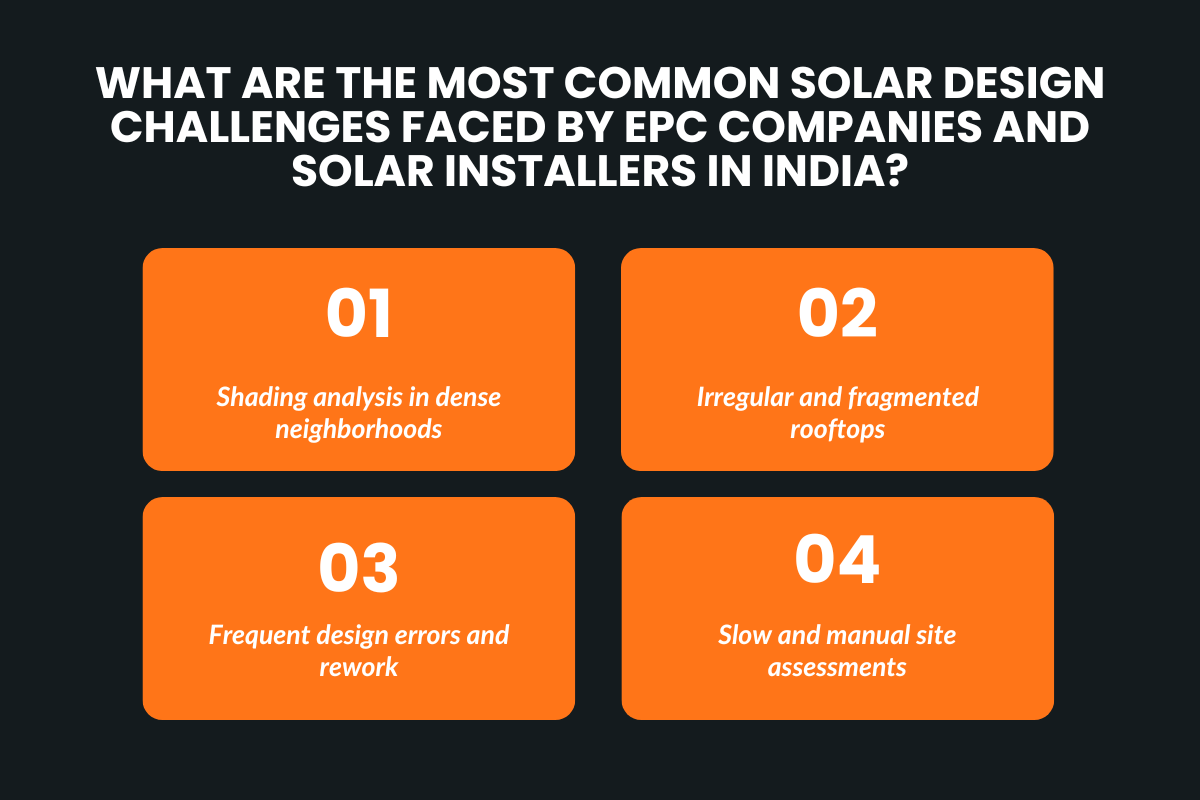
Solar design challenges in India rarely exist in isolation. Small inaccuracies during the design stage often cascade into sales delays, on-site execution issues, and customer dissatisfaction.
As solar businesses scale and handle multiple projects simultaneously, these challenges become more pronounced. This is why many EPC companies eventually move away from manual or fragmented design processes.
1. Shading analysis in dense neighborhoods
Manual shading analysis typically underestimates the impact of shadows on energy generation across seasons.
Designers often overlook nearby obstructions like buildings, trees, or rooftop structures that impact solar output during peak sunlight, causing projected figures to mismatch actual performance.
Modern solar design software uses satellite imagery and elevation data for detailed shadow analysis, enabling realistic shading modeling and more reliable system performance predictions.
2. Irregular and fragmented rooftops
Indian rooftops often include water tanks, staircases, parapet walls, and uneven slabs. Optimizing solar panels across such spaces requires careful layout planning and constant adjustments.
Without automation, designers rely heavily on trial and error. On the other hand, design software automates roof detection and layout creation, enabling faster and more accurate solar design. This allows EPC teams to maximize capacity while maintaining safety and access requirements.
3. Frequent design errors and rework
Errors related to tilt angles, spacing, inverter compatibility, or string voltages often remain hidden until installation begins.
These mistakes force redesigns, material changes, and schedule disruptions. Over time, rework significantly affects project profitability.
Advanced design software calculates string voltages and checks inverter limits during the design stage. This minimizes execution-stage surprises and improves system reliability.
4. Slow and manual site assessments
Physical site visits during pre-sales slow the solar sales process as sales teams wait for engineering inputs, reducing deal velocity and limiting customer engagement.
Remote site assessment tools enable designers to support sales faster, improving lead qualification and shortening sales cycles.
How Does Solar Design Software India Address These Challenges More Effectively?
Solar design software in India has evolved into a comprehensive support system rather than a standalone design tool.
These platforms integrate automation, localized data, and visualization to support solar professionals across departments.
Some modern solar design software platforms are so user-friendly that they require no training, enabling rapid adoption by new users.
Instead of slowing teams down, software removes friction from repetitive tasks. This shift has transformed how EPC companies manage projects.
1. Advanced shading and shadow analysis
High-resolution satellite imagery and 3D modeling enable accurate rooftop visualization. Designers can assess shading patterns across different times of the day and seasons.
This leads to realistic generation estimates that reflect actual site conditions and improve trust during customer discussions.
2. Smart roof detection and auto-layout
AI-driven modeling automatically identifies roof boundaries and obstructions. Solar panels are placed intelligently without violating spacing or safety rules.
Designers spend less time manually adjusting layouts, enabling EPC companies to handle higher project volumes more efficiently.
3. Accurate energy yield and financial analysis
Solar design software uses localized irradiance and weather data relevant to Indian regions. Financial analysis reflects realistic generation and consumption patterns rather than idealized assumptions. This improves transparency during sales conversations and supports informed decision-making.
4. Faster design-to-proposal workflows
Designs, energy calculations, and solar proposals are generated quickly within a single platform. Sales teams no longer wait days for engineering support. This responsiveness improves customer experience and deal momentum, especially in competitive markets.
How Does Solar Design Software Help Solar Businesses in India Scale?
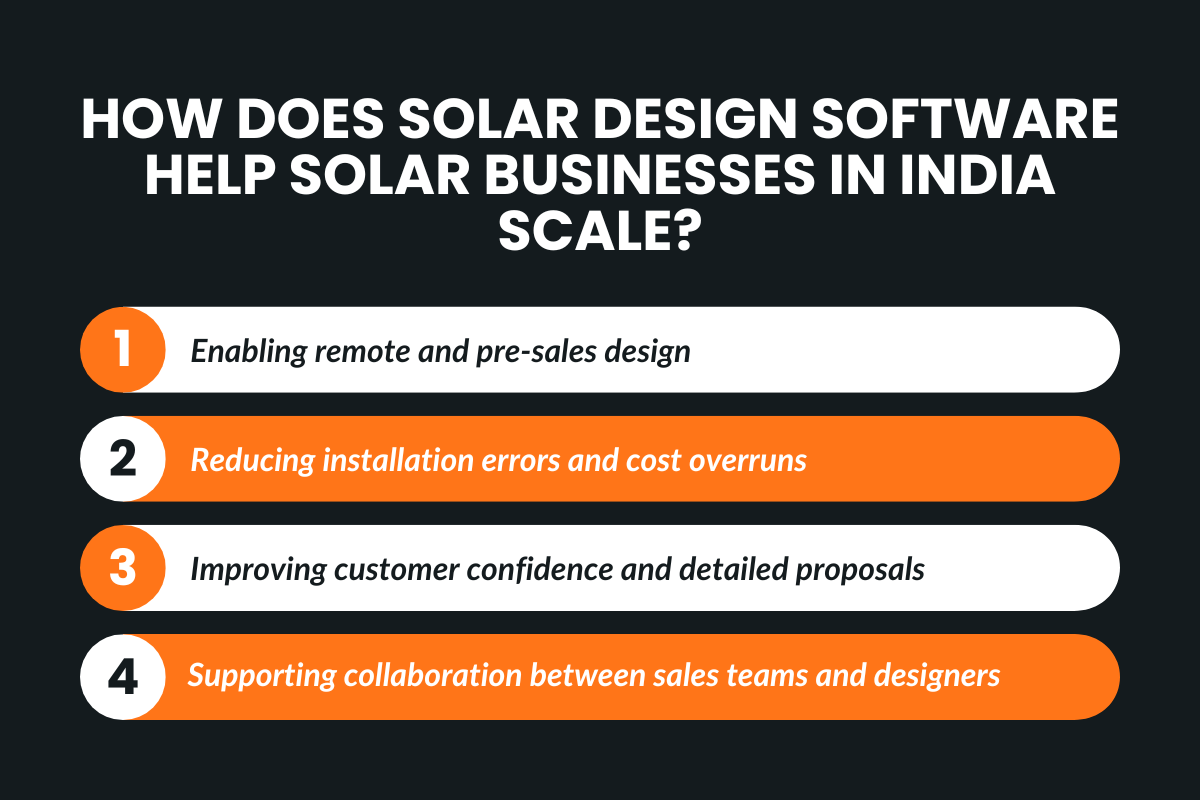
Scaling a solar business in India requires balancing speed with accuracy. Solar design software enables standardization while allowing flexibility for unique site conditions.
This combination is critical as competition increases. For solar professionals, software becomes a long-term growth enabler.
1. Enabling remote and pre-sales design
Remote solar design reduces dependence on early site visits. Sales teams can present preliminary layouts and generation estimates during initial conversations. This increases daily lead-handling capacity. Residential and commercial projects benefit significantly from this efficiency.
2. Reducing installation errors and cost overruns
Accurate layouts and compatibility checks reduce changes at execution time. Installers face fewer surprises related to spacing, wiring, or inverter limits. This leads to smoother installations. Predictable execution timelines help EPC companies better manage costs and resources.
3. Improving customer confidence and detailed proposals
Visual layouts, shading analysis, and clear financial analysis help customers understand system performance.
Detailed proposals stand out in competitive markets where buyers compare multiple vendors. A professional presentation builds trust.
4. Supporting collaboration between sales teams and designers
When sales teams and designers work on the same platform, miscommunication is reduced. Design updates are reflected immediately in proposals and customer conversations.
This alignment improves efficiency across the solar business. Unified workflows help EPC companies scale without operational chaos.
How Does Solar Design Software Improve Accuracy and Compliance for Indian Solar Systems?
In India, solar installations must meet strict electrical, structural, and grid interconnection standards that often vary from state to state. When designs are created manually or validated through disconnected spreadsheets, the risk of small oversights increases, and those small mistakes can turn into costly revisions later.
Solar design software brings structure to this process as potential issues are flagged before proposals are finalized or installations begin, reducing the need for on-site corrections.
Automated compliance checks also ensure that system configurations align with technical and safety requirements, including load calculations and grid constraints. As project sizes grow and regulatory scrutiny becomes stricter, this built-in validation becomes even more valuable.
How Solar Design Software India Is Changing the Way Solar Systems Are Designed?
As solar projects grow in scale and complexity, traditional design methods are no longer sufficient.
Solar design software solutions in India are reshaping how solar professionals approach system planning, layout, and execution.
Instead of relying on fragmented tools, teams now use purpose-built design software that aligns with real rooftop conditions and project requirements.
1. From Manual Design to Purpose-Built Design Software
Earlier, solar design relied heavily on generic design tools and manual calculations. But now, modern solar design software automates critical steps such as layout creation, shading assessment, and system validation, reducing dependency on individual expertise.
2. Better Alignment Between Solar Design and Solar Proposals
Accurate solar design directly improves the quality of solar proposals. When layouts, generation estimates, and system details come from the same design tool, sales teams can present clearer, more reliable proposals to customers.
3. Supporting Solar Installers and Sales Teams at Scale
By standardizing workflows, solar design software helps solar installers and sales teams collaborate more effectively.
This consistency allows solar businesses to manage higher project volumes without compromising accuracy or efficiency.
What Key Features Should You Look for in Solar Design Software in India?
Selecting the right solar design software directly impacts long-term operational efficiency. Not all design tools are suited to Indian rooftops, regulations, and grid conditions, which makes feature evaluation critical for EPC companies.
Key capabilities to look for include:
- India-optimized roof and terrain modeling: Accurately handles elevation changes, fragmented rooftops, and complex layouts to reduce design-to-installation gaps.
- High-accuracy shading analysis: Identifies obstructions and seasonal shadow impact to improve generation accuracy, especially in dense urban environments.
- Local weather, grid, and financing considerations: Uses regional irradiance data and integrates grid rules and financing options to deliver realistic projections customers can trust.
How Does Solar Design Software Strengthen the End-to-End Solar Sales Process in India?
Solar design software plays a key role in aligning sales conversations with technical reality. It allows sales teams to present accurate layouts, shading analysis, and generation estimates early in the sales process.
Advanced proposal software helps sales teams sell more effectively by enabling quicker, more persuasive presentations that increase the likelihood of closing deals.
This reduces dependency on assumptions and minimizes back-and-forth between sales and design teams. When customers see realistic designs tailored to their rooftop, trust builds faster.
As a result, deal cycles shorten and execution starts with clearer expectations.
Beyond the initial proposal stage, the same validated design data supports engineering approvals, compliance documentation, and installation planning. This continuity ensures that what was sold aligns with what gets installed.
By connecting early-stage design, proposal accuracy, internal coordination, and execution readiness, solar design software strengthens the entire end-to-end solar sales process in India rather than just improving presentation speed.
Why Does the Software Work So Well with Sunbase?
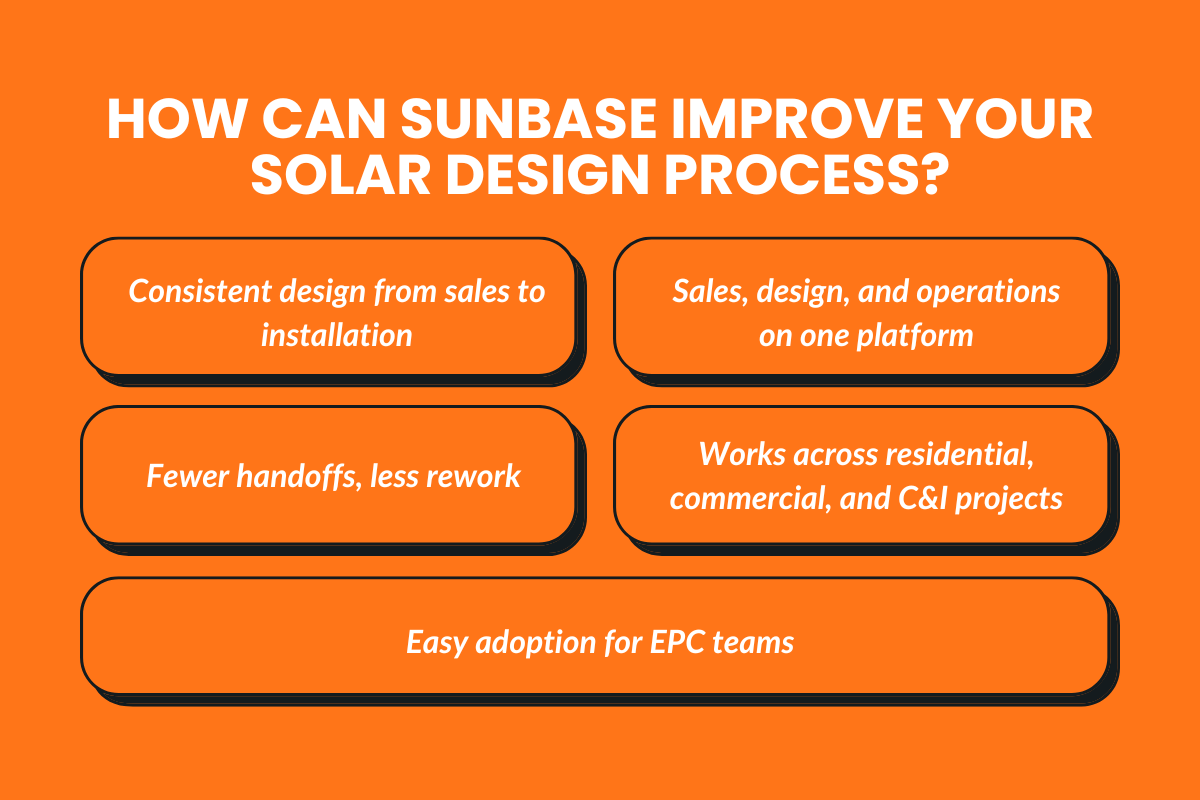
Sunbase aligns with Indian EPC operations by integrating solar design with sales, planning, and execution, reducing team friction and ensuring consistent project info throughout the lifecycle.
As the industry matures, platforms that combine solar design, CRM, proposal creation, and execution workflows are increasingly becoming the standard for scalable EPC operations in India.
Why the combination works in practice:
- Design intent stays consistent from sales to installation
- Sales, design, and operations work on a single platform
- Fewer handoffs reduce errors and rework
- Supports residential, commercial, and C&I projects seamlessly
- Easy adoption aligned with Indian EPC workflows
Future of Solar Design in India
India’s solar market is no longer in its early adoption phase. As installations scale across residential, commercial, and C&I segments, solar design is shifting from basic layout planning to intelligent system optimization. The future of solar design in India will be defined by automation, data intelligence, and grid-aware engineering.
Here’s what that future looks like:
1. AI-Driven Layout Optimization
Design tools are moving beyond manual panel placement toward AI-assisted modeling. Instead of simply fitting panels where space allows, advanced platforms optimize:
- Module orientation for maximum annual yield
- String sizing based on inverter voltage windows
- DC/AC ratio tuning for regional irradiance profiles
- Obstruction-aware layout placement
2. Advanced 3D Modeling and LiDAR Integration
Urban rooftops in India are becoming more complex due to vertical expansion, shared terraces, and mixed-use buildings.
Future-ready design tools will increasingly integrate:
- LiDAR-based elevation modeling
- High-resolution 3D roof mapping
- Precise obstruction and shadow simulations
- Seasonal sun-path modeling
3. Battery and Hybrid System Integration
As net metering caps tighten and grid export rules evolve across states, battery storage and hybrid systems will become central to solar design.
Future solar design software will need to support:
- Load profiling and consumption-based system sizing
- Battery backup calculations
- Time-of-day energy optimization
- Grid-export limitation modeling
Design will no longer focus only on generation; it will optimize energy usage and storage behavior.
In a Nutshell
Solar design in India involves more than just installing panels; it requires innovative tools due to irregular rooftops, shading, regulations, and customer expectations.
Solar design software enhances accuracy, speeds proposals, and aligns teams. For EPCs and solar pros, the right software converts complexity into advantage.
As the market expands, investing in robust workflows helps businesses grow faster with consistent, predictable outcomes.
Why Sunbase?
Sunbase is designed for solar businesses aiming to scale while maintaining accuracy. It unifies design, sales, and execution in one platform, reducing manual work and disconnects.
By keeping teams aligned and workflows consistent, Sunbase supports sustainable growth for solar businesses operating in competitive Indian markets.
Want to see how this flow works on real projects? A quick walkthrough makes it clear.
FAQs
1. Why is solar design software critical for solar businesses in India?
Solar design software is critical because Indian rooftops, shading conditions, and grid rules vary widely. Software ensures accurate solar design, reliable financial analysis, and smoother coordination between sales teams, designers, and installers across projects.
2. Can solar design software reduce site visits for EPC companies?
Yes, modern solar design software enables remote site analysis using satellite data and shading analysis. This reduces early-stage site visits, speeds up the solar sales process, and allows EPC companies to qualify more customers efficiently.
3. How does shading analysis improve solar system performance?
Shading analysis identifies how shadows affect energy generation throughout the year. This helps designers optimize solar panel placement, avoid underperforming areas, and deliver generation estimates that align closely with real-world performance.
4. Is solar design software suitable for small solar installers?
Solar design software benefits small solar installers by improving productivity, reducing errors, and enabling professional layouts and detailed proposals. It allows smaller teams to compete effectively without increasing operational complexity.
5. How does Sunbase support the complete solar business workflow?
Sunbase integrates solar design, CRM, proposal creation, and project tracking into one platform. This unified system helps solar professionals manage sales, design, installations, and scaling efficiently while maintaining accuracy and control.
One Platform.
Zero Chaos.
Run Your Entire Business in One Platform
Sunbase replaces your CRM, proposals, scheduling, job tracking, and reporting tools — all inside one clean, connected platform.
About Sunbase
The All-In-One Platform to Run Your Entire Business
Sunbase helps you organize operations, streamline daily workflows, and manage everything - from first customer contact to final project deliver- in one connected system.
Our Mission
- Organize your business.
- Optimize your workflow.
- Automate your dailytasks
Why Businesses Choose Sunbase
One Connected Workflow
Replace scattered tools and manual processes with a single platform that brings together your team, tasks, customers, jobs, and performance data.
🌎 Global Presence
Serving the United States, Canada, India, LATAM, Australia, and 10+ international markets.
👥 11,000+ Users
Trusted by contractors, installers, project managers, sales teams, and field technicians.
🏗️ Built for All Sizes
From small contracting teams to fast-growing enterprises, Sunbase adapts to your workflow.
Stop Managing Your Business Manually. Automate It.
Sunbase automates workflows, reduces mistakes, and helps your team get more done - without hiring extra staff or juggling multiple tools.
Still Managing Your Business Across Multiple Tools?
Bring your CRM, proposals, projects, and operations into one platform built for contractors.

