
As solar demand accelerates, growth creates a new kind of pressure. In high-volume solar sales environments, the real challenge is managing it without losing control. This is where advanced solar CRM workflows change the equation.
Solar CRM software solves the problem of missed leads, slow follow-ups, and fragmented sales workflows by bringing structure and speed to the entire sales process, from first inquiry to signed contract.
Built for the realities of modern solar companies, it aligns lead management, proposals, and project visibility into one system that helps teams close faster.
Therefore, the blog explores how advanced solar CRM workflows help solar businesses scale sales operations, reduce revenue leakage, and win more deals in a competitive solar industry.
Scalable Solar CRM Software Workflows for Modern Solar Sales
A solar CRM system is designed to support the full sales process in high-volume solar sales and is built specifically for the solar industry.
Generic customer relationship management tools lack solar-specific workflows, forcing teams to rely on disconnected project management tools and manual customer communication.
In simple terms, CRM for solar companies is purpose-built to handle the complexity of solar workflows. In contrast, generic CRM for solar use cases requires heavy customization and still lacks the depth needed to scale efficiently.
Key Takeaways
- Solar CRM software centralizes lead flow, proposals, and follow-ups, helping solar companies reduce delays across the sales cycle.
- A strong solar CRM improves lead conversion rates by structuring the sales funnel and eliminating manual data entry.
- Modern CRM software supports better customer relationships by enabling consistent communication and accurate data management.
- Integrated proposal generation, site surveys, and project tracking help solar teams manage solar projects more efficiently.
- Choosing the right solar CRM gives sales teams clearer visibility into new leads, performance, and long-term customer satisfaction.
Ready to put these insights into action?
Schedule a demo to see how solar CRM software simplifies your sales pipeline, automates follow-ups, and keeps your solar projects on track from lead to installation.
Understanding the Problem in High-Volume Solar Sales
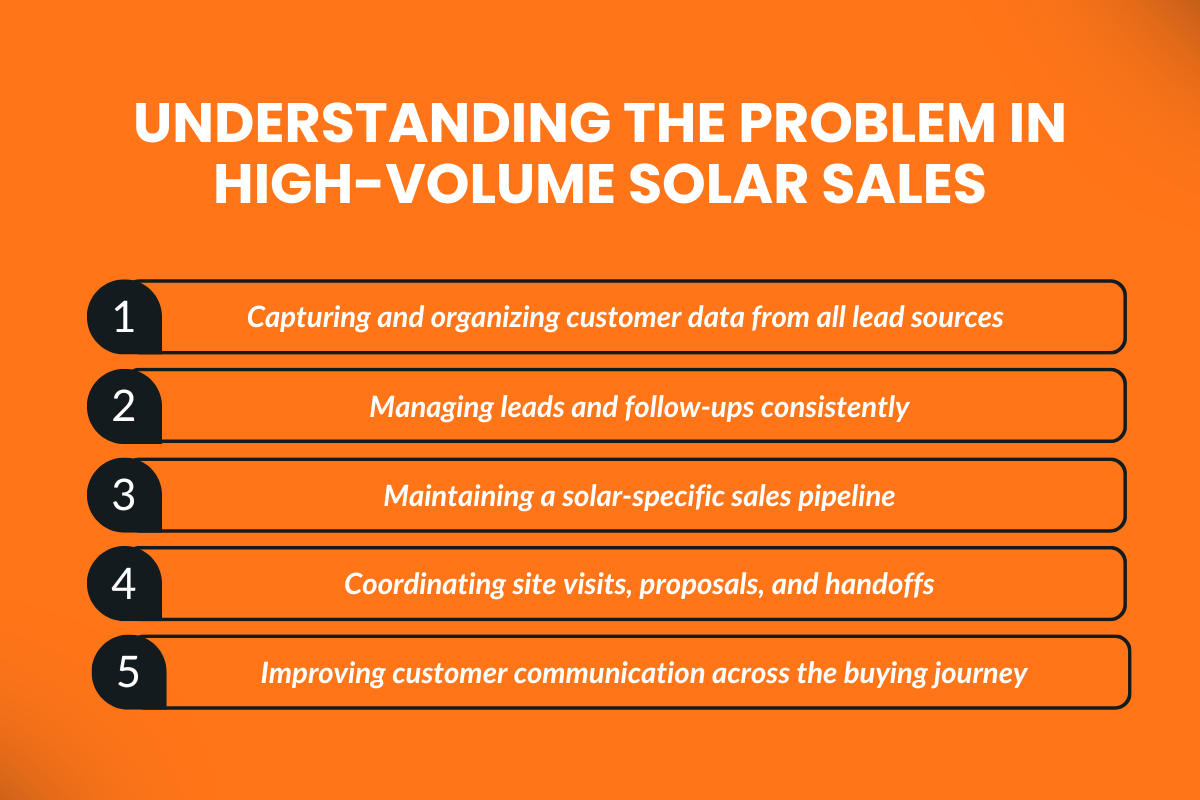
As solar companies scale, managing demand becomes less about lead quantity and more about process control. Without the right systems, increased volume exposes gaps in ownership, follow-up, and visibility, directly affecting revenue.
> What is Solar CRM Software?
Solar CRM software is an operational framework for managing solar sales at scale. To handle these challenges, solar businesses rely on purpose-built systems designed for complex sales cycles.
It enables sales teams to:
- Capture and organize customer data across all lead sources
- Manage structured lead management and consistent follow-ups
- Maintain a clear, solar-specific sales pipeline
- Coordinate site visits, proposals, and handoffs without manual work
- Improve customer communication throughout the buying journey
Unlike generic CRM tools, a solar CRM reflects how deals actually move in the solar industry. This alignment allows solar companies to protect revenue, improve sales performance, and scale without losing control.
> Why Leads Fall Through the Cracks in Solar Sales
As lead volume increases, execution complexity rises. Solar sales teams commonly struggle with:
- Slow response times across channels
- No clear ownership of incoming leads
- Inconsistent follow-up processes
- Poor visibility into deal stages
Without automation and defined workflows, even strong demand turns into lost revenue.
>> Impact of Lead Leakage on Revenue and Growth
Lead leakage reduces close rates, lowers individual sales performance, and weakens forecasting accuracy. Over time, solar businesses spend more on acquisition while converting fewer leads, slowing growth, and limiting scalability.
Automation and Pipeline Discipline as the Foundation of Effective Solar CRM Software
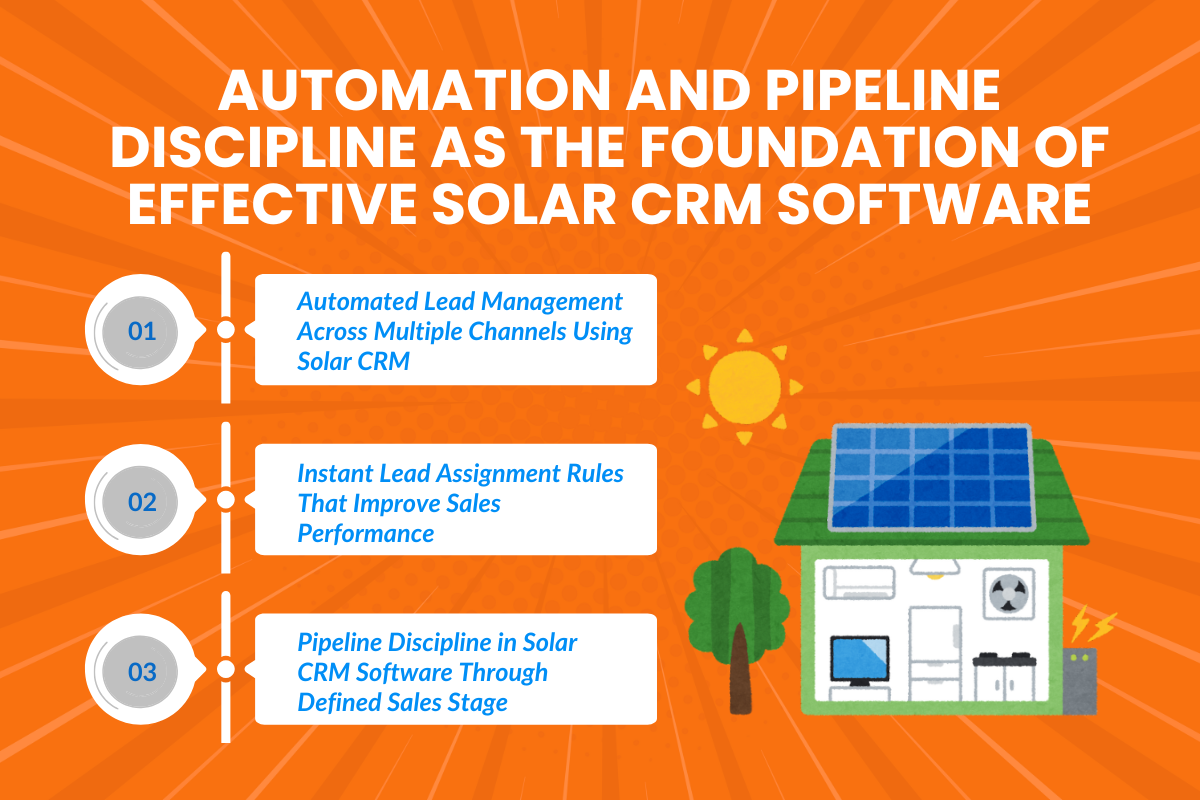
At scale, preventing lead leakage requires automation and consistency. Solar CRM software provides both by replacing manual work with defined workflows that guide sales teams from first contact to installation.
1. Automated Lead Management Across Multiple Channels Using Solar CRM
A modern solar CRM captures and organizes leads from all major acquisition sources into a single system, giving solar companies complete visibility into demand.
Key capabilities include:
- Capturing leads from websites, calls, marketplaces, and marketing campaigns
- Centralizing customer information for faster access and follow-ups
- Automatically tracking leads without manual data entry
- Prioritizing hot leads based on activity and intent
This centralized approach allows solar businesses to manage leads at scale without losing speed or accuracy.
A. Why Multi-Channel Lead Capture Is Critical for Residential Solar Sales
Residential solar generates high lead volume across fragmented channels. Without automation, teams face delays and data loss.
Centralized lead capture helps:
- Eliminate duplicate outreach by multiple sales reps
- Prevent missed enquiries and incomplete records
- Improve coordination across sales teams and solar operations
- Increase response speed in competitive residential markets
2. Instant Lead Assignment Rules That Improve Sales Performance
Speed matters in solar sales. CRM software automatically assigns new leads based on territory, availability, or predefined rules, ensuring every enquiry has clear ownership the moment it enters the system.
This eliminates manual routing, reduces response times, and helps sales teams focus on selling rather than administrative work.
When a specific sales rep owns every lead, accountability improves. No lead sits unclaimed, follow-ups are consistent, and managers gain clearer insight into individual sales performance, directly improving conversion rates and helping teams hit sales goals.
3. Pipeline Discipline in Solar CRM Software Through Defined Sales Stages
A disciplined sales pipeline is the backbone of scalable growth. Solar CRM software standardizes each stage of the sales journey, creating consistency across growing sales teams and locations.
Defined stages help solar companies forecast revenue more accurately, monitor key metrics, and align sales activity with downstream project management.
A typical high-performing pipeline includes:
- New enquiry captured and qualified
- Site surveys scheduled and completed
- Proposal software used to generate pricing structure and designs
- Contract signing and handoff to operations
- Solar installations tracked through project progress and timelines
This structure ensures smooth transitions from sales to execution without data loss or delays.
Automated follow-ups include:
- Email and SMS reminders at each pipeline stage
- Call task reminders for sales reps
- Timed nudges based on customer activity
By automating repetitive tasks, solar businesses save time while maintaining consistent customer communication.
B. Escalation Workflows That Protect Sales Performance
When deals stall, management software steps in. Automated escalation workflows flag inactive opportunities, notify managers, or reassign leads to keep momentum moving.
With built-in reporting tools and data-driven insights, leaders can identify bottlenecks early and protect revenue across sales and project timelines.
Workflow Comparison Between Basic Solar CRM Workflow and Advanced Solar CRM Software
As solar companies scale, manual sales processes create delays, visibility gaps, and inconsistent follow-ups. Disconnected tools make it harder for sales teams to track lead status and maintain momentum.
Solar CRM software closes these gaps through automation and a seamless flow from lead capture to deal closure.
| Area | Basic Solar CRM Workflow | Advanced Solar CRM Workflow |
|---|---|---|
| Lead Capture | Manual imports or simple form integrations; limited source tracking. | Automated multi-channel capture with source attribution and centralized data normalization. |
| Lead Assignment | Manual distribution or simple round-robin logic. | Rule-based routing based on territory, workload, product type, and performance logic. |
| Pipeline Structure | Generic stages with inconsistent definitions. | Clearly defined, solar-specific stages are aligned with qualification, survey, proposal, and installation milestones. |
| Follow-Ups | Task reminders are manually created by sales reps. | Stage-triggered automation with timed reminders, email/SMS sequences, and inactivity alerts. |
| Escalation Handling | Stalled deals are identified manually during reviews. | Automated escalation workflows flag inactivity and notify managers in real time. |
| Data Entry | Repetitive manual updates across CRM and proposal tools. | Centralized updates with activity logging and reduced duplication across systems. |
| Forecasting | Based on rep estimates and rough assumptions. | Weighted forecasting using stage probability and historical conversion data. |
| Sales-to-Operations Handoff | Manual sharing of proposal documents and scope details. | Automated data transfer from signed proposal into project workflows and task generation. |
| Performance Visibility | Basic reporting dashboards with limited funnel insight. | Stage-wise conversion tracking, sales velocity monitoring, and pipeline aging analysis. |
| Scalability | Works at low volume but becomes unstable as the leads increase. | Designed to maintain control and predictability at high lead volumes and across multiple teams. |
Additional CRM Software Capabilities That Strengthen Solar Sales Operations
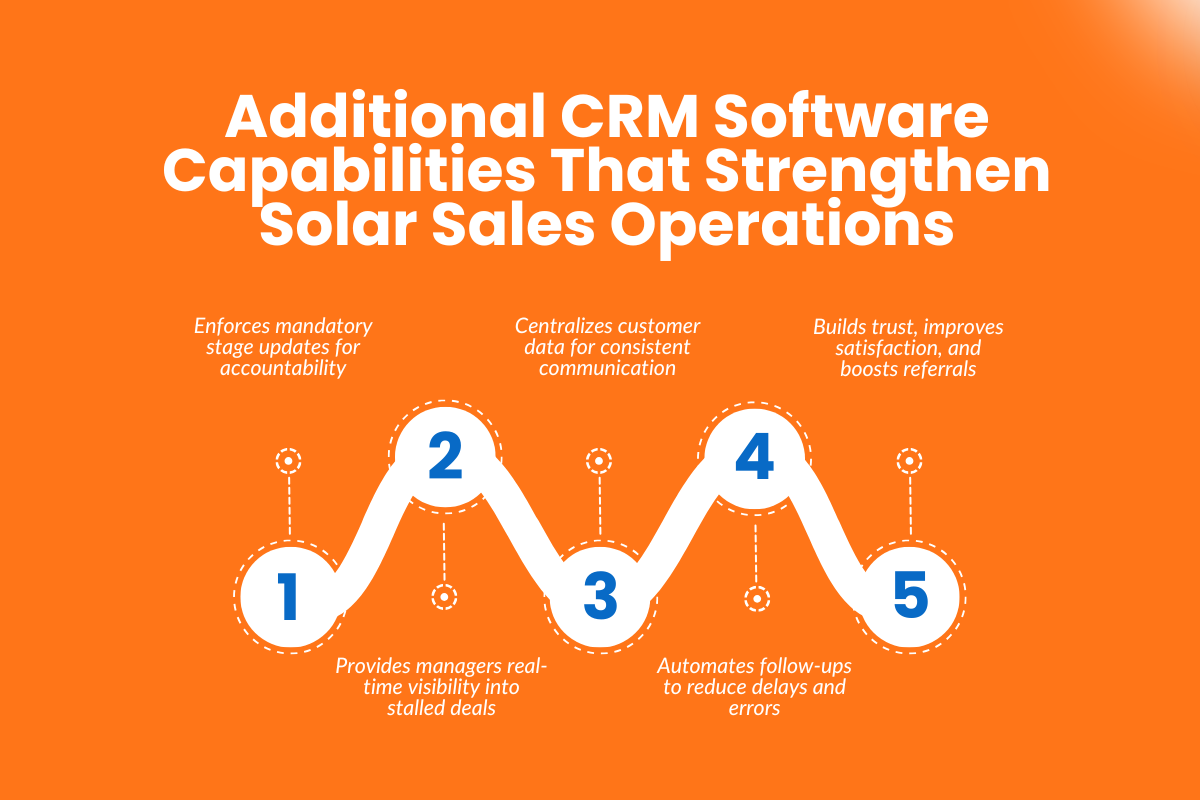
Once core sales workflows are automated, additional CRM capabilities help reinforce consistency and execution. These features improve internal alignment and customer experience without distracting from the primary sales process.
1. Improving Team Accountability with Solar Management Software
As solar sales teams scale, maintaining consistent execution becomes challenging. Solar management software introduces structure through enforced updates and time-based actions, ensuring every opportunity continues to move forward.
- Enforces mandatory stage updates and time-based actions to keep sales teams aligned
- Provides managers with real-time visibility into rep activity, stalled deals, and follow-ups.
2. Enhancing the Customer Experience Across the Residential Solar Journey
Residential solar buyers expect fast responses and clear communication. CRM Software enables consistent customer communication by centralizing customer data and automating responses across every touchpoint.
Faster follow-ups, fewer handoff delays, and accurate information at each stage build trust with buyers. Over time, this consistency improves customer satisfaction and increases the likelihood of referrals and repeat business.
How does Sunbase Support Advanced Solar CRM Software Workflows?
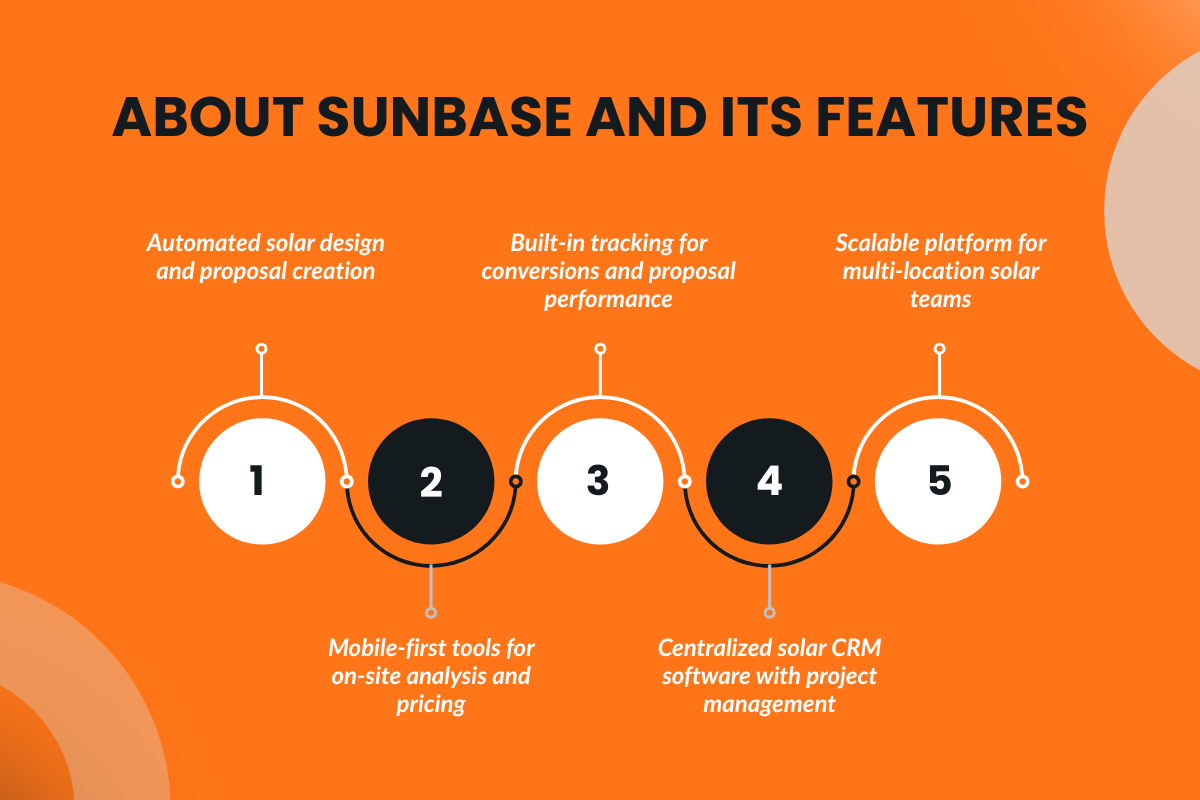
The solar industry is evolving rapidly, and solar businesses need software that can adapt just as quickly. They need more than disconnected tools.
Sunbase is built to support advanced solar CRM software workflows by unifying sales execution, proposal creation, and field coordination into a single operational platform, without adding complexity for growing teams.
1. Solar CRM Software Built for High-Volume Solar Companies
Sunbase is designed for solar companies managing large lead volumes and complex sales cycles. Instead of forcing teams to adapt generic systems, these platforms reflect how solar sales actually operate.
It supports:
- High-volume lead intake and structured lead management
- Defined pipelines that scale across growing sales teams
- Real-time visibility into sales activity and performance
This approach helps solar businesses maintain speed, consistency, and control as demand increases.
2. One Platform for Sales, Proposals, and Operations
Fragmentation slows execution. Sunbase connects sales workflows, proposal software, and field operations to ensure a seamless flow from lead capture to installation.
By unifying:
- Sales activity and customer data
- Proposal creation, pricing, and approvals
- Scheduling, site visits, and field coordination
Solar teams gain clearer handoffs, fewer delays, and better alignment between sales and operations, supporting faster closings and smoother project delivery.
3. Structured Automation Across the Sales Lifecycle
Advanced CRM workflows rely on automation to enforce consistency. Sunbase includes:
- Stage-based automation triggers (e.g., auto-task creation after proposal sent)
- Automated follow-up sequences via email and task reminders
- Inactivity alerts for stalled deals
- Escalation workflows for delayed approvals or pending site visits
This reduces reliance on memory and manual supervision while protecting revenue.
4. Operational Visibility Beyond the Sales Team
Scaling solar companies require leadership-level visibility. Sunbase provides:
- Funnel conversion analytics across each pipeline stage
- Forecasting based on weighted deal stages
- Installation backlog tracking
- Revenue tracking tied to project milestones
This helps management identify bottlenecks early — whether in qualification, proposal turnaround, or field execution.
5. Seamless Sales-to-Installation Handoff
One of the biggest risks in solar sales is data loss during handoff to operations. Sunbase minimizes this risk by:
- Transferring approved proposal data directly into project workflows
- Linking material requirements to signed contracts
- Assigning installation tasks automatically upon deal closure
- Maintaining a single source of truth for both teams
This continuity ensures smoother project execution and reduces post-sale friction.
6. Field-Ready, Mobile-Friendly Workflows
For solar companies with distributed field teams, Sunbase supports:
- On-site status updates
- Survey data capture directly into the system
- Photo uploads and document storage
- Real-time progress tracking accessible to office teams
This reduces communication gaps between sales and field crews.
7. Controlled Growth Without Operational Chaos
Advanced CRM workflows are not just about automation — they are about maintaining control while scaling. Sunbase enables:
- Role-based access controls
- Structured approval hierarchies
- Audit trails for key actions
- Centralized documentation storage
These controls help growing solar businesses expand without losing oversight.
Final Thoughts
Solar CRM software has become essential for high-volume solar sales teams operating at scale. When workflows lack automation, ownership, and visibility, even strong demand results in missed opportunities and revenue leakage.
By enforcing pipeline discipline and connecting sales, proposals, and field operations, solar CRM software gives solar companies the structure needed to move faster and stay aligned.
For modern solar businesses, scalable CRM workflows form the foundation for consistent sales execution and sustainable growth.
Ready to streamline how your solar business operates?
See how Sunbase helps you manage leads, proposals, and field operations in one unified platform, without adding complexity.
Book a demo to see Sunbase in action and start managing your solar sales smarter.
FAQs
1. What are the four types of CRM systems?
The four main types of CRM systems are operational, analytical, collaborative, and strategic. Operational CRM automates sales and customer workflows; analytical CRM delivers insights and reporting; collaborative CRM improves team communication; and strategic CRM focuses on long-term customer relationships.
2. How can I increase my solar sales?
Solar sales increase when response times are fast, follow-ups are consistent, and workflows are structured. Using solar CRM software to automate lead management, standardize the sales pipeline, and connect proposals with field operations helps sales teams close deals more efficiently.
3. What is the best CRM system for sales?
The best CRM system for sales depends on your industry and sales complexity. For solar companies, a dedicated solar CRM system is more effective than generic CRM software because it supports solar-specific workflows, proposal integration, and long sales cycles, helping teams scale without losing control.
4. How is solar CRM software different from a generic CRM?
Unlike generic CRM tools, solar CRM software is built around long solar sales cycles and solar-specific processes, offering structured pipelines, proposal integration, and better visibility into project progress.
5. Can solar CRM software handle high lead volumes?
Yes. Solar CRM software is designed to capture, assign, and track large volumes of leads automatically, helping sales teams respond faster and prevent lead leakage.
One Platform.
Zero Chaos.
Run Your Entire Business in One Platform
Sunbase replaces your CRM, proposals, scheduling, job tracking, and reporting tools — all inside one clean, connected platform.
About Sunbase
The All-In-One Platform to Run Your Entire Business
Sunbase helps you organize operations, streamline daily workflows, and manage everything - from first customer contact to final project deliver- in one connected system.
Our Mission
- Organize your business.
- Optimize your workflow.
- Automate your dailytasks
Why Businesses Choose Sunbase
One Connected Workflow
Replace scattered tools and manual processes with a single platform that brings together your team, tasks, customers, jobs, and performance data.
🌎 Global Presence
Serving the United States, Canada, India, LATAM, Australia, and 10+ international markets.
👥 11,000+ Users
Trusted by contractors, installers, project managers, sales teams, and field technicians.
🏗️ Built for All Sizes
From small contracting teams to fast-growing enterprises, Sunbase adapts to your workflow.
Stop Managing Your Business Manually. Automate It.
Sunbase automates workflows, reduces mistakes, and helps your team get more done - without hiring extra staff or juggling multiple tools.
Still Managing Your Business Across Multiple Tools?
Bring your CRM, proposals, projects, and operations into one platform built for contractors.