
Solar Software for PV Design, Sales and Project Delivery
From Lead to PTO
*Contact us for a quote based on your team size
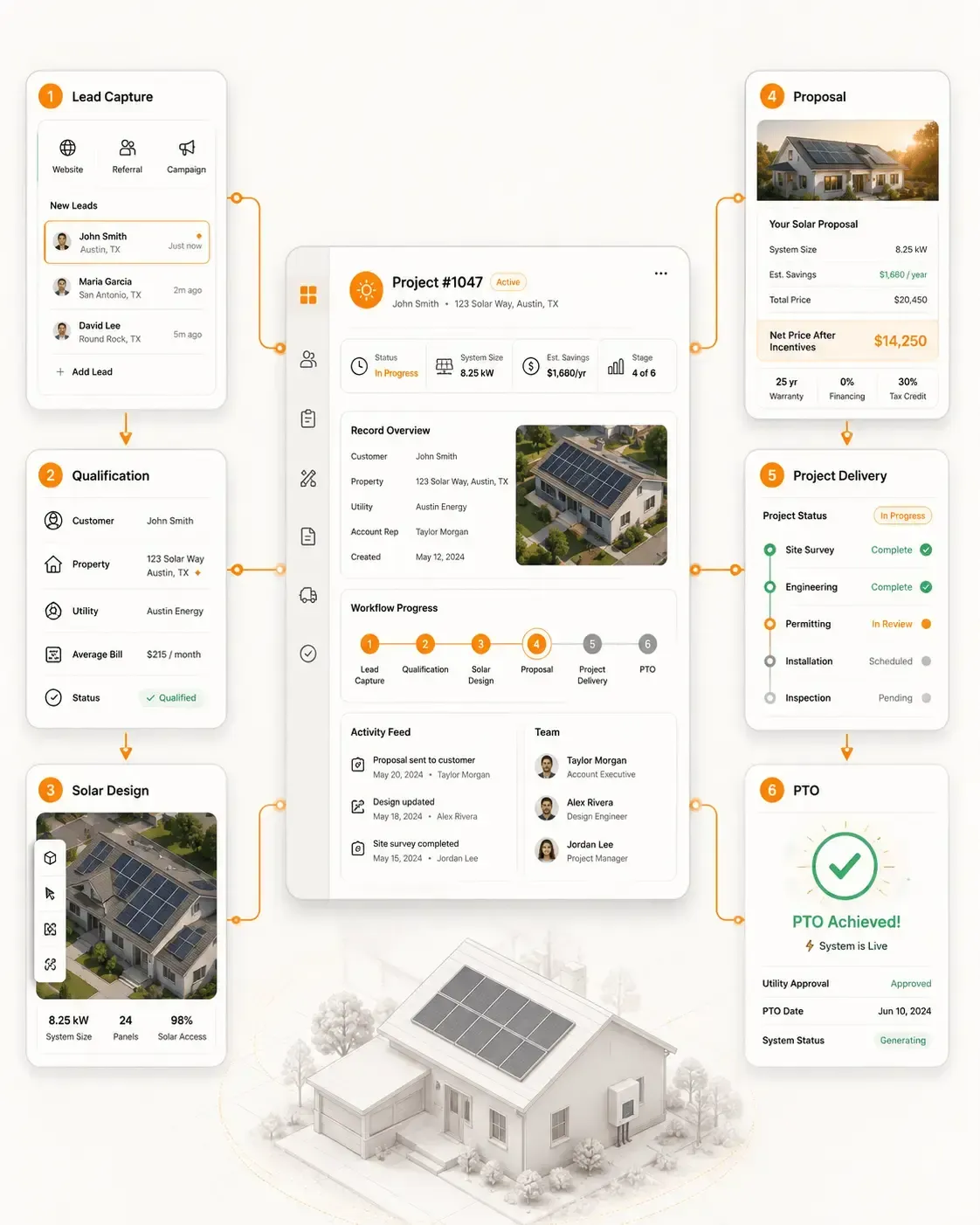
The Platform
WHAT IS SOLAR SOFTWARE?
Solar software is a digital platform that helps solar companies design PV systems, manage customers and sales, create proposals, and coordinate projects from initial site assessment through installation and permission to operate (PTO).
More Than a Single-Purpose Solar Tool
Why Solar Companies Need More Than Separate Design, Sales and Project Tools
Solar projects move through technical, commercial and operational stages that depend on the same customer, site and system information.
When design, CRM, proposals and project delivery are managed separately, teams often have to re-enter data and manually hand projects between systems.
Sunbase Solar Software keeps these workflows connected, including:
- Customer, property and electricity-consumption information.
- PV design, shading and production estimates.
- Leads, appointments and sales opportunities.
- Equipment, pricing and customer proposals.
- Contracts, documents and project handoff.
- Permitting, installation, inspection and PTO tracking.
This creates one connected workflow from site and customer information through PV design, sale and project completion, rather than treating each stage as a separate software process.
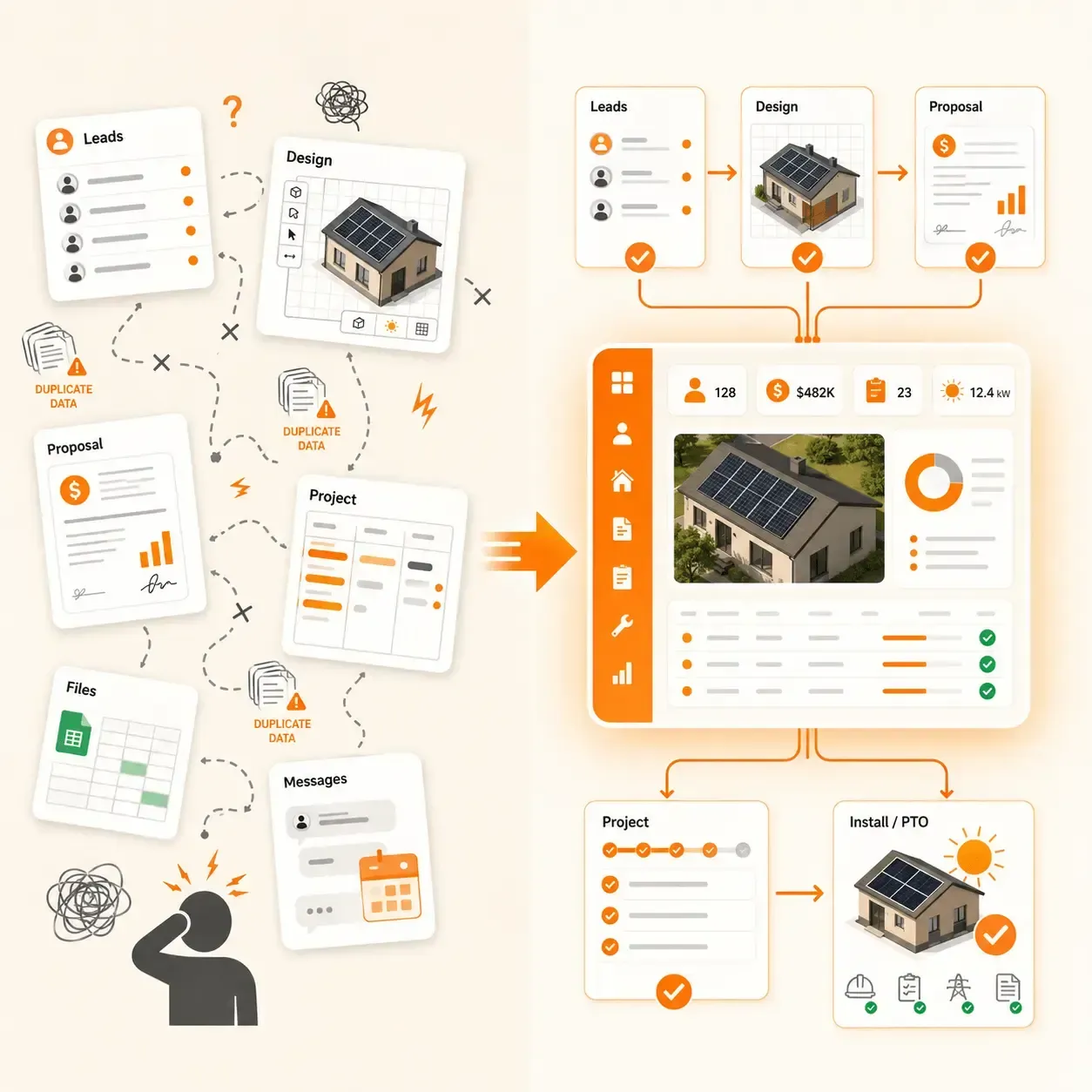
Complete Solar Software Workflow
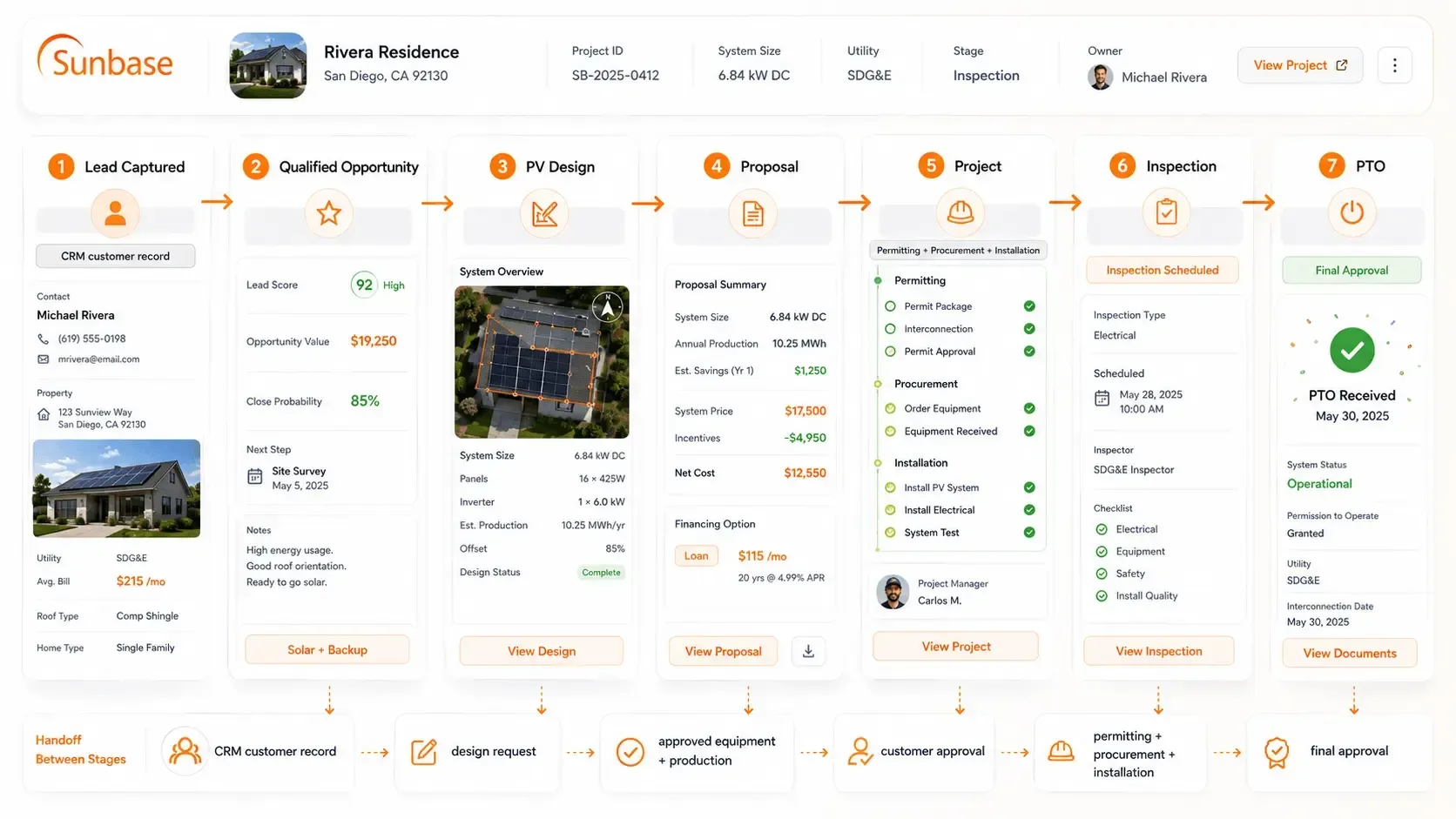
Connect Every Stage From Site Assessment to PTO
Sunbase Solar Software keeps the technical, sales and operational stages of a solar project connected to the same customer and project record.
Explore Sunbase Solar Software Modules
Manage the Core Workflows Behind a Solar Business
Sunbase Solar Software connects specialized tools for sales, system design, proposals and project delivery while keeping each stage tied to the same customer and project record.
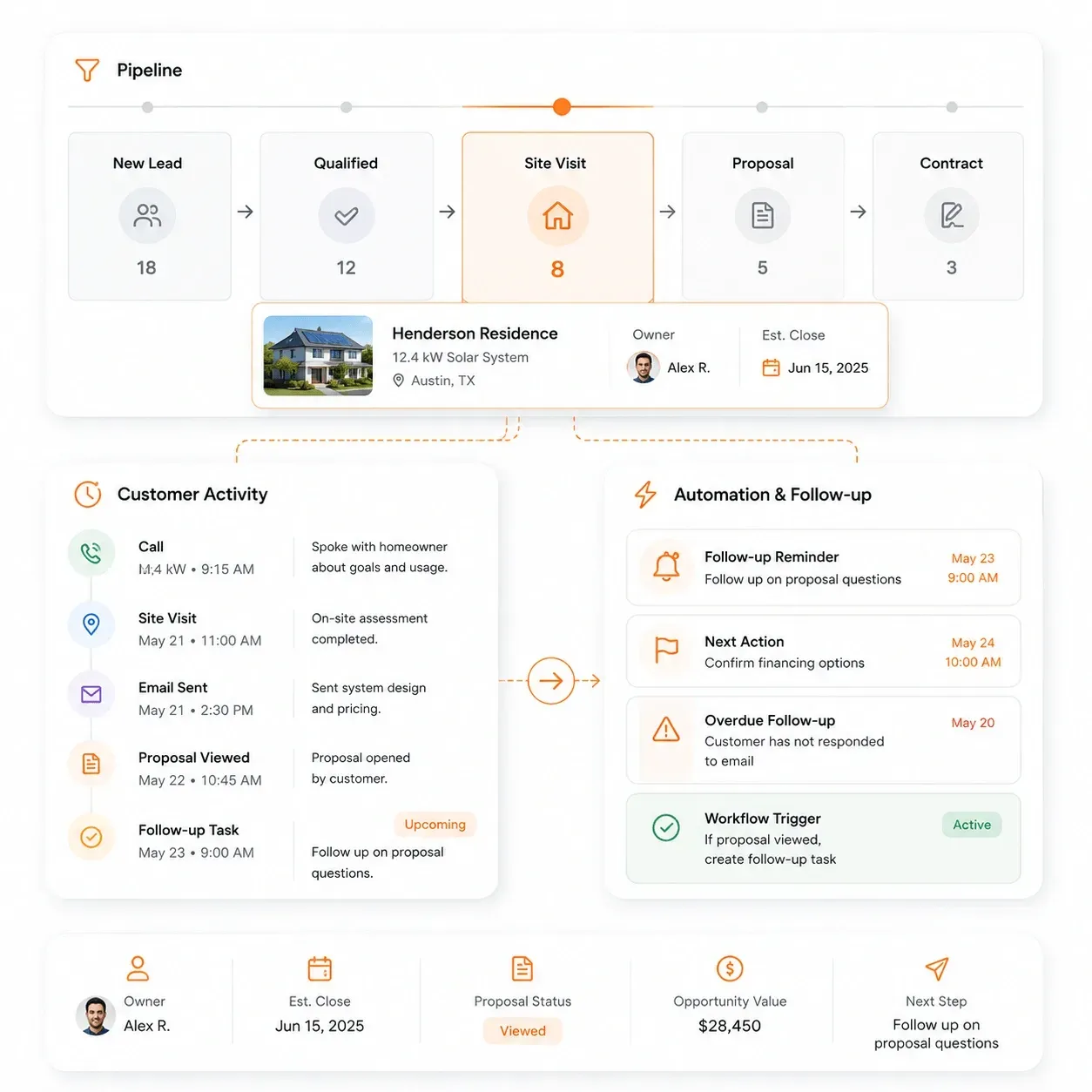
Solar CRM
Manage leads, opportunities, appointments, customer communication and sales activity from initial enquiry through approved sale.
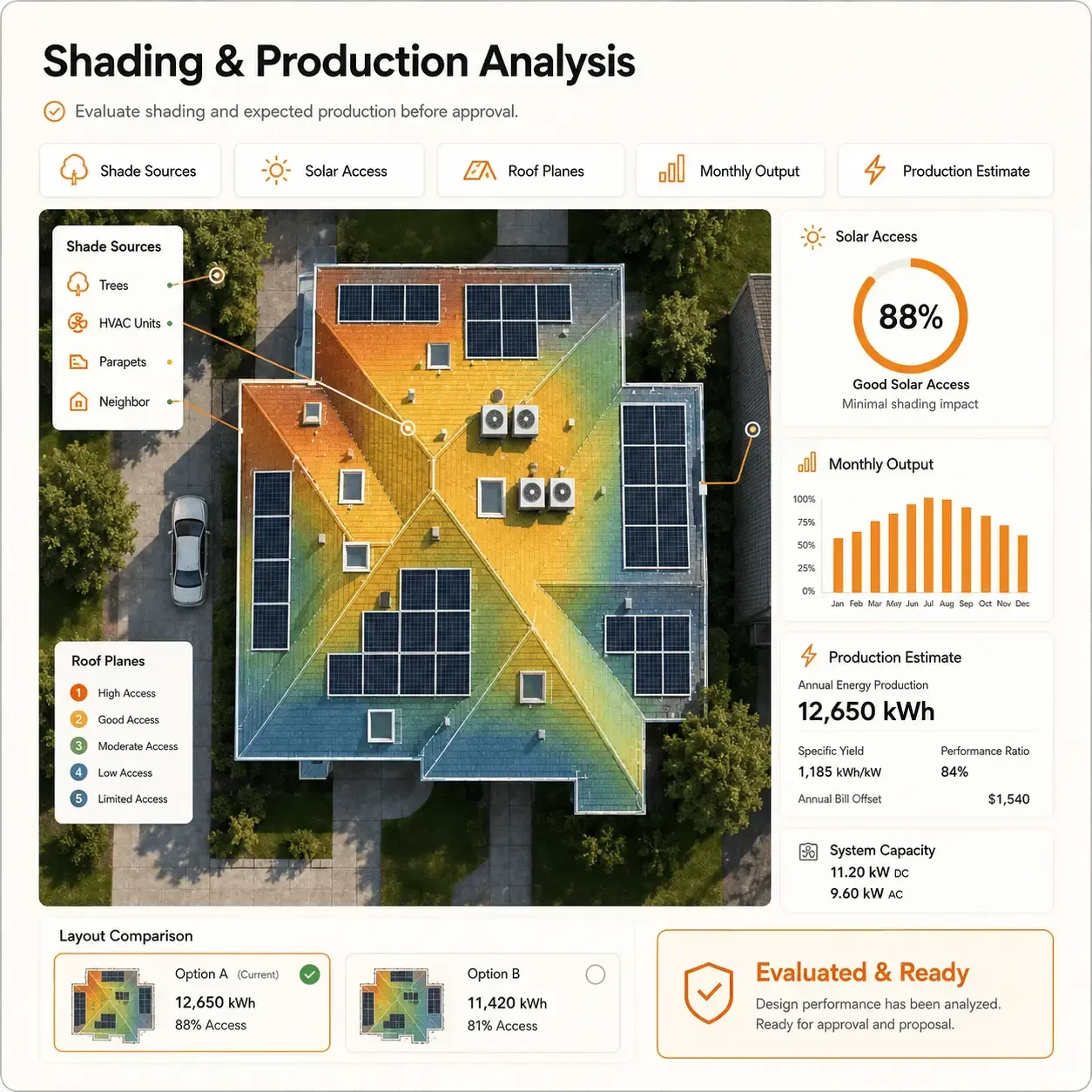
Solar Design
Model rooftops and sites, create PV layouts, assess shading, configure equipment and estimate expected energy production.
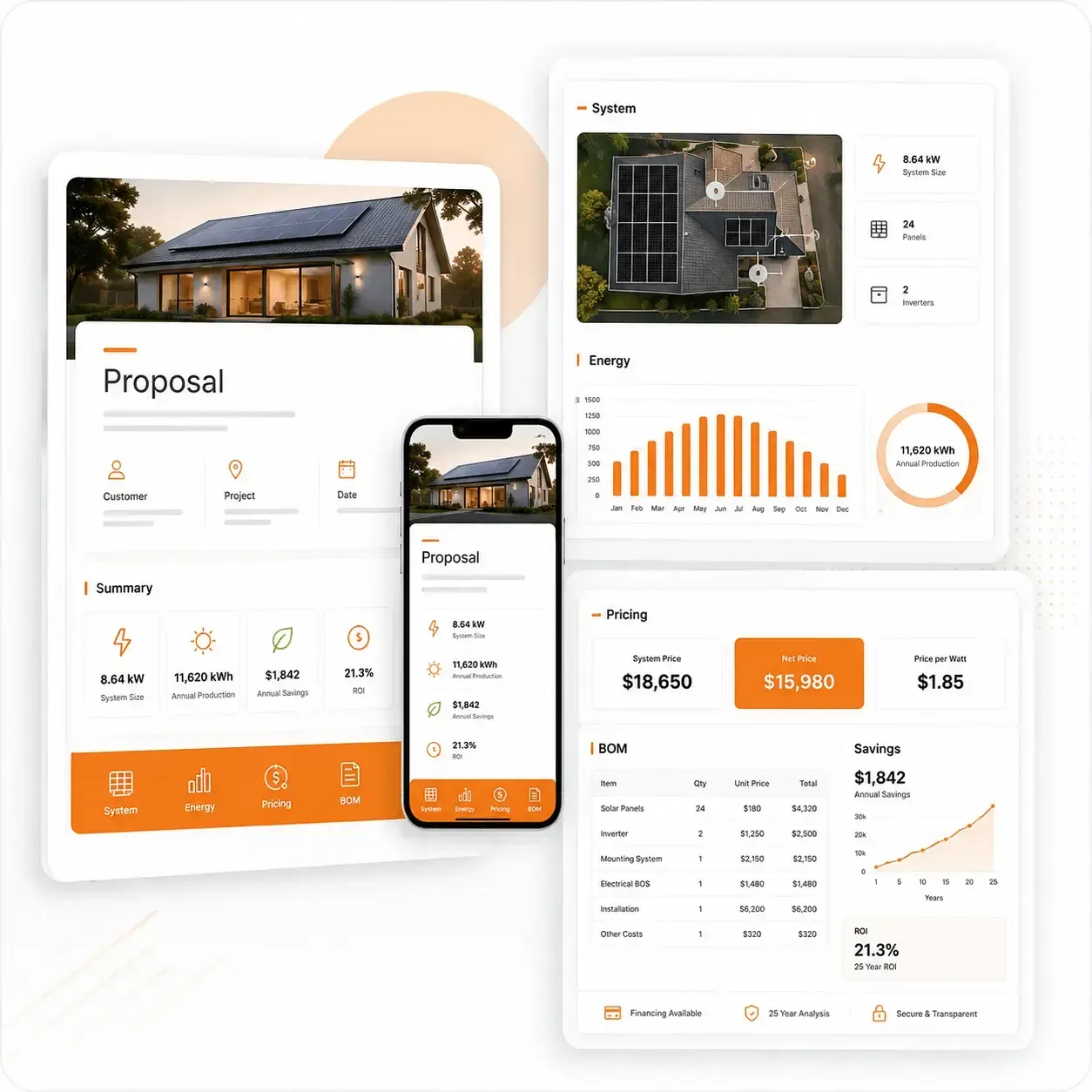
Solar Proposal
Turn approved design, production, equipment and financial information into customer-ready proposals and track approval.
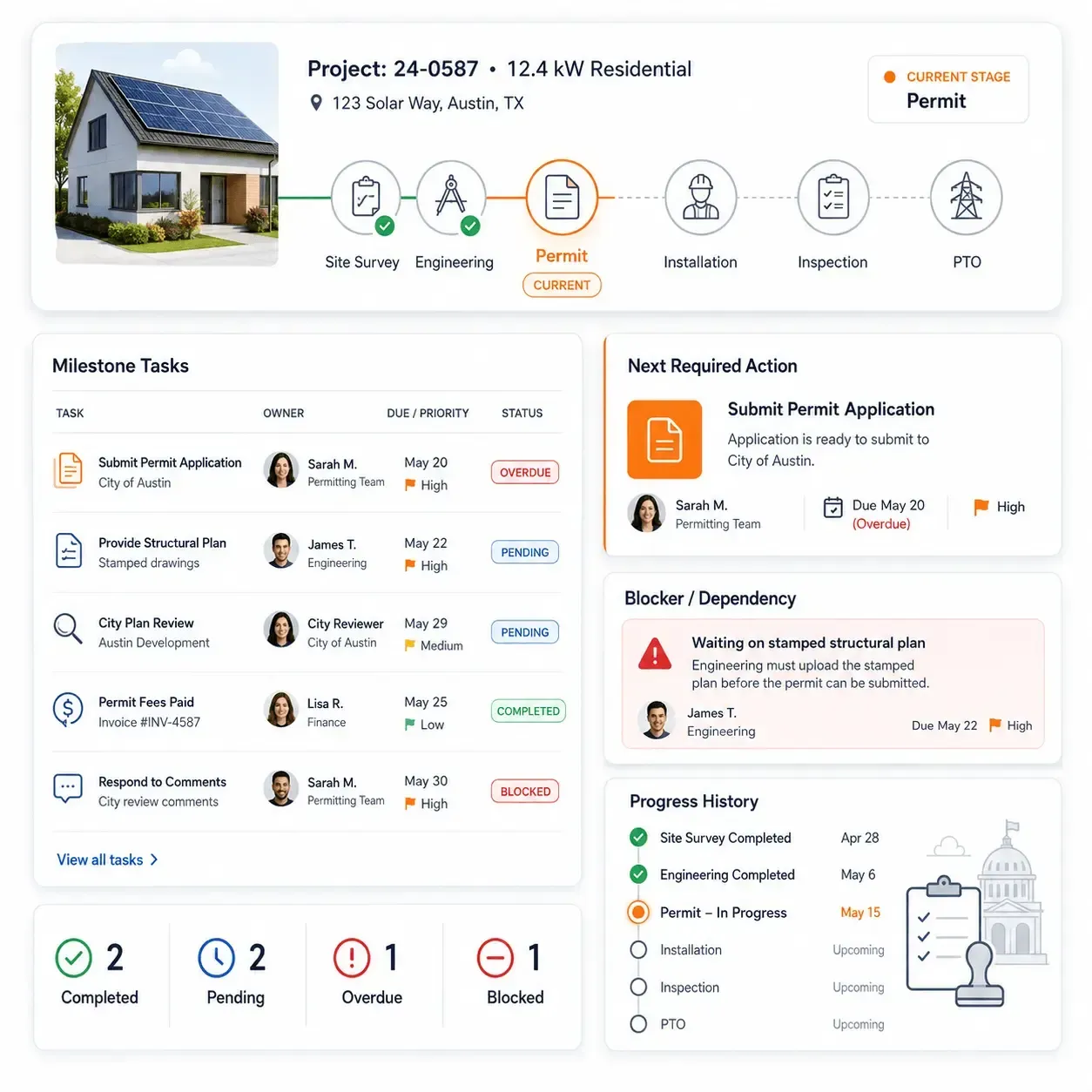
Solar Project Management
Coordinate permitting, equipment, installation, inspections, interconnection and PTO after the sale moves into project delivery.
Real Solar Operations
Keep Customer, Design, Sales and Project Data Connected
Sunbase Solar Software keeps the information created at each stage of the solar workflow connected to the same customer and project record.
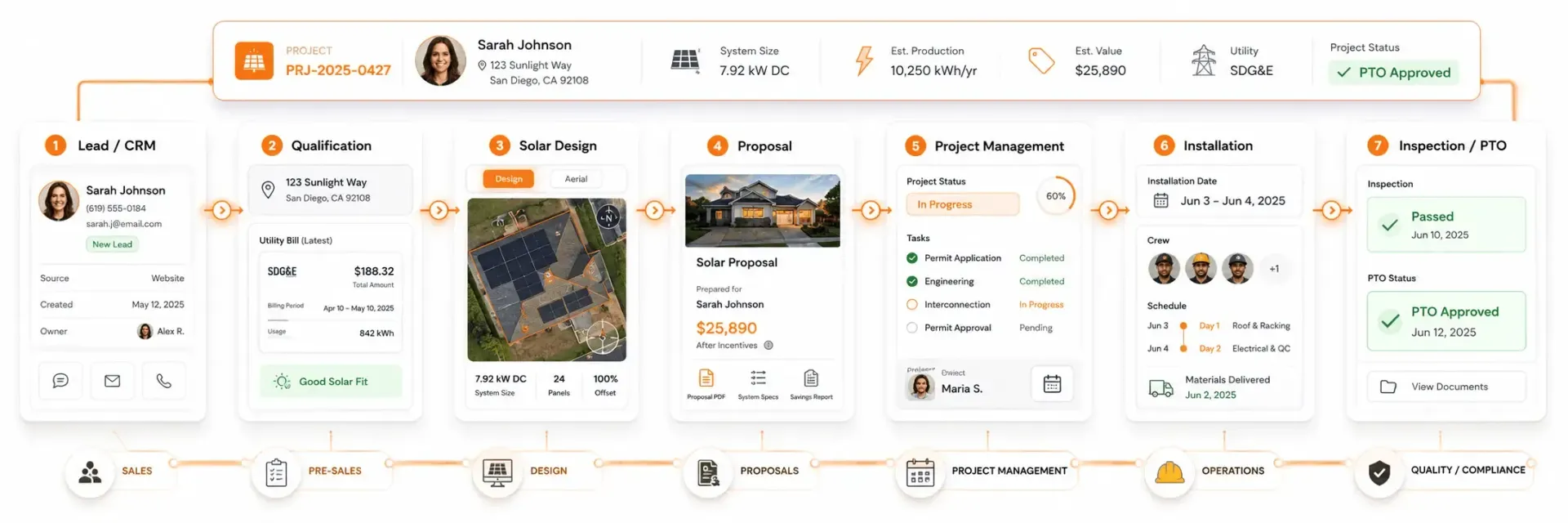
Cross-Team Visibility
Give Every Solar Team the Visibility They Need
Sunbase Solar Software reduces the gaps between departments by keeping
customer data, technical decisions, commercial approvals and project status connected from one stage to the next.
01
Solar Sales Teams
Manage leads, appointments, follow-ups, utility information, proposals and customer communication.
02
Solar Design Teams
Access property details, consumption data, design requests, revisions and approved system information.
03
Solar Project Coordinators
Track surveys, engineering, permits, documents, installation schedules, inspections and PTO.
04
Solar Installation Teams
Review approved designs, equipment requirements, site notes, assigned work and installation checklists.
05
Solar Finance and Operations
Monitor project values, invoices, expenses, commissions and payment-related records.
06
Business Owners and Managers
Review sales performance, project progress, delays, workloads and operational reporting across the company.
Solar Software Integrations
Connect Sunbase With the Tools You Already Use
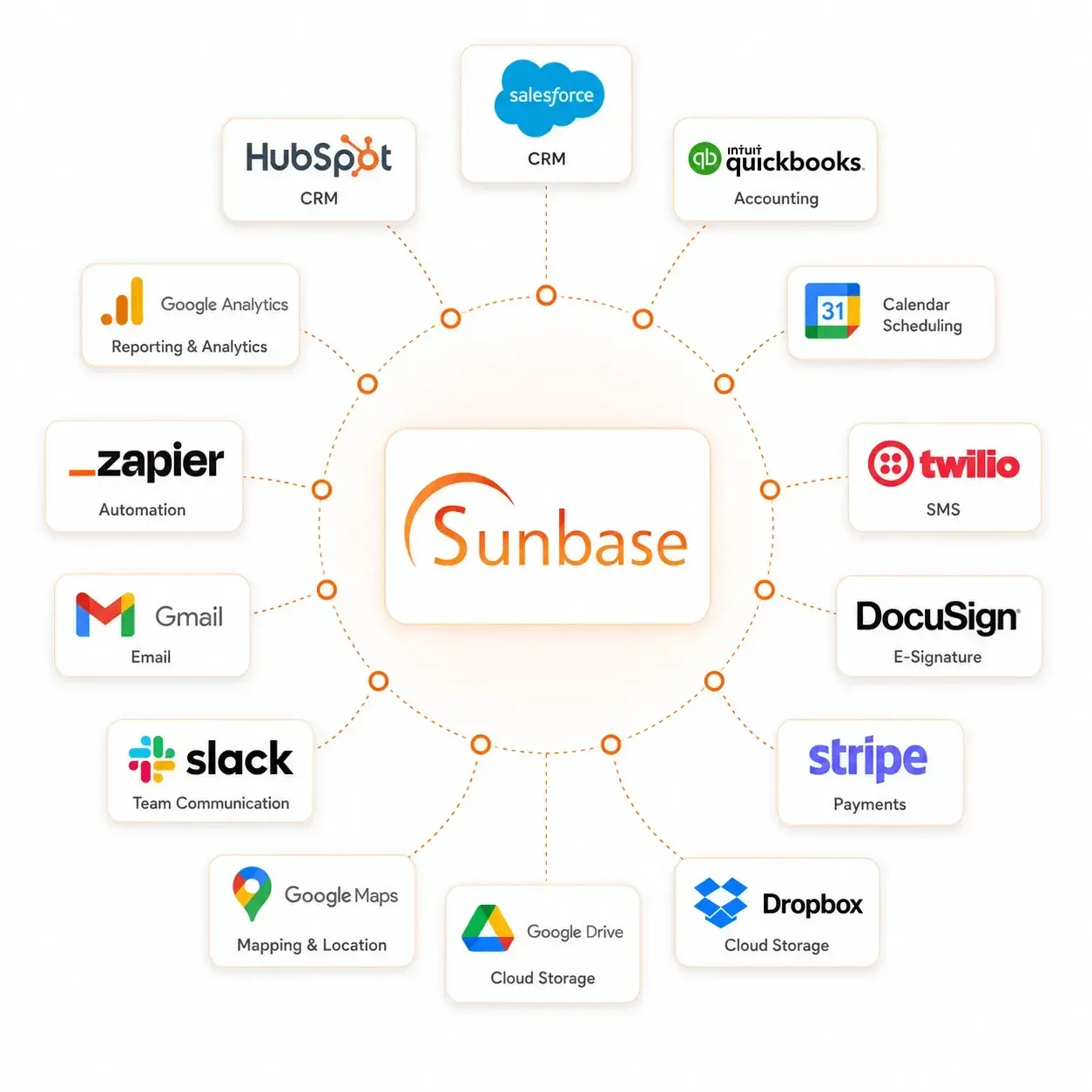
Solar companies use different systems for lead generation, sales, accounting, communication, design, financing and project operations. Sunbase Solar Software can be configured around your existing technology stack so the systems your teams already rely on can remain part of the workflow.
Depending on the platform and available connection method, integrations can be configured through
supported integrations, APIs, webhooks, automation platforms or custom connections.
CRM & Lead Management
Examples: HubSpot, Salesforce, Zoho CRM, Pipedrive, Meta Lead Ads, web forms
Accounting & Payments
Examples: QuickBooks, Xero, Stripe
Email, SMS & Scheduling
Examples: Gmail, Microsoft 365, Twilio, Google Calendar
Documents & E-Signature
Examples: Google Drive, Dropbox, DocuSign
Analytics & Reporting
Examples: GA4, Google Ads, Search Console, Looker Studio, Power BI
Workflow Automation
Examples: Zapier, Make, APIs, webhooks
Solar Design, Equipment & Financing
Examples: Aurora Solar, OpenSolar, Enphase, SolarEdge, GoodLeap, LightReach
Other Business Systems
Already using another platform? Sunbase Solar Software can evaluate the workflow and available connection options to fit it into your existing technology stack.
Built for Different Solar Business Models
Built for Different Solar Business Models
Sunbase Solar Software gives each team access to the customer, project and operational information required for its work.
Residential Solar Installers
Manage homeowner leads, utility bills, designs, proposals, permits, installations, inspections and PTO through one consistent workflow.
Commercial Solar Contractors
Coordinate longer sales cycles, multiple stakeholders, project documents, approvals and installation milestones.
Solar EPC Companies
Manage design requests, procurement requirements, project stages, contractor assignments, documentation and commissioning activities.
Solar Distributor Networks
Allocate leads across dealers, standardise proposal workflows and maintain visibility after projects are handed over to installation partners.
Solar Sales Organisations
Track canvassing territories, representative activity, homeowner interactions, appointments, follow-ups, proposals, contracts and post-sale project progress.
Multi-Location Solar Companies
Standardise sales stages, project workflows, approvals and reporting while maintaining visibility across branches and territories.
Connected Solar Software vs Standalone solar Tools
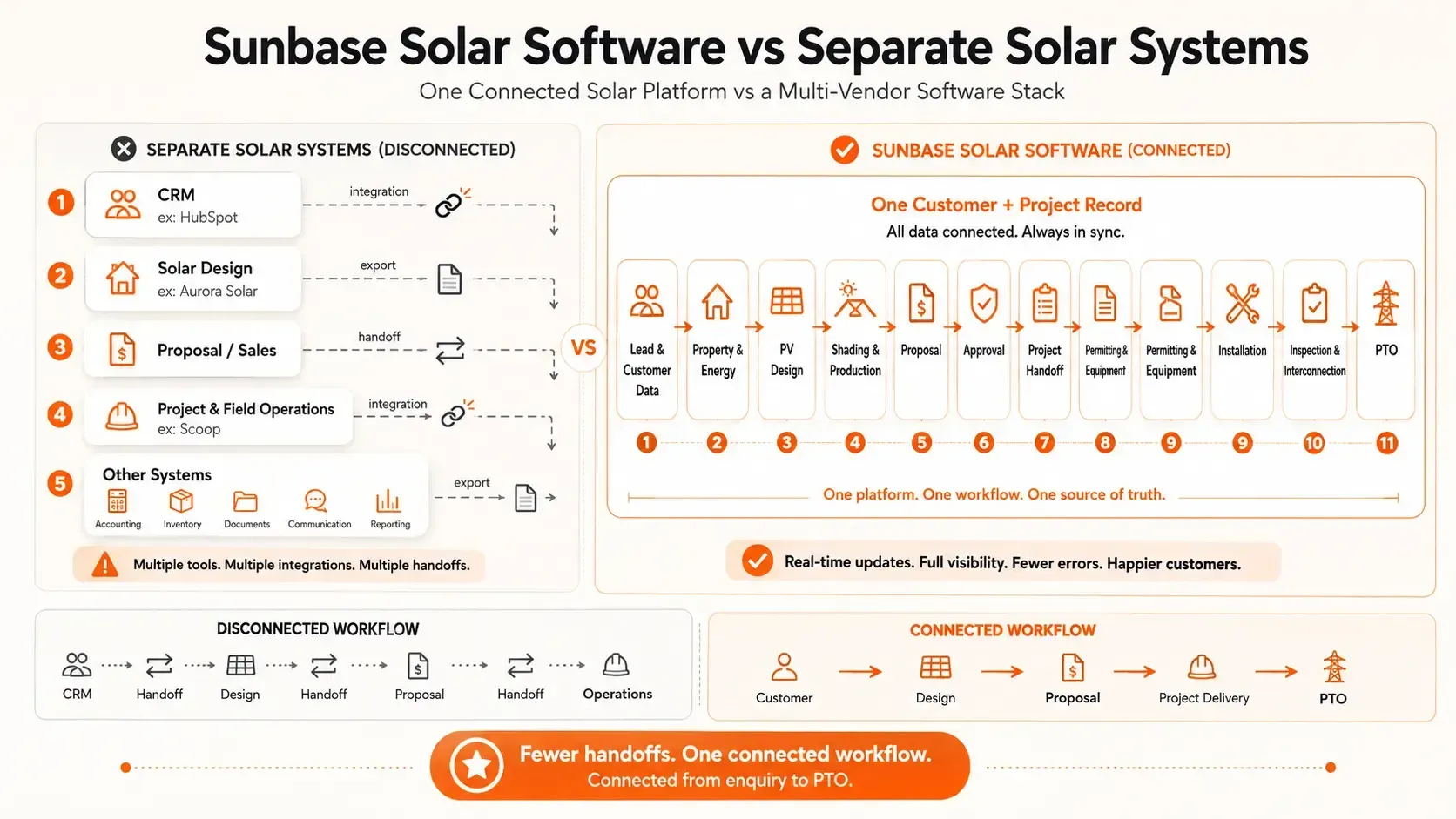
One Solar Workflow Instead of Multiple Disconnected Systems
Solar companies can use specialized tools for each stage, but information often has to be transferred manually when CRM, design, proposals and project management operate independently.
Sunbase Solar Software Pricing
Pricing That Fits the Solar Workflow You Need
Sunbase Solar Software plans start at $59 per user per month.
Sunbase Solar Software pricing can be configured around the number of users, selected modules, workflow requirements and integrations your business needs.
Companies can choose the capabilities required for their operation, including:
- Solar CRM and sales workflows.
- Solar design and production analysis.
- Solar proposal creation.
- Solar project management.
- Solar Marketing & Sales
- Solar Field Sales Management
This allows solar companies to build a connected software setup around their actual workflow rather than paying for a fixed combination of tools they may not use.
Sunbase Solar Software Implementation
Set Up Sunbase Solar Software Around Your Existing Solar Workflow
Sunbase Solar Software implementation begins with understanding how leads and projects currently move through your business.
1. Review the Workflow
Map lead qualification, design requests, proposal approval, project stages, installation and PTO requirements.
2. Configure Sunbase Solar Software
Set up users, permissions, workflows, automations, dashboards and required integrations.
3. Prepare and Migrate Data
Identify the leads, customers, active projects, documents and operational information needed for launch.
4. Train and Launch
Train each team around its responsibilities, launch the agreed workflow and review adoption after implementation.
Solar Software FAQs
Questions About Sunbase Solar Software
Sunbase Solar Software Implementation
What is solar software?
Solar software is a digital platform that helps solar companies design PV systems, manage customers and sales, create proposals, and coordinate projects from initial site assessment through installation and permission to operate (PTO).
What does Sunbase Solar Software do?
Sunbase Solar Software connects the technical, commercial and operational stages of a solar project within one platform. It brings together customer data, PV design, proposals, project delivery, equipment, documents and project status around the same project record.
Is solar software the same as solar design software?
Solar design software focuses primarily on modelling sites, creating PV layouts, analysing shading and estimating production, while solar software can connect design with sales, proposals and project delivery.
Sunbase Solar Software treats PV design as one connected stage within the broader solar workflow.
What workflows can Sunbase Solar Software manage?
Sunbase Solar Software can connect workflows such as:
Lead & Customer Data → Site Information → PV Design → Proposal → Customer Approval → Project Delivery → Installation → Inspection → PTO
The exact stages can be configured around the way the solar company operates.
Can Sunbase Solar Software create PV system designs?
Sunbase Solar Software includes solar design capabilities for modelling installation areas, creating PV layouts, configuring equipment, assessing shading and estimating expected energy production. The approved design remains connected to the customer and project record.
Can Sunbase Solar Software create solar proposals?
Sunbase Solar Software can use approved design, production, equipment and commercial information to prepare customer-ready solar proposals. Proposal revisions and approvals can remain connected to the same project as it moves toward delivery.
Can Sunbase Solar Software manage solar sales?
Sunbase Solar Software can manage customer and sales activity alongside the technical project workflow. Teams can keep leads, opportunities, appointments, communication and project information connected as an opportunity progresses toward design and proposal approval.
Can Sunbase Solar Software manage projects after the sale?
Sunbase Solar Software can continue managing the project after customer approval through permitting, equipment coordination, installation, inspection, interconnection and PTO. This reduces the need to recreate the approved project in a separate project-management system.
What information stays connected in Sunbase Solar Software?
A connected project record can bring together:
- Customer and property information.
- Electricity consumption and site data.
- PV layouts and system capacity.
- Shading and production estimates.
- Modules, inverters, batteries and equipment.
- Proposal and commercial information.
- Documents and project requirements.
- Installation, inspection and PTO status.
How is Sunbase Solar Software different from using separate solar tools?
Separate tools typically divide CRM, design, proposals and project management between different systems, while Sunbase Solar Software connects those stages around one customer and project record. This reduces the number of manual handoffs and repeated data-entry points as the project progresses.
Can Sunbase Solar Software support residential and commercial solar?
Sunbase Solar Software can support residential and commercial solar workflows while allowing project stages, responsibilities and required information to vary by project type. Commercial and EPC workflows can include additional engineering, equipment, approvals and project milestones where required.
Can Sunbase Solar Software support solar EPC companies?
Sunbase Solar Software can connect engineering, procurement and construction-related workflows with customer, design and project information. EPC teams can organize technical work, equipment requirements, milestones, documents and project delivery within a connected project structure.
Can Sunbase Solar Software integrate with other business systems?
Sunbase Solar Software can connect with supported external systems used for areas such as lead generation, communications, accounting, scheduling, documents and other business workflows. Available connection methods depend on the specific system and integration requirements.
Can Sunbase Solar Software be configured around an existing workflow?
Sunbase Solar Software can be configured around the stages, responsibilities, approvals, permissions and automation used by the solar company. This allows different teams, branches and project types to operate within a consistent connected structure without forcing every organization into the same process.
How is Sunbase Solar Software implemented?
Implementation typically begins with reviewing the existing solar workflow, configuring the required modules and processes, preparing data and integrations, testing the setup and training the relevant teams before launch.
How much does Sunbase Solar Software cost?
Sunbase Solar Software pricing depends on the number of users, selected modules, required workflows, configuration and integrations. The final setup can therefore be matched to the parts of the solar workflow the company intends to manage within the platform.
Ready to Run Your Solar Business on
One Platform?
Let's get started with Sunbase Solar Software. No contracts, no complexity — just a platform built for how your team works.
Plans start at $59/user/month · No long-term contracts required · Cancel any time