
Talking to solar business owners reveals common frustrations, such as sales teams, designers, and proposal tools being disconnected, slowing progress despite busy schedules.
In an industry that values speed, accuracy, and trust, these gaps hurt conversions and customer satisfaction. Errors and handoff failures hinder growth.
The main issue is the disjointed tech stack; the lack of integration among CRM, Design, and proposal software makes scaling difficult.
This is why more solar companies are turning to solar business management software that unifies CRM, design, proposals, and operations into one system.
Why Modern Solar Business Software Unifies CRM, Solar Design, and Proposal Software
Solar operations grow complex as markets mature, with expanding lead gen, evolving financing, and customer demands for faster responses. Many companies use disconnected tools, causing manual entries, mismatched data, and delays.
Modern solar software integrates CRM, Design, and proposals into a single platform, enabling teams to manage projects, customer interactions, and progress efficiently, and support growth without chaos.
When these tools work together, they function as a sales enablement platform, giving sales teams instant access to designs, pricing, contracts, and financing options without switching systems.
So, in this article, you’ll learn why disconnected CRM, design, and proposal tools slow solar businesses down and how an integrated solar software stack eliminates these bottlenecks.
Key Takeaways
- Disconnected CRM, Design, and proposal tools slow solar sales and increase costly errors.
- An integrated solar software stack creates faster handoffs and more consistent project data.
- Unified workflows improve accuracy, trust, and the overall customer experience.
- Automation reduces manual entry and helps teams scale without operational overload.
- Choosing the right solar business software depends on workflow fit, integrations, and adoption.
How Design, Proposals, CRM, and Project Management Actually Work Together?
Curious what unified workflows look like in practice? See It In Action and discover how unified solar software helps teams move faster and close more deals.
Why Integrated Solar Business Software Matters for Business Growth?
Once a solar business grows beyond a handful of installations per month, operational cracks start to appear.
Leads arrive faster, the sales pipeline fills up, and suddenly multiple teams need access to the exact project details at the same time. When information lives across various tools, delays become inevitable.
Someone works with outdated data, a solar proposal needs revision, or a solar installation stalls because details are not clearly shared.
Integrated solar business software serves as a shared operations platform, allowing sales teams, designers, field teams, and managers to work from a single source of truth.
The Solar Industry Shift Toward Speed, Automation, and Higher Conversion Rates
The solar industry is shifting toward faster sales cycles, more intelligent automation, and higher conversion rates as customer expectations and competition continue to rise.
- Speed: Customers expect fast, accurate solar proposals, instant access to pricing and financing options. Teams that respond quickly win deals, while slow handoffs and disconnected tools cause drop-offs.
- Automation: Automation improves the sales process only when CRM, solar design, and proposal software are connected, eliminating manual data entry and reducing errors across workflows.
- Higher Conversion Rates: Unified workflows streamline the sales funnel, reduce friction, and help sales teams close more deals by delivering consistent, accurate proposals and timely follow-ups.
Together, speed, automation, and connected systems give solar companies a clear advantage in closing deals and scaling sales efficiently.
Traditional Problems Caused by Disconnected Tools
Using multiple tools forces teams into repeated manual data entry. Lead management starts in one system, site surveys live somewhere else, and proposal tools rebuild pricing repeatedly.
Over time, these inefficiencies slow business operations. Sales teams lose visibility into lead status, project management becomes reactive, and customer interactions feel inconsistent.
Relying on multiple tools also makes it harder to track project progress across solar projects, increasing costs and reducing efficiency.
Challenges Solar Teams Face When Managing Multiple Tools
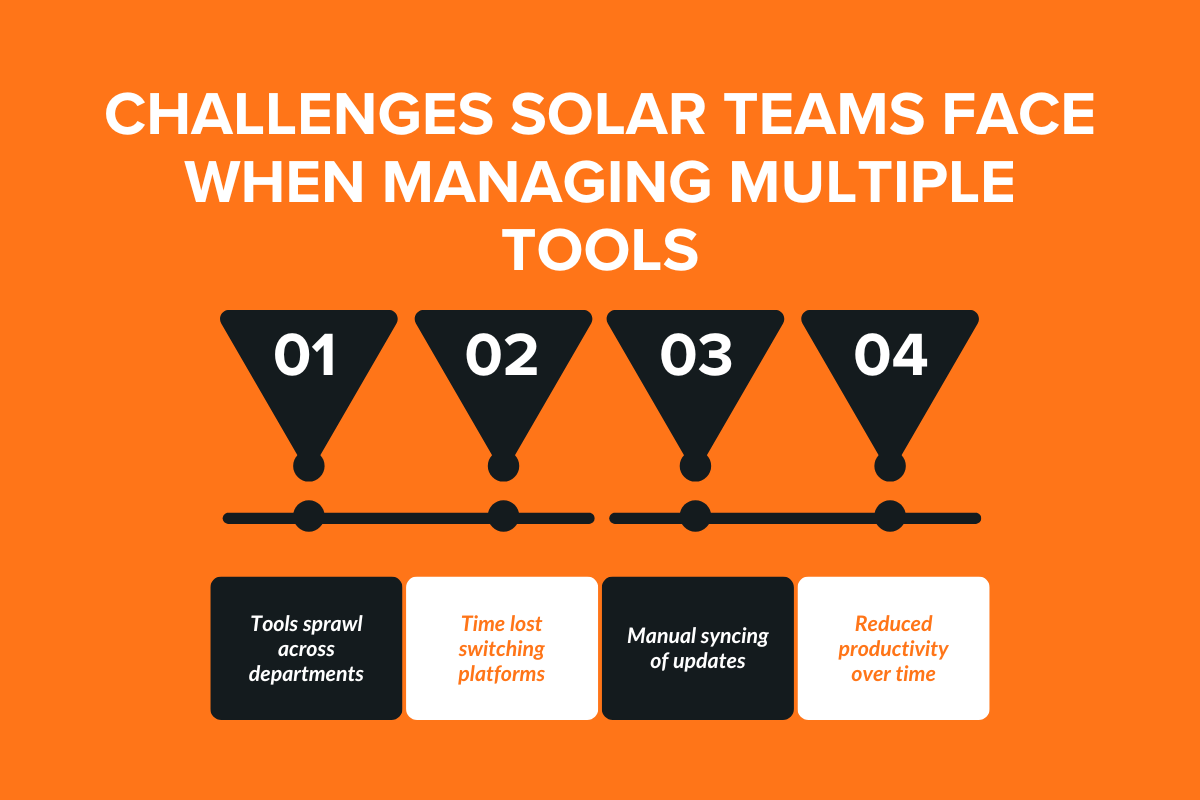
As solar businesses grow, their tool stack expands. What begins as a CRM and basic proposal software gradually becomes separate systems for solar design, inventory management, project tracking, and field service management.
Each tool may work well individually, but together they create friction. Teams waste time logging in to multiple platforms, verifying data, and manually syncing updates.
These inefficiencies rarely cause dramatic failures, but they quietly reduce productivity, delay responses, and increase operational costs over time.
1. Tool Sprawl Across Departments
Different teams use different tools to get their work done, leading to information living in silos. Sales, design, operations, and field teams often work in separate systems, making alignment more difficult as the business scales.
2. Time Lost Switching Platforms
Teams spend significant time logging into multiple systems, navigating dashboards, and searching for information.
This constant context switching breaks focus and slows response times across the sales and operations process.
3. Manual Syncing of Updates
Without connected systems, updates must be entered manually across tools. A change in solar design may not reflect in proposals, or a lead update may never reach operations, leading to errors and rework.
4. Reduced Productivity Over Time
These inefficiencies don’t always cause immediate failures, but over time they quietly reduce productivity. Teams feel busy but ineffective, response times are slow, and operational costs steadily increase.
A unified solar business software platform addresses these challenges by consolidating workflows, data, and teams into a single system, removing friction and restoring efficiency across the organization.
Why Accuracy, Consistency, and Trust Drive Customer Relationships?
Solar customers make long-term financial decisions. Inconsistent proposals or last-minute changes quickly erode trust, and trust is what moves prospects through the sales funnel into signed contracts.
Integrated solar business software ensures solar design, inventory availability, financing options, and proposal details remain aligned in real time.
When one system of record exists, customers see consistent information across conversations, proposals, and contracts, boosting confidence and reducing friction throughout the sales process.
To see how advanced design tools improve accuracy and reduce costly rework, teams often review use cases such as
"Optimizing Solar EPC Operations: How Design Software Improves Accuracy and Reduces Rework."
How Unified Solar Software Improves Customer Experience?
Customer experience in solar is shaped long before installation begins. It starts with the first interaction, continues through proposal review, and extends into installation and post-sale communication.
When internal tools are disconnected, customers feel that friction externally. Unified solar software creates a smoother, more professional experience at every stage of the journey.
1. Faster Responses Improve Lead Generation and Early Trust
When CRM, design, and proposal tools are connected, sales teams can respond faster and with more confidence. Customers receive accurate proposals quickly, without vague estimates or follow-up corrections. This responsiveness signals professionalism and builds trust early in the relationship.
2. Consistent Data Across Every Customer Interaction
Nothing undermines confidence faster than inconsistent information. When a system size mentioned in one call changes in the proposal, it creates doubt, even if the change is minor.
Integrated solar business software ensures customers see the same information across emails, proposals, contracts, and installation updates, reinforcing credibility.
What Does an Integrated Solar Business Software Tech Stack Really Mean?
An integrated solar software stack is not just light integrations between tools. It is a single platform that unifies lead management, solar CRM, solar design, proposal software, inventory management, and project management.
Sales teams gain instant access to project details. Field teams receive accurate designs and documents. Managers track project progress without having to chase updates.
Why has this become a game-changer:
- Sales teams can manage leads, move prospects through the sales funnel, and close more deals without manual data entry
- Leadership gains visibility into business growth, customer relationships, and overall efficiency through a single, all-in-one solution.
Old Workflow vs New Workflow: One Platform vs Disconnected Systems
In the old workflow, teams operate in silos. Sales enters data, designers recreate it, and proposal tools rebuild pricing. Updates rely on emails and spreadsheets.
In the new workflow, one update flows everywhere. Pricing, designs, proposals, and contracts are automatically synchronized, reducing delays and errors.
| Aspect | Old Workflow (Disconnected Tools) | New Workflow (Integrated Solar Software Stack) |
|---|---|---|
| Lead Management | Leads captured in CRM, then manually shared with design and proposal teams | Leads flow automatically from CRM into design and proposal workflows |
| Data Entry | Same customer and project data entered multiple times across tools | Single data entry updates CRM, design, proposals, and operations |
| Solar Design | Designers recreate inputs from emails, spreadsheets, or site notes | Design tools pull site and customer data directly from CRM |
| Proposal Creation | Proposals are rebuilt manually after every design or pricing change | Proposals auto-update when designs, pricing, or financing change |
| Pricing & BOM Updates | Pricing adjusted manually, increasing risk of errors | BOM and pricing sync automatically with the system design |
| Team Collaboration | Sales, design, and operations work in silos | All teams work from the same real-time data |
| Handoffs Between Teams | Frequent delays and miscommunication during handoffs | Seamless handoffs with shared visibility across teams |
| Error Risk | High risk of mismatched designs, pricing, and documents | Reduced errors due to synchronized data and automation |
| Customer Experience | Delays, revisions, and inconsistent information | Faster responses and consistent, professional communication |
| Scalability | Growth requires more staff to manage complexity | Teams scale efficiently without increasing operational load |
The Technology Behind a Modern Solar Operations Platform
Modern solar CRM systems rely on centralized databases and automation engines to keep teams aligned. Site surveys, satellite imagery, LiDAR data, and real-world field inputs feed directly into solar design tools, eliminating guesswork and rework early in the sales process.
Proposal software then pulls from the same dataset to generate accurate, branded solar proposals instantly.
Because design, pricing, and customer details stay synchronized, teams gain reliable, data-driven insights across sales, design, and operations.
For a closer look at how today's design tools compare and which platforms installers actually rely on, explore this breakdown of the top solar design platforms in 2026.
Using Site Surveys, Field Data, and Automation for Data-Driven Insights
Accurate solar business decisions begin with reliable field data. Site surveys, measurements, shading analysis, and equipment preferences are captured digitally, providing teams with instant, consistent project information.
Automation feeds this data into design, proposals, and workflow systems, updating designs, reflecting real conditions, and aiding installation planning.
This approach boosts conversion rates, reduces rework, and supports informed decisions to improve efficiency, customer satisfaction, and growth.
How an Integrated Solar Business Software Stack Improves Sales and Operations?
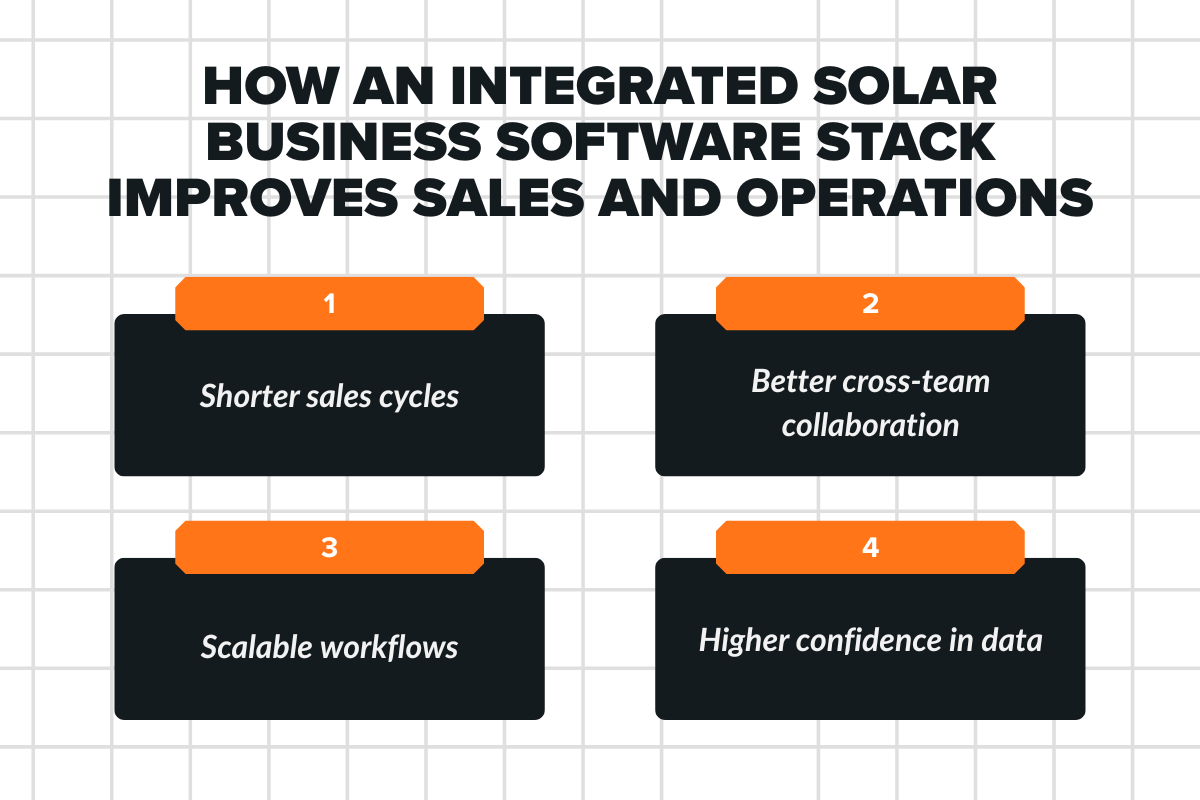
The benefits of integration appear sooner than most teams expect. Sales cycles shorten, collaboration improves, and confidence in data increases across departments.
Instead of questioning numbers or double-checking handoffs, teams trust the system they're working in. These improvements don't just help in the short term.
As deal volume grows, integrated workflows scale naturally, allowing solar businesses to handle more projects without adding unnecessary operational strain.
1. Faster Sales Cycles Strengthen the Sales Pipeline
When CRM, solar Design, and proposal tools are connected, handoffs effectively disappear.
Sales teams generate proposals instantly using real design data, eliminating the need for manual updates or back-and-forth communication.
Operations teams receive complete project details without delay, reducing confusion and maintaining momentum while customer interest is at its highest.
2. Better System Accuracy Improves Conversion Rates
Integrated platforms ensure that any change to a system layout automatically updates production forecasts, pricing, and financing options.
This alignment prevents discrepancies that often surface late in the sales process.
By protecting margins and setting realistic expectations early, teams avoid costly surprises and uncomfortable customer conversations.
3. Reduced Installation Risk Through Smarter Project Management
Late-stage errors are one of the most significant sources of installation delays. Integrated platforms surface inconsistencies early, before materials are ordered or crews are scheduled.
This proactive visibility reduces rework, minimizes scheduling conflicts, and leads to smoother solar installations overall.
4. Centralized Reporting for Better Informed Decisions
Centralized data gives leaders a clear view of the sales pipeline, conversion rates, and project progress across the business.
Instead of pulling reports from multiple tools, decision-makers see everything in one place. This clarity supports more thoughtful planning, better resource allocation, and more confident strategic decisions.
The Role of Inventory Management in Scalable Solar Operations
Inventory management often becomes a pain point as solar companies scale.
Without integration, stock levels are tracked separately from sales and installation planning, increasing the risk of shortages or over-ordering. When inventory management is part of the same platform, teams gain better control and visibility.
1. Avoiding Delays by Managing Stock Levels in One Platform
Integrated inventory data allows teams to confirm material availability before finalizing proposals or scheduling installations.
This reduces last-minute delays caused by missing equipment.
Installations move forward as planned, improving customer satisfaction and operational reliability.
2. Smarter Purchasing Decisions Through Centralized Data
Centralized inventory data helps leaders identify usage trends and plan purchases more accurately. Instead of reacting to shortages, teams can proactively manage stock levels and control costs.
Field Service Management, Sales Enablement, and AI: The Future of Solar Software
The future of solar software is moving beyond isolated tools toward intelligent, connected platforms that support the entire lifecycle of a solar project.
As competition increases and margins tighten, solar businesses are adopting solutions that combine field service management, sales enablement, and AI-driven automation to operate faster, smarter, and with greater consistency.
Field Service Management: Connecting the Office to the Field
Field service management bridges the gap between planning and execution by ensuring that field teams always work with accurate, up-to-date information. When site surveyors, installers, and operations teams are digitally connected to sales and design workflows, errors decrease, and project timelines become more predictable.
Key benefits include:
- Real-time access to site survey data, system designs, and installation plans
- Digital task assignments and scheduling for field crews
- Reduced installation delays caused by missing or outdated information
- Clear documentation and photo uploads from the field for faster issue resolution
Sales Enablement: Supporting Faster and More Confident Selling
Sales enablement tools ensure that sales teams are equipped with everything they need to engage customers effectively. By providing instant access to accurate designs, pricing, and financing details, sales teams can focus on consultative selling rather than internal coordination.
Key benefits include:
- Faster proposal generation using real design and pricing data
- Consistent presentation of system details, savings, and ROI
- Reduced dependency on engineering for routine proposals
- Better follow-ups through visibility into proposal status and customer engagement
AI: Driving Smarter Automation and Better Decisions
AI enhances solar software by reducing manual effort and improving accuracy across design, forecasting, and planning. Rather than replacing human expertise, AI supports teams by handling repetitive tasks and highlighting insights that may otherwise be missed.
Key benefits include:
- AI-assisted solar layouts and shading analysis for faster design creation
- Improved energy production forecasts based on historical and site-specific data
- Automated detection of inconsistencies or design constraints
- Smarter resource planning and forecasting as project volumes increase
Together, field service management, sales enablement, and AI form the foundation of modern solar software. By integrating these capabilities into a single platform, solar companies can reduce friction across teams, improve customer experience, and build operational systems that are ready for the next phase of industry growth.
How to Choose the Right Solar Business Software?
The right Platform depends on workflow alignment, integrations, and ease of adoption. Solar businesses should prioritize an all-in-one solution that reduces manual tasks and connects sales, design, and operations.
Let's look at the other mandatory things that you must look for before choosing the right software:
1. Start With Your Workflow, Not the Software
Before evaluating vendors, map your current sales, design, proposal, and installation workflows. Identify where delays, manual work, or miscommunication occur. The right software should simplify these pain points rather than force teams to change how they work just to fit the tool.
2. Look for True Integration, Not Just Add-Ons
Some platforms offer integrations that only pass limited data between tools. Prioritize software that unifies CRM, solar design, proposals, project management, and inventory within a single system or a tightly connected platform. True integration ensures updates in one area automatically reflect everywhere else.
3. Evaluate Ease of Use and Team Adoption
Even powerful software fails if teams don’t use it consistently. Choose a platform with an intuitive interface, role-based access, and minimal training requirements. Sales, design, and operations teams should be able to adopt the system quickly without relying heavily on technical support.
4. Ensure It Supports Both Current and Future Needs
Your software should handle today’s project volume while being flexible enough to support future growth. Look for platforms that offer scalable workflows, configurable features, and the ability to incorporate automation, analytics, or AI-driven tools as your business evolves.
5. Check Data Accuracy and Reliability
Accurate proposals, pricing, and project details are critical in solar operations. Evaluate how the software handles system design updates, BOM pricing, financing options, and regulatory requirements. A reliable platform reduces errors and protects margins by keeping data consistent across teams.
6. Assess Reporting and Visibility for Leadership
Management needs clear visibility into pipelines, margins, project status, and performance. Choose software that provides real-time dashboards and reports without requiring manual data consolidation. Better visibility leads to faster, more informed decisions.
7. Consider Implementation and Support
Finally, factor in onboarding, training, and customer support. A smooth implementation process and responsive support team are essential for long-term success. Software should feel like a growth partner, not an additional operational burden.
To see how many solar teams combine design tools in real-world workflows, read the blog on Exploring Aurora, Solargraf & OpenSolar: What Tools Solar Teams Are Using Together.
Preparing Your Solar Business for the Next Phase of Growth
As the solar industry becomes more competitive, operational efficiency will increasingly separate leaders from laggards. Integrated solar business software is no longer just a convenience; it's a strategic foundation.
1. Scaling Without Adding Operational Complexity
In the early stages, solar businesses often rely on manual coordination and disconnected tools to manage projects. While this may work at low volumes, it quickly becomes unsustainable as deal flow increases.
A unified platform allows sales, design, and operations teams to work from the same data, reducing repetitive tasks and eliminating the need for constant manual handoffs.
2. Building a Tech Stack That Evolves With You
Preparing for long-term growth requires technology that can adapt as business needs change. Integrated solar software provides a flexible foundation that supports new workflows, additional automation, and data-driven insights over time.
As features such as advanced analytics, AI-assisted design, and smarter project management become standard, businesses already operating on a unified platform can adopt these capabilities without reworking their entire system.
In a Nutshell
As the solar industry continues to mature, the ability to operate efficiently is becoming just as important as the quality of the technology being installed.
Disconnected tools, manual handoffs, and slow proposal workflows create friction that limits growth and erodes customer trust over time. In contrast, solar businesses that invest in integrated systems are better equipped to respond quickly, maintain accuracy, and scale with confidence.
Looking ahead, the integration of field service management, sales enablement, and AI will further reshape how solar companies operate.
Businesses that adopt connected, data-driven platforms today will be better positioned to adapt to future demands, improve conversion rates, and sustain long-term growth in an increasingly competitive market.
Why Sunbase?
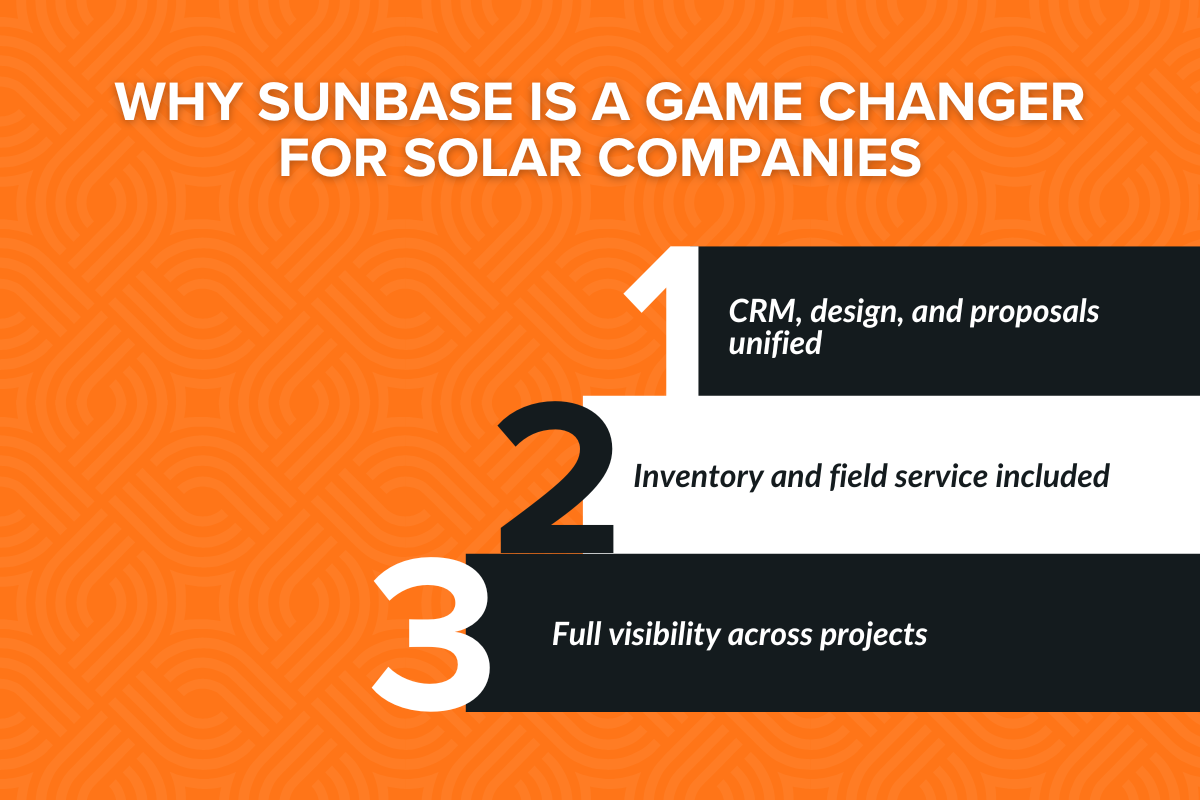
Sunbase brings solar CRM, solar Design, proposal software, inventory management, field service management, and project management into one powerful operations platform.
Sales teams close more deals, field teams avoid delays, and leaders gain complete visibility across solar projects. See how
Sunbase brings your entire solar workflow into one platform.
Book a personalized demo to explore how integrated solar software supports scalable growth.
FAQs
1. What is solar business software?
Solar business software is an all-in-one operations platform that helps solar companies manage lead generation, solar CRM, proposals, solar Design, inventory management, and project management from a single platform, improving efficiency and business growth.
2. How does solar business software improve project management?
It centralizes project details, tracks project progress, tasks, field teams, site surveys, and important documents, helping solar businesses manage solar projects efficiently, avoid delays, and improve overall business operations.
3. How does solar proposal software improve conversion rates?
Solar proposal software combines solar Design, shading analysis, financing options, and proposal tools into one streamlined sales process, reducing manual data entry and helping sales teams create accurate proposals that increase conversion rates.
4. How does lead management work in solar business software?
Solar business software captures leads from multiple sources, tracks lead status in the sales pipeline, automates reminders, and manages the sales funnel, helping sales teams convert more deals and improve customer interactions.
5. How does inventory management help solar companies?
Inventory management tracks stock levels, manages materials for solar installation, avoids delays caused by missing equipment, reduces costs, and ensures field teams have instant access to accurate inventory data.
6. Why is one platform better than using multiple tools?
One Platform eliminates disconnected tech stacks and multiple tools, reduces manual data entry, improves customer relationship management, and provides data-driven insights that support informed decisions, future growth, and higher customer satisfaction.
One Platform.
Zero Chaos.
Run Your Entire Business in One Platform
Sunbase replaces your CRM, proposals, scheduling, job tracking, and reporting tools — all inside one clean, connected platform.
About Sunbase
The All-In-One Platform to Run Your Entire Business
Sunbase helps you organize operations, streamline daily workflows, and manage everything - from first customer contact to final project deliver- in one connected system.
Our Mission
- Organize your business.
- Optimize your workflow.
- Automate your dailytasks
Why Businesses Choose Sunbase
One Connected Workflow
Replace scattered tools and manual processes with a single platform that brings together your team, tasks, customers, jobs, and performance data.
🌎 Global Presence
Serving the United States, Canada, India, LATAM, Australia, and 10+ international markets.
👥 11,000+ Users
Trusted by contractors, installers, project managers, sales teams, and field technicians.
🏗️ Built for All Sizes
From small contracting teams to fast-growing enterprises, Sunbase adapts to your workflow.
Stop Managing Your Business Manually. Automate It.
Sunbase automates workflows, reduces mistakes, and helps your team get more done - without hiring extra staff or juggling multiple tools.
Still Managing Your Business Across Multiple Tools?
Bring your CRM, proposals, projects, and operations into one platform built for contractors.