
The season of sales pitches that shout out "free solar", "no down payment", "big incentives" is officially over.
Today’s reality check is clear:
- Interest rates are high on loans.
- Attractive State Incentives have disappeared.
- Solar energy is a significant investment but has high upfront costs.
It has turned the homeowners hesitant to invest in solar panels, and they throw the real tough questions like "Why should I invest in solar panels when my energy bills may not reduce immediately? They are questioning the real benefits of adopting solar as the upfront investments feel heavier than ever.
This growing skepticism means solar sales professionals must shift the conversation from proactive to reactive!
The challenge now is to showcase that solar installation is not a bad deal, but a smarter one, built on long-term value, energy independence, and protection against rising utility costs, even when state rebates have vanished.
A Guide to Selling Real Value to boost the Solar Energy market over "Free Solar" Gimmicks
Tax credits, low-interest loans, and zero down payments once secured long-term commitments to solar technology.
Now, loans are up by 13%, and the same panels have jumped from $30,000 to $50,000, feeling heavy on every pocket!
Rising payments and ROI concerns are delaying purchases.
This guide shows the new messages and methods you need to win, leaving outdated 2025 tactics behind.
Ready to take advantage of the new chapter in the solar world?
Get exclusive access to our Solar Shift eBook to learn proven strategies and step-by-step guidance to connect with homeowners, drive referrals, and build lasting trust and loyalty.
Key Takeaways
- The “free solar” era is over: Sales success now depends on reframing solar around long-term ROI, ownership, and energy independence, and not $0-down gimmicks.
- Selling Clarity, confidence, and credibility: Homeowners are overwhelmed by policy changes, rising interest rates, and inflating utility costs. Sales reps must step into the role of educators and consultants to strengthen transparency and build lasting trust.
- Local authority beats national scale: As big brands lose trust, local solar businesses can stand out through hyper-local SEO, social proof, community presence, and referrals.
What Happened to “Free Solar”? (And Why Customers Are Confused)
The solar industry is facing uncertainty, and sales reps must become trusted guides who replace confusion with clarity.
What “Free Solar” Really Meant All Along
Social media posts and paid ads flashing “$0 cost to install solar panels” and “no payments for 18 months” are nothing more than promotional ploys.
Nothing was ever truly free. The real catch was simple:
- Companies pushed complex financing models, such as leases and power purchase agreements, which made solar look like a cheaper investment compared to current utility bills.
- Federal incentives of up to 30% covered a significant portion of installation costs, making solar much more affordable.
- Sales tactics promoted near 0% interest rates, making solar loans appear cheaper, while hiding the real, inflated pricing and substantial dealer fees masked by sales representatives.
Why “Free” Now Triggers Distrust and Vanished Trust
Trump announced in mid-2025 the end of the 30% federal residential solar tax credit through the “One Big Beautiful Bill.”
Eye-Opening Fact: This policy reshaped the entire market. Projects worth $24 billion in renewable energy, including solar technology, were frozen or canceled after the announcement.
The buzz that erupted among sceptical homeowners after the announcement :
- “Solar is too expensive now; my electricity costs are more feasible for me.”
- “Interest rates have made loans a financial burden.”
- “It was only worth it when we had the tax benefits.”
Your new job as a sales rep is to sell peace of mind and clarity, helping confused and hesitant homeowners build trust.
As Alan Watts puts it: “The only way to make sense out of change is to plunge into it, move with it, and join the dance.”
The transition will be tough, but you need to endure it strategically to stand strong in the industry.
Dive into our e-book to uncover what has truly changed in the solar market and learn actionable strategies to tackle challenges to grow the potential customers pipeline and power up your solar energy production.
Why Overcoming Solar Price Objections is a Prime Concern Today
With “free solar” losing its appeal, sales reps must shift focus to addressing common objections around price and feasibility to build trust and transparency, highlighting the long-term benefits of solar panels over offers from other utility companies.
1. The Monthly Payment Pitch Has Faced a Complete Blockout
The monthly solar payments will not be less than the utility bills, as higher APRs push up the total costs of setting up solar.
The disappearance of federal incentives increases the initial cost for the setup of modern solar panel designs.
Customers spend more upfront, but after just a few years, real ROI appears as energy costs drop once loans are paid off.
2. Price Objections Are Really Trust Objections
Customers are turning cautious, and capital is tight.
Whoever can clearly discuss financing options and show that electricity bills will be lower, but only after patience and heavy upfront investment, will win the sales deal.
It is no longer a price war; it is the trust and value game.
What Can You Do to Be the Best Consultative Solar Sales Rep?

Sales reps who are meeting their targets and earning handsome commissions are not just delivering salesy pitches; they have turned into actual consultants amidst a shaky environment, offering personalized solar strategies that stack up effectively. Let us explore:
1. Sell Energy Independence
Unveil the long-term value of solar panels that increases property value, reduces long-term energy expenses, and lowers carbon footprint while supporting sustainability goals.
2. Controlling Future Costs
Showcase the savings by locking in the energy costs by investing in modern solar panels, such as monocrystalline panels, to maximize energy production, to avoid the trap of rising utility bills and electricity costs in dynamic market conditions.
3. Peace of Mind in an Unstable Environment
Solar reps must leverage the advantage of the market uncertainties and unpredictable weather conditions. Homeowners worry about outages, blackouts, and disasters.
Solar + battery systems act as the new generators, providing security, stability, and peace of mind.
Sales professionals sell confidence and not just panels by showcasing solar as the ultimate resolution.
What are the Key Questions Solar Sales Reps Must Answer in 2026 After Federal Incentive Changes
1. How do Recent Federal Incentive Changes Impact the Overall Cost of Going Solar?
Recent federal incentive changes have increased the upfront costs and extended payback period of loans, raising doubts on the cost-effectiveness of investing in solar.
2. What is the Realistic Return on Investment (ROI) Now after the Change in Financing Rates?
The higher financing rates and reduced incentives raise doubts about real ROI amidst rising utility rates and energy expenses.
3. Are Financing Options Still Viable?
Financing options are still available, but rising costs require a more realistic view of payback timelines and interest rates to assess their feasibility.
4. How Does Solar Energy Compare to Staying on the Grid?
Whether staying on the grid or going solar, homeowners need to understand which option delivers higher efficiency in energy production and cost effectiveness over time.
5. What happens if Energy Prices and Battery Storage Costs Change in the Next Five to Ten Years?
The market is dynamic, and homeowners are hesitant about choosing the right time to invest in solar.
6. What Warranties and Protections are Included?
Warranties and Protection play a key role in increasing the valuation of investments.
7. How Complex is the Installation Process Now?
Installing solar panels may be straightforward, but concerns have increased after the federal incentive removal, which raises questions about the real ROI.
Takeaway: Sales Rep can turn uncertainties into opportunities by addressing concerns confidently and showcasing what sets you apart: fast installations, positive reviews, and transparent calculations that reveal real ROI
Read More: The Solar Shift: Why the "Easy Money" Era in Solar is Over & How installers Survive 2026
How to Reframe Pricing to Sell Value (Without Hiding Numbers)

1. Perform the Math to Reveal the Beneficial ROI
The new chapter in solar requires reps to hedge solar’s advantages against utility inflation to justify the changing economics of the energy market.
Nearly one-third of U.S. homeowners have cut back on essentials just to pay their utility bills (Source).
Sales reps must leverage this reality to showcase solar as an asset and upgrade it, and not just a monthly expense.
With utility rates projected to rise by at least 5%, homeowners’ wallets are under increasing pain.
Sales reps need to show the true cost of staying with solar in the tug of war of utility bills versus solar costs.
You need to do the math for them:
For example:
If a solar panel investment costs $250 per month, but your current utility bill is $180, the utility seems cheaper at first.
But if utility rates increase steadily by 5% per year, in five years your bill could reach $450 per month.
Solar may feel heavier initially, but the smarter choice is solar, as it will far outperform utility costs over the next five years.
2. Focus on Ownership and Not Just Financing
Sales reps need to become educators, showing homeowners the different options that may be more beneficial. Long-term loans are not always necessary; even if interest rates rise, some options are still available, such as:
- HELOC (Home Equity Line of Credit): Borrow against home equity at much lower interest rates.
- Short-term loans: Require higher monthly payments but shorten the payback period, suitable for homeowners with limited but steady cash flow.
Finance is no longer an obstacle. Ownership is the goal, and attractive financial options are the path to reach it.
Where Most Solar Sales Reps Lose the Deal (And How to Fix It)
Active listening is the key to closing deals. The abrupt early end to federal residential solar credits, before their previously announced 2034 expiration, has shifted the sales paradigm, forcing solar reps to adapt quickly.
Sales reps who lose deals are typically those who:
- Stick to outdated pitches: They lean on tested sales pitches relying on government incentive benefits and ‘low-interest’ gimmicks that no longer hold.
- Avoid addressing the surge of customer concerns: They stumble when it comes to clearly showcasing real ROI, especially when today’s solar systems require a higher upfront investment.
How to Train Teams to Handle Solar Price Objections With Confidence (To Make Real Impact)
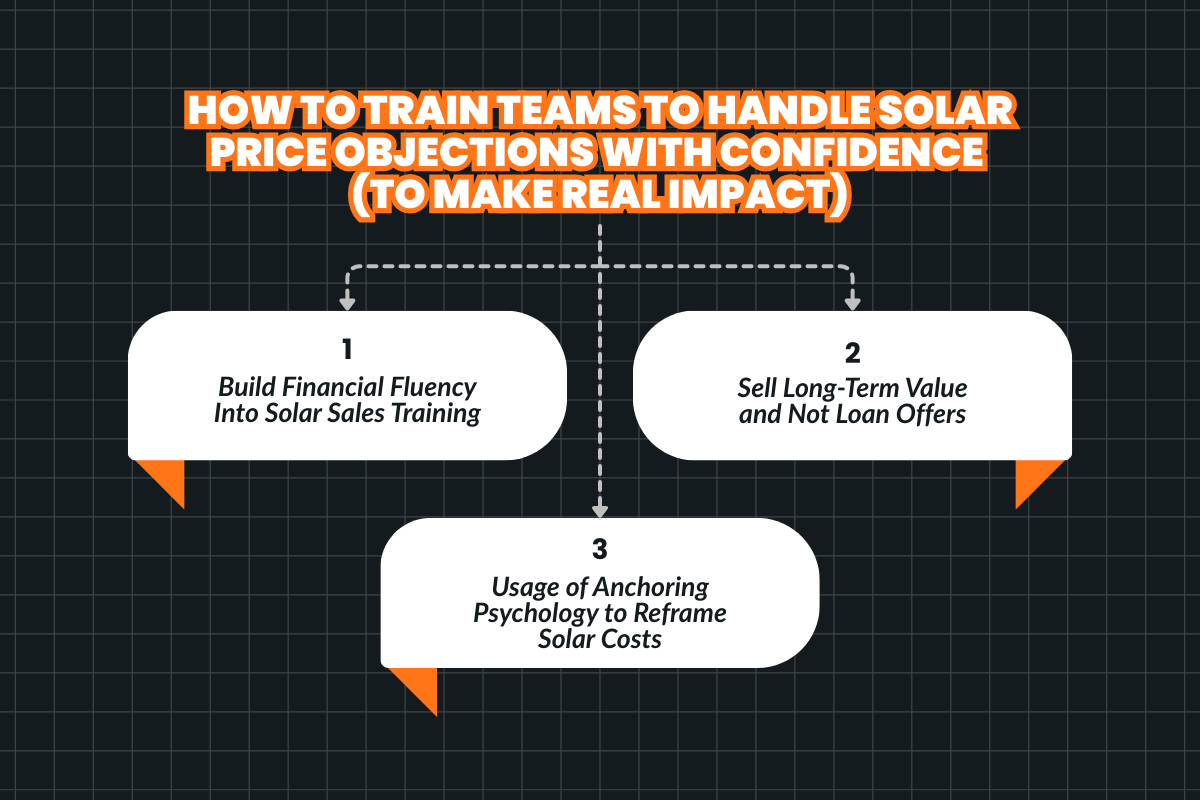
1. Build Financial Fluency Into Solar Sales Training
Sales teams that demonstrate financial competency can communicate value in a far more impactful way by directly connecting solar economics to customer realities.
Instead of leading with incentives or loan offers, sales reps must reposition solar as a long-term savings solution, not a short-term product pitch.
The focus should shift from how to buy solar to why solar makes financial sense over time.
2. Sell Long-Term Value and Not Loan Offers
Sales Rep must present the real monthly comparisons over a period of time, showcasing solar as a bill swap with the utility.
When supported by a visual representation, it allows homeowners to not just see the numbers but truly feel the difference.
Using data-driven responses carries more weight than generic claims in solar sales.
3. Usage of Anchoring Psychology to Reframe Solar Costs
Rather than starting the conversation with high upfront system costs, effective reps anchor value over a 10-year electricity cost horizon as people naturally fixate on the first number they hear.
Example of A Consultative Solar Pitch:
Our solar system costs about $200 per month over the next five years.
But you’re already paying close to $130 today for electricity, and with rising utility rates, that number could increase to $300 or more in the next five years.
Solar locks in your costs. You own the equipment, and your savings stay with you instead of going to utilities that keep raising prices.
When you look at it long term, solar isn’t more expensive, but it’s actually the smarter financial move.
On top of that, installing solar can increase your property value by 4–6%, giving you dual benefits: lower monthly bills and higher home equity.
Read More: Selling Solar Energy: Sales Pitch That Will Close More Deals
The Power of the Locals: Why Localized Solar Companies Are Clear Winners in 2026
Incentives are gone, financing is tougher, and skepticism is at an all-time high.
Big names that were built on incentives are struggling to adapt.
Local experts now have the advantage as they hold specialized knowledge of the region, weather, and real requirements.
What Makes Local Solar Companies More Credible and Trustworthy (Strategies to Win Sales)
1. Focus on Trust and Referrals
Customers today value credibility over flashy ads, annoying call-center calls, high-pressure sales, and brands that disappear after providing a service.
Local businesses, with their real presence, authentic testimonials, and referrals from trusted sources, carry far more weight in building trust to drive sales. In fact, 92% of consumers trust recommendations from people they know.
This presents a huge opportunity for local businesses to outshine national brands and outpace the competition.
2. Hyper-Local SEO Domination
You can rank for neighborhood-level searches using terms like “Solar Installer near me,” “Best Solar Technology Company,” “Solar Contractors,” and “Residential Solar Panels.”
Position yourself strategically by placing keywords thoughtfully, leveraging sales data and local feedback to match the personalized needs of your community, which turns into a mini sales campaign.
3. National Trust Is Eroding
Consumers fear the call centre scams and services from national brands that they can never meet face to face.
The increasing lawsuits of fraudulent services and negative reviews of solar panel efficiency from major brands create mistrust.
It holds a golden opportunity for local businesses where you can win over customers without spending six-figure dollars on ad spends. Hold accountability, show up through sponsorship to local events, or join HOA meetings to be amilar and build a brand.
4. Turn Every Install into a Neighborhood Campaign
For every project, collect “before and after” drone photos and share them on social media, tagging your business on Facebook and other local community platforms.
Build a testimonial page showcasing positive reviews from local projects.
Turn every project into proof of successful work and every client into a brand advocate, helping you grow a strong and loyal customer base.
4. Local Presence Builds Credibility
Business and brand grow with credibility, and you need to consistently showcase your expertise to build it.
Strengthen your local presence by including your city or region in strategic placements across your brand and promotional materials.
Set realistic expectations by highlighting proof of solar installations in your local area, especially at recognizable landmarks.
Showcase your expertise by providing valuable educational content that addresses local concerns through blogs and social media posts to reinforce your position as a trusted authority.
5. Be a Problem Solver, Not Just a Sales Engine
A sales rep who only delivers a pitch shows product knowledge, but a valuable conversation demonstrates a deep understanding of customer pain points and goals. This distinction is what truly closes the deal.
Manage Your Solar Business Smarter with Sunbase
1. Streamline Your Operations with Sunbase
Centralized project management and leads pipeline in one centralized platform that reduces delays and fast-tracks implementation to enhance efficiency.
2. Build Customer Trust Through Transparency
The financing tool helps monitor the status of each financing application, allowing clients to upload the necessary financing documents to streamline the process.
It provides complete cost breakdowns for every solar installation, sets automated reminders to ensure financing applications meet deadlines, and syncs with lender systems for real-time status updates.
4. Empower Your Sales Team in Consultative Selling For Building Trust
The tool gives reps real-time insights into pricing, incentive plans, accurate savings projections, and time-of-use rates, so they can use these as consultative insights during customer conversations to build credibility and trust.
Explore More: Can Solar Software Double Your Sales During a Downturn?
Final Takeaway
The future belongs to the sales reps who can successfully overcome solar price objections.
With federal incentives disappearing and loans becoming more expensive, many see solar systems as a less attractive option.
The perception that solar is too “costly” needs to be challenged—not with gimmicks, but by revealing the real truth to clear skepticism.
You know the real challenges now. Knowing and doing are not the same.
If you want to step up your solar game, you need to do it right with Sunbase.
Book your Personalized Demo with our experts to execute your plans the right way.
FAQs
1. What is the 33% rule in Solar Panels?
This solar panel rule refers to a fire-safety guideline stating that solar panels should not cover more than 33% of the roof area, as exceeding this limit can trigger additional fire-safety requirements. The layout must also ensure that ventilation points and firefighter access paths are not obstructed.
2. What is the Best Way to Overcome Common objections to selling solar?
The most effective way to overcome price objections in solar sales is to shift pitches away from short-term solar leases and toward long-term value and viable financing options. Using social proof such as real customer outcomes, case studies, and transparent numbers through one-page visuals helps to build credibility and trust, even when incentives are reduced.
3. Why is My Electric Bill so High if I have Solar Panels?
There are a few common reasons this can happen. First, your energy usage may be higher than the capacity of your solar panels to generate enough power, causing your home to rely on the electric grid for additional electricity, which increases your energy bills. Second, your solar system may not be performing efficiently due to issues such as faulty inverters, dirty panels, shading, or other external obstructions, all of which reduce its ability to generate power effectively.
4. What is the 20% Rule for Solar Panels?
The 20% rule in solar panels is a guideline for residential homeowners, stating that a solar system should not generate more than 20% of the property’s annual electricity usage. This ensures proper system sizing and helps maintain compliance with utility regulations and net metering limits.
5. How do Federal Incentive Changes Affect Solar Sales?
The 30% federal solar tax credit for homeowners has expired, increasing the upfront cost of solar systems and making them a less immediately attractive option. As a result, solar sales professionals now emphasize long-term savings, energy independence, and timely project installations. Consequently, successful solar sales rely more on consultative selling and demonstrating long-term ROI rather than upfront incentives.
6. Why are Local Solar Companies Winning in 2026?
Local solar companies have achieved success by shifting their business models away from relying solely on local incentives toward diversified energy services, personalized customer experiences, and meeting the growing demand for energy independence. They have built credibility by focusing on trust and referrals, turning each installation into a local marketing opportunity through personalized service that strengthens authority and enhances community trust.
7. What’s the best way to Overcome Monthly Payment Objections?
The best way to overcome monthly payment objections is to focus on long-term savings, showing how monthly solar payments can reduce the total utility bill. Using clear ROI calculations and real-life examples helps homeowners see solar as a smart financial investment rather than just another monthly expense.
One Platform.
Zero Chaos.
Run Your Entire Business in One Platform
Sunbase replaces your CRM, proposals, scheduling, job tracking, and reporting tools — all inside one clean, connected platform.
About Sunbase
The All-In-One Platform to Run Your Entire Business
Sunbase helps you organize operations, streamline daily workflows, and manage everything - from first customer contact to final project deliver- in one connected system.
Our Mission
- Organize your business.
- Optimize your workflow.
- Automate your dailytasks
Why Businesses Choose Sunbase
One Connected Workflow
Replace scattered tools and manual processes with a single platform that brings together your team, tasks, customers, jobs, and performance data.
🌎 Global Presence
Serving the United States, Canada, India, LATAM, Australia, and 10+ international markets.
👥 11,000+ Users
Trusted by contractors, installers, project managers, sales teams, and field technicians.
🏗️ Built for All Sizes
From small contracting teams to fast-growing enterprises, Sunbase adapts to your workflow.
Stop Managing Your Business Manually. Automate It.
Sunbase automates workflows, reduces mistakes, and helps your team get more done - without hiring extra staff or juggling multiple tools.
Still Managing Your Business Across Multiple Tools?
Bring your CRM, proposals, projects, and operations into one platform built for contractors.

