
For years, solar market growth followed a familiar script: strong incentives, zero-down offers, and fast closings. It worked so well that few questioned it until it stopped working.
What feels like an unexpected slowdown is creating panic, but this isn’t a temporary drop. It’s a reset. The easy-money era in solar is ending, and yesterday's tactics aren’t built for what comes next.
This moment serves as a wake-up call. The companies that survive it won’t wait for conditions to get better.
They’ll rebuild around what they can control, such as how they generate demand, how their teams operate, and how their business actually runs. And that shift has already begun!
The Solar Shift: Solar Industry Trends Behind the End of Easy Money and the Future of Installers in 2026
The Solar Shift Series isn’t about predicting the future of solar; it’s about explaining what’s already happening. As incentives fade, financing tightens, and homeowners grow more cautious, the industry is being forced to face an uncomfortable truth: the easy-money era is over.
This ebook reframes the conversation from blaming the market to fixing the model. It breaks down why old tactics like zero-down offers and incentive-led selling are failing, and what installers must control instead: pipeline, people, and platform.
More than just a guide, this is a deep dive into solar industry trends for businesses that want to survive 2026 by building durability, not dependence, in a resetting market, and keep up with solar industry trends.
We have divided this guide into eight separate chapters to make it easier for you to navigate. Here is the full list:
Chapter 1: Solar Business Mindset: Stop Blaming the Fed & Start Adapting
Chapter 2: Selling Solar Without Tax Credits: The Rise of Value-Based Selling
Chapter 3: The End of "Free Solar": How to Sell Energy Independence Over Gimmicks
Chapter 4: Solar Fulfillment Strategy: Why 30-Day Installs Are Your New Profit Margin
Chapter 5: The Solar+ Model: Bundling Batteries, Roofing & EVs for Higher Margins
Chapter 6: Stop Buying Solar Leads: How to Build an Owned Lead Gen Machine
Chapter 7: Leading a Solar Team Through Uncertainty: Building a "Fighter Culture"
Chapter 8:
From Installer to Empire: Structuring Your Solar Business for an Exit
Key Takeaways
- The “easy money” era in solar is over, with incentives and zero-down offers masking weak models. The new market values execution over shortcuts.
- This isn’t a downturn; it’s a structural reset. Demand still exists, but only companies built for discipline, clarity, and control will capture it.
- Blaming market delays recovery; taking ownership of the model speeds it up. Now, pipeline, people, and platform are leadership responsibilities rather than background functions.
- Lean teams with clear ownership outperform bloated organizations. Speed today comes from fewer handoffs, tighter systems, and better visibility, rather than more headcount.
- Execution has become the key competitive advantage in the solar industry. Companies that align sales, operations, and fulfillment will define the next era of growth.
Here's a spoiler: If your model depends on tax credits, you're running out of time
You're about to read what most solar installers are too afraid to say out loud. This isn't supposition. It's what the top 1% of solar companies are already doing, and what the other 99% are missing.
Want the complete insider playbook? The Solar Shift Series breaks down all 8 shifts the survivors are implementing right now. Read this article first. Then grab the ebook. Then decide if you're ready to shift!
Is this the End of the Easy-Money Solar Era?
For much of the past decade, the U.S. solar market followed a comfortable path. Growth felt predictable. Close rates stayed healthy. And most solar companies didn’t need to overthink their strategy, as long as demand kept flowing.
But that era was built on conditions, not durability.
Why Incentive-Led Growth Defined the Last Decade
For years, tax credits did most of the work in solar sales conversations. Homeowners didn’t need to fully understand long-term value when incentives made the numbers feel obvious.
- Programs introduced under policies such as the Inflation Reduction Act accelerated adoption and created a period of rapid industry growth.
- Zero-down offers changed expectations. Solar was no longer positioned as a long-term investment, but as something closer to a monthly utility alternative.
- Leasing models made adoption feel easy, fast, and low-risk.
The result? Impressive momentum over the past decade, but much of it was driven by policy support rather than by durable business models.
Later, even the industry groups like the Solar Energy Industries Association and the Interstate Renewable Energy Council have consistently warned that incentive-heavy growth masks operational weaknesses, a warning many companies only realize after the damage is done.
What Changed and Why It Matters in the US Market
The residential solar market today feels quite different. Installations have slowed down, not due to a lack of interest, but because the decision-making process has shifted.
Higher interest rates are forcing homeowners to think harder about long-term commitments. Rising electricity prices are creating urgency, yet growing electricity bills are also making buyers more cautious.
People still ask about solar, but fewer people act quickly on it. The gap between curiosity and commitment is wider than it used to be. This change is important because strategies focused on speed often struggle when the market demands clarity.
> Highlight!
Trade coverage from outlets like PV Magazine USA and recent solar market insight reports point to the same pattern: demand hasn’t vanished, but buyer behavior has slowed to a more planned pace. The solar market continues to grow, but without the recent artificial boost.
Here's how to keep up with Solar Financing Trends and the Impact of Rising Rates.
The Real Wake-Up Call: Why It Was Never the Market
When results start to decline, the instinct is almost automatic: blame the market. Leads weaken, customers hesitate, and policies seem uncertain. Surely some external factor must be at fault.
But that assumption slows recovery.
Why Blaming the Market Slows Recovery
Every industry goes through cycles. Solar is no exception. What separates companies that stall from those that adapt is how they respond to change.
Markets shift for several reasons: economic pressure, policy changes, and consumer behavior, but strong business models are designed to absorb that change.
Waiting for conditions to “normalize” assumes the market will return to what it was. That’s rarely how transitions work. Businesses built for one climate struggle when the environment changes, especially if their growth depended on uncontrollable conditions.
The longer companies focus outward, the longer they delay fixing what’s internal.
So, How Fragile Solar Models Were Exposed
As conditions tightened, the cracks became visible.
Many solar operators recognized their reliance on a few fragile levers, extended incentive periods, easy financing, and a constant stream of third-party leads. When any of these elements diminished, the whole system was affected.
Challenges across the solar supply chain, delays in solar deployment, and rising costs around solar installation exposed how little margin for error some models had.
The uncomfortable truth is this: Markets don’t destroy companies. But yes, fragile models do. Now you must be wondering...
Is the Solar Industry Facing A Downturn Or A Structural Reset?
At first glance, it’s easy to call this a downturn: slower sales, longer cycles, and more challenging conversations. But downturns are temporary. This is a reset.
Even with a slower pace, demand remains present. Global solar installations continue to grow as projected, driven by increasing demand for clean electricity not only in the U.S. but also in developing countries, as they modernize their grids.
The solar growth over the last few years has followed a strong upward trajectory, but that kind of expansion doesn’t last forever. What’s changing now is how companies grow, not whether the industry grows at all.
From Boom Mentality to Builder Mentality
The boom years rewarded speed. Scale mattered more than structure. If you could move fast, you could win. That mindset worked, until it didn’t.
Today, durability matters more than volume. Control matters more than reach. Success depends on clarity in pricing, discipline in operations, and consistent execution across teams.
The companies adjusting fastest are the ones building for longevity, not chasing the next spike in demand.
> While sales cycles stretch, electricity generation demand keeps climbing. Global power generation needs are rising as industries electrify, data loads increase, and aging grids strain under pressure.
Solar isn’t losing relevance; it’s replacing fossil fuels as a core pillar of renewable energy solutions and long-term energy independence.
Why Adaptability Is the New Advantage
Rising electricity demand, increased energy use, and the rapid expansion of data centers are putting long-term pressure on the grid. Solar remains part of the solution, but how it’s sold, delivered, and managed has to evolve.
Smaller, focused teams are moving faster than larger and inflated organizations.
Clear messaging is outperforming aggressive discounts. And operational speed is becoming a trust signal for homeowners who want certainty, not sales pressure.
Once the mindset shifts, the model must shift as well.
Got 5 more minutes? Read this if you're still curious: Can you really double your sales during a downturn?
What’s the New Survival Framework for Solar Companies?
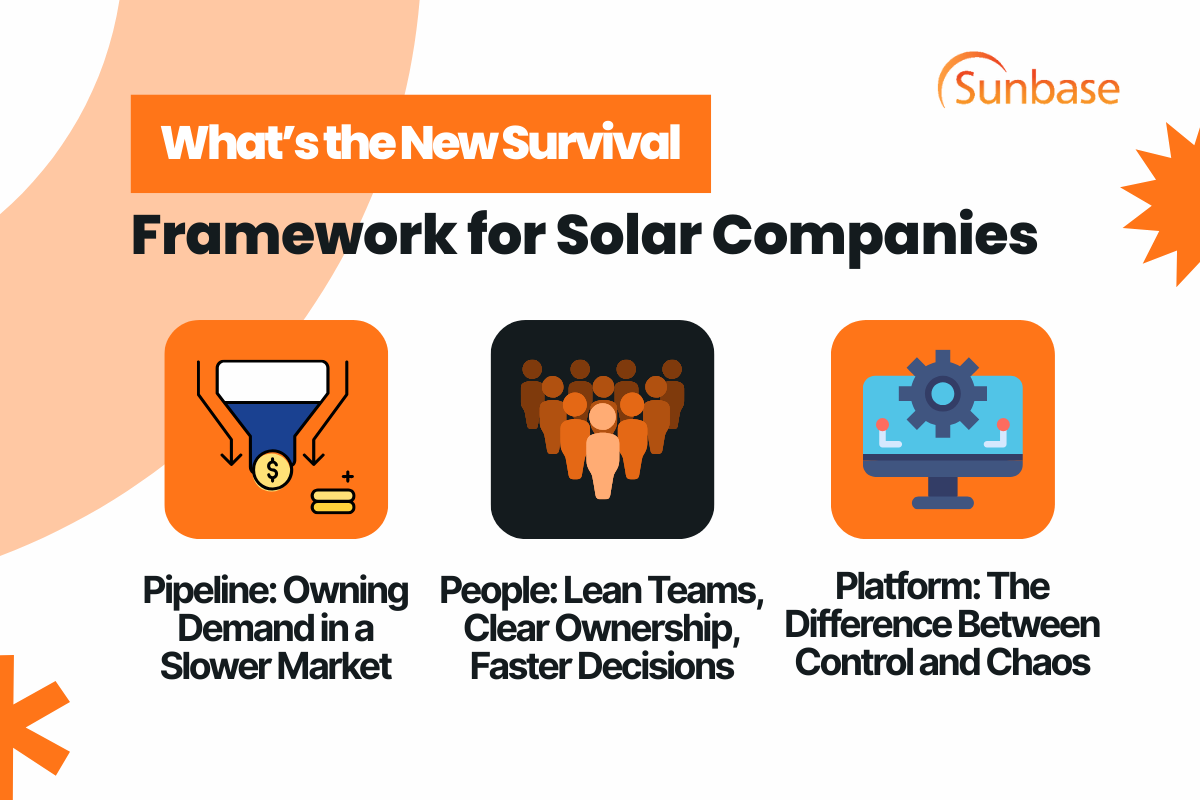
Once incentives, discounts, and market noise are removed, one truth becomes clear: survival in the current solar market depends on control. Not control over policy or pricing, but control over the parts of the business that actually determine outcomes.
That’s where the new framework emerges.
The Solar Shift Series breaks the transition into eight clear chapters, each addressing a different pressure point solar companies are facing, from mindset and market changes to sales, operations, leadership, and long-term resilience.
This isn’t a forecast or hype; it’s a practical guide explaining what’s changing and why the traditional approach no longer applies.
The framework centers on three stability levers every solar business can control: Pipeline, People, and Platform.
When these are aligned, companies stop reacting to chaos and start leading through it. Instead of chasing volume, they build durability. Instead of depending on conditions, they create consistency. Once the framework is clear, execution becomes the real differentiator. Let's dive in!
1. Pipeline: Who Actually Owns Demand When the Market Slows Down?
For years, demand felt like something you could rent, scale, and replace. When installs slowed, you bought more leads. When quality dipped, you widened the funnel. In a slower market, that logic breaks quickly.
Why Rented Leads Collapse When the Market Slows
Aggregator-led demand looks efficient, until it isn’t. As homeowner interest softens, costs climb, competition intensifies, and lead quality drops.
What once felt like a growth engine becomes a recurring expense with no long-term value. There’s no asset being built; it’s just spending being recycled.
The Shift from Lead Volume to Buyer Fit
The solar shift reframes demand around fit, not flow:
- Cash-ready, ownership-minded homeowners replace payment-first shoppers
- Local trust starts outperforming national reach
- Education-driven interest beats urgency-driven clicks
- Fewer leads, clearer intent, higher lifetime value
The goal isn’t more conversations. It’s the right conversations, ones that convert without pressure and sustain margins without panic because today’s serious buyers care less about urgency and more about control.
Buyers aren’t chasing urgency; they’re evaluating long-term value, especially around energy storage and how solar fits into broader renewable energy solutions.
In the residential segment, conversations increasingly center on self-consumption, managing excess energy, and predictable energy pricing. For others, community solar offers access without ownership, a reminder that demand is diversified.
Strong pipelines reduce panic. But execution still depends on people.
People: Why Did Bigger Solar Teams Start Moving Slower Instead of Faster?
In recent years, adding people felt like progress. But in today’s market, that same approach creates hurdles. More people didn’t increase output; it increased friction.
If you’re a founder or owner, this part usually hits close to home. You didn’t overhire because you were reckless; you hired because the market rewarded speed. Volume masked friction. Headcount felt like insurance.
But the market changed. And suddenly, what once felt like growth started feeling… heavy.
The Leadership Mistake Most Solar Founders Don’t Realize They’re Making
Most leaders assume a slowdown is a people problem. In reality, it’s an ownership problem.
As teams grow, responsibility quietly fragments. Deals pass through too many hands. Decisions require too many approvals. When something breaks, everyone is involved, yet no one truly owns the outcome.
What used to be momentum turns into hesitation.
Many solar jobs now compete with roles across other industries, making execution, not headcount, the true differentiator. The most resilient teams invest in a skilled workforce that understands multiple market segments, rather than over-specialized roles that slow decision-making.
How Headcount Quietly Became a Liability
As teams grew, work fractured. Deals passed through too many hands. Approvals piled up. Responsibility diffused. When something broke, no one owned it—and fixing it took longer than the customer was willing to wait.
What High-Performance Solar Teams Look Like Now
- Fewer roles with clearer, broader responsibilities
- Sales, ops, and installs understand each other’s constraints
- Decisions pushed closer to the field
- Speed is treated as an advantage rather than a risk
- Clarity replaces micromanagement. Ownership replaces escalation.
Even the best people can’t perform at their best without the right platform. So, let's move on to...
Platform: What Happens When Your Solar Business Runs on Too Many Tools?
As teams grow, tools multiply. What starts as “just one more system” slowly becomes a web no one fully owns. The problem isn’t software; it’s fragmentation.
How Fragmented Tools Slow Down Growing Pains
As installed capacity grows and solar capacity scales across regions, managing new solar projects, from residential to utility scale, requires systems built for real-world solar development, not spreadsheets patched together over time.
Here's what happens:
- Sales and operations live in separate systems
- Install timelines hidden across spreadsheets and inboxes
- Leaders are forced into constant firefighting instead of forward planning
Every disconnect adds delay. Every delay erodes trust internally and with customers.
Here's how you can Leverage Technology! Find out Tools for Solar Business Resilience.
Why Platform Ownership Creates Stability
Modern platforms increasingly rely on smarter solar cells, smart inverters, and even artificial intelligence to reduce friction and surface issues before customers ever feel them.
- Centralized workflows that make things simpler for everyone.
- Clear handoffs that define responsibility, not confusion
- Faster fulfillment with fewer last-minute surprises
When execution lives on one platform, teams stop improvising and start compounding. This leads us to a question: how does it actually look in practice?
What Does It Look Like When Sales, Ops, and Fulfillment Actually Align?
For many solar companies, misalignment isn’t obvious until margins tighten. Deals are sold one way, executed another, and explained a third. The gap shows up as delays, rework, and uncomfortable customer conversations.
This is where execution, not incentives, becomes the differentiator.
How Sunbase Supports the Shift From Incentives to Execution
Sunbase is built around a simple idea: growth should feel steady and manageable, not uncontrolled
Instead of stacking disconnected tools, Sunbase brings the entire solar workflow into a single system, reducing clashes between what’s sold, what’s designed, and what’s built.
> Solar Design: Less Assumptions, More precision
Designs are created with real-world constraints in mind, so sales promises align with install reality. This reduces redesigns, delays, and disagreeable handoffs later in the process.
> Solar Proposals: Clear Value, Not Just Lower Prices
Proposals reflect accurate system design and timelines, helping teams move away from incentive-driven selling toward transparent, value-based conversations.
Solar CRM: A Single, Trusted Source for the Pipeline
Customer data, deal stages, and follow-ups live in one place, giving teams visibility into what’s real, not just what’s predicted.
Solar Project Management: Seamless Execution with Confidence
From contract to commissioning, projects move through clearly defined stages. Teams know what’s next, who owns it, and where risks may surface.
Rather than increasing volume, teams build confidence in their commitments and capabilities.
But Why Do Tools Matter More When Margins Tighten?
When incentives fade, inefficiencies get expensive.
- Reduced variance across the customer journey from sale to install
- Clearer timelines that reduce internal blame and external surprises
- Stronger accountability without adding layers of management
In a market that now rewards discipline over hype, the right platform doesn’t just support growth; it protects it.
Volatility in module prices may continue to affect short-term planning. Still, the long-term fundamentals point to new capacity coming online as demand is expected to increase significantly in the near future.
In A Nutshell
The truth is uncomfortable, but freeing: the market didn’t fail you; the old model expired.
The companies that make it to 2026 won’t be the ones waiting for incentives to return or volume to magically spike. They’ll be the ones who choose to regain control. Who stopped reacting and started designing their business to work in this reality.
If you’re serious about surviving and actually growing in the next phase of solar, the question isn’t whether you need better execution. It’s how soon you put the right foundation in place.
What Happens Next Depends on You!
You've read the article. You understand what the shift exposed. But reading and implementing are two different things.
The companies winning right now aren't just reading about the 8 shifts. They're building them. And they're not starting from scratch. They're starting with a strategy with Sunbase.
Book your personalized 15-minute demo session. That's where it starts!
FAQ's
1. Is the solar industry currently facing challenges?
Not struggling, adjusting. Residential solar installations are slowing as financing tightens, but demand for renewable energy and grid stability remains strong.
2. Is residential solar still worth it for homeowners today?
Undoubtedly, but expectations have matured. Residential solar works best when homeowners understand how solar power actually offsets long-term electricity costs. With solar panels and more transparent solar and storage data, the residential market is shifting toward informed buyers who value stability over hype.
3. What’s happening in the solar industry today?
The industry is shifting from speed-driven growth to execution-driven discipline. Solar and storage data show installations taking longer, but projects becoming more intentional.
4. Is the solar energy industry still growing?
Yes. Growth hasn’t stopped; it’s matured. As systems scale, companies focused on execution and renewable energy solutions are better positioned for sustainable development.
5. Why is energy storage becoming essential in modern solar systems?
Pairing battery storage with rooftop solar improves reliability as grid infrastructure faces increasing pressure. That's where storage helps homeowners use more of what they produce, making solar systems more predictable and resilient.
6. Is renewable energy still growing despite market slowdowns?
Yes, renewable energy is still growing rapidly globally, despite recent market slowdowns and regional challenges. Global renewable power capacity is projected to nearly triple by 2030, with solar and wind leading this expansion.
One Platform.
Zero Chaos.
Run Your Entire Business in One Platform
Sunbase replaces your CRM, proposals, scheduling, job tracking, and reporting tools — all inside one clean, connected platform.
About Sunbase
The All-In-One Platform to Run Your Entire Business
Sunbase helps you organize operations, streamline daily workflows, and manage everything - from first customer contact to final project deliver- in one connected system.
Our Mission
- Organize your business.
- Optimize your workflow.
- Automate your dailytasks
Why Businesses Choose Sunbase
One Connected Workflow
Replace scattered tools and manual processes with a single platform that brings together your team, tasks, customers, jobs, and performance data.
🌎 Global Presence
Serving the United States, Canada, India, LATAM, Australia, and 10+ international markets.
👥 11,000+ Users
Trusted by contractors, installers, project managers, sales teams, and field technicians.
🏗️ Built for All Sizes
From small contracting teams to fast-growing enterprises, Sunbase adapts to your workflow.
Stop Managing Your Business Manually. Automate It.
Sunbase automates workflows, reduces mistakes, and helps your team get more done - without hiring extra staff or juggling multiple tools.
Still Managing Your Business Across Multiple Tools?
Bring your CRM, proposals, projects, and operations into one platform built for contractors.

