
Worried that the 30% cut in solar tax credits will crush your profits and stall your growth.
The economics of solar are shifting, but this marks a new beginning and not the end.
Growing your solar business requires you to transform your solar business strategies by leading through change and adapting to structural market shifts.
Waiting for uncertainty to pass is costly, and businesses that pivot now can turn this crisis into an opportunity for growth.
Solar Success Starts with Mindset: Adapt to Market Trends to Win
Solar installation companies have faced operational glitches due to incentive cuts and tariff increases, which have driven up equipment and operational costs for all commercial solar projects.
Rather than slowing down your pace from the persistent social media panic claiming “solar is dead,” real leaders stay calm and respond with structural changes, adapting confidently to the next chapter in the solar industry.
Changes in the solar incentive programs have been evolving over a decade, and every new policy needs solar industry leaders to tweak their marketing efforts and operations to sustain long-term success.
Unlock expert insights to stay ahead of market shifts by turning policy changes into opportunities. Read our detailed e-book guide to navigate the solar industry to future-proof your solar success.
Key Takeaways
- The Big Beautiful Bill has reshaped solar incentives, ending the 30% federal tax credit and forcing the industry to adapt rapidly.
- Rising equipment costs and higher interest rates have made leases and PPAs less viable, requiring solar installers to pivot towards ownership offers and operational efficiency.
- Waiting in denial for policies to change will simply lead to failure, and industry leaders must quickly accept the new reality.
- Success now depends on clear action and fast decision-making, while marketing teams must adopt consultative strategies and innovative tactics to thrive in the evolving solar landscape.
The solar market has shifted from boom to uncertainty—are your decisions keeping up?
Download your copy of the Solar Shift Playbook to learn how to adapt and pivot marketing and operational strategies to emerge as real winners.
Is This Really Just a Market Dip Or a Structural Reset?
The “One Big Beautiful Bill” by Trump serves as a reality check for solar and energy storage companies. It sets a deadline for the expiry of the 30% federal solar tax credit on solar and battery storage, discouraging solar installers and homeowners from investing in new projects as loan and equipment costs rise sharply.
Rather than waiting for policies to reverse or pausing during the market dip, businesses must take action.
Now is the time to devise new marketing strategies, optimize operations, and focus on generating high-quality leads while achieving cost savings.
What Changed in the Solar Industry And Why It’s Permanent
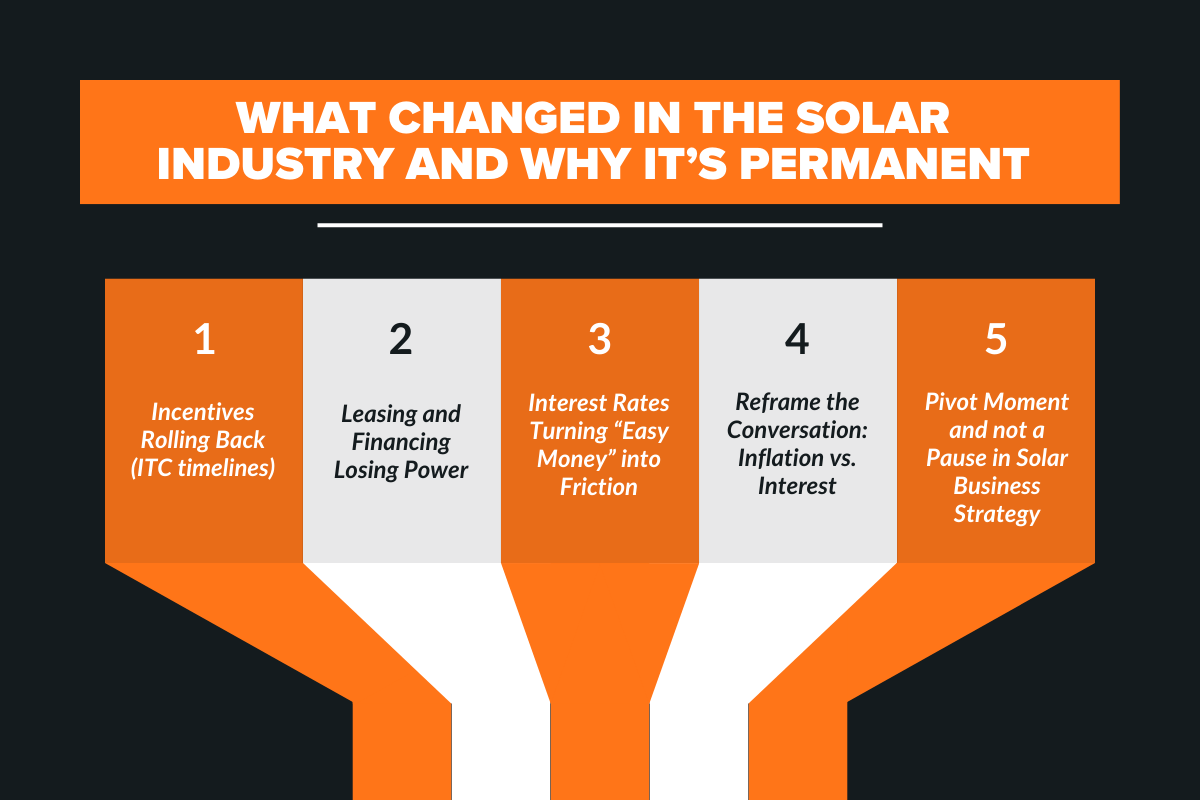
1. Incentives Rolling Back (ITC timelines)
The OBBA will end residential and commercial solar credits by 2025, with little chance of rollback until there is a political shift.
Instead of rushing, which creates bottlenecks in permits and installation, solar businesses should adapt to the new reality and plan strategically.
2. Leasing and Financing Losing Power
Many residential solar installers rely on leases and PPAs, which qualify for the ITC through 2027, but they face increasing risks due to rising equipment costs and higher interest rates.
Instead of getting entangled in the long-term deals in an uncertain market, solar installers can boost customer satisfaction by shifting them towards ownership offers with more transparent ROI.
3. Interest Rates Turning “Easy Money” into Friction
The Federal Reserve's interest rates were always low, but the real inflation has started with Fed rates increasing aggressively, which is the 'new normal'.
What once felt like “easy money” is now friction in the sales process, forcing solar businesses to rely less on financing-led growth and more on operational efficiency, clear value messaging, and strong fundamentals.
It has increased the total cost of solar panel loans, slowing down payback, adding to financial pressure, and tightening margins.
4. Reframe the Conversation: Inflation vs. Interest
The age-old sales pitches that once worked have become redundant under the new policy environment.
Content marketing strategy will take center stage, shifting every promotional message from simple savings to positioning solar as a hedge against inflation that the buyers really want to hear.
5. Pivot Moment and not a Pause in Solar Business Strategy
The current changes in incentives and tariffs are not temporary, but they represent a pivot moment where solar companies must rethink operations and sales strategies, focusing on delivering value that sustains loyal customers and engages potential ones.
Why Is Denial the Fastest Way to Kill a Solar Business?
The new bill eliminates federal incentives for solar investments, with no gradual phase-out.
Ignoring the end of federal solar incentives leads to failure; quick acceptance and strategic adaptation unlock long-term financial benefits.
The sooner you accept these changes and implement new strategies, the more financial benefits you can secure in the long run.
How Denial Shows Up Inside Solar Companies?
1. Planning like Last Quarter Still Exists
Denial is evident when marketing campaigns for solar solutions continue to rely on outdated incentive plans and ignore current market conditions.
Even powerful tools like Google Ads, which are essential for reaching target audiences, can fail when offers and messaging are not aligned with the new policy landscape.
2. Selling Outdated Offers
Denial is evident when your digital ads or door-to-door offers still promise incentives and low-interest rates based on the past decade’s solar playbook.
Selling outdated numbers tied to previous policies is a financial trap, and it can cause a structural collapse in your sales journey as prospects quickly realize your offers are irrelevant in the current market conditions.
Read More: Scaling Smart: Growth Strategies for Solar Businesses
The Real Cost of Waiting for the Old Market to Return
As Jack Welch states: “If the rate of change on the outside exceeds the rate of change on the inside, the end is near.”
Solar companies must actively participate in industry trade shows to stay informed about new incentives and regulatory shifts.
This awareness enables companies to pivot strategies quickly, strengthen lead generation, and build a pipeline of high-converting prospective customers.
Speed is the new subsidy, and the faster the company executes and adapts to policy deadlines, the stronger the result.
What Does a Strong Solar Business Look Like Without Incentives?
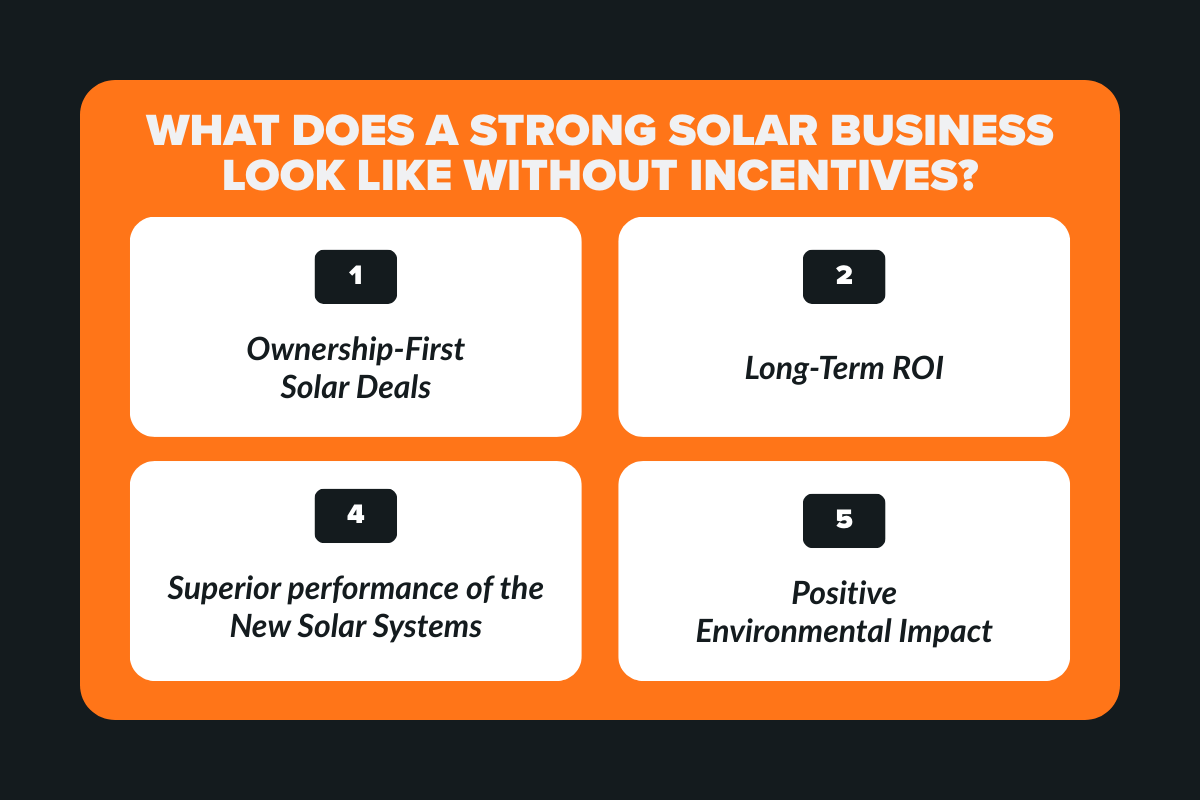
In a solar industry without incentives, companies must create educational content to drive organic traffic, guiding customers through higher upfront costs while emphasizing the real, value-driven benefits of solar solutions to strengthen the sales funnel.
The sales team should focus on guiding prospects around:
- Ownership-first solar deals that highlight control and independence
- Long-term ROI to show financial benefits over time
- Superior performance of the new solar systems without relying on free incentives
- Positive environmental impact to attract eco-conscious customers
Why Volume, Headcount, and Ad Spend Are No Longer “Strengths” for Growing Your Solar Business's Future
The more you invest in paid advertising for search engine rankings or build a large team of sales reps, the less it may matter in today’s solar market.
Big is not better anymore. Speed, adaptability, and value-driven strategies are the keys to success in an era of rapid policy shifts.
Smaller Local businesses that are agile can outperform larger competitors by leveraging expertise and credibility to earn customer trust in a market full of skepticism.
Local referral programs have become a dominant growth channel where satisfied customers amplify your reputation through Google reviews, and targeted marketing campaigns on social media platforms help build a micro-monopoly in your service area.
The New Definition of Strength: Anti-Fragile Businesses
1. Adaptability Over Size
The smaller companies that acquire agility in response to policy shifts can turn challenges into opportunities.
2. Clarity Under Pressure
Teams that wait for clarity may fall behind, but those who lead the change with clear direction and take the pioneer’s charge stand the best chance to win!
Why Speed Is the Only Real Competitive Advantage Left?
1. Speed To Cut Waste
Eliminate sales strategies, digital marketing tactics, and operational workflows that have become redundant due to new policy shifts.
2. Speed to Change Messaging
If you do not want to lose existing customers, act swiftly to price and financing options to seize opportunities before competitors, with a proactive response to policy shifts.
3. Speed to Execute
Permit delays, battery storage shortages, amidst policy changes require a quick move from a 90-day installation plan to a 30-day implementation before the scenario changes.
What Three Questions Must Every Solar Leader Answer Right Now?
1. What Part of My Solar Business Model No Longer Works?
Let us be honest! You need to identify whether your business still depends on leases, third-party financing, or tax incentives, all of which are disappearing into thin air.
Stop relying on “what used to work” and start adapting to the new reality.
2. What Is My Company Actually Good At Without Subsidies?
Incentives are gone, interest rates have sharply risen, and it is time for a brutally honest reality check.
Ask yourself: Does your team have the competency to execute quick installations? Do customers genuinely trust your company? Is your customer satisfaction strong enough to generate referrals?
You need to understand what edge you hold over your competitors, especially now, when the solar market is an open battlefield.
Success will come to those who combine smart tactics with quality execution.
3. What Does the New Solar Buyer Actually Want in 2026?
The real solar buyers want educational content, not a sales pitch.
They are already aware of market risks and uncertainties, so your role is to address their fears and needs.
You need to focus on providing long-term transparency that explains costs, ROI, system performance, and environmental impact to make informed decisions.
Explore More: The Complete Solar Sales Guide: Lead Gen, Qualification, Proposals, and Closing Strategies
Why Did “Easy Solar” Make the Industry Lazy?
Tax credits on renewable energy, lower interest rates, and heavy media buzz around long-term savings made the solar industry complacent.
Even average teams could succeed in their sales journey with minimal effort.
With the sweeping reforms under the Big Beautiful Bill, the era of “easy growth” is over.
Lead generation is no longer passive, and you need to fight for attention, shifting from incentive-driven growth to value-driven growth.
Dependence on subsidies and short-term wins no longer works. Today, conversions depend on quality, operational efficiency, long-term sustainability, and a truly customer-centric approach.
How the Boom Era Masked Bad Business Practices
Stat Alert: Backed by federal tax credits, solar surged to dominate the U.S. energy market and accounted for 55% of new power capacity in 2023, showing an increase from 44% the year before.
This revealed a boom in the industry, bringing higher demands, more margins, but in contrast to this, businesses unveiled practices that were not acceptable:
Solar Teams bloated without efficiency, and sloppy operations like manual scheduling, disconnected CRMs, and delayed installs became the norm.
These were tolerated because customers were already sold on solar incentives.
Now the tide has turned. With higher capital costs and incentives gone, only disciplined and efficient operators will survive. The era of easy growth is over.
Why the End of Easy Is a Competitive Filter
The sweep of the new bill has not shrunk the market, but it has filtered out the debris.
It has sifted out bad practices and amateur installers, leaving behind teams built on efficiency and value.
The industry may now have fewer players, but they will be far more skilled, disciplined, and value-driven solar panel contractors.
What Does “Getting Right” Actually Look Like in Today’s Solar Market?
1. Operational Shifts That Separate Survivors from Leaders
With demand dropping after policy shifts, the solar workforce has become leaner and more skilled.
Fast and reliable installations are now essential to delight customers, increase conversions, and generate referrals.
2. Offer and Positioning Changes That Build Trust
Policy changes have shifted the focus from “$0 down payment” and zero-interest offers to consultative selling that emphasizes clear outcomes and true energy ownership.
In the shifting landscape, what works is plain-language consultations that demonstrate expertise in local challenges and deliver real and practical solutions.
3. Margin Expansion Without Relying on Incentives
Solar Experts can tap into the growing electric vehicle segment by offering bundled EV charging with solar installations, adding extra value for customers.
Likewise, complementary home energy solutions, such as roofing or insulation upgrades alongside solar projects, and maximize the value of each installation.
These strategies boost overall revenue streams without relying on tax benefits.
Why Are the Best Solar Companies Acting While Others Freeze?
1. The Risk of “I’ll Decide Next Quarter” Thinking
The policy shift has been sudden, and any loss of momentum gives competitors the advantage, and if you fall behind, your path to recovery may be irreversible.
2. Why Action Creates Clarity — Not the Other Way Around
Clarity creates real action, not just noise. Waiting for the perfect time is sheer uncertainty. Decisive action to engage customers with new offerings can help you emerge as a winner.
When the Market Changes, Systems Matter: Why Sunbase Supports Adaptable Solar Teams
The solar market is no longer predictable, where incentives have suddenly disappeared, interest rates have surged, and supply chains face constant disruption.
The companies that survive and thrive are those fastest to adapt and execute.
As solar enters a new era in 2026, the Sunbase e-book gives your teams the tools to break barriers, move faster, and win in a market with rewritten rules.
Conclusion: This is a Leadership Moment — Not a Market Problem
The U.S. solar industry has entered a period of accelerated changes with tighter deadlines, vanishing incentives, shifting policies, lower interest rates, and supply chain risks.
This will test your resilience, but the solar industry has always progressed through adaptation. Success now requires innovative strategies and a mindset focused on winning.
You need to reform the new chapter of the solar industry rather than succumb to it.
Brace for the change, let go of outdated tactics, and move decisively.
The grass is always greener on the other side! To help you be on the brighter side, Sunbase e-guide can help you gain expert insights to navigate through the new solar industry.
The market is adjusting to new policy dynamics and structural bottlenecks. Gain expert insights to become practical leaders in the industry.
Get exclusive access to the Solar Shift Playbook to lead with confidence.
FAQ
1. Is the current slowdown in the solar industry temporary or permanent?
The slowdown is driven by changes in federal incentives, causing stock drops and project cancellations. It should be seen as a temporary structural pause, not a long-term decline. Solar businesses must adapt now, as demand is expected to rise after 2028 due to AI-driven energy needs and technological advances.
2. Can a Solar Business Survive without Government Incentives?
Solar business operations can remain sustainable without Government Incentives, as equipment costs have declined, and improved operating efficiency in business will build stronger customer trust, driving more sales.
3. What Should Solar Marketing Campaigns Focus on After the Policy Changes?
Solar marketing strategies must shift from incentive-based messaging to consultative selling, highlighting long-term ROI through educational content marketing strategies and the establishment of local credibility to drive referrals.
4. Can solar panel leases and PPAs prove to be a good option in 2026?
No, leases and PPAs are less attractive due to rising interest rates and higher equipment costs following the recent policy shifts in the solar industry, making ownership models the preferred focus.
5. How can Solar business build trust and generate leads after the new policy implementation?
Participation in local events can be a useful way to build trust and generate new leads. Obtaining positive customer testimonials on Google and social media platforms also enhances the trust of potential customers.
One Platform.
Zero Chaos.
Run Your Entire Business in One Platform
Sunbase replaces your CRM, proposals, scheduling, job tracking, and reporting tools — all inside one clean, connected platform.
About Sunbase
The All-In-One Platform to Run Your Entire Business
Sunbase helps you organize operations, streamline daily workflows, and manage everything - from first customer contact to final project deliver- in one connected system.
Our Mission
- Organize your business.
- Optimize your workflow.
- Automate your dailytasks
Why Businesses Choose Sunbase
One Connected Workflow
Replace scattered tools and manual processes with a single platform that brings together your team, tasks, customers, jobs, and performance data.
🌎 Global Presence
Serving the United States, Canada, India, LATAM, Australia, and 10+ international markets.
👥 11,000+ Users
Trusted by contractors, installers, project managers, sales teams, and field technicians.
🏗️ Built for All Sizes
From small contracting teams to fast-growing enterprises, Sunbase adapts to your workflow.
Stop Managing Your Business Manually. Automate It.
Sunbase automates workflows, reduces mistakes, and helps your team get more done - without hiring extra staff or juggling multiple tools.
Still Managing Your Business Across Multiple Tools?
Bring your CRM, proposals, projects, and operations into one platform built for contractors.

