
The solar age has dawned in the European Union, and it shines bright and bold as the continent’s ultimate Solar Powerhouse.
For the first time, solar energy has taken the lead, powering 22.1% of the region’s total energy mix, surpassing both nuclear and wind energy.
However, for solar installers, expansion across the East–West corridors of the EU is not a straightforward, sunlit path.
Progress requires navigating varied Bill of Materials (BOM) standardization rules, language barriers, country-specific compliance requirements, and workflow mismatches that can quickly slow momentum.
In this blog, we explore the key workflow challenges involved in solar panel design and implementation across the European Union and highlight how adopting unified solar design software helps address these complexities at scale.
Solar Software EU: Managing Multi-Country Design Compliance and BOM Complexity
Managing multi-country solar design compliance and BOM complexity across the EU means dealing with 27 variations of “the rules” instead of one. Every country has its own grid codes, safety standards, documentation formats, and approved components list, while procurement teams must align Bills of Materials with local regulations, import rules, and supplier constraints.
Add language differences, currency variations, and fragmented design tools into the mix, and even a well-planned project can slow down under rework, delayed approvals, and BOM mismatches.
This indicates that the unified solar design software is a "must-have" to eliminate obsolete workflows and the complexities of operating across multiple geographic markets within the EU.
Key Takeaways:
- The EU market is one of the most promising for solar businesses, but each country follows its own distinct regulatory compliance requirements.
- It is crucial to stay informed about new regulations on compliance and Bills of Materials (BOM) to ensure smooth procurement, solar design, and system installation to avoid project delays and costly penalties.
- Solar design software optimizes designs with precision, accuracy, and compliance readiness while generating accurate Bills of Materials (BOM).
- Sunbase is an all-in-one cloud-based platform that enables you to design, calculate, and execute solar projects with confidence across the European Union.
Before you dive in, consider this:
How many tools does your team switch between just to design, validate, and approve a single solar project in the EU?
If compliance checks, BOM updates, and proposal adjustments live in separate systems, complexity isn’t just increasing; it’s quietly slowing every project down. The best part? Switching to all-in-one isn't as painful as you'd think. See How Companies Make the Switch in about 12 minutes with a quick demo.
Why the EU Solar Market is Irresistible: Growth, Directives, and Opportunity
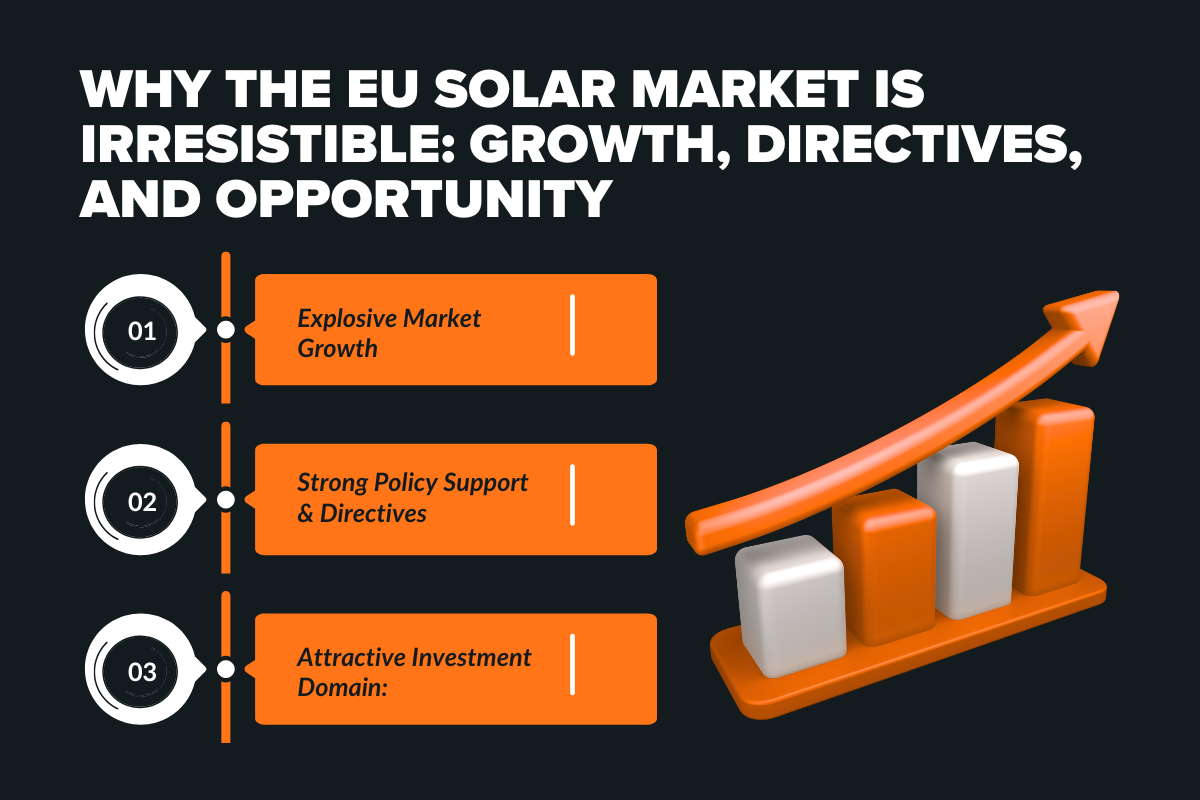
1. Explosive Market Growth:
The solar photovoltaic market is shining a bright light on its future, with 58% of EU solar PV installations in 2024 concentrated across major industrial sites.
The numbers show that solar energy is set to shape the future of solar sales, with expansion reaching beyond small utilities to major businesses and commercial hubs. It motivates solar contractors to expand into European regions that hold a bright and promising future.
2. Strong Policy Support & Directives:
Stats List: Snapshot into the Solar Market
- The EU solar sector is growing steadily, as the European Commission aims to reach at least 700 GW of solar PV capacity by 2030 (Source).
- The EU brings in the Solar Rooftop Initiative for new commercial buildings from 2027 and plans to refurbish existing ones with solar panels.
- The member states are also pushing for funds to remove bottlenecks in existing electricity grids for solar integration.
This creates new expansion avenues for every solar business to step into the next big energy revolutionary market in the EU.
3. Attractive Investment Domain:
The EU Funding Program has injected €95.5 billion to help solar companies expand across Europe through research and innovation grants, reducing R&D risks.
It enables faster EU market entry by solving compliance and BOM variation challenges with collaboration between the private sector and stakeholders, which simplifies the complex regulations.
Here's an example to highlight the positive impact:
The EIB reinforced this momentum with a €166 million loan to build 16 solar PV plants in Spain, Italy, and Portugal from the €500 million package targeting 1.7 GW capacity by 2026.
With incentives such as grants and tariffs, supported by advancements in the solar industry, the European Union has become a hotspot for solar contractors and installers looking to scale their operations.
Why EU Solar Projects Are More Complex Than They Look
1. Every Country, Every Rule — Understanding the Compliance Puzzle
With 27 countries in the European Union, there are 27 distinct sets of national directives to ensure solar panels fit smoothly without compliance obstacles.
Grid Connections have been standardized by the European Network Code, but Italy and Germany stand apart with their unique grid compliance requirements.
The Netherlands and Germany have experienced massive fires caused by solar panels, which have set unique solar installation safety requirement codes that make them distinct from other member countries.
Such strict compliance demands combined with disconnected systems create the perfect recipe for missed opportunities in the EU solar market.
The result? Lost documents, approval delays, multiple revisions, and missed deadlines culminate in missed opportunities to enter the EU market.
2. The BOM & Procurement Nightmare
Each EU country follows its own import regulations for solar components such as panels, chimneys, inverters, and mounting equipment.
If you think a single rulebook will work for Italian, German, and French solar clients, you will encounter BOM compliance mismatches, leaving you stuck in procurement bottlenecks that can drag on for months.
This matters because it prevents delayed shipments, regulatory penalties, and lost solar project opportunities to your competitors.
3. The Currency and Language Factor
The EU celebrates its multilingual entity with 24 official languages, and when you fail to connect to customers in their local language, you stand a strong chance of losing business and revenues.
Eye-opening Insight: 11% of businesses have lost contracts due to a lack of language skills.
Multi-currency invoice generation and payment processing reduce conversion fees and shield against unfavorable exchange rate shifts to bring better cash flow.
Exploring the
Environmental Benefits of Solar Design Optimization is something you would like to explore that most teams overlook.
What is Unified Solar Design Software (and Why is it Essential for EU Expansion)?
It refers to a specialized tool used to create precise and detailed PV system layouts with 3D dimensions, shading analysis, and energy projections for various components such as inverters, batteries, and panels, serving as a blueprint for the complete solar system installation process.
The software also addresses the complexities associated with the EU’s dynamic regulatory landscape by:
1. Navigating Fragmented Regulations and Compliance:
Unified solar design platforms help teams manage compliance by supporting country-specific standards, configurable local rules, and structured design checks. Instead of reacting to issues late in the project, teams can identify potential compliance gaps early in the design phase.
It sounds an alarm before a breach of any regulatory or safety standards, keeping your solar projects compliant from the initiation stage.
2. Rapid Scalability and Efficiency:
The cloud-based solar design software allows multiple users to access the database from different locations across the EU without the need for physical site visits.
The solar design software can also adapt to varying project requirements and job site conditions across different regions.
3. Accurate Project & Financial Analysis:
Solar Design Software like Sunbase helps you gain precise economic projections with a clear financial blueprint of varied solar panel installation expenses and profit returns based on subsidies, rebates, and electricity rates aligned to local EU incentives.
These precise economic projections and performance insights help adjust strategies to sustain long-term financial stability.
4. Enhanced Collaboration and Communication
If your solar design workflow is not connected to your business software, your project will always have gaps that delay progress and weaken performance, just like a puzzle with missing pieces!
But solar design software like Sunbase seamlessly integrates with other business systems, streamlining the entire process from design to installation.
It accelerates proposal generation and forecasts financial performance, helping you close more deals and stay on the path of consistent financial growth.
How Does Unified Solar Design Software Ensure Compliance and BOM Accuracy Across the EU?
1. Centralized BOM and Compliance Management:
The cloud-based platform features a centralized digital repository where every solar design is updated in real-time and accessible to every team member.
This ensures projects progress smoothly across different EU countries while meeting their specific regulatory requirements and also benefiting every team member within their role-based scope of responsibilities:
- Engineers can review detailed technical drawings for solar and roof designs, shading analysis, solar panel system sizing, electrical grids, battery and storage capacities, as well as inverter performance.
- Procurement teams can verify compliance with EU regulatory bodies and maintain accurate inventories by calculating materials lists for each project for the Bill of Materials (BOM), to prevent supply chain disruptions.
- Project managers can oversee on-site work progress, ensuring proper labor management and the enforcement of safety standards across all locations.
2. Adaptive Design Templates:
Modern PV design software enables installers to create accurate PV array designs within hours that eliminate manual errors and offer instant system simulations.
- The built-in ‘Country Profiles’ feature allows users to pre-load the necessary regulatory requirements for various EU nations, which wipes out the constant chaos of operational permit delays across multiple countries.
- Software solutions can deliver comprehensive and interactive views of solar design proposals with easy switching between 2D and 3D modeling to visualize shading, roof layouts, and overall solar installation.
- It creates branded, interactive proposals with a clean layout, organized information, and a built-in e-signature with instant payment options to drive quick client action.
Why Multilingual and Multi-Currency Workflows Create Friction in EU Solar Projects?
Expanding solar operations across the EU doesn’t fail because of poor engineering. It slows down because everyday operational details—language, currency, documentation, and approvals—don’t scale cleanly across borders.
What starts as a small workaround quickly becomes friction across design, finance, procurement, and execution. Below is where teams struggle most—and how the right workflow fixes it.
1. Language gaps slow decisions, even when the design is solid
The problem:
When proposals, technical documents, or compliance notes aren’t available in a stakeholder’s local language, projects slow down. Clients request clarifications, local partners misinterpret scope, and approvals take longer than expected—even when the system design itself is accurate.
The solution:
Solar software maintains a single system design as the source of truth. From that same design, it automatically generates:
- Proposals in local languages
- BOMs aligned to country-specific component rules
- Pricing in the correct local currency
This eliminates duplicated files, reduces version errors, and ensures every stakeholder works from consistent data.
2. Currency Mismatches Distort Project Economics
Using different currencies across proposals, BOMs, and financial summaries can skew project costs and margins. These discrepancies often surface late, during approvals or procurement, when corrections are costly.
Solution:
Solar software applies automated, location-based currency logic. Quotes, financial forecasts, and invoices are generated in the correct local currency using consistent conversion rules, protecting margins and ensuring financial transparency across teams
3. Finance and procurement teams struggle to reconcile numbers
When design outputs, BOMs, and invoices exist in different formats or currencies, internal teams spend time validating numbers instead of moving projects forward. This creates approval bottlenecks and delays procurement.
Solution:
Centralized, standardized outputs ensure that finance and procurement teams receive BOMs and cost breakdowns in consistent, country-specific formats. This makes validation faster, approvals cleaner, and procurement more predictable.
Key Features of the Solar Design Software for Installers Operating Across the EU
| Key Features | Description | Benefit for EU Installers |
|---|---|---|
| Compliance with Local Regulations | Automated compliance tracking for country-specific needs. | Upgraded to the latest compliance regulation to minimize the risk of project delays or costly fines. |
| Multi-Country Tariff/Incentive Logic | Real-time updates of local tariffs | Accurate quotes make the project more profitable. |
| Rapid & Intuitive Design Tools | Customizable, accurate CAD files in 3D for solar systems, within minutes on a user-friendly interface | 37% faster Project Completion and cut design time by 30-50% |
| High-Resolution Shading & Irradiance Modeling | Precise shading analysis visuals for maximum energy output and optimized panel placement. | Reduces costly post-installation redesigns. |
| Multilingual Proposal Generation | Client proposals generation in multiple European languages languages | Enhance communication that helps close deals faster |
| Bill of Materials (BOM) & Exports | Detailed BOMs with export-ready formats for procurement teams. | Simplifies cross-border purchase and prevents costly procurement errors |
| Integrated Project & Sales Management | One platform that connects design, sales, and operations teams for a smooth sales process | Streamline workflow across EU regions |
| Accurate Energy Production Forecasts | AI-powered technology to analyze shading analysis, tilt, and weather for long-term solar performance | Realistic ROI projections to devise smarter projects |
| Cloud-Based Accessibility & Updates | Secured platform with open data integration | Real-time access to all project modules from any location for seamless collaboration across the EU. |
| Scalability for Project Sizes | Supports both commercial and residential projects | Suitable for solar businesses of any size across the EU |
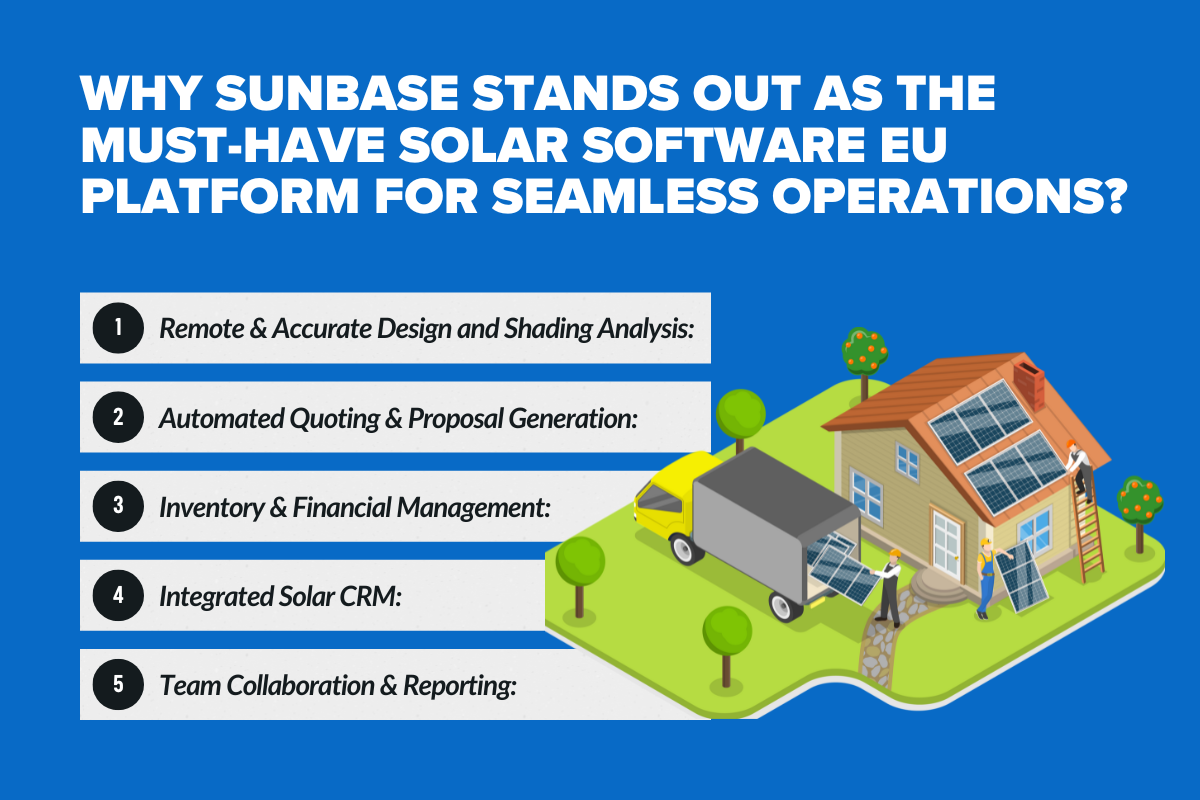
1. Remote & Accurate Design and Shading Analysis:
As a cloud-based platform, it enables solar designers to remotely design and simulate solar system outputs with precision, without the need to physically set foot on the job site.
The software integrates Geographic Information Systems (GIS), LiDAR data, and satellite imagery with real-time weather information to perform detailed shading analysis and assess system efficiency for year-round performance.
It allows the creation of editable solar designs for multiple EU locations, empowering solar professionals to conduct accurate pre-installation assessments and ensure maximum energy output from every project.
2. Automated Quoting & Proposal Generation:
Sunbase Solar Software is your trusted partner for creating detailed PV system designs with precision and speed.
It uses a real-time database to calculate labor, equipment, and permit charges specific to each EU country, requiring only basic project inputs from solar designers, while the software manages the complex calculations for roof layouts, shading, and solar panel configurations.
The platform enables users to create fully customizable, visually appealing solar proposals using pre-built templates that feature 3D views, accurate pricing, and detailed project visuals.
These professional proposals showcase expertise and professionalism, building instant trust and helping close deals faster.
3. Inventory & Financial Management:
Sunbase's advanced solutions for inventory management use GPS and a barcode scanning system to monitor every solar asset in real-time at multiple locations across the EU operational range. This ensures compliance with stringent local country regulations.
The platform consolidates all inventory data into a single, user-friendly dashboard, minimizing inventory waste and stockouts.
Solar managers across the EU gain insights from ready-made analytical reports that provide deep insights into financial performance, enabling strategic decision-making for better business.
4. Integrated Solar CRM:
Sunbase is a specialized tool to design solar PV systems, proposal generation, precise BOM generation, and quick invoice creation, fitting the multi-lingual and multiple currencies needs for every EU country.
It automates and streamlines the entire project lifecycle from initial design to completion in the dynamic European Union region to maintain compliance and customer trust.
5. Team Collaboration & Reporting:
Sunbase software solution helps overcome cross-border challenges for solar firms operating across diverse business environments with in-built collaboration features.
It permits instant two-way communication and shared dashboards to upload documents, job status, and project details on a mobile app.
This creates transparency, accountability, and workflow efficiency across all project stages.
Conclusion: Multi-Nation Solar Operations with Unified Solar Design Software
Every country in the European Union operates by its own set of rules. The Bill of Materials (BOM) serves as a crucial input that solar installers must include in project evaluations to demonstrate EU compliance.
Without proper BOM management and compliance alignment, a company risks losing its ability to deliver quality output while becoming exposed to legal penalties, supply chain vulnerabilities, and project delays that pull it away from success.
Take the first step with confidence into the EU region with Unified Solar Design Software.
Managing the unique Bill of Materials, electrical standards, and compliance regulations across the EU can be chaotic, but Sunbase has you covered!
Take a quick tour with our experts to discover how the solar software can help you overcome cross-border challenges! Book a Personalized Demo Now!
FAQs
1. Is it mandatory to use the local language in solar proposals in the EU?
The European Parliament has adopted a multilingual policy requiring all official documents to be translated into the official languages of EU member states. As a result, solar proposals must be prepared in English and at least one official EU language. In addition, several funding programs and public consultation documents have made the use of local languages mandatory to ensure transparency and compliance across the region.
2. Which EU Countries have the Most Complex Grid Connection Rules?
Expert Industry reports reveal that Western EU countries such as Germany, France, and Ireland, as well as Eastern Nations like Slovakia and Hungary, have some of the most complex grid connection processes in the region.
3. What is the Digital Product Passport (DPP), and how does it affect solar installers?
The Digital Product Passport (DPP) is an EU initiative under the Circular Economy Action Plan, designed to ensure transparency and sustainability across a product’s entire lifecycle.
For solar installers, it mandates maintaining key information about solar panels from the materials used to their carbon footprints. Installers are required to provide open data on solar systems to support regulatory compliance and facilitate recycling.
4. Can Solar Design software Handle Multi-Currency Quotes and Invoices?
Solar design software built for multi-country operations includes integrated financial tools that enable seamless invoice generation and quote creation in local currencies. These platforms also support multi-currency transactions for compliance across diverse financial systems in different EU markets.
One Platform.
Zero Chaos.
Run Your Entire Business in One Platform
Sunbase replaces your CRM, proposals, scheduling, job tracking, and reporting tools — all inside one clean, connected platform.
About Sunbase
The All-In-One Platform to Run Your Entire Business
Sunbase helps you organize operations, streamline daily workflows, and manage everything - from first customer contact to final project deliver- in one connected system.
Our Mission
- Organize your business.
- Optimize your workflow.
- Automate your dailytasks
Why Businesses Choose Sunbase
One Connected Workflow
Replace scattered tools and manual processes with a single platform that brings together your team, tasks, customers, jobs, and performance data.
🌎 Global Presence
Serving the United States, Canada, India, LATAM, Australia, and 10+ international markets.
👥 11,000+ Users
Trusted by contractors, installers, project managers, sales teams, and field technicians.
🏗️ Built for All Sizes
From small contracting teams to fast-growing enterprises, Sunbase adapts to your workflow.
Stop Managing Your Business Manually. Automate It.
Sunbase automates workflows, reduces mistakes, and helps your team get more done - without hiring extra staff or juggling multiple tools.
Still Managing Your Business Across Multiple Tools?
Bring your CRM, proposals, projects, and operations into one platform built for contractors.