
Audio overview: Listen & Learn
India’s solar market doesn’t operate like the rest of the world, and installers here feel that difference every day. Between state-wise DISCOM rules, subsidy paperwork, GST billing, and the sheer variety of rooftop structures, generic global software often falls short.
Therefore, Indian installers need tools built for local realities, not adapted after the fact. This is where region-specific solar software becomes essential.
The right platform should understand how Indian teams survey sites, design layouts, manage permissions, and handle documentation across multiple states.
When software aligns with these on-ground workflows, projects move faster, errors drop, and installers deliver a smoother experience to customers.
Why Solar Software India Needs to Be Built Differently for Installers
If you’ve tried running a solar installation team in India with software built for the US or Europe, you already know the pain. The subsidy forms never line up, the invoices don’t support GST, and field teams struggle with bulky apps in low-network areas.
Solar installation in India plays by different rules. Government schemes, DISCOM approvals, diverse languages, and price-sensitive clients shape every step of the process.
Most global tools miss these details, which is why solar software India must be built around local workflows instead of forcing installers to rely on spreadsheets, WhatsApp chats, and extensive manual work.
This blog explores why India-first solar software has become essential for faster execution, better compliance, and smoother project management across states. And by the end, you’ll see how Sunbase is built specifically for these realities.
Let’s take a closer look at what truly sets India apart in the solar industry.
Key Takeaways
- India’s solar workflows demand a level of localization that generic global software often cannot offer.
- Subsidy-linked documentation, DISCOM approvals, and complex state-specific rules shape installers' daily workflow.
- Field teams need mobile-first, multilingual apps that work in low-data conditions, which most foreign tools do not provide.
- Billing, currency, and tax structures in India are entirely different from those in Western markets and require proper GST-ready formats.
- Sunbase bridges these gaps with an Indian-first approach built around real local needs.
Before going further, ask yourself this:
How many logins, spreadsheets, and manual handoffs does it take to finish one solar project today?
If it feels messy, that’s because most global tools were never built for India’s subsidy-driven, approval-heavy workflows. Seeing how an all-in-one, India-focused system works often takes less time than chasing down a single missing document. Take a closer look at how Sunbase simplifies daily operations.
Why India’s Solar Market Cannot Rely on Western-Built Tools?
Walk into any solar business in India, and you’ll find subsidy tracking, paperwork, and client follow-ups scattered across photos, PDFs, Excel sheets, and WhatsApp. This isn’t due to a lack of interest in better tools but because Western software doesn’t match India’s subsidy-heavy, approval-driven, region-specific workflows.
Here’s why global tools fall short in the Indian market.
> Heavily Regulated, Subsidy-Driven Solar Installations
If you have worked in the solar business in India, you already know how central subsidies are. For many clients, the financial analysis of solar energy does not work without government incentives. That means every installation comes with a long list of forms, site images, identity documents, and approval steps.
Here is where Western software typically struggles. It provides generic workflow stages such as survey, proposal, installation, inspection, and commissioning. But in India, the journey includes concrete steps:
- Uploading documents for national and state-level subsidies
- Filling out DISCOM-specific forms
- Tracking feasibility approval
- Submitting installation photos in the correct format
- Waiting for inspections
- Coordinating meter installations
None of this is optional. Western software tends to treat compliance as a simple checklist rather than a detailed, mandatory workflow.
When installers try to use these platforms, they usually end up doing half their work inside the software and the other half manually. This defeats the purpose of having software in the first place.
Subsidy tracking needs structure. It needs precision and needs to be mapped directly into the everyday project management flow.
> State-by-State DISCOM Requirements
India’s solar sector operates differently across states. If you operate in Gujarat, your process looks very different from someone working in Rajasthan, Tamil Nadu, or Karnataka.
Even within the same region, DISCOMs can have various formats, deadlines, and portal requirements. Some require multiple on-site visits.
Some need inspection photos stitched together in specific layouts. Some need applications routed through a mix of digital and offline steps.
Global solar software usually assumes that approvals are standard everywhere. That assumption doesn’t hold up in the Indian solar industry.
For installation companies working across states, this becomes even more painful. They cannot force a uniform workflow because the rules themselves are not uniform. The software solution needs flexibility on the backend so the field experience can stay simple.
> India’s Price-Sensitive Market Dynamics
The Indian market is incredibly price sensitive. Clients compare prices from three or four installers and expect detailed breakups, fast solar designs, and quick financial analysis. Installers need the most accurate solar estimates, real-time inventory awareness, and flexible discount structures.
Western CRMs often assume stable pricing and high margins. They may not offer:
- Vendor comparison tools
- State-wise price lists
- Dynamic pricing inputs
- GST-compliant quotations
- Automated subsidy calculations
This forces installers to calculate things outside the system and manually adjust sales proposals. That alone can slow down the sales process significantly and confuse the client.
A software solution for solar in India needs to reflect local pricing behavior and give the sales team easy-to-use tools so they can respond quickly to every lead capture.
> Workforce Structure and On-Ground Realities
Anyone who has managed a field team in the solar industry knows how challenging it can be. Most workers rely entirely on mobile phones. Many speak regional languages. Some work in rural or semi-urban areas where the network often drops. All of this means the software must be simple, light, and mobile-first.
Western tools are usually built with desktop-heavy interfaces meant for office environments. That is not how India operates.
Here is what Indian field teams truly need:
- Offline access
- Fast-loading mobile pages
- Language options like Hindi, Gujarati, Tamil, Telugu, Marathi, and more
- Quick upload of photos and documents
- On-site task lists that do not overwhelm them
Software should make life easier, not harder. Moreover, field execution is a major aspect of any solar project. If your team struggles to update data or follow the process, the entire solar project slows down.
Operational Challenges Unique to Indian Installers
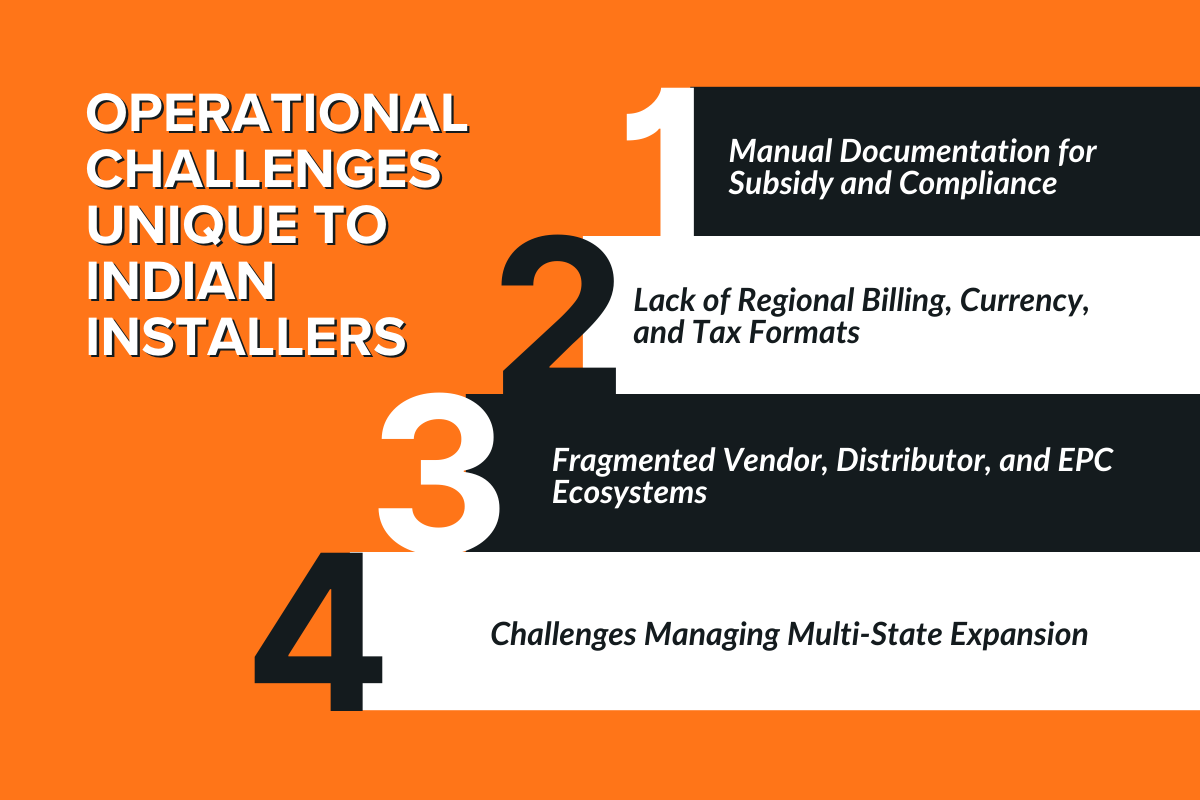
It is one thing to say that India is different. It is another to look closely at the struggles installation teams face every day. These problems are not theoretical. They are real, and they affect everything from client satisfaction to revenue.
Here are the challenges most installers face when using software that is not designed for India.
Manual Documentation for Subsidy and Compliance
Every solar installation comes with a huge amount of documentation. Identity proofs, property papers, application forms, on-site photos, inspection reports, sanction letters, and more. Global software tends to offer generic document upload fields, but nothing structured for local requirements.
Installers often create their own folders, sometimes naming files in ways only they understand. When the audit happens, they scramble to find all the documents. The process becomes stressful, and mistakes lead to delayed subsidy disbursement.
Imagine if the software already had the correct checklist for your state. Imagine if forms auto-filled client data pulled from the CRM. That would save hours of work.
Lack of Regional Billing, Currency, and Tax Formats
Billing in India is complex. Installers need invoices that include:
- GST rates
- HSN codes
- CGST, SGST, IGST breakdown
- Indian currency rounding
- Flexible discount formats
Try generating this with software designed for the US, and you’ll immediately see how mismatched the system is. Western tools often assume simple tax structures without state-specific tax handling.
For solar businesses in India, proper financial documents are not a bonus. They are a requirement for clients, auditors, and government schemes.
Fragmented Vendor, Distributor, and EPC Ecosystems
India’s solar supply chain is highly fragmented. Installers work with multiple vendors based on region, pricing, and availability. A single solar project can involve three different suppliers.
To stay profitable, installers need:
- Real-time access to vendor pricing
- Comparison tools to pick the best rates
- Awareness of available stock
- Local procurement support
Most foreign software never considers this. They assume installers have standardized vendor agreements. But in India, vendor relationships are built on negotiation and convenience.
Solar project management becomes much smoother when the software can integrate with local vendors and display updated rates and materials.
Challenges Managing Multi-State Expansion
When a solar business tries to expand to another state in India, the first hurdle is usually compliance. The rules are completely different. Even something simple like a site survey checklist changes.
Without localized software, multi-state expansion becomes messy. Teams rely too heavily on manual communication, managers struggle to maintain visibility, and workflows become inconsistent.
A unified yet flexible system is the only way to scale properly.
What Regionally Tailored Solar Software Should Offer: India Edition

If we were to imagine the perfect solar software for India, it would not be a copy of Western platforms. It would be designed based on the real ground-level needs of Indian installers. It would support the entire lifecycle of solar project management and give teams the confidence that nothing is missing.
Here is what truly Indian-first software should include:
1. Automated Subsidy Workflow Management
Subsidies sit at the core of most solar installations in India, so the software you use must manage them intelligently and without friction. A well-built system should simplify every step and eliminate repetitive manual work that often slows teams down.
Key features should include:
- Preloaded subsidy templates tailored to national and state programs
- Automated form creation with client and project data filled in instantly
- Workflow tracking aligned with each state’s rules and approval stages
- Document reminders to prevent missing any mandatory upload
- Submission status updates that keep teams informed at every step
Together, these capabilities accelerate the entire process, reduce errors, and protect businesses from delays that can affect cash flow and client satisfaction.
2. DISCOM-Aligned Compliance Modules
Every state’s DISCOM has its own rules, documents, and approval process. In an ideal solar software environment, each DISCOM should work like a plug-and-play module. The moment an installer selects the state, the entire workflow should automatically reconfigure to match that region’s requirements.
A DISCOM-ready module should include:
- State-specific checklists
- Required document lists with clear upload prompts
- Step-by-step approval stages tailored to each DISCOM
- Inspection reminders for site visits and meter installations
- Portal integration wherever digital submissions are supported
Installers should never have to memorize processes. The software should guide them naturally, ensuring compliance without the stress of keeping track of shifting rules.
3. Local Inventory and Vendor Price Integration
Profitability in the solar business depends heavily on having clear visibility into material costs and availability. Installers need real-time insights to accurately price, avoid delays, and stay competitive.
Essential capabilities include:
- Local market rates updated for different regions
- Material availability from nearby distributors
- Vendor comparisons to help choose the best prices
- Forecasting tools for upcoming solar projects and procurement planning
With these features in place, installers can create accurate solar estimates, respond faster to leads, and deliver polished proposals with confidence.
4. Mobile-First, Multilingual Field Apps
Field teams are at the heart of every solar installation, which means the software they use must be simple, fast, and built for real on-site conditions. A truly India-first solution should empower technicians rather than slow them down.
Key requirements include:
- Support for Indian languages to suit diverse regional teams
- Lightweight mobile experience that loads quickly and runs smoothly
- Offline mode for low-network or no-network areas
- Quick image capture for surveys, inspections, and documentation
- Easy task management so technicians can update progress effortlessly
When the app fits naturally into a technician’s workflow, execution becomes smoother, faster, and far more reliable.
5. GST-Compliant Billing and Indian Currency Support
Billing for solar projects in India is complex, which makes it essential for software to handle everything from HSN codes to multi-state GST calculations. A regionally aware system should simplify financial workflows instead of adding more manual work.
The billing module should support:
- Indian currency formats with proper rounding rules
- State-specific tax structures, including CGST, SGST, and IGST
- Auto-filled details pulled from client and project data
- Custom discount options suited for competitive pricing
- Easy sharing via WhatsApp or email for quick client communication
These capabilities make financial analysis clearer, help deliver professional documents, and build greater confidence during the sales process.
Future Trends Shaping India’s Solar Software Needs
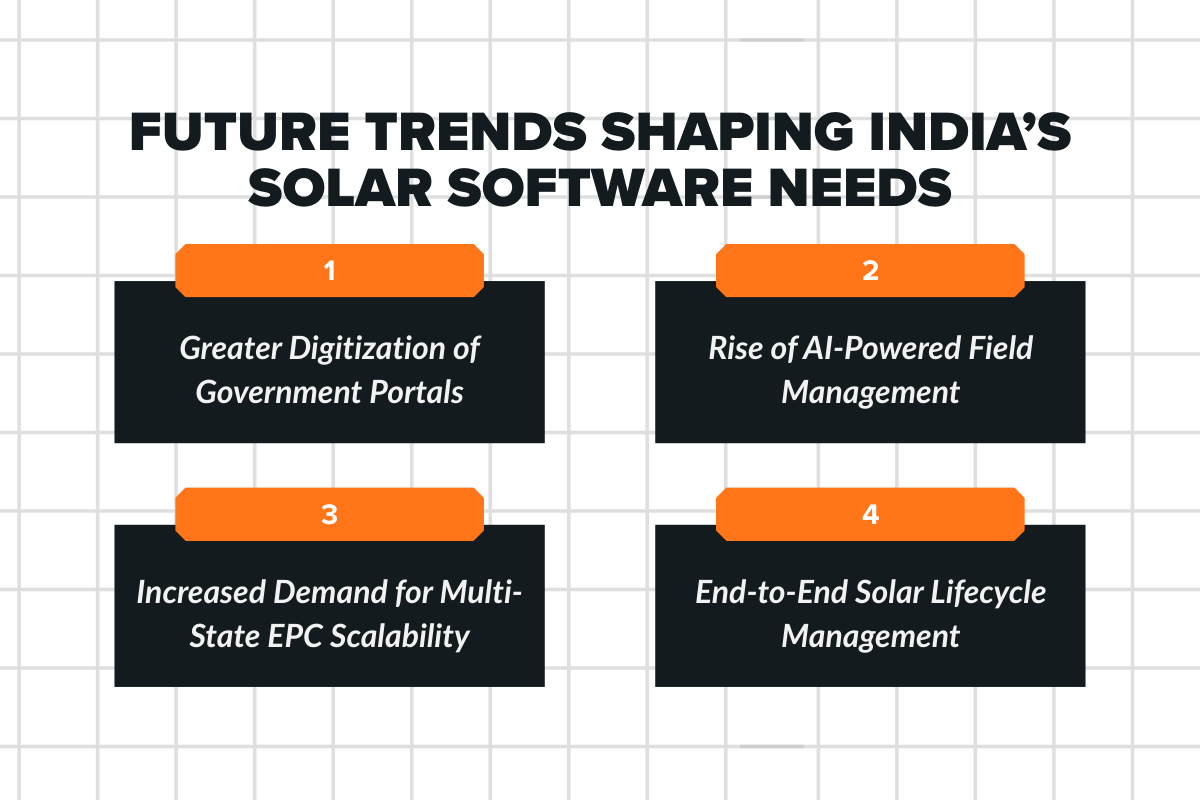
The solar industry is changing quickly. India is moving toward a more digital, interconnected future. Software that cannot evolve will soon become outdated.
Here are the trends shaping what installers will need next:
1. Greater Digitization of Government Portals
As government portals upgrade, installers can expect more digital steps in subsidy processing and DISCOM approvals. Software must be ready for future integrations, e-signatures, and real-time submission tracking.
2. Rise of AI-Powered Field Management
Advanced features will help teams spot issues early, manage service calls, and even detect installation faults through image uploads. This can make maintenance smoother and reduce long-term operational costs.
3. Increased Demand for Multi-State EPC Scalability
Large EPC companies will need tools that allow managers to track projects across regions through consolidated dashboards. Software will need smarter reporting, unified workflows, and flexible regional rules.
End-to-End Solar Lifecycle Management
India is shifting from one-time installation to long-term service. Software must support:
- Design
- Installation
- Commissioning
- AMC
- Service workflows
This will help companies keep clients engaged long after the system goes live.
Addressing India’s Solar Challenges With Purpose-Built Software Sunbase
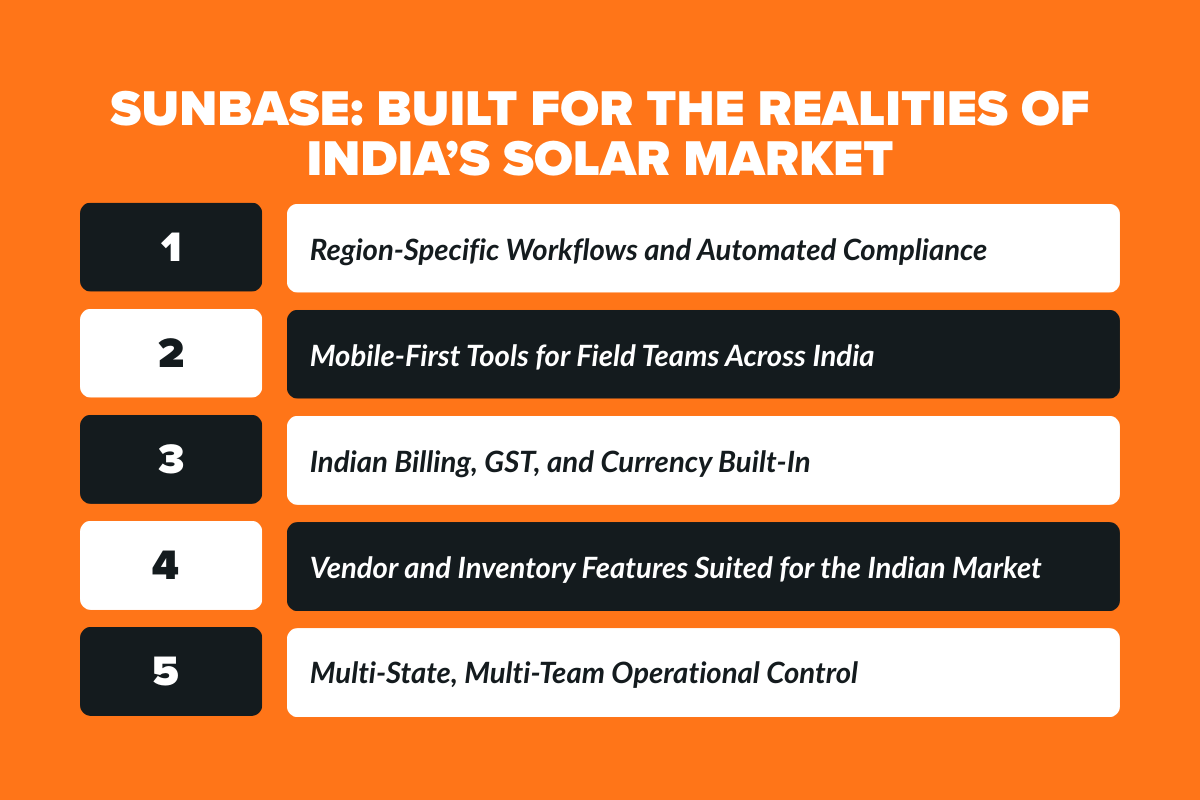
This is where Sunbase stands out. Unlike other tools that try to fit India into a template, Sunbase is designed around the daily challenges faced by Indian installers. Every feature reflects local needs, state-specific requirements, and the practical way teams work across the country.
1. Region-Specific Workflows and Automated Compliance
Sunbase includes:
- Subsidy-ready workflows
- Preloaded DISCOM formats
- Auto-generated forms
- Checklists tailored for each state
This reduces manual effort and keeps installers compliant with regional rules.
2. Mobile-First Tools for Field Teams Across India
Sunbase’s field app is quick, simple, and works even with low connectivity. Technicians can update tasks, upload photos, and track project steps without feeling overwhelmed.
3. Indian Billing, GST, and Currency Built-In
Invoices are automatically created in the correct GST format. Discounts, taxes, and price variations are handled smoothly. Installers can share documents instantly with clients.
4. Vendor and Inventory Features Suited for the Indian Market
Sunbase connects installers with local distributors, helps compare prices, and forecasts material needs. This improves accuracy and simplifies procurement.
5. Multi-State, Multi-Team Operational Control
For companies expanding across India, Sunbase offers:
- Centralized dashboards
- Workflow standardization
- Region-specific settings
This keeps operations steady even with complex regional rules.
Bringing It All Together
India’s solar industry is not a copy of Western markets. It has its own identity, challenges, and rhythm. Installers deal with subsidy-dependent workflows, multi-state regulations, a price-sensitive market, and field teams that need simple tools to keep up.
Using Western-built software in this environment creates friction at every step. It slows down the sales process, leads to compliance mistakes, and increases operational effort.
The solution is clear: India-first solar software is essential for modern solar businesses. It streamlines project management and maintenance, simplifies documentation, supports multilingual teams, and keeps every workflow aligned with regional rules.
Sunbase gives installers the confidence that every project, every document, and every client interaction is handled with a system designed for the real world they operate in.
If you want to boost efficiency, reduce errors, and scale your solar business without chaos, now is the time to adopt tools built for India, not adapted to it.
Start Managing Every Solar Project With Confidence and Compliance
Take control of your installations with software that simplifies every step, reduces errors, and keeps your entire team aligned from survey to commissioning.
Book your demo with Sunbase and see how things change for your business in a positive manner
FAQs
1. Why do Indian solar installers need region-specific software with the realities of solar in India?
Because India’s workflows depend on subsidies, DISCOM rules, and GST billing, which global tools do not support effectively.
2. How does localization improve the solar sales process for renewable energy companies?
Localized software aligns with state rules, gives accurate solar estimates, simplifies documentation, and improves communication with clients.
3. What features are essential in solar software for the Indian market, with the growing demand for solar installations?
Subsidy automation, GST-ready billing, mobile-first apps, multilingual support, and region-specific compliance modules.
4. Can regionally tailored software help installers scale across states with the correct data and project workflows?
Yes, because it standardizes operations while still adjusting to different state regulations.
5. What makes Sunbase suitable for solar businesses in India, and how does it support our solar operations?
Sunbase includes state-specific workflows, DISCOM templates, GST billing, vendor integration, and mobile tools designed for Indian field teams.
One Platform.
Zero Chaos.
Run Your Entire Business in One Platform
Sunbase replaces your CRM, proposals, scheduling, job tracking, and reporting tools — all inside one clean, connected platform.
About Sunbase
The All-In-One Platform to Run Your Entire Business
Sunbase helps you organize operations, streamline daily workflows, and manage everything - from first customer contact to final project deliver- in one connected system.
Our Mission
- Organize your business.
- Optimize your workflow.
- Automate your dailytasks
Why Businesses Choose Sunbase
One Connected Workflow
Replace scattered tools and manual processes with a single platform that brings together your team, tasks, customers, jobs, and performance data.
🌎 Global Presence
Serving the United States, Canada, India, LATAM, Australia, and 10+ international markets.
👥 11,000+ Users
Trusted by contractors, installers, project managers, sales teams, and field technicians.
🏗️ Built for All Sizes
From small contracting teams to fast-growing enterprises, Sunbase adapts to your workflow.
Stop Managing Your Business Manually. Automate It.
Sunbase automates workflows, reduces mistakes, and helps your team get more done - without hiring extra staff or juggling multiple tools.
Still Managing Your Business Across Multiple Tools?
Bring your CRM, proposals, projects, and operations into one platform built for contractors.