
For years, solar had a silent closer. It wasn’t the best panels. It wasn’t smarter reps. It wasn’t even a stronger pitch. It was the 30% federal tax credit.
That single line on the proposal did more closing than most sales reps did. It turned an expensive system into an affordable investment with one signature. Pair it with $0-down loans and leases, and the industry experienced a period of readily available credit where deals nearly closed on their own.
As of the present, tax credits are sunsetting. Loans are more expensive. Leases are losing their appeal. And now the industry is facing a reality check: If your offer only worked because of incentives… it was never strong to begin with.
Welcome to value-based solar selling, where discounts don’t do the talking, and the product has to stand on its own.
How to Sell Solar Without Tax Credits: A Practical Guide to Solar ROI Analysis and Value-Based Selling
Selling solar without tax credits is just the start; it shifts the focus to actual value. Homeowners no longer fall for discounts; they want transparency, control, and genuine solar ROI analysis.
This new age is about long-term savings, energy independence, and treating solar as an asset, not a discount. When electricity rates keep climbing, doing nothing costs more than going solar.
Value-based selling wins because it focuses on ownership, resilience, and smarter decisions. If you can sell why solar matters, you won't need additional convincing.
Key Takeaways
- The 30% tax credit was a crutch, not a sales advantage. Incentives closed deals faster than strategy, but as they fade, only companies offering real value will win.
- Solar ROI is still valid but needs to be explained, not discounted. Modern Buyers focus on long-term ROI, ownership, and protection from rising utility costs, not short-term incentives.
- Cash buyers are setting the new standard for solar sales. They move faster, trust clearer math, and reward transparency.
- Value-based selling fails without strong execution systems. Clean proposals, accurate ROI analysis, operational follow-through, and software are now essential to building trust and closing confidently.
Think tax credits are the only way to close a solar deal?
Well no! You are about to find out how smart solar companies are winning customers by selling the real value of solar, and we'll show you exactly how to do it, too.
Tap here to get the full picture in our Solar Shift Series.
What Changed in the Solar Market and What’s Not Coming Back?
For over a decade, the unspoken closer in solar sales wasn’t charisma, technology, or your proposal design. It was the federal tax credit.
Why the Federal Tax Credit Was the Real Closer?
- That 30% incentive quietly turned a $30,000 solar panel system into a $21,000 decision overnight.
- It shortened the solar payback period and made the initial cost feel lighter before any discussion of energy savings started.
- Combine that with “no-money-down” leases and reasonable loans, and the industry fell into automatic sales mode.
Sales reps didn’t need a deep solar ROI analysis. They just needed the line: “Sign here ....... the government is paying for almost a third.”
Some homeowners reached breakeven in as little as 5-7 years, especially in states with high electricity costs, making the product feel irresistible. Incentives did the talking. Panels were just the paperwork. Until it stopped working...
So, Why Does The Old Script No Longer Work?
Now the timeline is real:
- Loans & cash systems → ITC sunsets after 2025
- Leases & PPAs → benefits phase out by 2027
With higher rates and tighter products, financing can no longer hide the total cost of a solar installation. The “lower-than-your-utility-bill” pitch doesn’t land when APRs stretch payments, and upfront costs are clear on paper.
The industry is being forced back to honesty. Solar has to stand on: ownership, resilience, lifetime return on investment, and real solar energy ROI, not tricks!
The truth is simple: When the subsidy fades, the product has to speak for itself.
To get a deeper understanding, here's: Why the "Easy Money" Era in Solar is Over & How installers Survive 2026
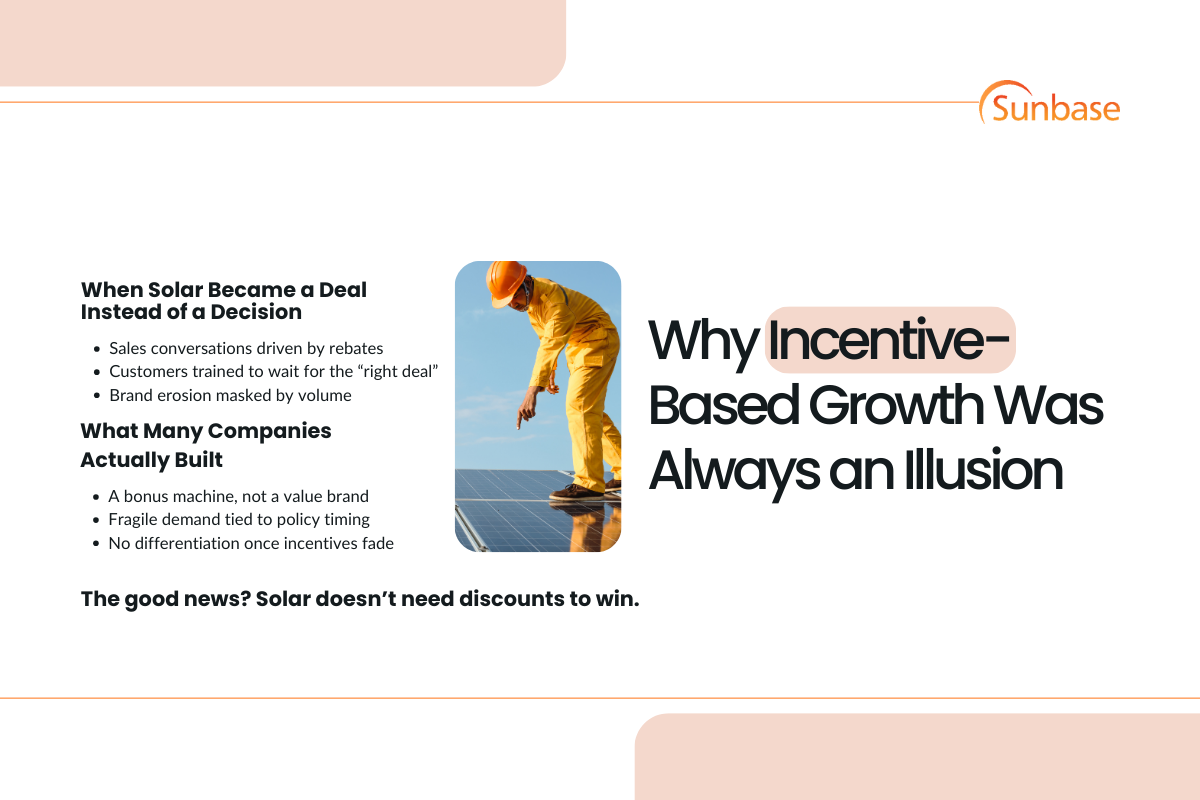
Why Incentive-Based Growth Was Always an Illusion
Somewhere along the last decade, solar quietly shifted from being a long-term energy decision to being just another limited-time offer. But why?
When Solar Became a Deal Instead of a Decision
Sales conversations shifted from focusing on energy independence, lifetime value, and system performance and started revolving around rebates, tax incentives, and whatever the current promotion happened to be. Homeowners were trained to wait for the “right deal,” not the right solution.
Volume hid the truth. Companies looked successful because installations were happening quickly, not because their offers were truly differentiated. As long as solar incentives were strong, it felt like growth.
In reality, the momentum came from policy. Many representatives weren’t actually selling solar energy systems; they were promoting discounts that were presented as solar.
What Many Companies Actually Built
Many organizations didn’t build durable brands. They built bonus machines:
- Demand tied to tax timelines
- Urgency based on expiration dates
- Messaging that collapsed the second rebates changed
Once incentives fade, the question becomes brutal: Why should a homeowner choose you, without the coupon attached?
If the only reason someone installs solar panels with your company is that it’s “30% off,” that’s not a strength. That’s dependency. So, if your offer only works with a tax credit, it isn’t strong; it’s short-term.
The good news? Solar doesn’t need discounts to win. It just needs to be sold for what it actually is: a powerful, long-term wealth-building energy solution.
Why Solar Still Delivers Real Value Without Tax Credits
Even without the federal tax credit providing major support, the economics haven’t fallen apart; they’ve just taken on a different form.
How Rising Electricity Rates Change the Math
Here’s the uneasy truth every homeowner is starting to feel: Electricity costs are rising faster than income in many regions.
That means “doing nothing” is no longer the solution. It’s expensive.
Every year of waiting is another year of:
- Higher utility bills
- Unpredictable energy pricing
- Zero ownership of your solar power
That’s why solar increasingly functions as insurance against future rate hikes. Even when the upfront costs feel higher, solar panels pay money over time because they replace rented energy with owned energy.
Some homeowners now see their solar payback period shrink simply because their electricity rates are rising. In high-cost markets, break-even has happened in as little as five to seven years, and panels typically last 25 years or more.
Doing nothing has a cost. Ownership is action.
Here's Why Solar ROI Still Works, Just Differently
The math didn’t break. The story did. Incentive-era selling focused on instant discounts. Value-based selling focuses on solar ROI analysis over decades.
Typical solar panel ROI now looks like this:
- Average payback period: 7-12 years
- Typical ROI: 8%-20% annually
- Panels produce power for 25+ years, even accounting for minor degradation
Instead of “30% off today,” the conversation becomes:
- Wall against inflation
- Control over energy usage
- Long-term savings instead of short-term rebates
- Building equity instead of just lowering a bill
The new message isn’t “this is cheaper this year.” It’s “this is owned energy for the next 20+ years.” That’s real return on investment. Value hasn’t disappeared, it’s just deeper than before.
How to Reposition Solar as a Long-Term Asset (Not a Discount)
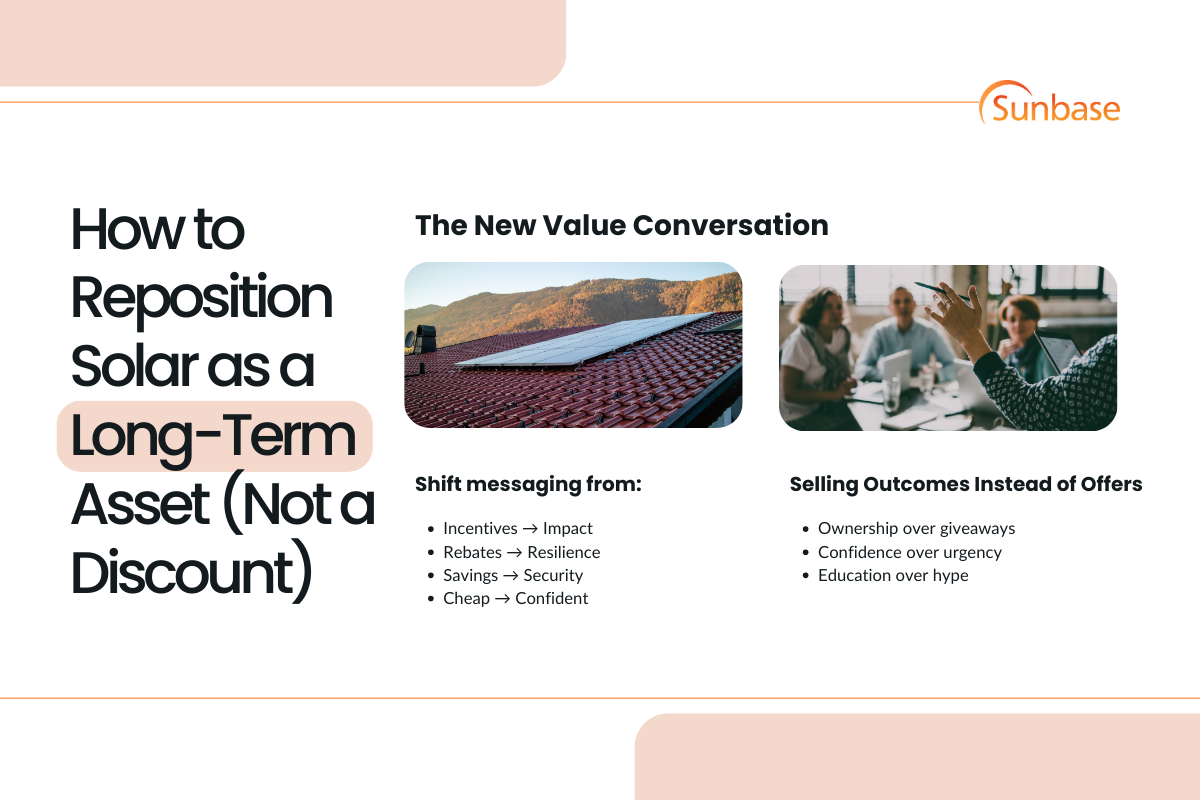
When people grasp the outcome, they don’t need a discount to say yes. Here's how:
The New Value Conversation
The old pitch is ancient; the new one is much simpler.
- Incentives → Impact
- Rebates → Resilience
- Savings → Security
- Cheap → Confident
Homeowners are not only interested in solar panels but also in having control over their energy usage. They are fed up with unpredictable bills, confusing fine print, and waiting for the next program to come along.
When you frame solar as ownership of your energy future rather than a coupon, the entire conversation shifts.
This isn’t just about finding the lowest price; it’s about treating it as a solar investment that provides long-term savings, stability, and independence. So how do you do that?
Selling Outcomes Instead of Offers
Without the federal solar tax credit or other financial incentives, solar ROI doesn’t disappear; it matures. Here's where value-based selling means you stop selling “deals” and start selling outcomes.
Explain how a strong return on investment works.
- How much power does the system generates
- Local net metering programs
- Offset electric bill costs over time
- Controlled overhead costs
- Education and long-term potential savings, not short-term hype
High-efficiency systems mean solar panels produce more usable power per square foot, which directly improves solar panels' worth over time.
In many markets, net metering still allows excess energy to be credited back, stabilizes energy costs, improving lifetime value even without rebates. And unlike a solar lease, ownership keeps the upside with the homeowner or business.
This is why educated buyers accept slightly longer timelines, because durability beats urgency. This shift doesn’t just change your pitch; it changes how buyers think, decide, and trust you.
Why the Cash Buyer Is Becoming Solar’s Most Important Customer
Before we explore the topic, let's find out: Who the modern cash buyer really is?
They’re usually long-term homeowners, often equity-rich, and they’ve stopped waiting for the perfect tax credit headline.
They care less about schemes and more about solar panels' return on investment (ROI).
They look at solar ROI, ask about the real solar payback period, and think in terms of long-term savings, not just monthly payment tricks. They’re not allergic to upfront costs. They just want honesty about what the system delivers over 20+ years.
And when they see the numbers, especially as electricity rates keep climbing, they are quick to make decisions.
Why Financing-First Solar Is Fading
High-APR loans quietly ate the story. What used to “beat the utility bill” now sometimes costs more than staying on the grid.
Financing can inflate the total cost of solar installation, stretching the payback and erasing the feeling that solar panels save money.
Cash buyers skip the interest burden completely. That often means:
- Shorter solar payback periods (sometimes 5–9 years)
- Cleaner solar panel ROI
- Higher trust and faster closes
Cash buyers don’t need a deal; they need clarity, math that makes sense, and a system that actually performs.
Winning them isn’t about louder pitching; it’s more about smarter conversations and value-first selling. Read our article on: Solar Business Mindset: Stop Blaming the Fed and Start Adapting!
How to Sell Solar ROI Without Monthly Savings Tricks

Here's where you stumble upon the question:
What Cash Buyers Actually Care About?
Cash buyers aren’t chasing coupons. They want inflation protection, true asset ownership, and a home that’s more resilient when the utility grid misbehaves.
They’re thinking beyond the next electric bill and asking smarter questions: What will this do for my property's value over the next 20 years? How predictable are my outcomes?
They care about how a solar system helps them generate electricity, how solar panel efficiency holds up, and whether a solar battery keeps the lights on when it matters.
In short, they’re buying confidence: the long-term financial benefits, not “limited-time offers.”
How Exactly You Reframe Solar ROI Analysis
This is where your story changes.
- Stop selling “$X off this month” and start selling solar power ROI. Show the return on investment by comparing 20-year utility bills with ownership.
- Explain that the payback period is calculated using Net Upfront Cost divided by Estimated Annual Savings, and that the typical payback period can range from 5 to 13 years, depending on installation costs, electricity rates, and available incentives.
- Walk buyers through lifetime solar savings, factor in operational costs, and if needed, use a simple solar ROI calculator to make it real. When value is framed as wealth preservation rather than discounts, clarity follows.
And to consistently deliver value, your systems must support it.
Why Value-Based Selling Breaks Without the Right Platform
You can have the perfect pitch, but a random proposal will kill it in seconds.
Why Manual Proposals Undermine Trust
Spreadsheets, copy-paste quotes, and last-minute number edits create confusing numbers, inconsistent messaging, and way too much room for doubt.
If a homeowner has to “do the math themselves,” they won’t. And if two reps from the same company present two different stories, trust exits right away.
Value-based selling depends on clarity, and manual processes do the opposite!
How Does Execution Reinforce Value?
On the other hand, a clean platform turns your message into proof. Clear proposals, evident timelines, and accurate project tracking signal professionalism before a panel is even installed.
When customers see exactly what happens from solar panel installation to permission-to-operate, confidence rises. Strong execution turns ROI talk into reality and makes premium pricing believable because the experience matches the promise.
This is where tools either reinforce or contradict your message. Also, to make it easier for your reps, here: Solar Sales Playbook: Scripts and Strategies for Field Teams
How the Solar Shift Series Helps Teams Adapt to This New Reality
Before we start, what is the Solar Shift Series all about?
The Solar Shift Series is more than a motivational ebook; it’s a practical, multi-part blueprint for selling solar in a post-incentive world.
It walks teams through the real market shifts, how buyer psychology has changed, and what it takes operationally to win when tax credits are no longer the automatic closer.
Each chapter breaks down what’s gone, what’s coming next, and how to rebuild around value instead of discounts. It’s carefully written for companies ready to stop leaning on incentives and start building real, durable growth models.
And to bring the plan into action, keep reading...
How Sunbase Software Supports Value-First Solar Teams
Take a quick look:
- Multi-Dimensional Proposal Generation: Sunbase proposals go beyond tax credits, showing savings, value, independence, and impact in ways customers clearly understand.
- Design & Sales Configuration Flexibility: Reps can quickly design various system sizes, roof layouts, and battery options based on customer goals, enabling real conversations about trade-offs and helping optimize for what the customer values.
- Real-Time Market & Incentive Adaptation: It keeps teams updated on incentives, rebates, and financing, enabling instant adjustments to positioning as programs change without losing core messaging.
- Financing Flexibility: Sunbase simplifies financing with cash, loans, leases, and PPAs. It clearly shows monthly costs and options so customers can understand value without confusion.
- Smart Customer Profiling With Insights: Lastly, built-in CRM takes your customer data and turns it into helpful advice, making it easier to connect and improve your success rate.
Lastly, use project management software to bring the proposal into reality!
So, it's time to design, propose, maintain, and manage not in multiple tabs, but rather in an all-in-one Sunbase software!
In a nutshell
The question for your organization isn't whether to shift toward value-based selling.
The question is whether you'll do it intentionally and systematically, with the right tools and culture in place, or whether market forces will eventually force the transition on less favorable terms.
So you see, it isn't the future of solar, it's the present. And the installers who nail it first are the ones who'll own their markets for years to come.
Stay Tuned On Sunbase
This is just one piece of a much bigger puzzle! You now understand one major market shift in solar sales. But there's more happening behind the scenes: market consolidation, changes in buyer behavior, and new competitive threats.
The installers who see the whole picture are the ones building recession-proof businesses. That's exactly what the Solar Shift Series Ebook is designed to show you. Grab the ebook now!
FAQ's
1. What is solar panel ROI, and how do you calculate it?
Solar panel ROI measures how long it takes for solar panels to pay back their installation costs through lower energy bills. It depends on how much energy your system produces, local utility costs, and total solar costs. A shorter initial payback period indicates stronger long-term value, especially as electricity prices continue to rise.
2. How much solar energy savings can homeowners realistically expect?
Solar energy savings vary by location and electricity usage, but most home solar panels are designed to offset a large portion of monthly utility bills. Over time, these savings compound as utility rates increase, making ownership more attractive than relying on the grid long term.
3. How does solar system size affect return on investment?
The size of a solar system determines how much energy it can generate. Larger systems cost more upfront but often deliver faster payback periods for households or businesses with high energy consumption, because more grid power is replaced with self-generated electricity.
4. Are commercial solar panels still profitable without tax incentives?
Yes. Commercial solar panels often deliver a strong ROI because businesses typically have higher electricity usage and larger energy loads. That means greater savings on utility costs, even when incentives are limited or unavailable.
5. How do rising utility costs impact solar payback periods?
As utility costs increase, solar becomes more valuable. Higher energy prices shorten the initial payback period, allowing solar owners to recover solar costs faster while locking in predictable energy expenses.
6. Does adding battery storage improve solar ROI?
In many cases, yes. Battery storage helps store excess energy and reduce reliance on peak utility rates. For some users, this leads to faster payback periods, greater energy control, and more consistent savings during outages or high-demand hours.
One Platform.
Zero Chaos.
Run Your Entire Business in One Platform
Sunbase replaces your CRM, proposals, scheduling, job tracking, and reporting tools — all inside one clean, connected platform.
About Sunbase
The All-In-One Platform to Run Your Entire Business
Sunbase helps you organize operations, streamline daily workflows, and manage everything - from first customer contact to final project deliver- in one connected system.
Our Mission
- Organize your business.
- Optimize your workflow.
- Automate your dailytasks
Why Businesses Choose Sunbase
One Connected Workflow
Replace scattered tools and manual processes with a single platform that brings together your team, tasks, customers, jobs, and performance data.
🌎 Global Presence
Serving the United States, Canada, India, LATAM, Australia, and 10+ international markets.
👥 11,000+ Users
Trusted by contractors, installers, project managers, sales teams, and field technicians.
🏗️ Built for All Sizes
From small contracting teams to fast-growing enterprises, Sunbase adapts to your workflow.
Stop Managing Your Business Manually. Automate It.
Sunbase automates workflows, reduces mistakes, and helps your team get more done - without hiring extra staff or juggling multiple tools.
Still Managing Your Business Across Multiple Tools?
Bring your CRM, proposals, projects, and operations into one platform built for contractors.

