
If there’s one thing every solar business owner knows, it’s that closing deals isn’t just about having the best solar panels or the lowest price. The real challenge lies between the first conversation and the final signature.
Leads fall through the cracks, follow-ups are delayed, and proposal revisions take up valuable time. For sales teams, it feels like they’re always chasing information instead of moving the sales process forward.
If that sounds familiar, you’re not alone. The solar industry is growing rapidly, but it’s also becoming more competitive. Customers expect quicker communication and transparent project updates.
Yet, too many solar companies still rely on manual spreadsheets, scattered emails, and disconnected systems that cause delays.
Automating the Solar Sales Workflow Using Solar Sales Process Software: From Lead to Close Made Simple
Automating your solar sales workflow streamlines lead capture, qualification, proposal generation, and closing by using integrated software (CRM, Design, Proposals) to handle repetitive tasks, enabling faster responses and personalized experiences, such as AI-generated designs with savings.
It also supports digital contracts and data-driven insights, ultimately boosting efficiency and improving closing rates for your sales team.
This simply indicates that in the fast-paced solar industry, success isn’t just about generating leads but is more about how efficiently you move them through your sales pipeline.
From the first point of contact to the final installation, every stage presents an opportunity to either impress a potential customer or lose them to a faster competitor.
Manual processes, such as spreadsheet tracking, scattered communication, and delayed follow-ups, often slow teams down and cause deals to slip away. That’s where automation changes everything.
In this blog, we'll break down what a modern, automated solar sales workflow looks like, why traditional processes fail to keep up, and how solar businesses can streamline every step from lead capture to close without increasing headcount or operational complexity.
Key Takeaways
- Understand where traditional solar sales workflows fall short.
- Learn how automation reshapes each stage of the sales funnel.
- Learn how to select the ideal solar CRM software for your team's size.
- See measurable ROI with less manual data entry, faster proposals, and better pipeline management.
- Find out how platforms like Sunbase help solar companies close more deals using a single, integrated system.
There’s a Reason Some Deals Close Faster
Here’s a quiet pattern you start noticing after working in solar long enough. The teams closing faster aren’t working harder. They’re working with fewer tabs open.
No chasing spreadsheets. No guessing which version of the proposal is final. No wondering who was supposed to follow up.
At some point, they stopped stitching tools together and let the workflow do the work instead.
If you’re curious what that shift actually looks like in practice, it’s worth a closer look. Take a quick walkthrough of Sunbase and understand how modern solar teams run their sales process
Understanding the Modern Solar Sales Process
The solar sales landscape has evolved beyond spreadsheets and manual follow-ups. To stay competitive, modern solar businesses need smarter, faster workflows that connect every stage of the lead-to-close process.
Why the Traditional Solar Sales Workflow No Longer Works?
Picture a typical solar company workflow. A lead fills out a web form or calls in. Someone copies that lead into a spreadsheet, then another person manually assigns it to a rep.
That rep creates a proposal, sends an email, and waits. Days go by, and the customer loses interest or signs with a competitor.
That must sound familiar? It’s the old manual cycle:
Lead capture → Spreadsheet → Proposal creation → Email → Waiting for signature
This outdated process creates several inefficiencies:
- Delayed follow-ups: Leads get cold while waiting for reps to respond.
- Missed opportunities: Manual tracking means it’s easy to overlook high-value prospects.
- Lack of visibility for managers: There’s no real-time view of the sales pipeline or project progress.
Studies show that solar businesses lose up to 30% of leads due to poor follow-up and tracking. That’s not because the leads were bad; it’s because the workflow wasn’t built for today’s fast-paced environment.
What an Automated Solar Sales Workflow Looks Like?
Automation changes everything. Imagine this instead:
Lead captured → Auto-assigned to rep → Proposal auto-generated → Customer signs digitally → CRM syncs instantly → Follow-up reminders triggered
Each step happens automatically, powered by a solar CRM system that connects your sales, design, and project management teams.
Reps spend less time juggling manual tasks and more time closing deals. Managers now have visibility into lead status, conversion rates, and performance metrics, all from a single dashboard.
Now, let’s break down how to automate your solar sales process step by step.
How to Automate Your Solar Sales Workflow? Step-by-Step Guide
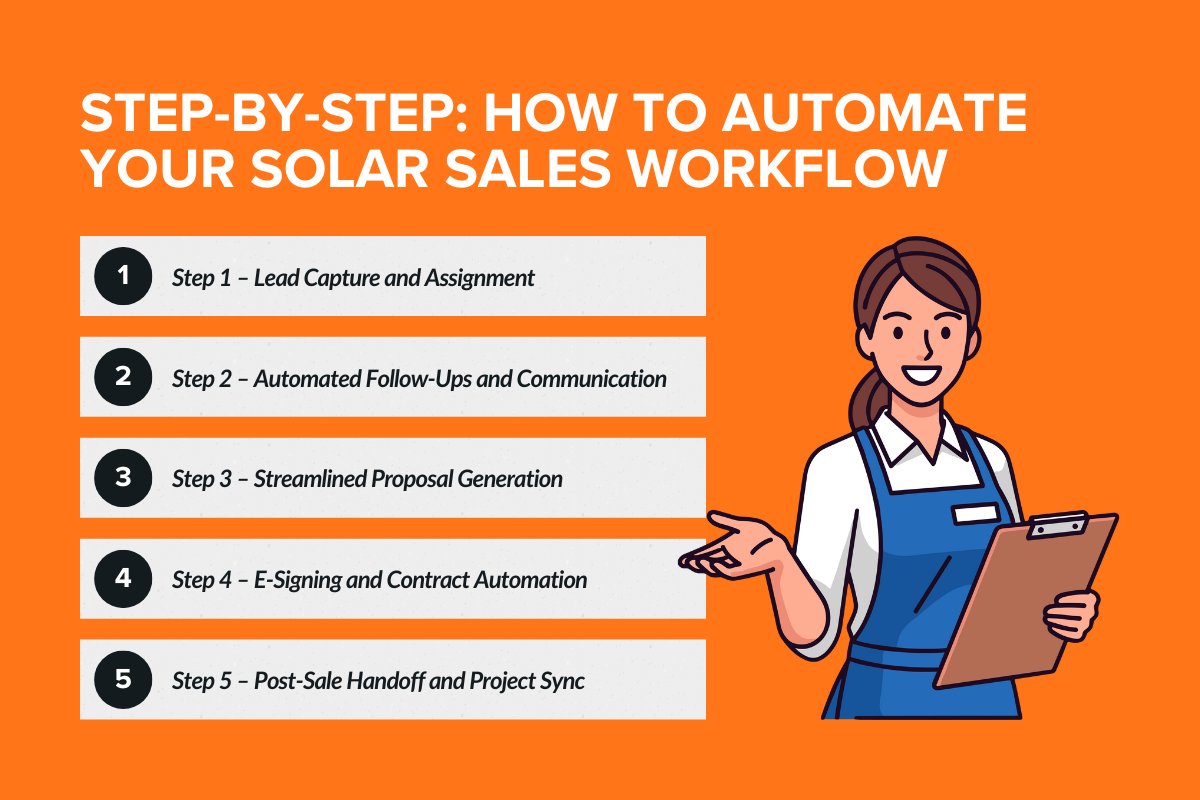
Automating the solar sales workflow focuses less on time savings and more on creating a smoother, faster journey from first contact to final installation.
Here’s how to transform every stage of your sales process into an efficient, connected system step by step:
Step 1 – Lead Capture and Assignment
Challenge: Leads pour in from multiple sources: your website, paid ads, referrals, or field reps. Without an organized system, it’s easy for leads to be missed or mishandled.
Automation: Solar CRM software automatically captures and assigns leads based on set criteria like location, team capacity, or sales rep performance.
Benefit: No lead goes unnoticed, and response times drop dramatically.
Example: A Facebook lead gets routed instantly to your top-performing rep in that region. Within minutes, the prospect receives a call or text. No spreadsheets, no delays, no manual handoff. That’s how modern solar companies stay ahead of competitors.
Step 2 – Automated Follow-Ups and Communication
Problem: Even the best sales reps forget to follow up sometimes, and manual reminders or sticky notes just don’t cut it.
Solution: A solar sales process software like Sunbase automates follow-ups through pre-set email and SMS sequences. It ensures consistent, timely communication with potential customers at every stage.
Highlight: Consistent engagement leads to higher lead conversion rates and improved customer satisfaction.
Example CTA: “With Sunbase, you can nurture every lead automatically even while your team focuses on closing deals.”
Step 3 – Streamlined Proposal Generation
Problem: Creating proposals manually is time-consuming and error-prone. Many solar reps spend hours adjusting prices, editing PDFs, and double-checking system details.
Automation: Use automated proposal generation tools within your solar CRM software. These systems pull in pricing data, component lists, and design layouts automatically to produce accurate proposals in minutes.
Add value: With integrated solar design tools, your representatives can generate proposals that display system sizing, energy savings, and financing options, all automatically updated with real-time data.
Result: Faster proposal turnaround and a smoother customer experience. The faster you deliver proposals, the faster customers make decisions.
Step 4 – E-Signing and Contract Automation
Problem: Waiting for physical signatures or scanning contracts unnecessarily delays your deals.
Solution: Integrated e-signature tools built into solar proposal software make closing deals effortless. Customers can sign contracts from their phone, and the system instantly notifies your team.
Benefits:
- Real-time signature tracking
- No paperwork or scanning
- Secure, compliant documentation
CTA: “Close deals in hours, not days, all from your Sunbase dashboard.”
Step 5 – Post-Sale Handoff and Project Sync
Automation doesn’t stop once the deal is signed. With connected systems, your sales and operations teams stay perfectly aligned.
Example: When a customer signs, the project data automatically syncs with your solar project management system. Project details, site notes, and financing info move seamlessly into production.
Benefit: A seamless handoff from sales to installation keeps the customer informed and improves the overall experience. It’s what separates professional solar companies from the rest.
For a Crisp idea about the Canadian Solar market, have a look at this: Door-to-Door vs Digital Solar Marketing in Canada
The ROI of Automating Your Solar Sales Workflow
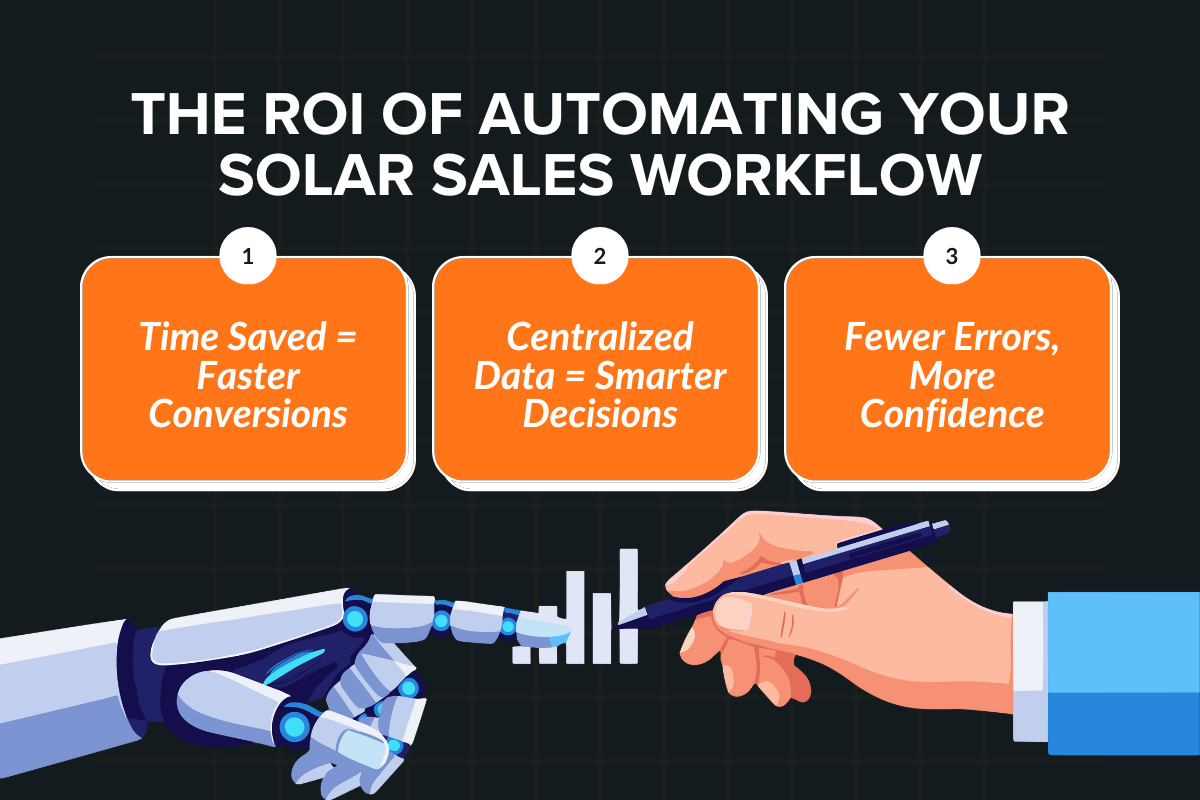
Automation isn’t just about working faster. It’s about improving accuracy, visibility, and confidence across your team. Let’s explore how that plays out.
> Time Saved = Faster Conversions
When your system automatically handles lead assignment, proposal generation, and signing, your reps can focus on meaningful conversations instead of repetitive tasks.
Teams typically save 10+ hours per week after switching from spreadsheets to automation, allowing them to reinvest in lead generation and customer communication.
Here’s a simple before-and-after look:
| Workflow Stage | Before Automation | After Automation |
|---|---|---|
| Lead Assignment | 1–2 hours daily, manual handoff | Instant, auto-assigned |
| Proposal Creation | 2–3 hours per proposal | Under 15 minutes |
| Contract Signing | 2–5 days average | Same-day closures |
| Data Entry | Frequent duplicates and errors | Synced automatically |
| Follow-Ups | Often forgotten | Fully automated sequences |
That’s not just time saved, it’s a direct boost to conversion rates and sales performance.
> Centralized Data = Smarter Decisions
With a solar CRM system, all customer data, project progress, and communication live in one place. Managers can track leads, monitor rep performance, and view deal status without needing to request updates.
Data-driven insights help identify which sales reps are performing best and which stages of the sales funnel need improvement. This visibility enables quicker, more informed decisions that yield better results.
> Fewer Errors, More Confidence
Manual data entry leads to pricing mistakes, outdated materials, and forgotten follow-ups. Automation eliminates those risks. Automated workflows ensure that every proposal, contract, and communication follows your company's standards.
Customers receive accurate proposals, consistent communication, and a level of professionalism that builds trust and improves customer satisfaction.
Choosing the Right Tool for Your Business Size & Model

Not every solar business runs at the same scale, and neither should their software. The right solar CRM or sales tool depends on your team size, workflow complexity, and growth goals.
For Small Solar Teams
Smaller teams need solar software that’s quick to set up, affordable, and easy to use. Focus on key features like lead capture, automated follow-ups, and proposal generation. A clean dashboard and minimal training requirements help your team start closing deals faster.
For Mid-Sized Solar Businesses
Growing solar businesses require more robust tools. Look for software with pipeline management, CRM integration, and automated project tracking. These capabilities enhance visibility across departments and facilitate smooth scaling of operations.
For Large Solar Enterprises
Enterprises need custom workflows, advanced analytics, and role-based permissions. The best solar CRM software integrates seamlessly with other systems in your tech stack, enabling regional teams, finance departments, and installation crews to work from a single, unified platform.
How Solar Sales Process Software Empowers Growing Teams?
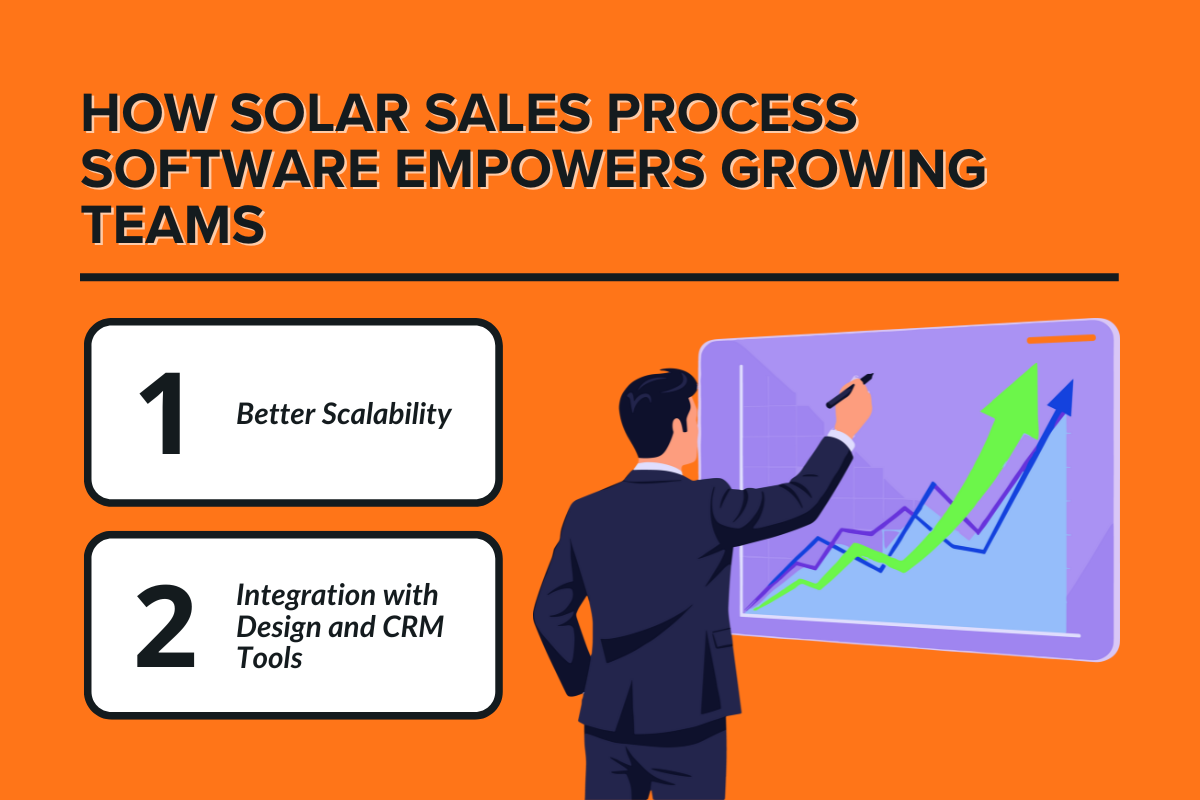
As solar businesses grow, maintaining team connectivity and efficient workflows becomes increasingly essential.
That’s where solar sales process software steps in, helping expanding teams stay organized, scalable, and perfectly aligned across every project.
Better Scalability
As your company expands, automation enables you to manage leads, track projects, and maintain customer relationships without incurring unnecessary administrative work. Whether you’re managing five reps or fifty, the process stays streamlined and efficient.
Regional teams can operate independently while maintaining unified customer data and maintaining visibility into performance.
Integration with Design and CRM Tools
Integration is what makes a platform truly powerful. When your solar design software, CRM, and payment systems communicate seamlessly, everyone from the sales team to project managers stays aligned.
Additionally, real-time data mapping ensures that project details are always accurate, minimizing confusion and maintaining smooth business operations.
If you are still confused about real-time data integration, then you must go through this: How Solar Businesses Can Benefit from Real-Time Data Integration
What Are The Common Mistakes When Automating Solar Sales & How to Avoid Them?
Automation is powerful, but it’s not foolproof. Here are common pitfalls to watch out for:
- Automating the wrong processes: Always map your workflow before setting up automation.
- Choosing tools based on features, not fit: The best solar CRM is the one that matches your workflow, not just your wish list.
- Skipping team training: Even the best solar tools won’t work if your team doesn’t know how to use them.
- Ignoring the data: Measure conversion rates, track performance, and review reports on a regular basis. Automation without analysis means missed opportunities.
Case Example – Turning a 7-Step Process into 3 Clicks
A mid-sized solar firm in Spain recently streamlined its 7-step sales workflow into just 3 clicks. Using an automated sales process platform, they reduced deal closing time by 40% while increasing customer satisfaction through faster responses and clearer communication.
Their takeaway? Automation doesn’t replace people, it empowers them to work smarter.
Why Choose an All-in-One Platform Like Sunbase?

If you’re serious about scaling your solar business, you need more than disconnected tools; you need one powerful platform.
That’s precisely what Sunbase delivers: a unified solution that automates your entire sales journey from lead to close.
1. End-to-End Sales Automation
Sunbase offers a complete, end-to-end automation suite built specifically for solar businesses. From lead capture and proposal generation to e-signing and project synchronization, everything runs on one platform.
That means no more switching between multiple logins or scattered data. You can track projects, manage leads, and close deals without friction.
2. Tailored for Solar Teams
Sunbase isn’t just generic CRM software. It’s designed for solar workflows with:
- Built-in component libraries
- Custom pricing templates
- Integrated solar design tools
- Multi-user dashboards for sales reps, designers, and managers
This specialization helps teams handle solar projects of all sizes while maintaining clarity, consistency, and control.
3. Designed to Grow with You
Whether you’re on a free plan or scaling toward enterprise, Sunbase adapts with you. It’s scalable, customizable, and compliant with industry standards. You get access to the most powerful tools without the typical tech clutter or manual data entry issues.
Automate Today, Win More Tomorrow
The solar industry is evolving fast, and manual workflows simply can’t keep up. The difference between struggling and scaling often comes down to automation.
By automating your solar sales workflow, you replace manual chaos with a streamlined sales process that connects your team, data, and customers in one place.
You’ll spend less time on repetitive tasks and more time building relationships, improving customer experience, and growing your business.
Automation doesn’t just save time; it helps you make informed decisions, track progress, and close deals faster.
Ready to Streamline Your Solar Sales Workflow and Close More Deals?
Transform your sales process with Sunbase, the all-in-one solar CRM built to automate every step, from lead capture to contract signing.
Save time, boost conversions, and deliver a seamless customer experience. Book a demo today and see how Sunbase can simplify your solar sales workflow.
FAQs:
1. What does solar sales process software do?
It automates your entire sales workflow from lead capture to proposal and project tracking, helping you close deals faster and reduce manual work.
2. How does Sunbase handle lead management?
Sunbase automatically captures, assigns, and tracks leads in one place, ensuring that no potential customer is lost and follow-ups occur on time.
3. Can automation really boost sales conversions?
Yes. With faster responses, automated follow-ups, and accurate proposals, automation helps solar teams convert more leads into customers.
4. Is Sunbase suitable for small teams as well?
Definitely, Sunbase scales easily, providing straightforward tools for small teams and more advanced features for larger solar companies.
One Platform.
Zero Chaos.
Run Your Entire Business in One Platform
Sunbase replaces your CRM, proposals, scheduling, job tracking, and reporting tools — all inside one clean, connected platform.
About Sunbase
The All-In-One Platform to Run Your Entire Business
Sunbase helps you organize operations, streamline daily workflows, and manage everything - from first customer contact to final project deliver- in one connected system.
Our Mission
- Organize your business.
- Optimize your workflow.
- Automate your dailytasks
Why Businesses Choose Sunbase
One Connected Workflow
Replace scattered tools and manual processes with a single platform that brings together your team, tasks, customers, jobs, and performance data.
🌎 Global Presence
Serving the United States, Canada, India, LATAM, Australia, and 10+ international markets.
👥 11,000+ Users
Trusted by contractors, installers, project managers, sales teams, and field technicians.
🏗️ Built for All Sizes
From small contracting teams to fast-growing enterprises, Sunbase adapts to your workflow.
Stop Managing Your Business Manually. Automate It.
Sunbase automates workflows, reduces mistakes, and helps your team get more done - without hiring extra staff or juggling multiple tools.
Still Managing Your Business Across Multiple Tools?
Bring your CRM, proposals, projects, and operations into one platform built for contractors.

