
If you’ve looked into tools for the solar industry, you’ve probably encountered the terms solar software and solar design software. Initially, they seem quite similar as both help solar companies optimize their operations, right?
But here's the truth: Mistaking these two tools goes beyond a mere technical error; it’s a costly blunder. Use the wrong one, which will cost you both time and profit. But get it right, and you’ll find smoother workflows, satisfied clients, and projects that actually finish on time.
So, which one does your solar business really need? Or do you need both? This guide explains the difference between solar design software vs. solar software, when to use each, and why modern solar businesses increasingly rely on both to grow efficiently.
Solar Software vs. Solar Design Software: Breaking Down the Basics
The solar industry operates across two fundamentally different workflows:
- Precision workflows, where accuracy, modeling, and engineering logic matter most
- Operational workflows, where coordination, speed, and lifecycle management determine profitability
Solar design software optimizes precision workflows. It uses algorithms, site data, shading models, and performance simulations to ensure systems are technically sound. Solar software, on the other hand, optimizes operational workflows. It connects CRM, proposals, permitting, scheduling, financials, and post-installation monitoring into a single system of record.
Although both tools are indispensable in solar projects, they serve very different purposes. Whether you're a solar engineer, sales representative, or project manager, understanding which tool meets your needs can save you time, money, and frustration.
Let’s break it down in simple terms.
Key Takeaways
- Solar design software is a specialized tool for creating precise and detailed PV system layouts.
- Solar software unifies all aspects of a solar project, seamlessly linking the construction crew, project manager, and sales team.
- If you want to scale your business, you need both. Solar design software seals the deal, while solar software keeps the sales pipeline flowing.
- A comprehensive solution like Sunbase Solar Software includes both, ultimately helping you accelerate the installation process.
Here’s a reality most solar leaders realize too late.
You can grow revenue while profitability quietly shrinks—without ever missing a sale. The difference lies in how efficiently projects move from proposal to permission to power-on.
See how unified solar software protects margins while you scale.
Schedule a Sunbase demo and identify the hidden ROI gaps in your current workflow.
Exploring Solar Design Software: The Specialized Design Tool
> What Exactly Is Solar Design Software?
Solar design software is a dedicated tool for designing accurate and intricate PV system layouts. It includes capabilities such as 3D modeling, shading analysis, energy production projections, and panel optimization.
If you’ve ever wondered how installers determine the best spots for panels to maximize performance, this is the secret behind the scenes. Solar design software answers one question extremely well: “Will this system perform safely and efficiently on this site?”
Understanding Solar Software: The All-in-One Solution
> What Exactly Is Solar Software?
Solar software unifies every aspect of your solar projects into a seamless workflow, bringing together the entire construction crew, project manager, and sales team in one location.
Design is just one aspect of solar project management. It involves managing the entire lifecycle of a solar project, from customer relationship management (CRM) to financial modeling, permitting, scheduling, and even performance tracking. Solar software does it all.
You can consider it the ultimate multitasker of the solar world.
Key Differences: When to Use Which Tool?
Selecting solar design software vs. solar software is not a matter of "good or bad"; it’s about using the “right tool for the right job.” Many professionals get confused about which tool they actually need. So, let's find out what makes the difference.
> Scope of Functionality
Solar Design Software: Laser-focused on system design

Solar design software is solely dedicated to designing a specific solar PV system. This tool ignores deadlines and client emails, prioritizing perfection in design instead.
It enables solar professionals to model various system configurations so that every panel is perfectly optimized and meets all compliance standards. Furthermore, solar design software can enhance your sales by crafting engaging proposals that effectively showcase value to potential clients.
It’s a highly technical tool used for:
1. Panel Layout & System Configuration
Correct panel placement is trickier than you might think! The software accurately positions solar panels in optimal locations to capture maximum sunlight.
It considers factors such as roof size, panel tilt, and spacing to boost efficiency and prevent common placement errors.
2. Shading Analysis
Not every rooftop receives full sunlight throughout the day. Trees, buildings, and chimneys can cast shadows that reduce solar energy production.
The software conducts shading analysis to determine sunlight exposure across the day and year, showing exactly where shadows will be cast.
3. Structural and Electrical Design
No one wants a solar system that looks good but crashes in a storm or damages the electrical system.
Design software comprises tools for structural and electrical design.
It ensures compatibility with the roof’s load capacity by considering panel weight, wind resistance, and snow loads for safety.
4. Energy Production Estimates
The best part? These estimates are more than just numbers; they are supported by data.
Solar design software estimates system power generation based on location, panel efficiency, weather, and shading. Clients can see expected monthly, annual, and lifetime kilowatt-hour production.
5. 3D Site Modeling and Visualization
In the solar industry, a 3D model can be worth a signed contract. Good solar design software generates realistic solar installation previews on properties.
With 3D modeling, clients can visualize panel placement and wiring paths before installation, which helps them visualize how their roof will look after installation.
To understand how precise system design directly impacts project success and sales conversions, explore why every solar company needs solar design software to stay competitive.
Solar Software: End-to-end project management
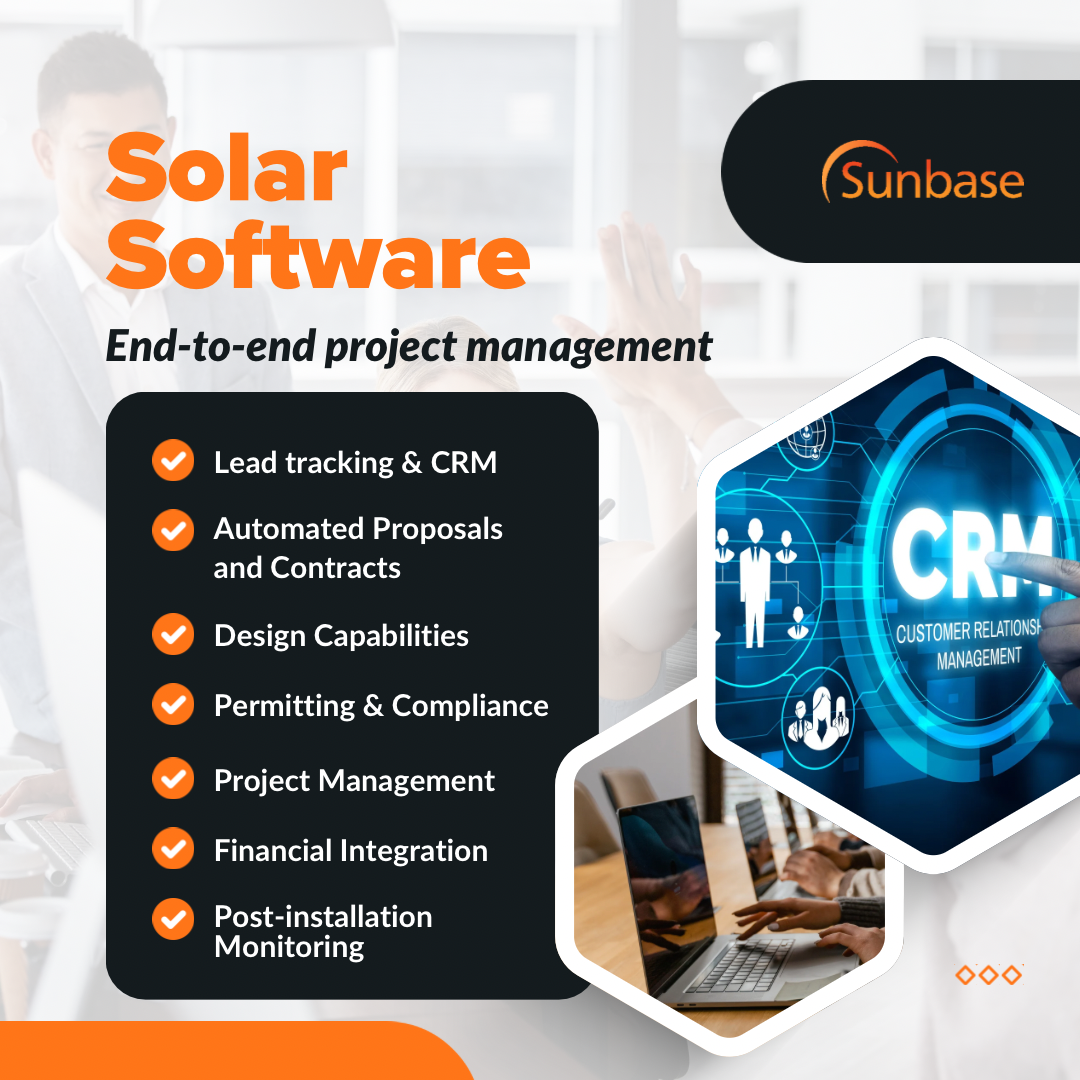
Unlike design software that only focuses on design, solar software is a comprehensive solution for managing solar projects. It is built to oversee every facet of the solar journey.
Curious, what does it cover? Let's find out!
1. Lead tracking & CRM
Identifying and nurturing leads is half the battle in the solar industry. That’s where lead tracking and CRM (Customer Relationship Management) features excel. With integrated CRM tools, sales teams can monitor potential customers, follow up with interested prospects, and close deals more quickly.
And here’s the best part: it’s not just for salespeople. This data is accessible to your entire team.
2. Automated Proposals and Contracts
Precision and speed matter (a lot)! Solar software helps you to personalize proposals by incorporating energy savings estimates, financing options, and appealing visuals, all customized to meet the client’s unique requirements.
And when they’re ready to sign the dotted line........? No more printing, scanning, or running after signatures. Solar software includes e-signature features, allowing contracts to be finalized in minutes.
3. Design Capabilities
Want to demonstrate to a client how their roof will appear after installation? It's easy. These design features frequently connect with 3D modeling tools, providing you with high-quality visuals without requiring an additional program.
Point to note: Not all solar software includes design functionality, but many platforms offer built-in tools that simplify creating solar arrays, placing panels, and positioning systems.
4. Permitting & Compliance
Permits and regulations can delay projects, but that won’t happen with the right solar software. It automates forms, ensures compliance with local codes, and accelerates approvals to transition from design to installation more quickly.
Additionally, they guarantee that your designs comply with code requirements, which minimizes the risk of expensive rejections.
5. Project Management
The real work begins once the sale is made and the permits are approved. Coordinating installations across multiple sites, scheduling crews, and assigning tasks can seem never-ending.
This is where project management features come in handy. It ensures everything is on track, whether you’re overseeing one or multiple projects.
6. Financial Integration
An integration you can't afford to overlook! Financial integration tools allow you to manage pricing, financing options, and tax incentives, all from a single location.
These features enable you to generate precise cost breakdowns, provide flexible payment options, and calculate ROI for clients. Besides, many platforms integrate with external financing providers, simplifying the process of offering loans or leases during sales.
7. Post-installation Monitoring
The work doesn't end after the panels are installed. After the system is operational, the software enhances its value by monitoring performance metrics such as energy production, consumption, and overall system health.
If something goes wrong, such as a panel malfunctioning or an unexpected drop in production, the software immediately sends alerts.
If you’re aiming to increase profitability without adding more tools or headcount, read our blog on Maximizing ROI with All-in-One Solar Software.
> Who Benefits Most?

Solar design software:
- Solar engineers: Seeing precise calculations for energy production, shading, and structural integrity, solar design software offers detailed specifications.
- Solar Installers: Ensuring precise panel positioning and wiring arrangements.
- Technical teams: Need comprehensive design oversight for large or complex projects.
Solar Software:
- Sales teams: It's built-in CRM features help track leads, manage proposals, and close deals faster, thus simplifying the entire process.
- Project managers: Ensure installations operate seamlessly through scheduling and tracking projects.
- Multi-department businesses: If your company has separate teams for sales, engineering, and operations, it brings everyone together.
Solar Software vs. Solar Design Software: Head-to-Head Comparison
| Feature | Solar Design Software | Solar Software |
|---|---|---|
| Scope | Design & engineering only | Full project lifecycle |
| User-Friendliness | Technical interface | Intuitive dashboards |
| Integrations | CAD and other design tools | CRM, proposal, design, and financing tools (nearly all tools) |
| Cost Efficiency | Short-term savings | Long-term ROI |
Why do solar companies need both solar software and solar design software?
In the solar industry, it’s clear that designing a solar energy system and managing a project present distinct challenges. However, it’s important to note that you cannot achieve one without the other.
Let's look at an example: you’re building a house. Would you start building without a plan? Absolutely not! Similarly, solar companies require a comprehensive system design before installing panels. Once the design is complete, they also need effective tools to track leads, manage projects, and streamline paperwork.
In short, solar software manages the business aspects, while solar design software focuses on the technical details. You wouldn’t ask your sales team to build a solar array, nor would you ask your engineer to handle customer relationships. That’s why you need both!
> They play different roles, but both are essential.
- Engineers and designers thrive with solar design software but need solar software for proper planning and execution.
- Project managers depend on solar software but require precise designs to execute.
Moral: Scalability and growth depend on both tools. Solar companies thrive not from relying on a single tool but from employing the right combination of tools.
Before investing in a platform, read this blog to find out the Top Features to look for in Solar Software.
Choosing the Right Solar Software for Your Business
Selecting the right solar software is not about chasing the longest feature list—it’s about choosing a platform that aligns with how your teams actually sell, design, install, and scale solar projects. Here are the most important factors to evaluate before making a decision:
1. End-to-End Workflow Coverage
Your solar software should support the entire project lifecycle, not just one stage of it. From lead capture and proposals to permitting, installation, and post-installation monitoring, every phase should be connected. When workflows live in one system, teams avoid duplicate work, data loss, and miscommunication.
Why it matters: Disconnected tools create delays and errors that directly impact profitability.
2. Built-In or Integrated Solar Design Capabilities
The best solar software either includes design tools or integrates seamlessly with solar design software. This ensures that layouts, energy estimates, and system changes flow smoothly from sales to engineering to installation.
Why it matters: Manual rework between design and operations slows projects and increases the risk of costly mistakes.
3. Proposal, Contract, and E-Signature Automation
Your solar software should help you generate professional, accurate proposals quickly and allow contracts to be signed digitally. This reduces friction during the buying process and shortens sales cycles.
Why it matters: Speed often wins deals—especially in competitive U.S. markets.
4. Permitting and Compliance Support
Permitting delays can derail projects. The right solar software simplifies compliance by automating documentation, aligning designs with local codes, and accelerating approvals with authorities having jurisdiction (AHJs).
Why it matters: Fewer rejections mean faster installs and lower administrative overhead.
5. Scalability for Business Growth
Your solar software should scale as your business grows—whether that means handling more projects, expanding to new states, or adding new teams. Cloud-based platforms with flexible permissions and reporting are ideal.
Why it matters: Outgrowing your software leads to costly migrations and operational disruptions.
So, if you’re still deciding between the two, stop thinking in terms of "either/or” and start considering
“both.” When you combine the precision of solar design software with the productivity of solar software, there’s no limit to what your business can achieve.
What Makes Sunbase Solar Software The All-in-one Solution?

The struggle: managing leads, designing systems, handling proposals, and keeping projects on track, all while questioning how one tool could do it all. That’s exactly what Sunbase Solar Software brings to the table.
1. Solar Design: Precision meets customization
Its solar design capabilities are unmatched, allowing you to create precise, optimized layouts customized to each customer’s specific needs.
2. Solar CRM: Track and manage leads with ease
The CRM allows you to build relationships that extend beyond merely closing a sale, ensuring that clients stay engaged. You can automate follow-ups and track every interaction with prospects in real-time.
3. Solar Proposals: Present with clarity
An impressive proposal might determine whether you secure a contract or lose a client. Sunbase enables you to generate professional, branded proposals in just minutes.
4. Solar Project Management: Hassle-free operations every time
Managing installations across various locations, scheduling teams, and coordinating equipment deliveries can seem overwhelming. However, with Sunbase’s project management tools, you can
manage it effortlessly.
Now you see how beneficial solar software can be for you!
In a nutshell
How do clients get the best of both worlds?
Solar design software tools communicate in the language of engineers (shading, azimuth angles, kWh, and forecasts), while solar software communicates in everyone else's language (deadlines, dollars, planning, and tracking).
When solar and design software work hand in hand, catering to distinct needs while striving for the same objective, i.e., installing efficient solar systems for your clients.
Discover More About Sunbase
Choosing between solar design software and solar software isn’t a technical decision—it’s a business one. One determines how well a system performs. The other determines how smoothly that system gets sold, approved, and installed.
High-performing solar companies don’t compromise between the two—they connect them. If you want to understand what that connection looks like in real workflows, book a Sunbase demo and explore how unified solar software eliminates the trade-offs entirely.
FAQs
1. What happens if a solar company skips one of these tools?
Skipping solar design software can result in inaccurate designs, leading to inefficient systems and dissatisfied customers. On the other hand, without solar software, business operations may turn chaotic with missed deadlines, lost customer details, and delayed projects.
2. Are there any all-in-one tools combining solar design and solar software?
Platforms like Sunbase All-in-one Solar Software offer features that blend design and management capabilities, making them the perfect combination for long-term success!
3. How does this combination benefit customers?
When companies use both tools, customers enjoy:
- Optimized Energy Production: Achieved through ideal panel placements.
- Streamlined Processes: Quicker turnaround times and fewer hurdles.
- Enhanced Communication: Solar software effectively and professionally handles customer interactions.
4. What should I prioritize when choosing solar software?
Look for workflow alignment, integration depth, scalability, and real-world usability—not just feature lists.
5. Is solar design software enough for residential solar companies?
For early-stage or design-only teams, solar design software may be sufficient initially. However, once a company begins handling sales, permitting, installations, and customer follow-ups at scale, solar software becomes essential to manage operations efficiently.
One Platform.
Zero Chaos.
Run Your Entire Business in One Platform
Sunbase replaces your CRM, proposals, scheduling, job tracking, and reporting tools — all inside one clean, connected platform.
About Sunbase
The All-In-One Platform to Run Your Entire Business
Sunbase helps you organize operations, streamline daily workflows, and manage everything - from first customer contact to final project deliver- in one connected system.
Our Mission
- Organize your business.
- Optimize your workflow.
- Automate your dailytasks
Why Businesses Choose Sunbase
One Connected Workflow
Replace scattered tools and manual processes with a single platform that brings together your team, tasks, customers, jobs, and performance data.
🌎 Global Presence
Serving the United States, Canada, India, LATAM, Australia, and 10+ international markets.
👥 11,000+ Users
Trusted by contractors, installers, project managers, sales teams, and field technicians.
🏗️ Built for All Sizes
From small contracting teams to fast-growing enterprises, Sunbase adapts to your workflow.
Stop Managing Your Business Manually. Automate It.
Sunbase automates workflows, reduces mistakes, and helps your team get more done - without hiring extra staff or juggling multiple tools.
Still Managing Your Business Across Multiple Tools?
Bring your CRM, proposals, projects, and operations into one platform built for contractors.

