
Audio overview: Listen & Learn
India’s solar market is expanding across rooftops, commercial rooftops, and utility farms. In 2025, the country added a record ~40 GW of solar power, bringing total installed solar capacity to about 133 GW. Also, the government aims to reach 500 GW of non-fossil energy by 2030.
What worked for some projects often breaks down when we expand. Teams using spreadsheets, WhatsApp messages, and manual processes start dropping focus.
Site approvals slip, handovers stall, and reports are delayed until problems surface. In fact, one EPC owner discovered that as projects increased, tracking everything with a notebook and WhatsApp led to double-booked crews, missed deliveries, rising maintenance costs, and costly mix-ups.
In other words, rapid expansion without solid systems can turn informed decisions into huge setbacks for your solar business.
Solar Business Software India: The Key to Smooth EPC Growth
Growing your EPC business is thrilling, but unchecked growth in the solar industry invites risk. When manual habits start cracking under expansion, it’s time to find solar CRM tools that fit your solar sales process.
A structured solar business software solution brings discipline: it ties together your sales pipeline and solar design work, streamlining operations. With one platform, teams stay coordinated, solar energy project data flows freely, and you can predictably scale without chaos.
In fact, modern solar EPCs that outgrow spreadsheets often credit specialized software for making project delivery smoother and margins healthier.
In this guide, we’ll cover the key ideas: the biggest operational challenges that arise as solar companies expand in India, why generic or disconnected apps fail to address them, and the software capabilities a scalable EPC needs.
Key takeaways:
- Many solar EPCs in India see hidden cracks in their operations when project volume jumps.
- Overloaded manual tracking, poor sales team coordination, design rework, material bottlenecks, and fragmented oversight of site surveys. These slow projects and squeeze profits.
- Generic CRMs and spreadsheets only track leads, not solar installations. Using many separate apps creates duplicate work and errors.
- A solar-specific CRM, design simulator, project management, inventory tracker, and compliance module keep everyone on the same page from sales performance to financial analysis.
- With the right stack, teams work in sync, decisions become proactive, and scaling new projects becomes predictable and profitable.
Watch Sunbase Fix the Issue of Disconnected Solar Systems with the Right Solar Business Software. Schedule a call now.
What Are the Top Challenges Solar EPCs Are Facing in India Today?
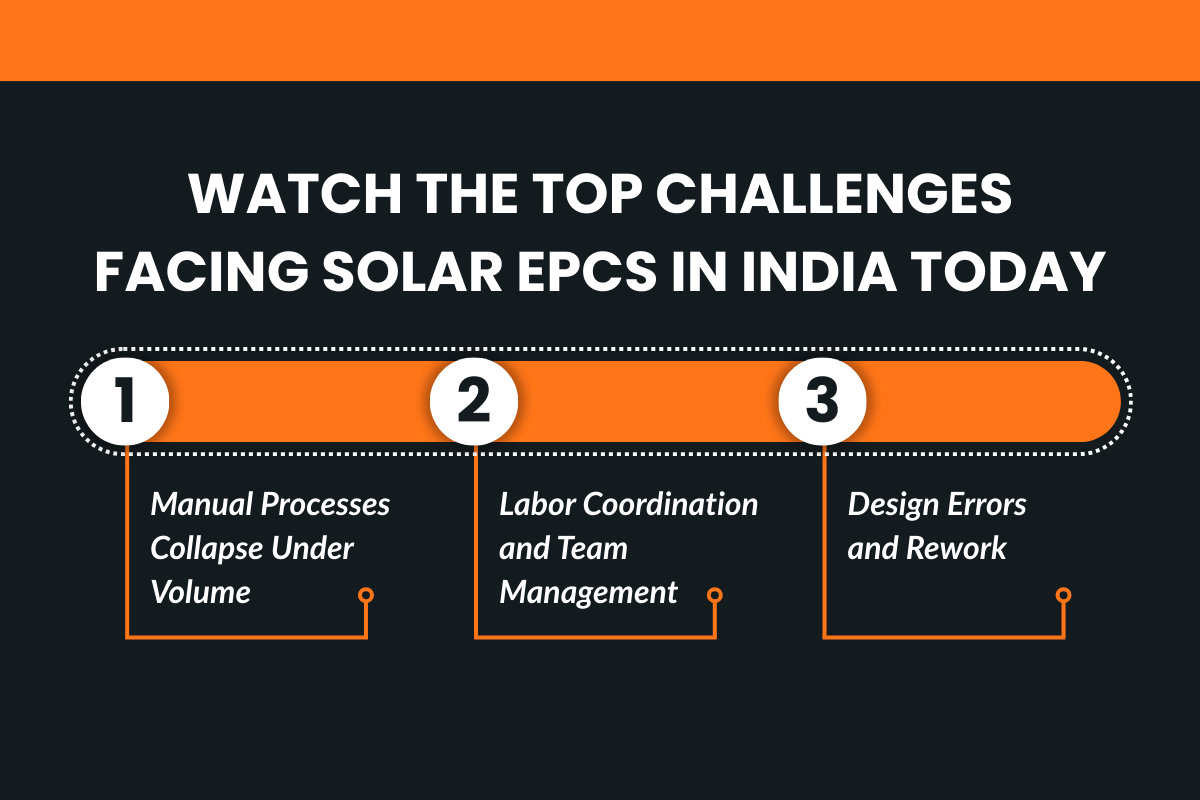
As project counts rise, Indian EPCs face challenges in getting more control over projects. Key challenges include:
1. Manual Processes Collapse Under Volume
Tracking work in spreadsheets or notebooks works for a few projects, but falls apart as more projects run simultaneously. For example, using Excel to manage tasks and approvals quickly leads to errors and missed updates.
One analysis notes that static spreadsheets lack real-time data and advanced features, leading to inaccurate schedules and more project delays.
In practice, site progress is often updated only after delays have already occurred, so senior managers react to late changes instead of anticipating them. In short, when projects multiply, manual lists and Excel become bottlenecks.
2. Labor Coordination and Team Management
Scaling project teams highlights communication gaps. It’s hard to keep the stages of sales, engineering, design, and field crews on the same page. Miscommunications like unclear handoffs or double-booked technicians directly affect efficiency and accuracy.
For example, an EPC owner found his crews were sometimes assigned to two jobs at once, causing confusion and customer wait times. Chasing updates manually by phone or WhatsApp reduces everyone’s productivity.
Without a shared system, daily stand-ups and follow-ups consume time that could be used on installation.
3. Design Errors and Rework
Mistakes in solar ladder or lead capture estimates mean costly site returns. If panel placement or shadowing is calculated incorrectly, engineers must revisit sites, push deadlines, and adjust panels.
Solar Energy industry standards warn that even small design errors can affect major delays and extra costs. On top of that, rework hurts customer trust and eats into margins, making each project take longer to drive success.
4. Procurement and Inventory Bottlenecks
Large-scale solar projects demand coordinating dozens of parts, such as solar installers, modules, inverters, mounting racks, wiring, etc. Studies of solar operations note that equipment shortages delay project delivery and decision-making.
On the other hand, keeping too much stock ties up capital in India’s thin-margin solar business because manually tracking dozens of stock items often leads to over-ordering or missed re-orders.
Why Most Solar EPCs in India Outgrow Their Tools Too Fast?
Many growing EPCs start with makeshift tools: a generic CRM or spreadsheet plus WhatsApp. These work until they don’t. Two key reasons are:
A. Generic CRMs Do Not Fit EPC Workflows
Popular CRMs focus on lead tracking and sales stages, not on coordinating site work. They manage opportunities and contacts, but offer nothing for assigning solar installers or tracking the sales process.
Firms observe that using a generic CRM often means extra work: managers must create duplicate entries for the same project under each customer to perform financial analysis.
After the deal is closed in the CRM, the actual product sales and payments remain untracked. This simply means generic CRMs “create more work” and rarely integrate with specialized solar assets. The result is that post-sale processes remain unmanaged.
B. Too Many Disconnected Apps Create More Work
Faced with no single place, teams use multiple apps together: one for sales, another for design, spreadsheets for finances, WhatsApp for field updates, and so on. But this use of disconnected systems means data must be manually re-entered across the board.
For example, a change in project schedule in the tool might not update the finance tracker or the mobile app.
Teams spend more time copying info and hunting for the latest insights than doing actual work. This manual syncing is a productivity drain and leads to errors.
What a Scalable Solar Business Software Stack in India Must Include?

If you are building a solar EPC business in India, this checklist becomes your operating backbone as you scale. These are the systems that decide whether growth stays under control or turns messy.
1. CRM for Solar Sales & Lead Management
A solar CRM must do more than store contact details. It should give full visibility into where every lead comes from and what happens next in a single platform.
With the right CRM, you can:
- Track dealers, channel partners, referrals, tenders, and organic website leads in one place
- See exactly who owns each lead and which stage it sits in
- Stop lead leakage caused by missed follow-ups or unclear ownership
- Avoid duplicate calls and repeated proposals that confuse customers
2. Solar Design & Simulation Software
Design mistakes are expensive once installations begin. A strong design tool protects both timelines and margins.
This layer of new features helps you:
- Create quick and accurate proposals without waiting days for manual drawings
- Run shadow analysis and generation estimates before committing to numbers
- Set clear expectations with customers from day one
- Cut down redesign cycles that delay approvals and installations
3. Project Management Software
Once a project is sold, execution speed becomes the deciding factor. Project management software keeps every team aligned from survey to commissioning.
It allows you to:
- Assign tasks across site survey, engineering, procurement, installation, and commissioning
- Track responsibility so nothing slips through the gaps between teams
- View all active sites on a single dashboard without chasing updates
- Spot delays and minimize errors early, and take action before deadlines are missed
4. Billing, Documentation & Compliance
Paperwork delays can hold projects long after installation is complete. This layer ensures nothing gets lost or forgotten.
A strong compliance system helps you:
- Manage net-metering applications, subsidies, and utility approvals
- Track billing milestones and payment status
- Store warranties, test reports, and customer documents digitally
- Eliminate missing files and repeated document requests
Scale Without Chaos: How the Right Software Changes the Growth Curve?
| Outcome | Statistic |
|---|---|
| Operational discipline replaces firefighting | 78 % of companies reported improved productivity after ERP implementation, signaling more streamlined, efficient operations. |
| Teams scale without increasing complexity | 77% of organizations eliminated information silos by integrating systems, improving data flow across teams. |
| Growth becomes predictable, repeatable & profitable | 62 % reported measurable cost reductions after implementation, supporting more controlled growth. |
| Software shifts from support tool to growth engine | 71 % of companies leverage centralized data for forecasting and planning, improving future decision-making. |
What do You Learn From This Table?
- Teams move away from daily firefighting and start following clear, repeatable processes.
- Managers gain visibility without constant check-ins or micromanagement.
- Decisions shift from reactive to planned because data is available on time.
- Software becomes a tool that actively supports growth, not just record-keeping.
When Should a Solar EPC Invest in Solar Business Software?
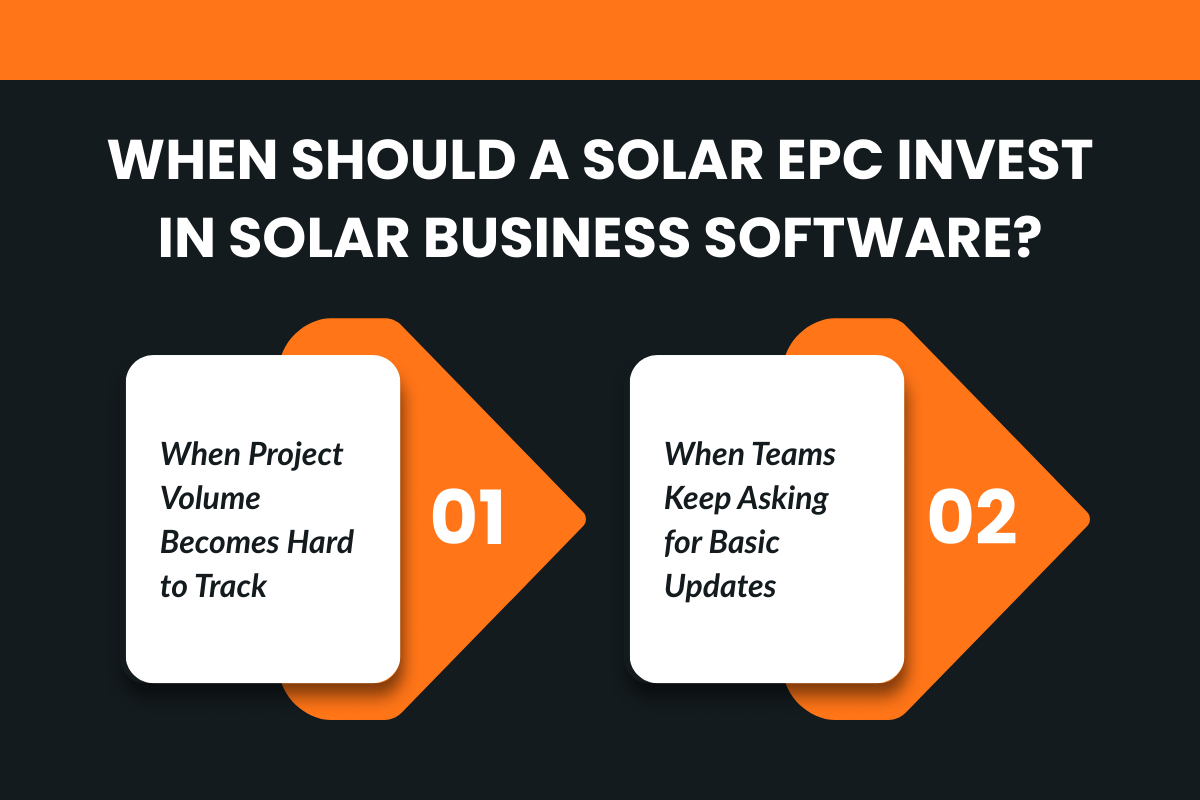
Below are a few points that will help you make an informed decision on when to invest in solar software for your business:
I. When Project Volume Becomes Hard to Track
In the early days, a few spreadsheets and WhatsApp groups felt manageable. Once multiple projects run simultaneously, those tools start breaking down.
Missed follow-ups, wrong numbers, and forgotten site updates become more common. That is usually the moment when your existing process has reached its limit.
II. When Teams Keep Asking for Basic Updates
If sales teams keep checking whether a contract is signed, or field teams ask whether a vendor payment has been made, the problem is not effort, but visibility.
When information lives in different places, teams slow each other down. Leaders should be able to see project status without having to chase people every day.
III. When Delays Start Hurting Trust and Margins
Late installations and billing errors do more than slow cash flow. They frustrate customers and damage your reputation in a competitive market.
If projects are slipping because office systems cannot keep up with execution, those delays will eventually eat into margins and future referrals.
IV. When Founders Need More Control Without Constant Oversight
Many founders try to fix growing pains with more calls, more meetings, and more follow-ups. That approach works only for a short time.
The game-changer solution is using the right software, which replaces constant supervision with data-driven decisions. You stay in control because the system shows you what matters, not because you are involved in every step.
Measuring Success: KPI Checklist to Measure Success with Solar Business Software
| KPI Area | Checklist Items |
|---|---|
| Project Completion Times | ☐ Projects tracked from survey or contract to commissioning ☐ Planned timelines compared with actual delivery dates ☐ Key milestones clearly defined and monitored ☐ Delays flagged before they affect handover |
| Lead-to-Install Conversion Ratio | ☐ All leads captured from every source ☐ Quote-to-install conversion rate visible ☐ Drop-offs identified at each stage ☐ Conversion tracked by sales rep or channel |
| Profitability and Resource Utilization | ☐ Cost versus revenue tracked per project ☐ Project margin or ROI visible ☐ Labor usage monitored across sites ☐ Rework and cost overruns flagged early |
If most boxes are checked, your business is running with clarity. If several boxes stay unchecked, growth will feel heavier than it should.
How Sunbase Helps Solar Business Software Built for Indian EPCs?
Sunbase is built for how solar EPCs in India actually operate, not how generic software expects them to work. It supports local workflows such as site surveys and utility approvals with minimal setup and improves efficiency.
Whether you work on residential rooftops, commercial sites, or large utility projects, Sunbase adapts to the way your teams already execute on the ground. That means less confusion, faster adoption, and systems that feel familiar from day one.
Key Features of Sunbase:
- Built around Indian solar processes such as site surveys, net-metering, subsidies, and utility approvals
- Tracks the full project lifecycle from lead capture to final commissioning
- Keeps sales, project managers, and field crews aligned with real-time updates
- Automatically manages tasks, materials, approvals, and site progress
- Stores site photos, approvals, invoices, technical drawings, and compliance documents in one organized repository.
- Provides analytics on conversion rates, project timelines, revenue tracking, and operational bottlenecks.
- Provides regulatory authorities with clear visibility and control without constant micromanagement
Conclusion: Scaling a Solar EPC Business in India Requires More Than Demand
Growing demand alone does not make a solar EPC successful. Every project, from the first conversation with a customer to switching on the panels, relies on smooth coordination between sales, design, procurement, and field teams.
Without strong processes, even a small mistake can slow timelines, reduce margins, and frustrate customers. In India’s fast-moving solar market, businesses that lack structured systems often struggle to keep up as they expand.
This is where the right software makes all the difference.
Platforms like Sunbase bring all teams, data, and workflows into one place, giving leaders real-time visibility and enhancing customer experience. With the right tools, adding more projects or team members does not mean more chaos. Book a demo with Sunbase Today.
FAQs
1. Where can I buy solar business software in India?
Solar business software is typically sold directly by manufacturers of systems developed specifically for Indian businesses via their websites or local sales reps, but most manufacturers offer demos so you can see how each system integrates with your existing business processes before purchasing a platform.
2. Affordable solar ERP software providers catering to the Indian market?
Many companies are developing ERP software solutions that include CRM, Project Management, Inventory Control, Manufacturing Compliance, and Sales through a single platform. One company that fits these criteria is Sunbase, which provides EPCs with a total solution for managing their businesses without using multiple app-based solutions.
3. How to choose solar business software for installation firms in India?
Select software that works how your employees do their jobs, instead of making your employees adapt their jobs to the way you want them to be done. Look for software that allows you to view projects from lead through to commissioning, along with the functionality needed to meet compliance requirements in India.
4. Which solar business software offers good customer support in India?
When selecting solar software providers, it is critical to consider whether they offer good customer support. Different areas have different requirements regarding workflows and approvals. For that reason, look for vendors that provide customer support via local phone or e-mail, as well as onboarding and training, so problems can be resolved efficiently.
5. What are the Top-rated solar project management tools in India?
The best solar project management tools available in India include Sunbase, TrakSun, SolarSAAS, and OctaBees ERP, which are specifically designed to assist Indian EPC organizations in managing projects, tracking task progress, and managing inventory.
One Platform.
Zero Chaos.
Run Your Entire Business in One Platform
Sunbase replaces your CRM, proposals, scheduling, job tracking, and reporting tools — all inside one clean, connected platform.
About Sunbase
The All-In-One Platform to Run Your Entire Business
Sunbase helps you organize operations, streamline daily workflows, and manage everything - from first customer contact to final project deliver- in one connected system.
Our Mission
- Organize your business.
- Optimize your workflow.
- Automate your dailytasks
Why Businesses Choose Sunbase
One Connected Workflow
Replace scattered tools and manual processes with a single platform that brings together your team, tasks, customers, jobs, and performance data.
🌎 Global Presence
Serving the United States, Canada, India, LATAM, Australia, and 10+ international markets.
👥 11,000+ Users
Trusted by contractors, installers, project managers, sales teams, and field technicians.
🏗️ Built for All Sizes
From small contracting teams to fast-growing enterprises, Sunbase adapts to your workflow.
Stop Managing Your Business Manually. Automate It.
Sunbase automates workflows, reduces mistakes, and helps your team get more done - without hiring extra staff or juggling multiple tools.
Still Managing Your Business Across Multiple Tools?
Bring your CRM, proposals, projects, and operations into one platform built for contractors.

