
Solar Proposal Software: What It Is, Why It Matters & Which Platforms Stand Out
Most solar installers don't fully appreciate how much of their close rate is decided by their proposal- not their pricing, not their panel brand, not their installation reputation.
Which raises an obvious question: if the proposal matters that much, why are so many solar companies still building them in Excel?
The answer is mostly historical inertia. Five years ago, dedicated solar proposal software was either an expensive enterprise-grade tool or didn't really exist. That's no longer true. The category has matured. There are now well-supported platforms at every price point. But which one to choose?
Some tools specialize in proposal creation, while others combine proposal creation with estimation, CRM, financing, and project management in a single workflow.
This guide explains what solar proposal software is, what it does, which platforms lead the market, and how to figure out which one belongs in your business.
Key Takeaways
- Solar proposal software automates the creation of customer-facing solar quotes, combining system specs, savings projections, incentive calculations, and financing options into one professional document.
- The average manual proposal takes 2–4 hours to build; software reduces this to under 30 minutes, often under 10.
- Proposal software ≠ design software. Design tools engineer the system; proposal tools sell it. Many platforms now combine both.
Still Building Solar Proposals Manually?
You don't need another spreadsheet. You need a system that builds a professional, accurate solar proposal in minutes- with your branding, real utility rates, and financing options already in it.
What Is Solar Proposal Software?
Solar proposal software is a tool that automatically generates customer-facing proposals for solar installations, combining system design data, financial modeling, incentive calculations, and branded presentation into a single document that's ready to send.
Unlike a generic quoting tool, solar proposal software is built around the unique variables of solar sales: roof orientation, shading, utility rates, local incentives, net metering policies, and payback periods. It automates the calculations that would otherwise take hours to do manually.
What Does a Solar Proposal Contain?
This is where the real value lives. At the functional level, solar proposal software handles:
| Proposal Element | Why It Matters |
|---|---|
| System Design | Shows the proposed panel layout, equipment, and expected energy production |
| Savings Projections | Estimates how much the customer can save on electricity over time. |
| Financial Analysis | Calculates payback period, ROI, and long-term financial benefits. |
| Financing Options | Compares cash purchases, loans, leases, and PPAs side by side. |
| Incentives & Rebates | Applies available federal, state, and local solar incentives. |
| Branded Proposal | Presents the project in a professional, customer-friendly format |
| Digital Delivery & E-Signature | Allows customers to review and approve proposals online. |
| Proposal Tracking | Shows when a proposal is opened, viewed, or shared for smarter follow-up. |
Why Are Solar Companies Switching to Proposal Software?
The solar market has changed. Customers are more educated, margins are tighter, and the sales cycle is more competitive than ever. Here's why proposal software has gone from "nice to have" to operational necessity:
1. Speed-to-Quote is a Close-Rate Driver:
Homeowners often compare multiple solar quotes before making a decision. The longer it takes to send a proposal, the greater the chance that customer interest shifts toward a faster-moving competitor.
Research on proposal automation platforms shows organizations reporting a 60-75% reduction in proposal creation time, allowing teams to respond faster and handle more proposal volume without increasing headcount.
2. Accuracy Builds Trust:
A proposal with a vague savings estimate or a wrong system size damages credibility before you've even started. Automated calculations, pulling from real utility data and irradiance maps, reduce human error to near zero.
3. Professionalism Differentiates You:
In markets where homeowners are comparing 3–5 quotes, the visual quality and clarity of your proposal signal the quality of your installation. A branded, interactive proposal positions you above competitors still using Word docs.
4. Volume Without Headcount:
As your sales team scales, manually building proposals doesn't scale with them. Software means your 10th sales rep creates proposals just as fast and consistently as your first.
What Is a Solar Proposal Template and Why Does It Matter?
A solar proposal template is the structural foundation that proposal software uses to generate consistent, branded documents. It's the layout, formatting, branding, and standard content blocks that get applied to every proposal so that each one looks professional and on-brand without anyone manually building it from scratch.
Three reasons templates matter operationally:
1. Consistency at scale: When every proposal follows the same structure, customers get the same quality experience regardless of which rep handled them or how busy the team was that day. Inconsistent proposals erode trust; consistent ones build it.
2. Speed of generation: A configured template means the proposal "shell" is already done. The software just needs to populate it with the specific customer's design and financial data, which is what turns a four-hour manual process into a twenty-minute automated one.
3. Brand reinforcement: Every proposal is a brand touchpoint. Templates ensure your logo, color palette, typography, and tone are applied uniformly across every customer interaction.
A strong solar proposal template should include:
- Customizable fields that adapt to each customer's specific situation
- Embedded calculations for production and savings
- Detailed cost estimates with line-item transparency
- Visual elements like charts, production graphs, and roof renderings
- Pre-built sections for warranties, terms, and FAQ
- Mobile-friendly formatting since most homeowners now review proposals on phones
Most modern proposal software ships with multiple template options that can be customized for your brand, then locked in so reps can't accidentally break the formatting on a critical deal.
What's the Difference Between Solar Proposal Software, Design Software, and CRM?
One of the most common sources of confusion in the solar software category is understanding what each tool type actually does. Here's a clear breakdown:
| Software Type | Primary Purpose | Key Functions | Main Output |
|---|---|---|---|
| Solar Proposal Software | Create customer-facing proposals and quotes | Savings calculations, financing options, proposal generation, e-signatures | Sales-ready proposal |
| Solar Design Software | Design and validate solar systems | Roof modeling, shade analysis, system sizing, production forecasting | System design |
| Solar CRM | Manage leads and customer relationships | Lead tracking, pipeline management, follow-ups, and reporting | Organized customer data |
| Solar Sales Software | Streamline sales operations | Canvassing, lead routing, territory management, and appointment scheduling | Improved sales workflow |
The key distinction: Solar design software tells you how to build the system. Proposal software tells the customer why they should say yes.
In practice, many modern platforms are converging. Sunbase, for example, combines proposal creation, CRM, and project management in one platform. Aurora Solar has expanded from pure design into proposal territory. The trend in 2026 is toward all-in-one solar sales platforms rather than disconnected point solutions.
If you're evaluating software, the real question isn't "proposal vs. design"- it's "what does my team's workflow look like, and where are the bottlenecks?"
What Features Should Solar Proposal Software Include?
If you're evaluating platforms, these are the features that separate the strong tools from the weak ones in 2026.
1. Accurate 3D Roof Modeling
The foundation of every credible proposal. Modern platforms generate 3D roof models from satellite imagery and LiDAR data- automatically detecting pitch, obstructions, and shading patterns. If you're doing commercial work, verify the platform supports larger and more complex roofs.
Explore the fundamentals and see how top solar installers leverage design software to create better layouts, boost system performance, and significantly increase project profitability!
2. Live Utility Rate and Incentive Databases
The platform should maintain a continuously updated database of utility rates, net metering policies, federal incentives, state incentives, and local programs across the U.S. markets you serve. Confirm coverage in your specific operating states before committing.
3. Automated Financial Modeling
The platform should automatically generate cash, loan, lease, and PPA scenarios with monthly payment calculations, payback periods, and long-term savings projections updated in real time.
Customers care about outcomes, not technical specifications. They want to know how much they'll save, what they'll pay each month, and how long it will take to recover their investment.
4. CRM Integration
Bidirectional integration with your CRM (whether that's Salesforce, HubSpot, or a solar-specific CRM like Sunbase) is non-negotiable for any business doing meaningful volume.
Customer data should flow in; proposal status should flow back. Without integration, sales reps end up entering the same information multiple times across different systems.
5. Design Tool Integration
If you use a standalone design platform, confirm the proposal tool integrates with it directly so design data doesn't need to be re-entered.
Manually transferring design information between systems slows proposal creation and increases the likelihood of mistakes. Direct integrations allow layouts, production estimates, equipment selections, and system specifications to flow automatically into the proposal, creating a faster and more reliable workflow.
6. Engagement Tracking
Know when the customer opens the proposal, how long they spend, and which sections they review. This transforms follow-up from guesswork into strategy.
A rep can see whether a customer is actively reviewing financing options, comparing savings projections, or hasn't opened the proposal at all. These insights help sales teams prioritize follow-ups and improve conversion rates.
7. Built-In E-Signature
Embedded e-signature beats routing through DocuSign as a separate step. Less friction between proposal and contract.
Every additional step between interest and commitment creates friction. Routing customers to a separate signing platform can delay decisions and increase drop-off rates. Built-in signatures streamline the approval process and help sales teams close deals while customer interest is highest.
8. Customizable Branded Templates
Your proposals should reflect your brand, not the software vendor's defaults. Look for full customization of logos, colors, typography, and content blocks. Consistent branding reinforces trust and creates a more polished customer experience.
9. Multi-Language Support
In markets with Spanish-speaking customer bases, such as large parts of California, Texas, Florida, and the Southwest, multilingual proposal generation can be a meaningful competitive advantage.
Providing customers with the right solar proposal software in their preferred language improves comprehension, builds trust, and creates a better overall experience. For companies operating in multilingual regions, this feature can expand market reach and improve communication throughout the sales process.
What to Avoid:
- Platforms that require 30+ minutes of manual data entry per proposal
- Software with no mobile presentation mode
- Tools without a live utility rate database (estimates are not good enough in a competitive market)
- Platforms that can't generate proposals in the field, from a tablet or phone
What Makes a Solar Proposal Win or Lose a Deal?
Software gives you speed and accuracy, but the content strategy of your proposal is what closes deals. Here's what experienced solar sales operators have learned while creating a winning proposal:
What Wins Deals:
- Leading with the customer's current problem: "You paid $2,340 last year in electricity. Here's how that changes." Personalization beats generic savings claims every time.
- A 25-year savings visualization: Customers don't buy solar on month-1 savings. They commit when they see the 20-year payback curve.
- Clear, honest payback period: Don't hide the 7-year payback period in the back. Own it, explain it, show why it's still a great investment.
- Financing options that match their situation: Effective solar proposals focus on long-term 25-year savings projections, personalized energy cost analysis, and realistic utility inflation modeling, rather than just immediate, short-term gains. Winning strategies involve leveraging third-party leases or PPAs to capture commercial tax credits and employing automated compliance tools to ensure accuracy in a post-tax credit market. For a comprehensive guide, read the full article at Solar Sales Toolkit.
- Social proof embedded: A customer quote or local install photo directly in the proposal builds trust at the exact moment of decision.
What Kills Deals:
- Proposals sent more than 48 hours after the site visit
- Financial projections that don't match real utility bills
- Proposals with no clear next step or CTA
- Overcrowded designs with too much technical jargon
- A PDF that doesn't render well on a phone
The best solar proposal software gives you the tools to execute all of the "wins" above and avoid the common mistakes that cost close rates.
How Does the Solar Sales Process Actually Work and Where Do Proposals Fit?
If you're new to solar sales or you're evaluating software without a clear picture of the full workflow, it helps to understand where a proposal actually lives in the process. A lot of solar installers treat the proposal as an afterthought. The top-performing ones treat it as the centerpiece.
| Stage | What Happens | Primary Tool |
|---|---|---|
| Lead Generation | Capture and manage incoming leads. | CRM / Sales Software |
| Qualification | Verify homeowner eligibility and project fit. | CRM / Sales Teamdez |
| Site Assessment | Evaluate roof, shading, and system requirements | Solar Design Software |
| Proposal Creation | Present system design, savings, pricing, and financing options. | Solar Proposal Software |
| Close | Customer reviews, signs, or requests revisions. | Proposal Software + E-Signature |
| Project Handoff | Transfer project details to operations and installation teams | Project Management Software |
Which Are the Best Solar Proposal Software Platforms?
The market has consolidated around a clear set of leaders, with meaningful differentiation in pricing, target customer, and feature depth. Here's where the major platforms actually stand.
1. Aurora Solar
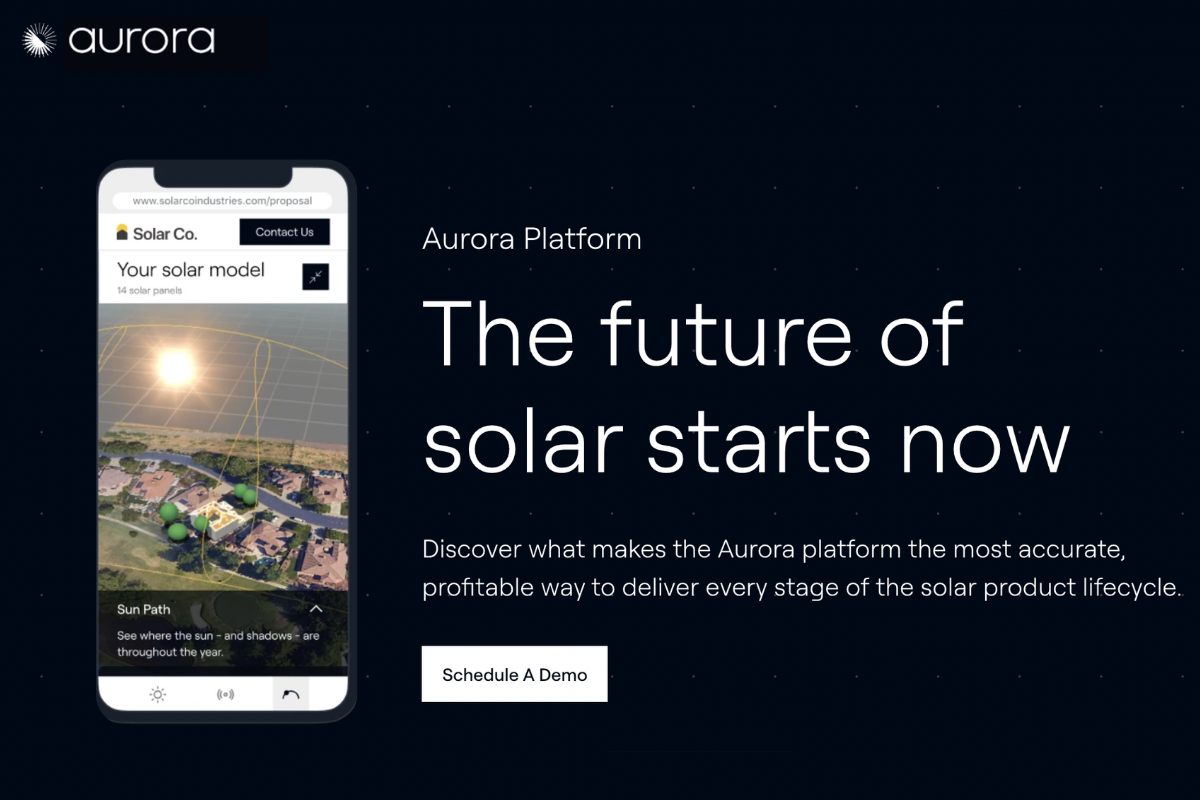
The polished, enterprise-grade choice. Aurora dominates the high-end of the U.S. residential market with AI-powered roof detection, LiDAR-based shading analysis, and visual proposals. Tight Salesforce CRM and DocuSign integrations make it a natural fit for enterprise sales teams.
Best for: Mid-to-large residential installers and enterprise teams prioritizing visual proposal quality and CRM integration.
Pricing: Begins around $159/month for basic residential tiers, with credit-based pricing on advanced AI design features. Custom enterprise pricing for larger teams.
Watch out for: Electrical engineering (SLDs, wire sizing) isn't automated; commercial users often need AutoCAD or supplementary tools. Pricing isn't transparent- you have to talk to sales.
2. OpenSolar
The free option has become genuinely capable. OpenSolar offers an end-to-end solar design and proposal platform with 3D modeling, financial analysis, and a lightweight CRM at no cost. It monetizes through financing partner integrations.
Best for: Startups, small installers, and budget-conscious teams handling primarily residential projects.
Pricing: Free. Financing partner integrations generate the revenue model.
Watch out for: Shading analysis is basic compared to LiDAR-powered competitors. Visual proposal quality is a step below Aurora. Hits the capability ceilings on larger commercial projects.
3. Sunbase
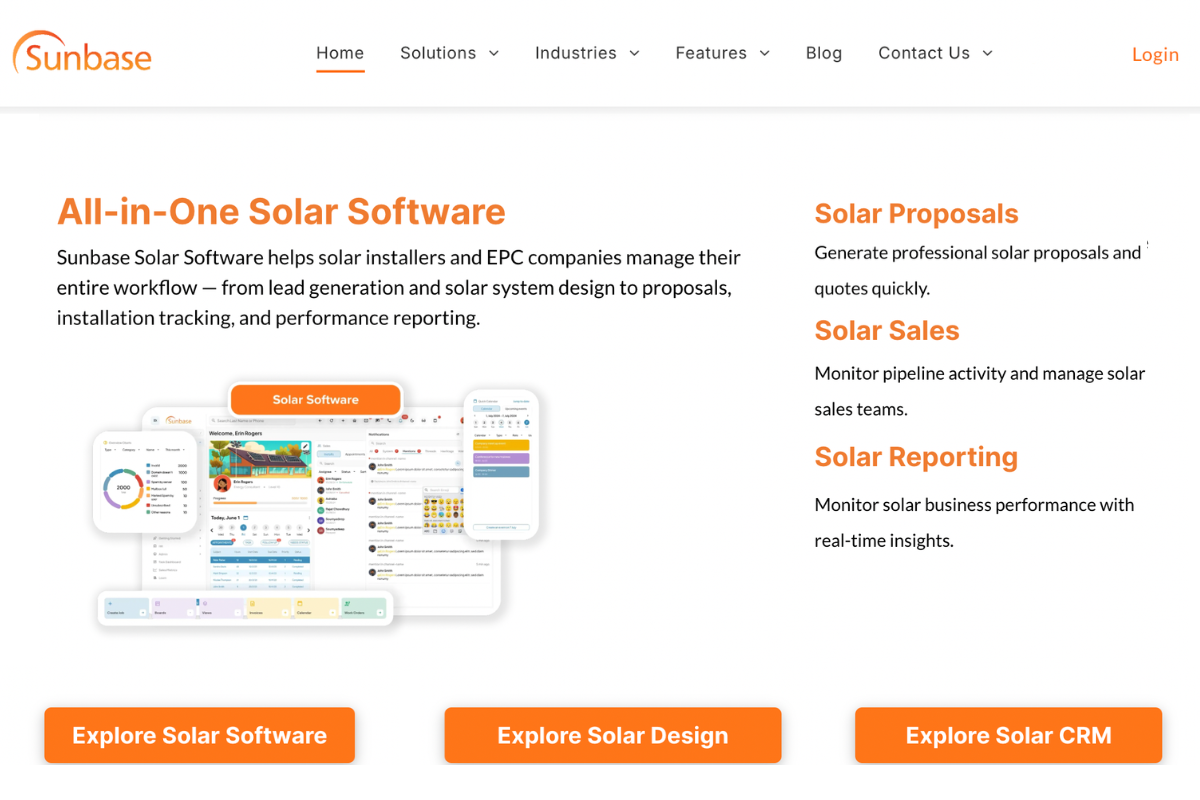
The integrated platform option. Sunbase combines solar CRM, proposal, design, and project management into a single connected system, useful for installers who want to consolidate their tech stack rather than wire together separate tools.
Best for: Solar installers who want CRM + proposals + project management in one platform without integration headaches; mid-sized teams scaling sales operations.
Pricing: Starts from $59/per month. You can contact for a personalized quote based on team size.
Watch out for: As an integrated suite rather than a pure-play proposal tool, evaluation should weigh the value of the broader platform, not just the proposal module.
4. HelioScope
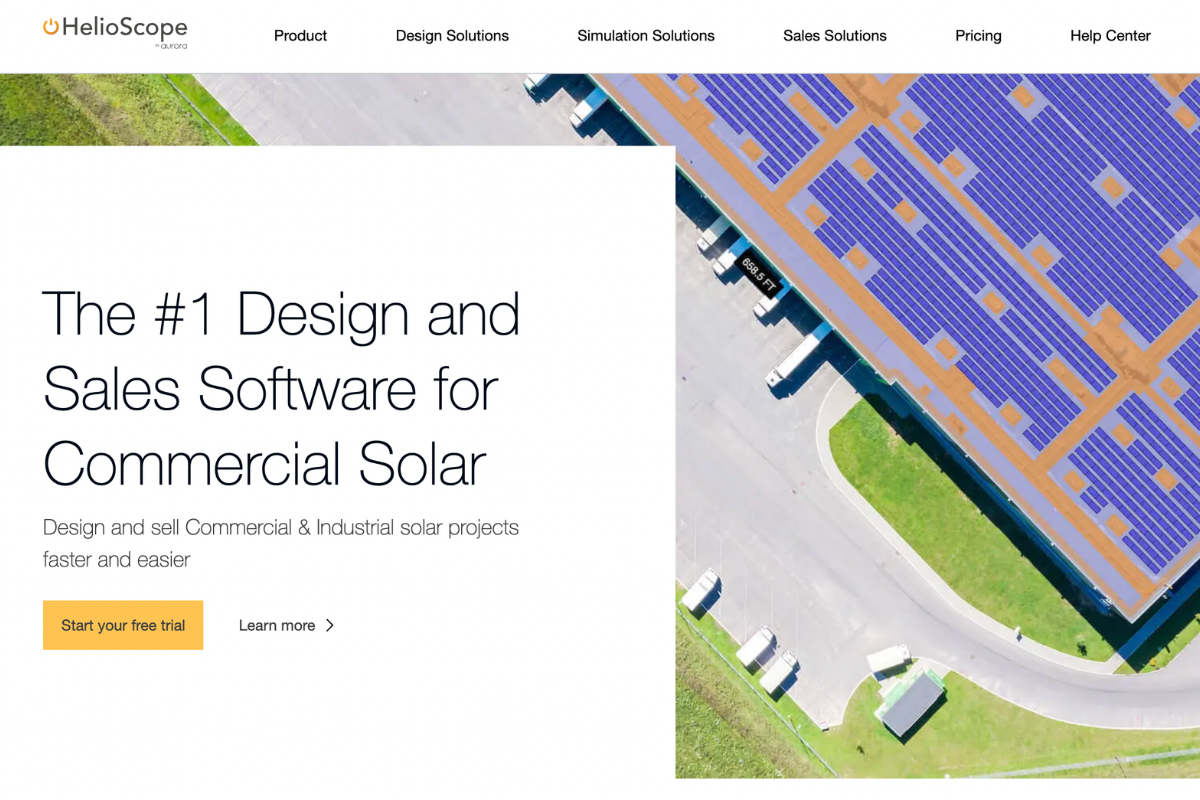
The engineering-grade choice for complex projects. HelioScope focuses on system performance simulation, bankable production reports, and detailed shading analysis. It's not really a sales tool; it's a design tool, but it's often used alongside dedicated proposal software for commercial work.
Best for: Commercial and utility-scale projects where engineering accuracy matters more than sales velocity.
Pricing: Subscription-based software starting at $159/month per license for the Basic tier. Upgrading to the $259/month Pro tier.
Watch out for: It is still not a full-cycle, customer-facing proposal generator or CRM in the way tools like Sunbase or its parent company, Aurora Solar, are. For high-volume workflows, many teams still prefer to pair their raw engineering data with external front-end sales software.
5. SolarGraf
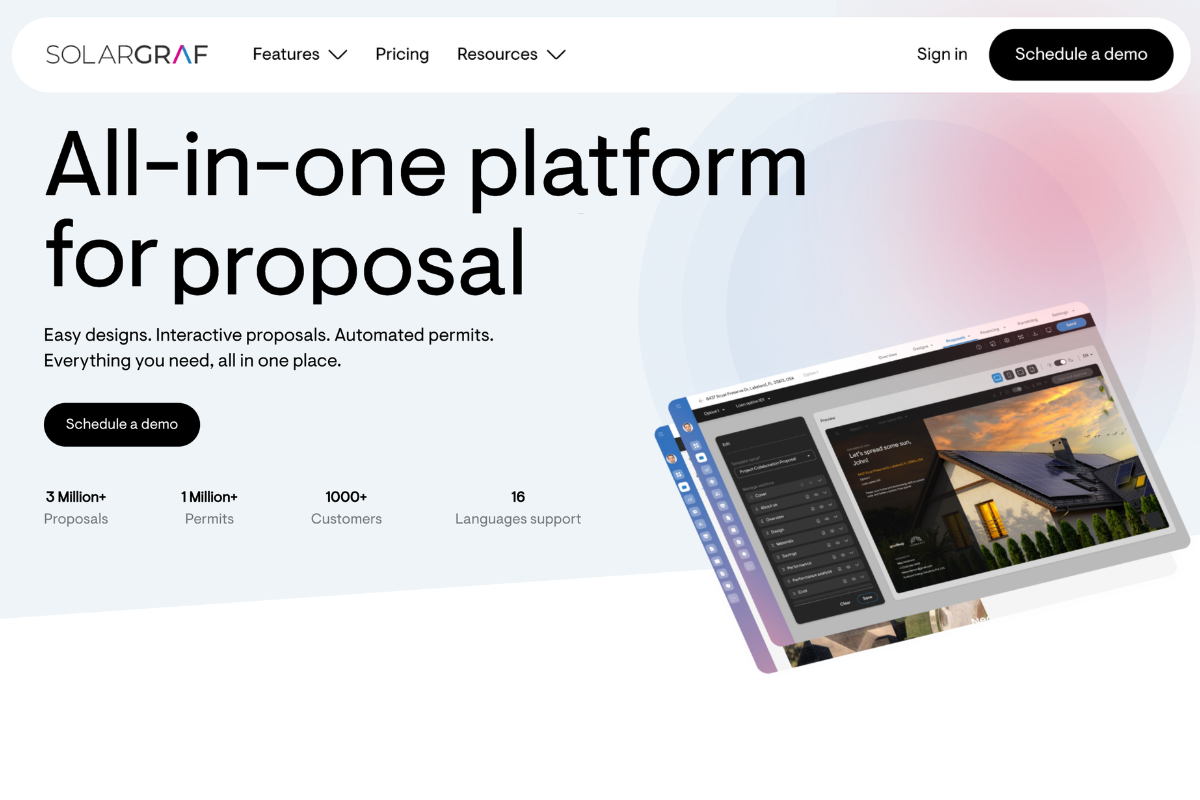
The sales-focused middle ground. SolarGraf combines solar design, proposal generation, financing integrations, and permit package creation into a single platform.
Its biggest strength is speed, allowing sales teams to move from lead to proposal quickly while keeping the workflow relatively simple. The platform is particularly popular among residential installers who need more functionality than free tools but don't require enterprise-level complexity.
Best for: Residential solar installers looking for an all-in-one proposal, financing, and permitting platform with a strong focus on sales efficiency.
Pricing: Starter Tier: $2,799/year (up to ~240 projects). Subscription-based pricing with custom plans based on company size and feature requirements.
Watch out for: While strong for residential sales workflows, SolarGraf's design and shading capabilities aren't as advanced as engineering-focused platforms like Aurora or HelioScope. Larger commercial projects may require supplementary design or engineering tools.
Who Actually Uses Solar Proposal Software and How?
Solar proposal software isn't one thing used one way. Different people inside a solar company use it differently- and knowing that helps you evaluate whether a platform fits your real workflow.
1. The Door-to-Door Rep in the Field
A D2D rep knocks on a door. The homeowner has 15 minutes. The rep enters the address, pulls in utility data, and has a branded proposal on a tablet in under 5 minutes with savings projections, financing options, and an e-signature block ready to go.
For the user, speed and mobile performance are everything. If it takes longer than 5 minutes at a doorstep, it's already too slow.
2. The Inside Sales Rep Following Up on a Site Visit
A site visit happens on Monday. The rep needs a proposal out by Tuesday morning before the homeowner shops around. With proposal software, that's a 15–20 minute task, not a 3-hour evening of spreadsheets and copy-pasting.
For this user, CRM integration and proposal tracking matter most. Know when the customer opened it. Follow up at the right moment.
3. The Sales Manager Tracking the Team
How many proposals went out this week? Which ones were opened but not signed? Which reps are sending proposals 4 days after a site visit instead of same-day?
Without centralized proposal software, none of these questions has a clean answer. With it, the manager has a real-time dashboard across the entire team and can actually see where deals are dying.
4. The Ops Team Receiving a Signed Contract
When a proposal is signed, operations need to know exactly what was sold: system size, equipment, financing type, and installation timeline. In a manual process, that handoff is a forwarded email and a prayer.
Proposal software that connects to project management closes this gap automatically. A signed proposal triggers a live project record. No re-entry, no miscommunication, no margin lost in translation.
What Should You Look for When Choosing Solar Proposal Software?
The right software depends on where your business is today and where it's headed. Here's a practical decision framework:
For Solo Installers and Small Teams (1–5 reps):
- Prioritize ease of use and fast onboarding
- Look for flat-rate or affordable per-user pricing
- You need proposals fast- not a platform that takes 3 weeks to learn
- Key check: Can a new hire create a solid proposal on day one?
For Growing Sales Teams (6–25 reps):
- CRM integration becomes critical- pipeline visibility matters
- Look for proposal templates your whole team can use consistently
- Multi-rep access with role permissions
- Key check: Can you see proposal activity across your whole team from one dashboard?
Review your Solar CRM with this 2026 checklist.
Compare the top 10
CRM features demanded by leading solar companies and identify the gaps to avoid high costs.
For Regional or Enterprise Installers (25+ reps):
- Workflow automation and API integrations are essential
- White-label capability so proposals look fully branded
- Reporting on proposal-to-close conversion rates
- Key check: Does it integrate with your existing tech stack (Salesforce, HubSpot, ERP)?
Universal Questions to Ask Any Vendor:
- How long does it take to generate a proposal after a site visit?
- Does the software update incentive programs automatically?
- Can it handle battery storage proposals?
- What does onboarding look like, and how long before my team is productive?
- Is there a trial or demo available before committing?
What Mistakes Should You Avoid When Adopting Solar Proposal Software?
The most common mistakes when choosing or implementing proposal software:
- Choosing features alone: Feature lists are nearly identical across competing platforms. Implementation quality, support, and team adoption matter far more than whether a tool checks one extra box.
- Underweighting integration: A platform that doesn't connect to your CRM and design tool creates a new data silo instead of eliminating an existing one. Always test integrations before committing.
- Skipping the live trial: Demos are designed to look good. Trial the platform with real customer addresses in your service area, your local utility rates, and your incentive programs. The trial reveals problems demos hide.
- Ignoring the incentive database coverage: A platform with weak data coverage in your operating states will produce proposals with stale or missing incentive information, which directly costs deals.
- Buying for theoretical future scale: Some teams over-buy enterprise platforms because they expect to need them in three years. By the time they actually scale, the platform landscape has moved, and they've paid premium pricing for a capability they didn't use.
- Underestimating change management: Solar proposal software isn't plug-and-play. Sales reps have to change how they work. Budget for training, expect adoption resistance, and plan for a two-to-three-month productivity dip before the new workflow becomes natural.
- Picking a free tool when you've already outgrown free: OpenSolar is genuinely useful at a small scale. At higher volume, the limits of its visualization and analysis depth start showing up in lost deals. Free isn't free if it costs you dearly.
Conclusion
The right platform does more than generate professional-looking proposals. But there's no single "best" solar proposal software for every company. A startup installer may prioritize affordability and ease of use, while a larger organization may need CRM integrations, workflow automation, and advanced reporting.
The key is understanding where your current sales process slows down and choosing a platform that removes those bottlenecks.
At the end of the day, the goal isn't simply to create better proposals. It's to create a faster, more consistent, and more scalable sales process that helps turn more qualified leads into signed solar projects.
Not sure which solar proposal software fits your business? Every solar company's sales process is a little different. Some need CRM integration. Some need field-ready mobile proposals. Some just need to stop losing deals to competitors who send better quotes.
Tell us how you sell solar, and we'll show you exactly how Sunbase fits in. Get a quick 15-minute walkthrough now.
FAQs
Is solar proposal software worth the cost for a new installer?
For most installers, the ROI calculation is straightforward: if proposal software saves 2–3 hours per quote and helps close even one additional deal per month, it typically pays for itself quickly. The harder-to-quantify value is in consistency, branding, and not losing deals to competitors who look more professional.
Does solar proposal software work for commercial solar projects? or Question
Yes, though commercial proposals require more complexity- larger system sizes, demand charge analysis, and more detailed financial modeling. Platforms like Aurora Solar and Sunbase support commercial proposals, but the learning curve and setup time are typically higher than for residential.
Can solar proposal software automatically calculate energy savings?
Yes. Most solar proposal platforms integrate with irradiance databases and utility rate feeds to calculate how much energy a proposed system will produce and how much that saves the customer each year — including projections over 10–25 years.
How Much Does Solar Proposal Software Cost?
Pricing varies significantly based on what the platform includes, how many users you need, and whether it's a standalone proposal tool or part of a broader solar sales suite.e item or answer the question so that site visitors who are interested get more information. You can emphasize this text with bullets, italics or bold, and add links.ho are interested get more information. You can emphasize this text with bullets, italics or bold, and add links.
What features should you look for in solar proposal software?
The best solar proposal software should include customizable proposal templates, automated pricing, energy production estimates, financing calculations, e-signature support, and CRM integration. Solutions that combine proposal generation with solar design and customer management, such as Sunbase solar proposal software, can help installers create proposals more efficiently while keeping customer and project information organized in one place.
One Platform.
Zero Chaos.
Run Your Entire Business in One Platform
Sunbase replaces your CRM, proposals, scheduling, job tracking, and reporting tools — all inside one clean, connected platform.
About Sunbase
The All-In-One Platform to Run Your Entire Business
Sunbase helps you organize operations, streamline daily workflows, and manage everything - from first customer contact to final project deliver- in one connected system.
Our Mission
- Organize your business.
- Optimize your workflow.
- Automate your dailytasks
Why Businesses Choose Sunbase
One Connected Workflow
Replace scattered tools and manual processes with a single platform that brings together your team, tasks, customers, jobs, and performance data.
🌎 Global Presence
Serving the United States, Canada, India, LATAM, Australia, and 10+ international markets.
👥 11,000+ Users
Trusted by contractors, installers, project managers, sales teams, and field technicians.
🏗️ Built for All Sizes
From small contracting teams to fast-growing enterprises, Sunbase adapts to your workflow.
Stop Managing Your Business Manually. Automate It.
Sunbase automates workflows, reduces mistakes, and helps your team get more done - without hiring extra staff or juggling multiple tools.
Still Managing Your Business Across Multiple Tools?
Bring your CRM, proposals, projects, and operations into one platform built for contractors.