
Your design team finishes the roof layout by Tuesday afternoon. But it's Thursday morning, and the proposal still hasn't reached the homeowner.
Somewhere between the design tool, the pricing spreadsheet, the financing calculator, and the branded PDF template, the momentum died. By the time your proposal lands in the prospect's inbox, they've already received two quotes from competitors, and one of them sent theirs within the hour.
It's the daily reality for hundreds of solar installation companies that still rely on disconnected tools and manual workflows to produce customer-facing proposals. And in 2026, it's costing them deals.
Key Takeaways
- Faster proposal delivery often translates into higher close rates and a better customer experience.
- Most proposal delays come from moving data between disconnected tools, not creating the design itself.
- Automated proposal software improves both speed and accuracy by reducing manual work.
- CRM and design integrations are critical for eliminating duplicate data entry and workflow bottlenecks.
- Proposal automation helps sales teams handle more opportunities without adding headcount.
- The right platform should fit your current workflow while supporting future growth.
Proposal Delays Usually Start Long Before the Proposal
If you're still mapping where your team's proposal time is actually going, it helps to see what a fully connected design-to-proposal-to-signature workflow looks like end-to-end.
The detail is in the integration- how the design output flows into financial modeling, how live incentive data gets applied, how engagement tracking changes follow-up behavior.
Explore how Sunbase structures the proposal workflow, or browse our related guides on solar CRM, design tool integration, and proposal accuracy.
→ Explore Sunbase Solar Proposal Software
The Ultimate Guide to Bring Your Solar Designs Alive with Instant Solar Proposal Software To Win More Deals
Solar proposal software utilizes AI-powered algorithms to tailor proposals to each client’s specific needs. You also get pre-built templates with custom branding, so every proposal looks standardized, credible, and professional.
Each proposal gives the clients a clear picture of the system design, complete pricing information, estimated long-term savings, warranties, and guarantees, with all the important project terms and conditions.
And the best part? Everything is delivered with clean visuals and interactive formats, making your proposals stand out from the competition.
In this article, you’ll learn why manual and slow solar proposal workflows often lead to lost deals and reduced profitability, and how proposal automation helps convert designs into client-ready quotes in minutes.
You’ll understand the real operational risks of relying on spreadsheets and disconnected tools, what core features matter most in solar proposal software, and when it makes sense for solar teams to move from manual processes to automated, scalable proposal workflows.
Why Are Some Solar Companies Sending Proposals in Hours While Others Take Days?
The companies that have collapsed their proposal timeline didn't get faster designers. They eliminated the gaps between their systems.
A typical manual solar sales workflow has six or seven distinct handoffs: lead capture in the CRM, site assessment in a design tool, BOM and pricing in a spreadsheet, financing in a separate calculator, document assembly in a template, manager review by email, and delivery via a standalone e-signature platform.
Every handoff is a place where data gets re-entered, files get versioned wrong, and time gets lost. The fastest installers in the market have done one thing differently: they've connected those steps into a single workflow where data flows through automatically.
When the design is finalized, the proposal is essentially already built- system specs, utility rates, incentive data, financing scenarios, and branded formatting have all been applied in the background.
The competitive logic is straightforward. In a market where homeowners are routinely getting three or four quotes, response speed is no longer a tiebreaker; it's the primary filter. The proposal that arrives on Tuesday gets opened.
The one that arrives Friday gets ignored, because by then the customer is already in active conversations with the company that responded Tuesday.
What Is Solar Proposal Software?
Solar proposal software is a platform that automatically converts solar system design data into complete, accurate, customer-ready proposals without requiring manual data entry, spreadsheet calculations, or document formatting.
Most modern solar proposal software solutions work alongside solar design software to transform roof layouts, shading analysis, equipment selections, and production estimates into customer-facing proposals. For many solar installers, this creates a more efficient workflow across the entire sales process.
In practice, it's the connective tissue between three workflows that traditionally live in separate tools:
- Design data: Roof geometry, shading analysis, panel layout, projected production.
- Financial modeling: System cost, federal and state incentives, utility offset, financing scenarios, payback, 25-year ROI.
- Customer-facing presentation: Branded proposal documents with interactive visuals, e-signature, and engagement tracking.
The defining feature is the absence of manual data movement between those three layers. When a design is completed, the proposal is generated automatically with current pricing, utility rates, incentive data, and the correct branded template in minutes, not hours.
Where Does the Solar Proposal Process Actually Slow Down?
This is the section most business owners in the solar industry haven't actually mapped. They know proposals are slow; they don't know where the time goes. Fix the wrong step, and the bottleneck just moves.
Here's where the hours actually disappear in a typical manual workflow:
1. Manual Data Transfer Between Design and Proposal Tools
A finished design in software produces a complete system specification- panel count, inverter selection, module type, projected production, and BOM.
In a manual workflow, someone has to read that data out of the design platform and re-enter it into a proposal template or spreadsheet. Typical time cost: 30–60 minutes per proposal, plus a meaningful error rate on system size and production numbers.
2. Spreadsheet-Driven Financial Modeling
Most solar businesses below the enterprise tier still run savings projections in Excel. The spreadsheet uses utility rate assumptions, incentive values, and financing parameters that someone updated at some point and may or may not be current.
When the IRS adjusts the ITC schedule, when a state SREC market shifts, or when a utility changes its net metering rules, the spreadsheet doesn't know. The rep doesn't always know either.
3. Incentive Research That Should Be Automatic
State, local, and utility-level incentives change frequently in the U.S. solar market. Programs open, close, get modified, and get capped.
A rep who isn't actively tracking their service-area incentive landscape is going to miss things, and a competitor's proposal showing an extra $3,000 in state incentives will look cheaper, even at an identical price point.
4. Template and Branding Overhead
Every pricing change, equipment update, or brand refresh forces someone to update the proposal template. In a fast-moving market with regular price adjustments, this becomes a part-time job.
5. Approval Bottlenecks
In organizations where manager review is required before proposals go out, the review process itself becomes a queue. A proposal sitting on a sales manager's desk for 18 hours is 18 hours of competitor opportunity.
6. The CRM-to-Proposal Disconnect
Customer data lives in the CRM. The proposal gets built in a different tool. Site notes, utility bill uploads, prior conversation history- all of it has to be manually referenced and copied. The result is proposals that don't reflect what was actually discussed during the site visit.
Each of these is fixable in isolation. The point of solar proposal software is that it fixes all of them simultaneously by removing the manual data movement that creates them in the first place.
How Does Solar Proposal Software Actually Work?
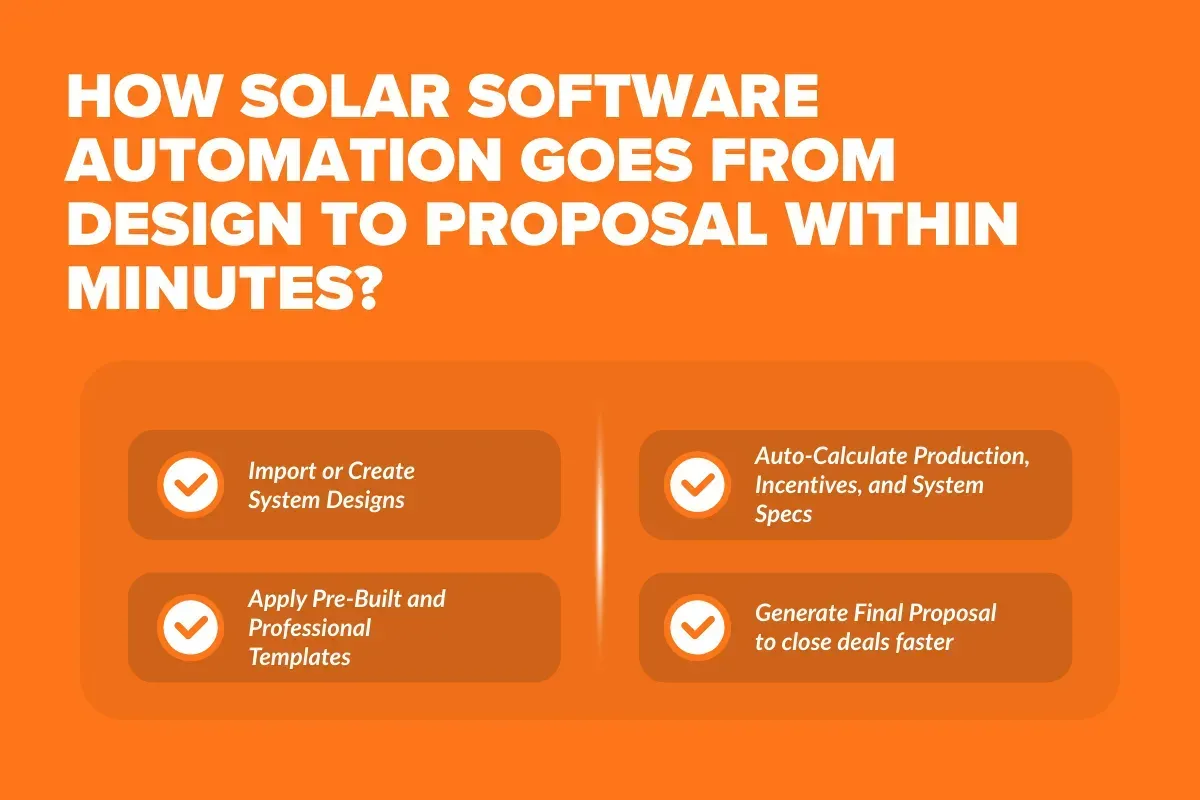
The operational sequence inside a modern solar proposal platform is straightforward. Understanding it makes the time-saving math obvious.
Step 1: Remote Site Assessment and Design Generation
Best solar design software platforms can generate system layouts from just an address using high-resolution imagery, satellite imagery, and LiDAR data. Advanced systems also support ground mounts, hybrid systems, and complex layouts that require more detailed engineering review.
The system identifies pitch, azimuth, obstructions, and shading patterns automatically, then proposes a panel layout optimized for production.
For more complex commercial or ground-mount projects, manual design adjustments and engineering review are usually still required, but the foundational work that used to take half a day now takes minutes.
Step 2: Automatic Data Flow Into the Proposal Engine
Once the design is finalized, system specifications flow directly into the proposal engine. Panel count, module type, inverter selection, BOM, and projected annual production move automatically — no copy-paste, no re-entry, no transcription errors. The proposal already "knows" what's being installed.
Step 3: Real-Time Financial Modeling
This is where the largest accuracy improvements happen. The platform automatically applies:
- The current federal ITC value
- State-level rebates and tax credits applicable to the property
- Utility-specific net metering policies and rate structures
- Local incentives, including SREC market values where relevant
- Pre-configured pricing structures and target margins
It then generates the financial story: system cost, monthly savings, first-year savings, payback period, 25-year ROI, and multiple financing scenarios (cash, loan, lease, PPA, where offered).
Because all of this pulls from live data, the proposal that goes out Tuesday morning reflects Tuesday morning's incentive landscape, not whatever someone manually entered into Excel three months ago.
Step 4: Automated Proposal Assembly
The platform pulls design data and financial outputs into a branded, pre-configured template. The customer sees a consistent, professional proposal document regardless of which rep generated it- same visuals, same flow, same data presentation.
The proposal includes interactive elements: financing comparisons the customer can toggle between, savings projections by year, and system performance visualizations.
Step 5: Digital Delivery, Engagement Tracking, and E-Signature
The proposal is delivered digitally via email link or customer portal. The rep receives notifications when the customer opens the proposal and which sections they reviewed, enabling timely and informed follow-up.
Built-in e-signature lets the customer sign directly from the proposal. No DocuSign hand-off. No paper. No friction between decision and contract.
End-to-end, this workflow runs in 15–30 minutes once configured properly. The manual equivalent typically takes 3–6 hours.
What Changes When You Switch From Manual to Automated Proposals?
Faster proposal delivery is one of the biggest advantages of automation. Industry data shows proposal automation can reduce response times by 40–60%, helping sales teams engage prospects while interest is still high.
Here are the before-and-after changes when you switch from manual to automated proposals:
| Stage | Manual Workflow | Automated Workflow |
|---|---|---|
| Design completion to data transfer | 30–60 min (manual copy-paste) | < 1 min (automatic) |
| Incentive and rate research | 20–30 min per proposal | 0 min (live database) |
| Financial calculations | 30–45 min (spreadsheet) | < 1 min (auto-generated) |
| Template formatting | 30–60 min | 0 min (pre-built) |
| Manager review | 1–4 hours (variable) | Standardized, ~15 min |
| Customer delivery | Email + manual PDF | Digital link + tracking |
| E-signature | External tool, 1–3 days | Built-in, same session |
| Total proposal cycle | 3–6 hours of labor, 2–3 days elapsed | 15–30 minutes of labor, same day |
The operational changes that show up downstream are equally significant:
- Throughput per rep: A sales rep producing four proposals a week manually can produce ten to fifteen with automation. Capacity scales without hiring.
- Quality consistency: Every proposal looks and feels the same regardless of who built it. Newer reps stop being a quality liability.
- Error rate: Pricing mistakes, system sizing errors, and missed incentives drop dramatically because the data isn't being manually re-entered at any step.
- Follow-up timing: Engagement tracking turns follow-up from a guess into an informed action. Reps know when to call.
- Pipeline visibility: Proposal status flows back into the CRM automatically, giving sales leaders accurate forecasting data.
Why Does Proposal Accuracy Matter Just as Much as Speed?
Many conversations about solar proposal software focus on how quickly proposals can be delivered. Speed is important, but speed without accuracy creates a different set of problems, ones that often surface after the contract is signed.
An inaccurate proposal can trigger a chain reaction that affects customer satisfaction, project profitability, and operational efficiency.
Common consequences include:
- Customer trust issues when projected savings don't align with real-world results.
- Pricing discrepancies between the quoted system and the final project cost.
- Permitting delays when proposed system details don't match installation requirements.
- Reduced profit margins caused by unexpected design revisions or scope changes.
- Negative reviews and referrals from customers who feel their expectations weren't met.
Common sources of inaccuracy include:
- Using outdated utility rates or incentive information.
- Estimating shading conditions instead of using detailed site modeling.
- Manually updating financing calculations and payment scenarios.
- Sizing systems using incomplete consumption data.
- Re-entering information across multiple tools and spreadsheets.
The more manual steps involved in creating a proposal, the more opportunities there are for mistakes to enter the process.
What Features Should You Look for in Solar Proposal Software?
These are the key features that actually matter to find the best solar proposal software in 2026, the ones whose absence will create real operational problems:
Integrated 3D Roof Modeling With LiDAR/Satellite Data
The proposal chain starts with the design. Software that can generate accurate 3D roof models from satellite imagery and LiDAR, including pitch, azimuth, and shading analysis, without requiring manual on-site measurement, removes the earliest and largest bottleneck.
Live Utility Rate and Incentive Database
The single most underweighted feature in most evaluations. Confirm two things: how often the platform updates its rate and incentive data, and whether its coverage includes the states and utilities where you actually operate. A platform with strong coverage in California and weak coverage in Texas is a problem if your business is Texas-heavy.
Automated Multi-Scenario Financial Modeling
Customers want to compare cash, loan, and lease scenarios side-by-side. Quality platforms generate all three in a single proposal, with monthly payment calculations, payback timelines, and 25-year savings projections updated in real-time as the customer toggles between options.
Tight CRM Integration
A proposal tool that doesn't connect to your CRM creates a new data silo. Confirm bidirectional integration: customer data flows into proposals automatically, and proposal status (sent, opened, signed, declined) flows back into the CRM for pipeline tracking.
Proposal Engagement Tracking
When the customer opens the proposal. How long do they spend? Which sections do they review? Where they exit. This is sales intelligence that converts directly into smarter follow-up, and it's only possible with interactive digital proposals, not static PDFs.
Built-In E-Signature
Friction between proposal and contract kills deals. E-signature embedded in the proposal experience rather than routed through DocuSign or HelloSign removes the final stall point.
Branded, Configurable Templates
Proposals are a brand touchpoint. Make sure the platform supports your color palette, logo, typography, and proposal flow without requiring developer involvement to change a button label.
Offline Mode and Mobile Capability
Sales happen in driveways, on rooftops, and on kitchen tables across coverage gaps. Mobile-first design with offline functionality that syncs when connectivity returns is non-negotiable for field-heavy operations.
Compliance and Permitting Document Integration
The proposal isn't the end of the workflow; permitting follows. Platforms that generate compliance-aligned documentation alongside the proposal save real time downstream.
What Mistakes Are Solar Teams Still Making With Their Proposals?
1. Sending proposals more than 24 hours after the site assessment: Once a homeowner has slept on the idea twice without a concrete number in front of them, your conversion probability drops measurably.
2. Sending static PDF proposals in a world of interactive ones: A PDF can't show financing comparisons interactively, can't track engagement, and feels generic next to a competitor's branded digital experience.
3. Building proposals on stale incentive and utility rate data: Programs change. Spreadsheets don't update themselves. Manual workflows produce proposals that are technically wrong on the day they're sent.
4. Producing inconsistent proposals across reps: When proposal quality depends on which rep built it, you have a process problem that gets worse as you hire. Standardization is what makes proposal volume scalable.
5. Treating proposal delivery as the end of the workflow: Sending and waiting isn't follow-up. Engagement tracking exists specifically so reps can re-engage at the moment of peak customer interest, not three days later when the lead has gone cold.
6. Showing only the cash price: Most residential solar customers can't or won't pay cash. Proposals that don't lead with loan or lease scenarios are showing the customer the wrong financial picture.
7. Skipping the visual narrative: Customers don't process kilowatts and inverters. They process the picture of panels on their roof, the dollar amount of their savings, and the year their system pays itself off. Proposals that don't tell the visual story aren't proposals- they're spec sheets.
When Is the Right Time to Switch From Manual to Automated Proposals?
There's no universal answer, but there are clear signals. If two or more of these are true for your team, you're past due:
- Your proposals routinely take longer than 24 hours from completed design to customer delivery.
- Your sales reps are spending more time building documents than selling.
- You're seeing recurring accuracy problems- wrong rates, missed incentives, sizing errors.
- Proposal quality varies between reps.
- Your proposal volume is growing faster than your team can scale.
- Your competitors are sending interactive proposals while you're still on PDFs.
- Your close rates have plateaued despite your design and pricing being competitive.
The decision usually isn't really whether to automate; by the time leadership is asking the question, the operational pressure has already built up. The decision is which platform to commit to and how fast the team can implement it.
Who Benefits Most From Solar Proposal Automation?
Proposal automation isn't equally valuable across every solar business. Some operational profiles get outsized returns:
> Growing Residential Installers (5–50 Employees)
This is the sweet spot. Companies in this range have enough proposal volume to feel the manual workflow pain acutely, but not enough engineering resources to build internal tooling. The ROI on platform-based automation is typically realized within the first quarter of implementation.
> EPC Companies Running High-Volume Sales Operations
For EPCs running 100+ proposals a month, automation is structural rather than optional. Manual workflows simply don't scale to that volume without breaking somewhere, usually in accuracy, sometimes in turnaround.
> Multi-Office or Multi-State Operators
Standardization becomes critical the moment you have more than one office or service area. Automated platforms enforce consistency across geographies, ensure each office is using current local incentive data, and give leadership unified visibility into proposal volume and performance.
> Door-to-Door and Field Sales-Heavy Teams
Reps working in driveways and kitchen tables benefit most from mobile-friendly, instant-quote capability. The ability to walk a customer through a personalized proposal during the first visit rather than scheduling a follow-up to "send something over" dramatically shortens the sales cycle.
> Commercial Solar Installers
Commercial deals are higher-stakes and more financially complex. The accuracy improvements from automated financial modeling, ITC depreciation calculations, and current incentive databases create proportionally larger value at the commercial scale.
They often manage larger solar projects, residential and commercial portfolios, and more complex customer requirements. The value of automation increases as project size, financing complexity, and stakeholder involvement grow.
How Should You Evaluate Solar Proposal Software Before You Commit?
A real evaluation isn't a demo. It's a structured test against your actual workflow. These are the questions that matter most:
1. Does it integrate with the design tool you already use? If your team uses Sunbase, HelioScope, or another design platform, confirm direct integration. Manual data transfer between design and proposal tools defeats the core value of automation.
2. Does it integrate bidirectionally with your CRM? Customer data should flow in. Proposal status should flow back. Anything less creates duplicate work.
3. How current is the incentive and rate database for your service area? Ask specifically about the states and utilities you operate in. Some platforms have deep U.S. coverage; others have meaningful gaps.
4. Can the customer experience hold its own against your competitors'? Request a sample proposal generated for a real address in your market. Open it the way a customer would. Does it feel professional? Does it tell a clear financial story? Can you toggle financing scenarios?
5. What's the realistic time-to-value? Some platforms deploy in days; others require weeks of configuration and integration work. Understand the full implementation curve, including team training.
6. What does pricing look like at your projected volume? Per-proposal pricing favors smaller operations; subscription pricing favors scale. Run the math on six and twelve months of projected volume before signing.
7. Can you trial it on live projects? Test with real customer data, real utility rates, and real addresses in your service area. Demos are theater; trials are evidence.
8. What does the support and onboarding model look like? Solar proposal software isn't plug-and-play. The platforms that produce real ROI are the ones whose vendors invest in onboarding your team properly, not the ones that hand you a login and walk away.
Conclusion
The decision-making framework is straightforward. If your team's proposal turnaround is longer than 24 hours, if your reps are spending more time building documents than having sales conversations, or if your close rates have plateaued despite competitive pricing, the case for proposal automation is already there.
The question shifts from whether to automate to which platform fits your workflow and how quickly you can implement it.
The solar companies that will outscale their competition over the next three to five years aren't necessarily the ones with the best panels or the lowest prices. They're the ones building systematic, technology-enabled sales processes now while their competitors are still rebuilding every proposal from scratch.
Your Competitors Are Already Sending Proposals in Under 30 Minutes
If your team is spending three hours per proposal while competitors are sending theirs within an hour of the site assessment, the deal math has already shifted against you even before equipment, pricing, or reputation come into the conversation.
Sunbase brings the best design software, financial management, CRM, and customer delivery into a single connected workflow. A 20-minute walkthrough with someone on our team will show you exactly what your proposal cycle looks like on the platform, tailored to your business size, service area, and existing tech stack.
FAQs
How much time does solar proposal automation save?
Proposal creation time typically drops 60–80%. Manual proposals that take 3–6 hours of labor across 2–3 elapsed days can be generated in 15–30 minutes with same-day delivery using modern proposal software.
Will solar proposal software integrate with my existing design tool?
Most modern platforms integrate with leading design tools like Aurora Solar and HelioScope, allowing design data to flow directly into the proposal engine. Always confirm specific integration compatibility before selecting a platform.
Can solar proposal software handle multiple financing scenarios?
Yes. Quality platforms automatically generate cash, loan, lease, and PPA scenarios within a single proposal, with monthly payments and payback periods calculated for each. Customers can typically toggle between scenarios interactively.
How does proposal automation actually improve close rates?
Three mechanisms: faster delivery captures customers while their interest is highest, accurate financial modeling builds trust, and professional presentation builds confidence. Industry benchmarks consistently show 15–25% close rate increases after full automation implementation.
Is solar proposal software different from a solar CRM?
Yes, a CRM manages customer relationships, pipeline, and lead tracking. Proposal software handles the creation and delivery of customer-facing quotes. The most effective setups integrate the two, so customer data and proposal status are visible in a single system.
When is the right time to switch from manual to automated proposals?
The clearest signals are proposals routinely taking longer than 24 hours, reps spending most of their week on document production rather than selling, recurring accuracy problems, inconsistent quality across reps, or proposal volume growing faster than your team can scale.
Does solar proposal software work for commercial projects?
Yes, though commercial projects typically require additional engineering review and more complex financial modeling. The best solar platforms scale from residential rooftops to commercial installations, with appropriate ITC depreciation handling and PE-stamped documentation support.
One Platform.
Zero Chaos.
Run Your Entire Business in One Platform
Sunbase replaces your CRM, proposals, scheduling, job tracking, and reporting tools — all inside one clean, connected platform.
About Sunbase
The All-In-One Platform to Run Your Entire Business
Sunbase helps you organize operations, streamline daily workflows, and manage everything - from first customer contact to final project deliver- in one connected system.
Our Mission
- Organize your business.
- Optimize your workflow.
- Automate your dailytasks
Why Businesses Choose Sunbase
One Connected Workflow
Replace scattered tools and manual processes with a single platform that brings together your team, tasks, customers, jobs, and performance data.
🌎 Global Presence
Serving the United States, Canada, India, LATAM, Australia, and 10+ international markets.
👥 11,000+ Users
Trusted by contractors, installers, project managers, sales teams, and field technicians.
🏗️ Built for All Sizes
From small contracting teams to fast-growing enterprises, Sunbase adapts to your workflow.
Stop Managing Your Business Manually. Automate It.
Sunbase automates workflows, reduces mistakes, and helps your team get more done - without hiring extra staff or juggling multiple tools.
Still Managing Your Business Across Multiple Tools?
Bring your CRM, proposals, projects, and operations into one platform built for contractors.