
We’ve all been there: after five-plus years of growing your solar business, installs are running smoothly, your team is aligned, and the numbers look strong on paper. Yet, something still feels off. Because behind that surface-level growth, the day-to-day reality tells a different story.
You’re deep in permitting delays, coordinating with local contractors, managing customer escalations, and trying to maintain operational flow across multiple services.
At the end of every quarter, the realization hits: you’re not building an asset. You’re just running faster on the
same wheel.
This is the hamster wheel problem, and it’s one of the most common pain points for solar business owners in 2026.
The distinction that matters isn’t how many solar panels you installed this month. It’s whether you own a job or a company. And this distinction matters even more than you might think.
Scaling Solar Business From Installer to Empire: How to Structure for a Profitable Exit
Demand for renewable energy projects and large-scale solar adoption continues to rise as homeowners and businesses shift toward cleaner, sun-powered electricity. Solar isn't just another energy source; it’s a central pillar of long-term energy infrastructure.
And that’s exactly why the stakes are higher. Structuring for an exit isn’t about leaving the industry. It’s about building something valuable within it, a business that can scale, adapt, and earn a bonus when the time comes.
As the final chapters of The Solar Shift series make clear, the companies that will lead the next decade of solar power aren’t just surviving the current reset. They’re using it to build lasting empires.
This blog covers exactly how to make that shift: from service company to platform, from hustle to systems, and from installer to a business that commands real market value.
Key Takeaways
- Scaling a solar business requires a mindset shift from installs to infrastructure. Moving from one-time projects to a platform model transforms your company into a long-term asset.
- A strong solar exit strategy is built years in advance, not months. Buyers prioritize systemized operations, recurring revenue, and leadership depth, not just top-line growth.
- Controlling your value chain and reducing delays directly increases margins and scalability. Streamlined operations create better performance, faster execution, and higher business valuation.
- Solar business acquisition is the fastest path to expansion in 2026. Acquiring complementary services helps you enter new markets, serve more communities, and scale efficiently.
- Legacy businesses are built on systems, not founders. If your company can run without you, it becomes sellable, scalable, and positioned for long-term sustainability.
Still Stuck in the Day-to-Day Grind?
Scaling isn’t about doing more; it’s about building systems that do more for you. If your business still relies on you to operate, it’s time to change that.
Grab The Solar Shift Series and learn how to structure your solar business for real growth and long-term value.
Why Most Solar Companies Get Stuck on the Hamster Wheel
Let's start with...
The Installer Identity Trap
Most solar founders based their businesses on technical expertise and relentless effort. They mastered the installation process, had a deep understanding of renewable energy economics, and worked tirelessly to establish their operations. However, this technical focus often becomes a limiting factor.
When the founder is still the best installer on the crew or the only one who knows how to close a deal, the business can’t grow without them. And it absolutely cannot sell without a steep discount.
Breaking out of this cycle starts with a solar business mindset shift required to scale, where operators stop reacting to market conditions and start building systems that adapt and grow.
Working In vs. Working On: The Key Difference
This shift becomes clearer when you look at how top operators spend their time.
| Working IN the Business | Working ON the Business |
|---|---|
| Running installs personally | Systemizing install workflows |
| Managing every sales rep directly | Building a scalable sales process |
| Handling every customer escalation | Training a team to own customer success |
| Chasing monthly solar project revenue | Building recurring revenue and margin |
| Reactively hiring when overwhelmed | Building a leadership bench proactively |
The 2026 Solar Market Reality Check
The renewable energy sector is entering a new phase of maturity. Growth is no longer just driven by incentives; it’s being shaped by institutional investing, evolving government policies, and expansion into new markets.
Today’s landscape is being influenced by large project developers, private equity firms, and infrastructure funds looking to consolidate high-performing operators. While demand remains strong, the long-term shift away from fossil fuels has made solar an attractive investment class.
Demand hasn’t disappeared, but how you capture it has fundamentally shifted. Growth is still expected, but only for companies that operate efficiently and scale strategically.
This is especially true as financing conditions tighten. Access to favorable financing is no longer guaranteed, which means only disciplined operators with strong systems and predictable revenue will stand out.
The result? A clear divide:
- Businesses that are built to scale
- Businesses that are stuck reacting
The question is no longer whether solar will grow; it’s who will capture that growth.
The Shift from Service Company to Solar Platform
> What a Platform Business Actually Means
A platform business isn’t defined by the number of solar projects it completes. It’s defined by who owns the customer relationship.
The companies leading today’s market are leveraging technology, operational innovation, and smarter development strategies to move beyond installs and into full-service ecosystems.
When you control the full homeowner energy journey, from the first solar PV installation through battery storage, EV charging, smart home integration, and ongoing maintenance, you’re not just a contractor. You’re a platform.
This shift also plays a critical role in improving grid reliability, as distributed energy systems become more interconnected and performance-driven.
For example, a regional solar company in Arizona that layered roofing and battery storage onto its core service in 2023 increased average revenue per customer by 60% and more than doubled its EBITDA margin within 18 months, without adding a single new sales rep.
In simple terms: You’re not just completing projects, you’re building infrastructure.
> The Value Ladder: Stacking Revenue at Every Stage
Empire builders think in terms of lifetime value, not one-time transactions.
Each layer of your offering should increase customer lifetime value, deliver measurable benefits, and improve system performance. By expanding your services, you not only increase revenue per customer but also strengthen your market position.
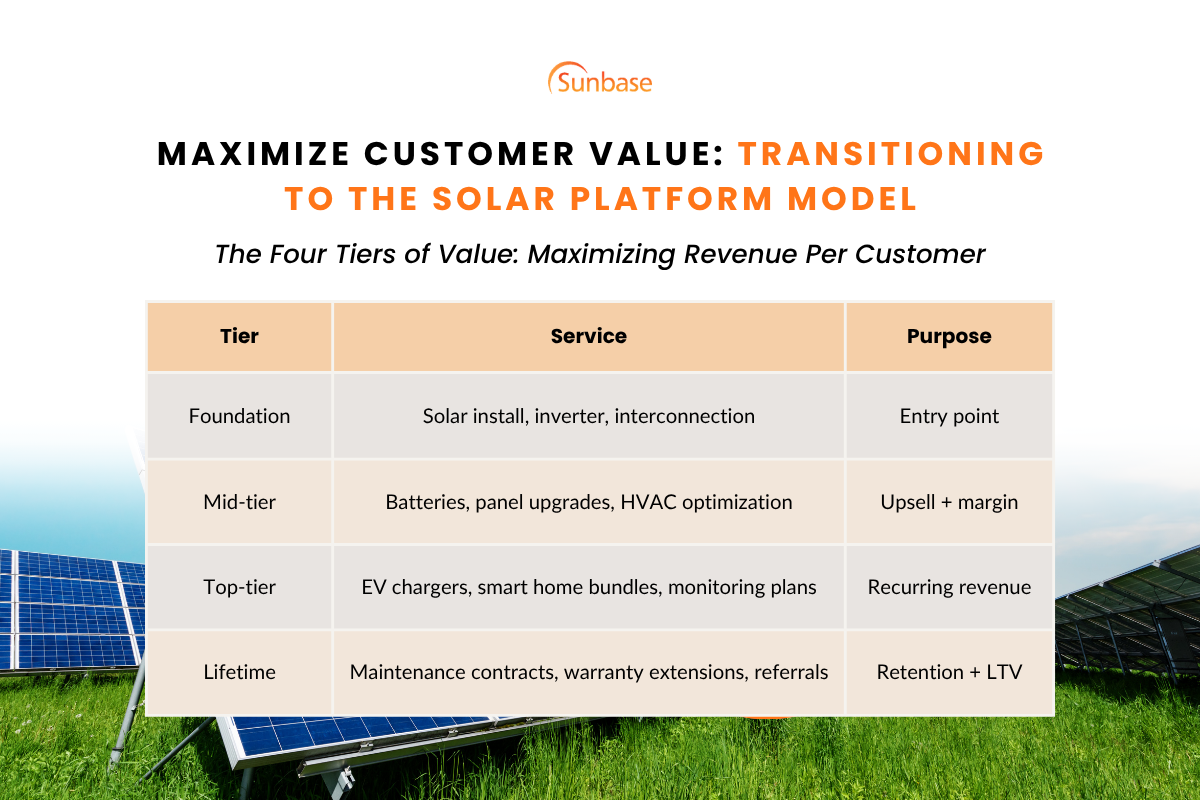
To make this more concrete, here’s how a modern solar value ladder typically looks:
- Foundation: This is the primary entry point into the customer relationship. It involves the initial solar install, inverter, and interconnection services, focusing on establishing the base customer interaction.
- Mid-tier: The focus here is on upselling high-margin items. Services include batteries, panel upgrades, and HVAC optimization, which are intended to increase both upsell opportunities and overall margin.
- Top-tier: The objective of this tier is to generate recurring revenue. This is achieved by offering EV chargers, smart home bundles, and monitoring plans.
- Lifetime: This tier is designed to drive retention and increase Lifetime Value (LTV). Key services include maintenance contracts, warranty extensions, and referral leverage.
The result is simple: More value for the customer, and more predictable revenue for your business.
Each tier deepens the customer relationship, increases total revenue per homeowner, and makes your business harder to replace. That’s not just good for growth, it’s what makes a solar company sellable.
> Owning More of the Value Chain
Most solar businesses lose margin in places they don’t fully control.
Look honestly at your current model and identify where money leaks out: outsourced engineering, third-party permitting services, dealer fees to someone else’s finance partner, or customers who drift away after PTO. Each of those is a crack in your empire.
From initial site evaluation through engineering, construction, and even upstream manufacturing dependencies, every external dependency creates friction. These gaps slow execution, increase costs, and make it harder to scale.
The fix isn’t to own everything at once. It’s to ask the right question for each function: Can I bring this in-house? Can I build or acquire this capability? Can I partner smarter, or create my own version?
The businesses that reduce delays across their value chain, tighten operations, and cut unnecessary handoffs are the ones that scale. Simple systems scale, complex ones fail. Your future business relies on clarity, not layers.
When you reduce handoffs, streamline operations, and build tighter control over critical functions, you naturally reduce delays, improve consistency, and create a more scalable system.
Solar Exit Strategy: What Buyers Actually Want in 2026
Buyers today are more knowledgeable and wise than ever before.
They’re not just evaluating revenue, they’re analyzing efficiency, margins, and long-term sustainability. Metrics like cost per kilowatt hour, operational efficiency, and system performance matter just as much as top-line growth.
Buyers want businesses that:
- Deliver energy at a competitive, low cost
- Maintain consistent margins
- Operate with predictable outcomes
Because ultimately, they’re not buying your past performance, they’re buying future stability.
This shift is especially clear in how companies are selling solar without tax credits, focusing more on value, savings, and long-term benefits rather than relying on incentives.
So, What Are The Four Drivers of Solar Business Valuation?
When a buyer evaluates your solar company, they’re not just looking at your revenue. They’re looking at the quality of that revenue and the business's transferability.
The four things that move the needle most on valuation are:
- Systems and documentation: Can the business operate without the founder?
- Revenue quality: Is it recurring, diversified, and margin-healthy?
- Market position: Do you own a clear geography or niche?
- Leadership depth: Can the team run it without you in the room?
Sellable vs. Not Sellable: A Side-by-Side Look
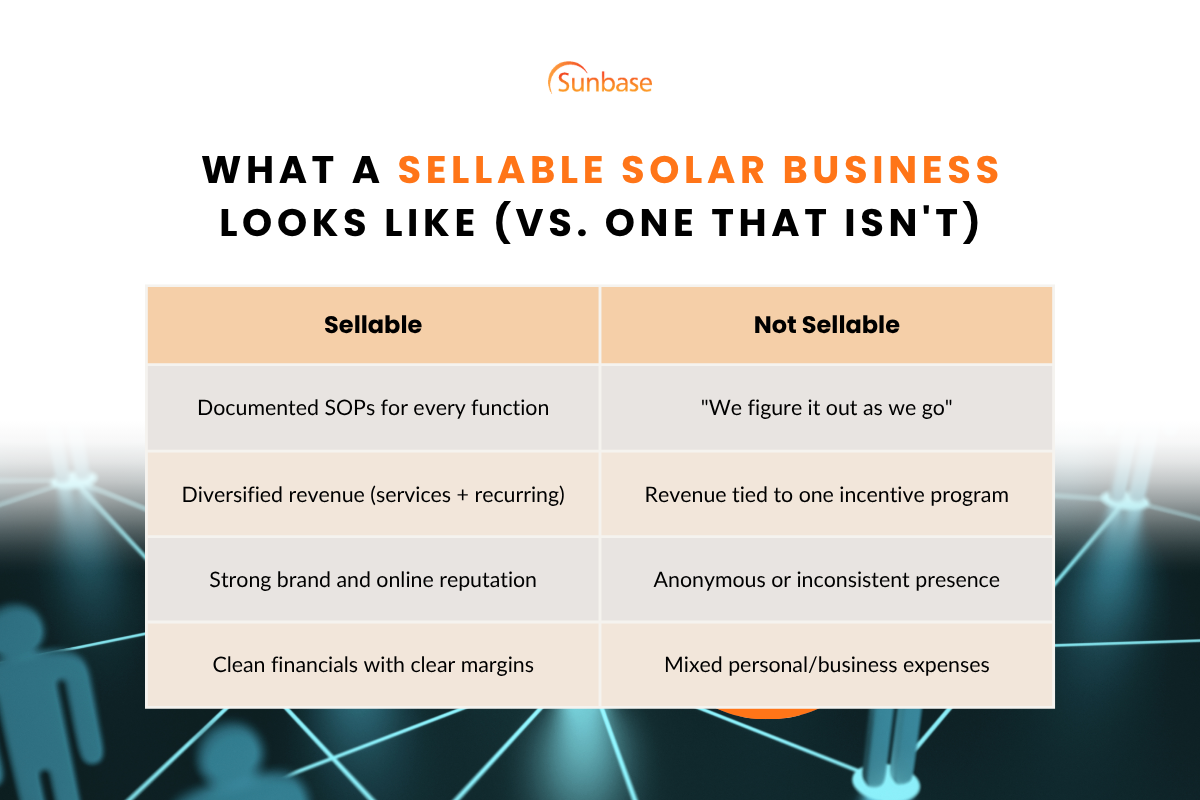
The Buyer's Lens: Why Some Solar Businesses Sell and Others Don't?
- Operations: Sellable businesses have documented SOPs for every function, whereas non-sellable ones rely on outdated knowledge and figure things out as they go.
- Revenue: Diversified revenue through services and recurring streams makes a business sellable, unlike being tied to a single incentive program.
- Market Presence: A strong brand and consistent online reputation contrast with the anonymous or inconsistent presence of a non-sellable business.
- Leadership: Sellable businesses have an independent leadership bench, while others are overly dependent on the owner to function.
- Financials: Clean financials with clear margins per job are preferred over mixed personal/business expenses and unclear unit economics.
The Timeline Most Solar Owners Get Wrong
Most founders start thinking about exit readiness six months before they want to sell, which is far too late.
The best practice is to begin building for exit three to five years in advance. And the reason is simple: building for exit just means building a great business with intention.
Solar Business Acquisition: Growing Without Starting From Scratch
Acquisition is one of the fastest ways to scale in today’s market.
Instead of building every capability internally, smart operators acquire businesses that already serve their target communities. This allows them to deliver greater local value while enabling faster expansion across services.
Whether it’s HVAC, roofing, or electrical, the right acquisition strengthens your ecosystem and significantly accelerates your growth timeline.
The key is integration, not just ownership. Now, let's understand why acquisition consistently outpaces organic growth.
Why Acquisition Is Often Faster Than Organic Growth
Building a new service line organically takes time, typically 12 to 24 months before it’s generating real margin.
Acquiring a two- to four-person HVAC crew or a local permitting firm can add capability within 90 days.
- The current market reset has created a genuine buyers’ market: there are skilled, undercapitalized operators in every solar-adjacent sector who need the infrastructure, brand, and leadership you’ve already built.
- Red flags to avoid: owner-dependent teams, poor online reputation, or deferred maintenance on equipment.
Understanding The Stair-Step Expansion Model
The most successful regional empire builders in markets like Texas, Florida, and the Southeast follow a recognizable stair-step pattern: dominate one core service, acquire one adjacent capability, expand to a second geography, and repeat.
Applied to solar, it looks like this:
Solar Install → Roofing → Battery Storage → HVAC → Home Energy Management Platform
Each step broadens your value ladder, deepens the customer relationship, and strengthens the defensibility of your market position. This isn’t just theory, it’s the blueprint being executed by the fastest-growing operators in renewable energy right now.
When you combine operational efficiency, strong positioning, and predictable demand, you’re no longer just growing; you’re scaling beyond installs with the solar+ model and building a business that compounds over time.
Legacy Building: Structuring the Business So It Outlasts You
But scaling isn’t the end goal; what you build long-term matters just as much.
The Four Legacies Every Solar Owner Leaves
Whether you’re planning a high-ticket exit or handing the business to the next generation, you’re already building a legacy; the question is whether you’re doing it intentionally.
The most valuable solar businesses don’t just generate income. They contribute to long-term sustainability, support energy independence, and create lasting value across the country.
The Solar Shift identifies four distinct legacy dimensions every owner creates:
- Brand Legacy: What customers, vendors, and competitors say about you when you’re not in the room.
- Team Legacy: The leaders you developed, the culture you enforced, the careers you changed.
- Systems Legacy: Whether your business is transferable or purely dependent on your personal involvement.
- Customer Legacy: Whether you genuinely improved homeowners’ energy security or just completed transactions.
Because at the end of the day, the goal isn’t just to build a business that works today, it’s to build one that continues to perform without you.
Building a Leadership Bench That Doesn’t Need You
And this is where most businesses fall short: The single biggest valuation killer for a solar business is when the founder is the business. Buyers see it immediately, and they discount accordingly.
The fix starts now: document your decision-making frameworks, create clear growth paths for your best people, and build a GM or operations lead role before you think you need one.
When your team can run installs, close deals, and handle customer issues without your direct involvement, your business stops being a job and starts being an asset.
The strongest companies understand how to sell energy independence rather than free solar, building trust and long-term relationships rather than relying on short-term gimmicks.
How Solar Software Helps You Build a Business Worth Buying
> From Chaos to Clarity: Standardizing Your Workflows
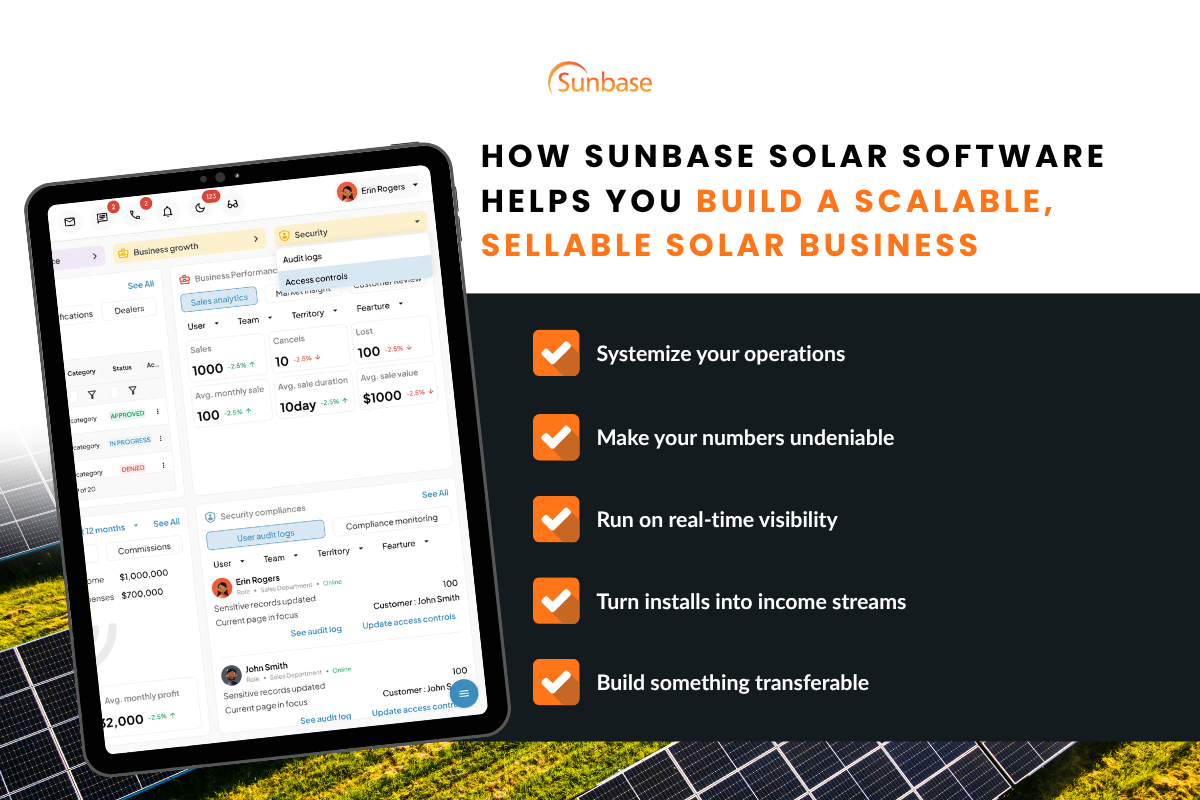
Sunbase transforms how solar businesses operate by bringing structure to complexity.
With centralized systems, real-time dashboards, and actionable quick facts, it improves operational flow and eliminates inefficiencies that slow growth. Powered by advanced technology, Sunbase ensures your business runs on clean, actionable data
This is what buyers want to see: Where clarity, consistency, and control all come together.
> The Data Buyers Want and Sunbase Delivers
When a buyer or private equity group evaluates your solar business, they want to see clean, real-time data: pipeline visibility, margin per solar project, install velocity, and customer lifetime value.
Sunbase gives you an operational dashboard that answers the questions buyers ask before they ask them. This is the foundation of a credible, high-value exit.
> Building Recurring Revenue Infrastructure with Sunbase
Scaling solar businesses need more than install management; they need systems that support service contracts, maintenance scheduling, and long-term customer lifecycle management.
Sunbase is built to handle this recurring revenue layer, helping you stack monthly recurring revenue to drive higher exit multiples and long-term business stability.
> The Solar Shift + Sunbase: Strategy Meets Execution
The Solar Shift series, provides the strategic framework: how to think about empire building, what legacy really means, and how to structure your business for an exit that reflects the value you’ve actually created.
Sunbase is the operational engine that makes that strategy real.
Together, they answer both the “what” and the “how,” giving you the vision to build an empire and the infrastructure to run one.
The Decade Belongs to Builders, Not Installers
The energy landscape is evolving rapidly. Solar is no longer competing in isolation; it’s part of a broader ecosystem that includes wind, gas, and hydro resources.
The solar industry is in the middle of a reset, and that reset is separating the operators who built real businesses from those who just rode the wave.
Rising demand and sector consolidation compel smart operators to scale up or exit at high multiples. The choice between a solar job and a legacy is a decision. Stop chasing installs and build systems; prioritize recurring value and lead rather than just tech.
The companies that acted on that decision, that used today’s clutter as fuel rather than a reason to pause, are the ones that will represent what solar looks like for the next decade.
Don’t Just Grow Your Solar Business... Make It Sellable with Sunbase
You’ve built something real. Now build something that lasts. Your empire starts with your operations. If your business can’t run without you, it can’t sell or scale.
Schedule a walkthrough with Sunbase today and see how the right infrastructure makes your business not just scalable, but sellable.
FAQ's
1. What does scaling a solar business actually involve?
Scaling a solar business goes beyond increasing installs; it requires building systems, expanding service offerings, and creating predictable revenue streams. Successful companies shift from handling individual solar projects to managing operations that can grow efficiently across multiple markets.
2. How can solar power companies grow in a competitive renewable energy market?
Solar power companies can grow by diversifying their services, improving operational efficiency, and adopting new technology. In the current renewable energy landscape, businesses that focus on customer experience, recurring revenue, and strong brand positioning are better equipped to scale sustainably.
3. What are the key challenges in managing multiple solar projects at scale?
Managing multiple solar projects often leads to challenges such as permitting delays, contractor coordination, and maintaining consistent quality. To scale effectively, businesses need streamlined workflows, centralized data, and systems that reduce delays and improve overall project performance.
4. How is scaling a solar business different from managing utility-scale solar projects?
Scaling a solar business typically focuses on residential or commercial growth, whereas utility-scale solar projects entail large-scale infrastructure, higher capital investment, and coordination with utility providers. Both require strong systems, but utility-scale operations demand more advanced planning, financing, and regulatory compliance.
5. Why is renewable energy growth creating new opportunities for solar businesses?
The rapid expansion of renewable energy is opening up new markets and increasing demand for solar solutions. As more utility customers and businesses transition to solar power, companies that invest in scalable systems, efficient operations, and long-term customer relationships are best positioned to capture this growth.
One Platform.
Zero Chaos.
Run Your Entire Business in One Platform
Sunbase replaces your CRM, proposals, scheduling, job tracking, and reporting tools — all inside one clean, connected platform.
About Sunbase
The All-In-One Platform to Run Your Entire Business
Sunbase helps you organize operations, streamline daily workflows, and manage everything - from first customer contact to final project deliver- in one connected system.
Our Mission
- Organize your business.
- Optimize your workflow.
- Automate your dailytasks
Why Businesses Choose Sunbase
One Connected Workflow
Replace scattered tools and manual processes with a single platform that brings together your team, tasks, customers, jobs, and performance data.
🌎 Global Presence
Serving the United States, Canada, India, LATAM, Australia, and 10+ international markets.
👥 11,000+ Users
Trusted by contractors, installers, project managers, sales teams, and field technicians.
🏗️ Built for All Sizes
From small contracting teams to fast-growing enterprises, Sunbase adapts to your workflow.
Stop Managing Your Business Manually. Automate It.
Sunbase automates workflows, reduces mistakes, and helps your team get more done - without hiring extra staff or juggling multiple tools.
Still Managing Your Business Across Multiple Tools?
Bring your CRM, proposals, projects, and operations into one platform built for contractors.