
If your company is struggling with high turnover, fear-driven decisions, or low morale when sales drop, you are facing the retention crisis that most solar leaders can’t ignore in 2026.
When reps view their roles as temporary stepping stones, one exit can cause major problems across your 50+ operations roles.
While average teams break down, the best companies aren't waiting for conditions to change; they’re making a change, building stronger teams by adopting a "Wartime Leadership" approach.
This approach requires honest, decisive, and performance-driven leadership. This guide provides the practical, detailed playbook for solar founders and managers to create a focused, accountable fighter culture that performs under pressure.
How to Build a Fighter Culture and Strengthen Your Solar Company Culture
Solar company culture often collapses during sales slowdowns because firms built on boom-time foundations prioritize rapid volume over operational durability, a reality tied closely to why the solar industry is shifting in 2026.
When high incentives dry up, structural weaknesses, such as reliance on expensive third-party leads and high-pressure sales tactics, are exposed, leading to internal friction and financial fragility.
Companies that fail to reinforce structure, transparency, and purpose during these periods don’t just lose momentum; they lose their team. A resilient solar company culture is what separates those who recover from those who collapse.
But before you build a fighter culture, you need to understand why most solar teams fall apart when the market tightens.
Key Takeaways
- Strong culture is your survival advantage: When sales slow down, culture determines whether your team stabilizes or falls apart.
- Retaining top performers is the highest-ROI move: Losing A-players in a downturn costs far more than keeping them engaged and aligned.
- Clarity beats perfection in leadership: Decisive, consistent communication builds trust even when the path forward isn’t fully clear.
- Fighter culture is built on accountability and standards: Clear expectations, visible performance, and daily discipline create teams that perform under pressure.
- Focus and systems drive execution: The companies that win simplify their priorities and rely on structured systems to scale performance.
Let's First Understand: It’s Not Just Your Team, It’s the System Behind Them
And this is where most leaders get it wrong. You can coach people. You can refine processes. But until you fix the platform you run everything on, you’ll keep hitting the same ceiling.
If your team is still using tons of spreadsheets, disconnected tools, and delayed handoffs, it’s not a people problem; it’s a system problem. And in today’s market, bad systems kill good teams.
If you’re starting to see those gaps in your own operations, it might be time to explore how an all-in-one solar platform like Sunbase can simplify workflows, improve visibility, and help your team operate at its full potential.
Why Solar Company Culture Collapses When Sales Slow Down
Here's what most solar owners won't say out loud: the culture was never really tested during the boom years. Leads were inexpensive, demand was quite high, and even average reps looked like superstars. You didn't need a fighter culture.
The market has now shifted. The 25D residential tax credit expired at the end of 2025, leading to uncertain demand. Simultaneously, culture is no longer just a behind-the-scenes aspect tied to revenue; it is now the primary focus.
It's not about having a better loan product or a more impressive pitch deck. Instead, it's about a stronger team and a resilient solar company culture that remains steady even when the pipeline slows.
That's when weak systems cause culture to break down, leading to early signs such as drops in retention.
The Retention Crisis Solar Leaders Can't Ignore in 2026
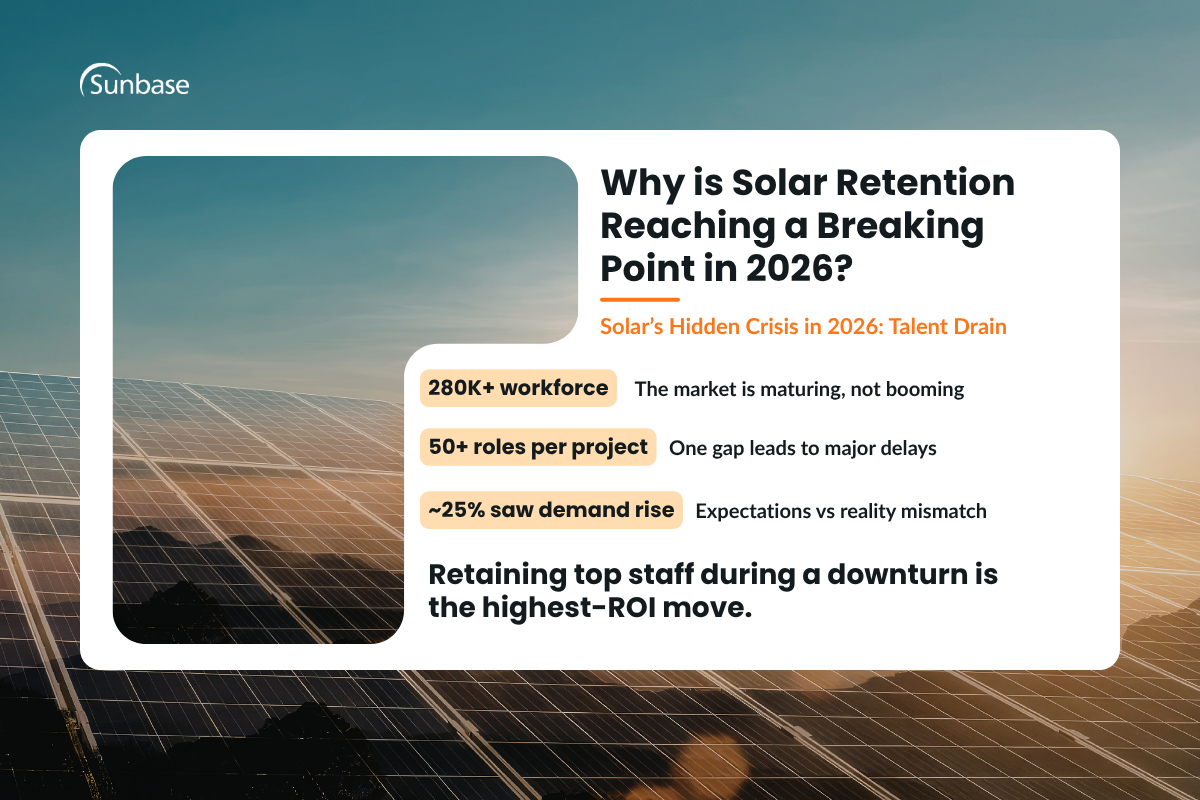
High turnover isn’t new in solar; it’s a structural challenge that many companies still haven’t solved. Too many employees continue to view installer and sales roles as temporary stops rather than long-term careers.
And when sales slow down, it’s not just underperformers who exit; it’s your top talent with the most options. This is where leadership matters most. Strong leaders don’t just manage, they encourage stability, support their teams, and build initiatives that create a real sense of purpose.
When people feel connected to something bigger, like driving sustainability and shaping the future of energy, they’re far more likely to stay and strive through uncertainty.
Consider the reality:
- 280K+ solar workers in the U.S. by late 2025, a workforce entering maturity, not rapid growth
- 50+ distinct roles in rooftop solar deployment, where even one gap creates bottlenecks
- Only ~25% of installers saw demand increase in 2024, despite optimistic forecasts
The takeaway is simple: retaining your best people during a downturn isn’t just clever; it’s everything, because value-based solar selling ultimately depends on execution, which comes down to the team delivering it.
The real pattern: Teams don't fall apart because of the market. They fall apart because of the silence, the blame, and the loss of direction that comes from leadership going dark when numbers drop.
So the question becomes: what does leadership actually look like when the pressure is real?
What Wartime Leadership in Solar Actually Looks Like (It's Not What You Think)
Let's reset expectations here. Wartime leadership isn't about being loud or intense. It's about being clear, consistent, and decisive, especially when clarity feels impossible.
When everyone on your team is looking around, waiting for a signal, you're the one who has to give it.
> Leading With a Flashlight, Not a Map
The map won't always be clear. Interest rates, policy changes, customer psychology shifts, you cannot predict all of it. What you can do is take the next step and make it visible.
A 60% right decision made with conviction beats 100% indecision every time. Motion builds momentum.
Momentum builds belief. And right now, your team needs something to believe in more than they need a perfect forecast.
One practical move: send a brief direction memo every Monday. Three sentences: what we know, what we're doing, what I need from you. It sounds almost too simple, until you realize most leaders aren't doing it.
> Anchor decisions in your foundational principles
You can't control the market, but you can control how you respond to it. The leaders who stay steady in downturns don't have better information; they have better principles.
Customer obsession, financial discipline, and team trust aren't slogans. They're the decision-making framework when everything else is uncertain.
Build a one-page operating principles doc and actually use it. Read it before big calls. Reference it in team meetings. Let your values be what hold the company together when external conditions try to pull it apart.
> Calm is a competitive advantage
You are the emotional thermostat of your organization. When you panic, the team unravels. When you shut down, the business stalls. When you stay calm and ask good questions, your team follows.
One simple tactic: start every team meeting with a real win from the previous week before opening the floor to problems. It's not toxic positivity, it's evidence that progress is still happening. And right now, your team needs that evidence.
Once leadership sets the tone, the next step is to operationalize it within the culture.
How to Build a "Fighter Culture": The 8-Step Playbook
A fighter culture isn’t burnout with a better name. It’s clarity, conviction, and a team that runs toward hard conversations.
It’s about building something committed to long-term success, grounded in shared experiences, and strong enough to scale from local markets to a national level. Here’s how you build it:
1: Identify your A, B, and C players- then act on it
Run a simple internal audit: who would you rehire today without hesitation? That’s your A-list. Coach your B-players and help them close the gap. Exit your C-players quickly, clearly, and respectfully.
Every weak link impacts performance, relationships, and overall reliability. You owe your top performers a team worth joining.
2: Reinforce the mission every single day
Your reps aren’t just closing deals, they’re delivering real benefits to homeowners, helping clients take control of their energy and power.
Tie the mission to real impact through community outreach, customer stories, and education. Purpose helps people achieve more, even when numbers dip.
3. Create scoreboards that make performance visible
Teams that can't see the scoreboard guess, and guessing kills enthusiasm. Use daily dashboards, weekly leaderboards, and monthly individual progress charts.
When performance is visible and celebrated, accountability becomes cultural. You stop policing it and start living it.
Open communication around numbers builds the foundation.
4. Set expectations and hold the line
Vague standards produce vague results. Define non-negotiables around communication, response time, and execution. This creates operational safety and consistency across every job, ensuring your team delivers at a high level.
5. Overcommunicate, especially when it's hard
Silence breeds fear. When leaders go quiet, teams assume the worst. Weekly updates don't have to be long; they just have to be honest: inform what's working, what's not, what's changing.
Even when the news isn't good, clarity is a form of respect. An inclusive environment is built on consistent, transparent communication, not just during the good months.
6. Train like your competitors aren't, because they're not
Winning teams invest in growth because turning solar ROI promises into real outcomes requires constant skill development, not just better leads.
Daily role-plays, weekly reviews, and cross-functional training build skills that drive innovation. Prioritize training opportunities; it isn’t a second option; it’s how you deliver better services and stay ahead in a competitive market.
7. Make morale a measurable metric
Ask your team every week: "What's frustrating you?" and "Who deserves a shoutout?" Run a simple 1–5 pulse survey and track the trend, not just the score. Fight for your people, not just with them.
8. Celebrate the fight, not just the finish line
In tough markets, recognize effort and ownership instead of closed deals. The rep who got nine no's and still booked one deserves a spotlight. The installer who handled a difficult customer with grace deserves to be seen.
Rewarding grit signals to the whole team: persistence is valued here. That's how you keep fighters fighting. It's how you lead daily decisions that determine whether it holds under pressure.
Leadership in the Fog: What Real Leaders Actually Do?
Right now, across the solar industry, everyone is waiting on someone else.
- Sales reps are waiting for better financing.
- Homeowners are waiting for rates to drop.
- Competitors are waiting for the next policy shift.
That collective pause creates a vacuum, and a vacuum is an opportunity.
The leaders who step into that space, who make calls without guarantees and rally their teams around a shared mission of survival and dominance, are the ones who come out ahead when the fog lifts.
| What most leaders do | What fighter-culture leaders do |
|---|---|
| Wait for clarity before making a call | Make the best call available, then adjust |
| Go silent when numbers are bad | Communicate more, honestly, not just optimistically |
| Add more products and tactics to compensate | Narrow focus to the one constraint that matters most |
| React to the day's problems | Let their focus dictate the day, not the other way around |
| Celebrate only closed deals | Celebrate the effort, the grit, the discipline |
| Skip rituals when things get rough | Keep the 7:30 AM huddle every single day |
Keep showing up... it compounds!
Leadership in a downturn isn't a single speech. It's the team huddle that never gets skipped. It's the weekly forecast meeting you run even when projections look rough. It's the one-on-one check-in with the rep who's clearly struggling.
Consistency in uncertainty is how trust gets built, and trust, over time, compounds into something no competitor can buy or replicate.
And in uncertain markets, clarity doesn’t come from instinct; it comes from visibility.
How Data Cuts Through the Fog
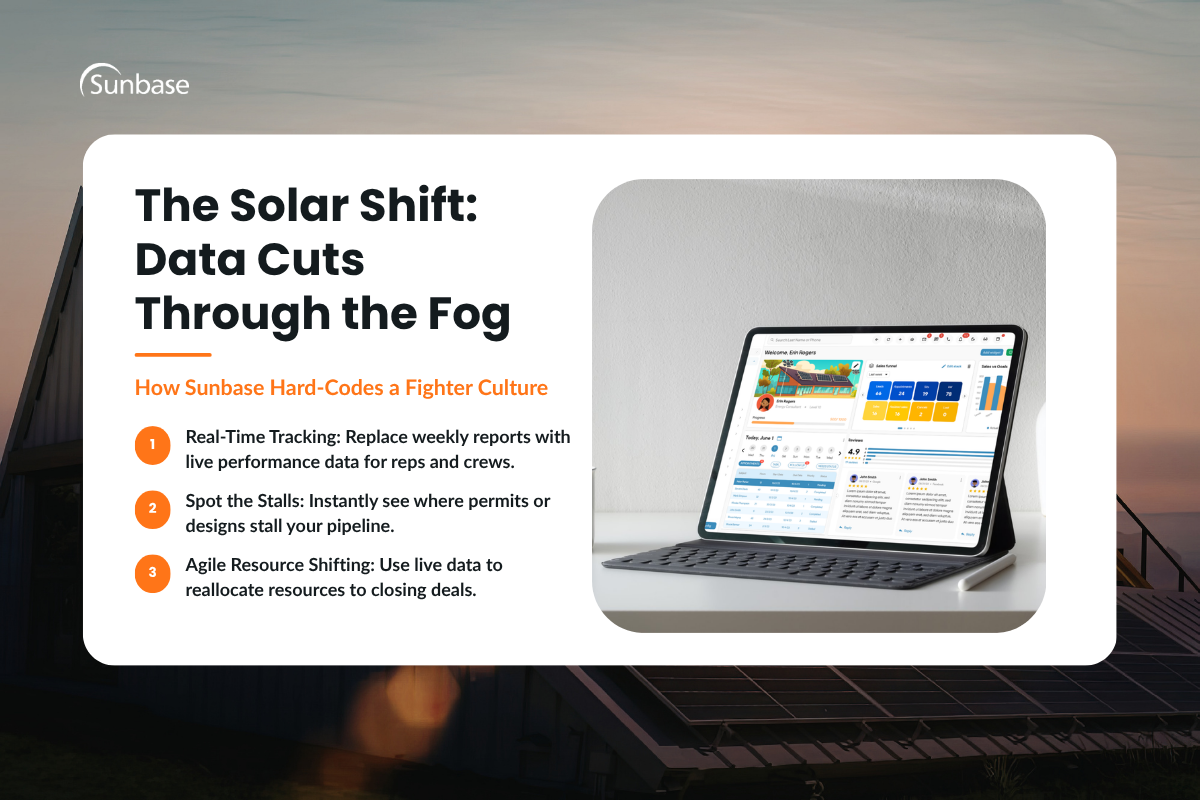
Gut instinct got many solar companies through the boom years. It won't be enough anymore. The solar market isn’t slowing down; it’s separating.
The Solar Shift Series isn’t your ordinary playbook. It’s a real-world playbook for companies navigating tighter margins, longer sales cycles, and operational pressure in 2026.
If you’ve made it this far, you’re not just trying to survive; you’re building a business that can win when conditions aren’t easy.
Explore the full Solar Shift Series to learn how top solar companies are:
- Rebuilding margins without incentives
- Closing deals through value, not discounts
- Scaling operations without chaos
- Leading teams that perform under pressure
Because the companies that win this shift won’t be the ones waiting for the market to recover, they’ll be the ones adapting faster than everyone else.
This is where systems stop being optional and start becoming your competitive advantage.
> How can Sunbase help you foster a fighter culture?
You can’t build a fighter culture on spreadsheets and disconnected tools. With Sunbase, you can:
- Live Performance Monitoring: Transition from outdated weekly summaries to instantaneous data tracking for both sales representatives and installation teams.
- Identify Bottlenecks: Gain immediate visibility into specific stages, such as design or permitting, where projects are currently stalled in the pipeline.
- Dynamic Asset Allocation: Leverage real-time insights to pivot and reassign resources toward high-priority deal finalization.
They're how you embed the fighter culture into the company's DNA, rather than depending on it living in one person's energy.
The leaders who step into that space and understand what’s driving the solar market reset are the ones who come out ahead when the fog lifts.
What a Fighter Culture Actually Looks Like Day-to-Day
Let's be specific, because "culture" can sound abstract until you actually describe the behavior.
A fighter culture is lean, focused, and accountable. There's no room for passengers, politics, or drama, not because the environment is harsh, but because the mission is too important.
These are the teams that run toward hard conversations, execute fast, measure what matters, and hold each other accountable when they fall short. They're not the loudest team on the leaderboard. They're the most locked-in.
Core idea: Culture isn't about comfort. It's about performing well under pressure. Currently, pressure defines the operating environment.
A new team member joining this kind of company feels it immediately, not from a poster on the wall, but from how people actually talk to each other, how problems get raised and solved, and how leadership shows up every single day.
That's the difference between a culture that's written and a culture that's lived.
The 2026 Reality Check: Why This Matters More Than Ever
The residential solar market is under real pressure heading into 2026.
- The 25D tax credit ended in December 2025. Policy headwinds from the IRA rollback could reduce deployment by 20% or more relative to prior projections.
- The race to safe harbor projects before the July 4, 2026, deadline is creating a short sprint, but only organized, high-performing teams will be able to capture it cleanly.
Companies with discipline and strong cultures will dominate, while those relying on hope and hype will struggle. Past practices from the IRA boom won't determine future winners.
This is exactly why operational speed is becoming the new advantage, something we break down in detail in Solar Fulfillment Strategy: Why 30-Day Installs Are Your New Profit Margin, where faster execution directly translates into higher revenue and lower cancellations.
Meanwhile, the case for solar remains strong with rising electricity prices, increasing outages, and steady long-term demand. Right now, the window belongs to those most ready, not those with the best specs. Which brings us to the real takeaway!
Final Takeaway: Culture Is a Competitive Weapon
Strategy doesn't win without execution. Execution doesn't scale without culture. Anyone can copy your pitch. Nobody can copy your people.
Because when markets are booming, culture hides behind revenue. When markets shift, culture steps forward. Build it now, before you need it.
The surviving companies won't be those with the best financing or most leads, but those with teams that kept showing up, training, communicating, and fighting even when the scoreboard was unfavorable. That's not luck. It's a deliberate commitment to build something worth fighting for!
How Sunbase Turns Culture Into Execution
If you’re serious about building a team that executes under pressure, not just when the market is easy, it starts with the system you run on.
Book a free strategy call with Sunbase. We’ll break down where your pipeline is slowing, where your team is losing momentum, and how to fix it with a faster, more controlled operating system.
Because fighter cultures don’t just happen. They’re built on clarity, accountability, and the right platform.
FAQ's
1. How can leaders strengthen solar company culture during uncertain times?
Strong leadership focuses on clarity, consistency, and purpose. Reinforcing values, encouraging teamwork, and aligning everyone toward a better future helps stabilize morale. When teams feel dedicated to a mission beyond numbers, they stay engaged and resilient even when market conditions shift.
2. What business practices help solar teams stay productive during downturns?
The most effective business practices prioritize transparency, performance tracking, and continuous development. Leaders should use data and research to guide decisions, encourage teams to collaborate, and refine processes that improve efficiency while maintaining accountability across the organization.
3. Why is community outreach important for building a resilient solar team?
Community outreach connects teams to a larger purpose beyond sales, helping them feel passionate about the impact they create. When employees understand how their work supports the climate and contributes to a better world, it strengthens motivation and builds deeper commitment.
4. How should you onboard a new team member during a challenging market?
When onboarding a new team member, focus on helping them grow personally while integrating them into the company’s culture of excellence. Provide clear expectations, mentorship, and tools to help them develop quickly so they can confidently serve customers and contribute from day one.
One Platform.
Zero Chaos.
Run Your Entire Business in One Platform
Sunbase replaces your CRM, proposals, scheduling, job tracking, and reporting tools — all inside one clean, connected platform.
About Sunbase
The All-In-One Platform to Run Your Entire Business
Sunbase helps you organize operations, streamline daily workflows, and manage everything - from first customer contact to final project deliver- in one connected system.
Our Mission
- Organize your business.
- Optimize your workflow.
- Automate your dailytasks
Why Businesses Choose Sunbase
One Connected Workflow
Replace scattered tools and manual processes with a single platform that brings together your team, tasks, customers, jobs, and performance data.
🌎 Global Presence
Serving the United States, Canada, India, LATAM, Australia, and 10+ international markets.
👥 11,000+ Users
Trusted by contractors, installers, project managers, sales teams, and field technicians.
🏗️ Built for All Sizes
From small contracting teams to fast-growing enterprises, Sunbase adapts to your workflow.
Stop Managing Your Business Manually. Automate It.
Sunbase automates workflows, reduces mistakes, and helps your team get more done - without hiring extra staff or juggling multiple tools.
Still Managing Your Business Across Multiple Tools?
Bring your CRM, proposals, projects, and operations into one platform built for contractors.