
The day a solar contractor signs a contract, it is a promise to deliver lower utility bills and complete satisfaction through solar adoption on the committed date.
From the moment a lead is captured and the proposal approved, the clock starts ticking toward final PTO approval.
The journey from lead to PTO is a relay race, and every handoff needs to be won.
If you fall behind because of permit rejections or miscommunication, and installation dates slip further, your workflow is broken. It does not just cost time but stalls final payments and erodes client trust.
Delays happen, but a faulty project management process should not be the reason. That’s where Solar Project Management Software is built to deliver speed, strategy, and structure, and to eliminate the friction points that slow projects from lead to PTO.
Solar Project Management Software to Achieve the Perfect Solar Workflow
The solar journey begins with the initial lead capture and concludes when the final Permission to Operate (PTO) is approved. Between the start and end points, there are 12 critical obstacles, including sales, design, permit approvals, inspections, utility rebates, and installation.
Most Solar Projects stall before they reach the PTO due to delays and disorganization, which denotes outright failure. That is where Project Management Software steps up to help you sail on a smooth and profitable installation journey.
This blog is curated for solar business owners, project managers, and installation teams to streamline end-to-end functionality with solar project management software, speeding up the process to reach the final destination in the solar installation journey.
Key Takeaways
- Broken Workflows Cause Delays: Delays in the lead-to-PTO solar panel installation journey are often caused by broken workflows and manual inefficiencies that stall projects, reduce profit margins, and hamper customer satisfaction.
- Need for End-to-End Automation: Solar project management software provides a streamlined, end-to-end workflow that accelerates the entire project lifecycle from lead capture to final PTO approval.
- Choosing the Right Software: There are multiple solar project management software options, each offering unique features and pricing suited to different business needs.
- Sunbase as a Scalable Solution: Sunbase is an all-in-one, scalable platform that streamlines sales and operations to execute solar projects with improved accuracy, shortening sales cycles and installation timelines.
The Real Reason Solar Projects Take Longer Than They Should
A small mistake in the solar project lifecycle can trigger a cascading effect, delaying procurement, permit approvals, and pushing project timelines forward, which shrinks profit margins and erodes customer satisfaction levels.
And believe us, stop blaming the weather, supply chains, or the installers when the real culprit is poor project management.

- Leads slipping away: Solar teams are bogged down with repetitive admin tasks, delaying lead response, and often causing 'hot' leads to forget your existence before you respond.
- Design errors: Incomplete blueprints, incorrect equipment labeling, or improper grounding in solar designs are a leading cause of permit rejections, triggering costly reworks such as redesigns, equipment reorders, and delays in installation.
- Non-Compliant Plans: Solar companies must ensure their designs comply with local codes and regulations. Failing inspections lead to resubmissions, which stall project completion and push timelines back.
- Poor communication: Lack of a unified communication portal keeps office teams and field crews in the dark, increasing confusion, slowing progress, and wasting valuable productivity hours.
If you want to skip the obstacles and stay ahead as a successful company, minimize these friction points in your lead-to-PTO workflow by using software engineered to support the entire solar project lifecycle with a specialized integrated solar software platform for installers and EPC companies.
The Full Solar Workflow (Lead → PTO): What It Should Look Like
The installation of a solar power system is a multi-step process. Let us simplify the entire workflow from lead capture and engagement to site assessment, design, and installation into 5 simple stages for peak efficiency.
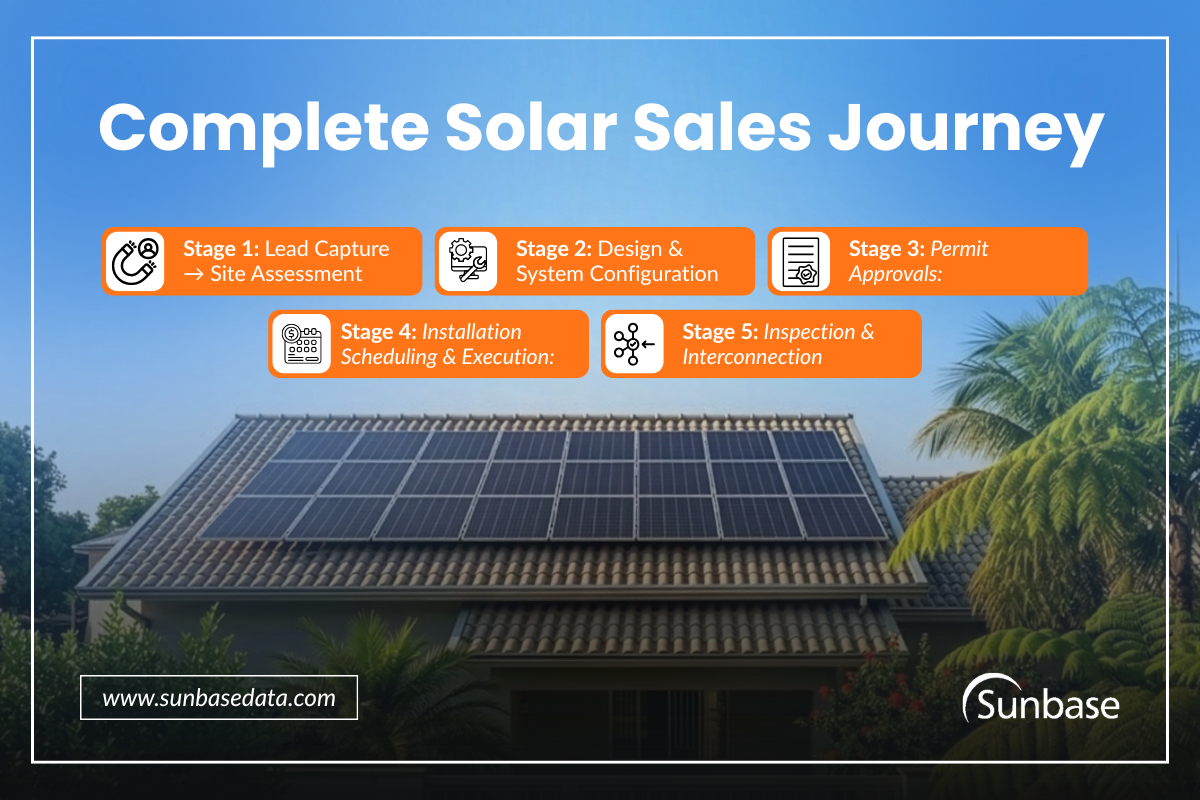
Stage 1: Lead Capture to Site Assessment: Where Good Leads Go Silent
The Real Problem:
Are you still tracking solar leads in notebooks and chasing them with calls and SMS? That's exactly how 'hot' leads go cold and vanish from your list of prospective customers!
Most leads end up forgotten, misplaced, or stuck in a sales rep’s memory. And if that rep leaves? Your entire pipeline walks away with them.
Even if you invest dollars to buy leads, conversion is not guaranteed if you fail to capture them through consistent and strategic follow-ups across multiple channels.
The Best Fix:
Advanced Solar Sales funnel software with lead management features to capture and organize leads from multiple sources and automate instant responses and timely follow-ups to keep prospects engaged.
Stats That Matter:
A report by demandlocal.com says that 78% of customers purchase from the business that responds first, highlighting a clear opportunity for companies that use automated follow-ups to ensure instant lead responses.
Speed + Automation = More Conversions
Stage 2: Design and System Configuration: The Handoff That Breaks Most Often in Field Operations For Solar Companies
Problem: The Gap Between Design and Implementation
It is neither a flat sales script nor the absence of incentives that fail solar projects; it is the disconnected design and system configuration handoff.
The design team often receives incomplete contracts, forcing them to loop back to sales for missing details. Even after manual updates, designs are scattered across multiple files with no version control and the absence of a
single source of truth.
When there is no real-time communication or proper document updates, teams just fall out of sync.
Things slow down at the service locations, delays start piling up, and before we realize it, the whole project is stalled, leaving customers frustrated and losing trust.
Resolution to the System Problem:
The Solar Design Software creates precise PV designs and shading analysis for every project, while maintaining version control.
It connects outputs directly to proposals, contracts, and the live project workflow on a centralized platform that’s accessible to every team member in real-time.
Stage 3: Permit Approvals: The Longest Wait Often Extends Project Lifecycle
Permit delays are a major challenge in the U.S. solar industry. Solar Panels may be ready, crews scheduled, but permits fail to get approval.
Incorrect system design, AHJ code violations, and missing documents add two to four weeks more for the final PTO.
Expedite the Permit Process With the Right Tool :
Solar Design Software generates permit-ready designs with AHJ code compliance, while enabling real-time regulatory requirements tracking with automated notifications for instant action.
A smart solar software can be the key to building a high-performing system that accelerates sales and seamlessly tracks every stage, from permits to installation, so you can close deals faster and better!
Stage 4: Installation Scheduling and Execution: When Co-ordination Gaps Increase Customer Complaint Burdens on Solar Contractors
Everything is Ready, but Real Action Starts After Haul. The system design is ready, permits are approved, but installation has not started.
Managers blame crew shortages, material delays, or slow updates, but everything keeps getting pushed. Meanwhile, homeowners are left waiting with every passing day, building frustration.
But the real issue is not just the delay; it is the lack of timely communication. When teams lack alignment, even a small delay triggers another. One gap leads to the next, and the entire workflow suffers.
A Software Solution That Connects Here
A unified platform with real-time visibility through desktop and mobile access ensures seamless handoffs from sales to operations with notifications and alerts at every stage.
Stage 5: Inspection and Interconnection: The Interruptions Before the Solar Panels Are Finally Ready to Shine
Before you can switch on a solar system, the utility company needs to give the green light after an inspection. But when inspection requests are handled manually, delays are almost inevitable, which pushes timelines and stalls final payments.
At times when the inspection fails, teams often rely on ad-hoc communication, which further delays resubmissions and final clearance.
What Software Connects at This Stage
The software auto-triggers inspection requests, logs results instantly on a centralized platform, and updates reworks in real time, unlocking a faster path to PTO.
Once approved, it automatically triggers final invoice generation and payment processing, helping maintain a healthy cash flow.
An all-in-one solar software built for solar companies to manage and execute projects efficiently will help you succeed in every stage.
Solar Project Management Software Comparison: Which Platforms Connect the Entire Solar Workflow
Let us take a closer look at the top-rated solar software options to help you choose the right system and confidently navigate the future with success.
1. Sunbase
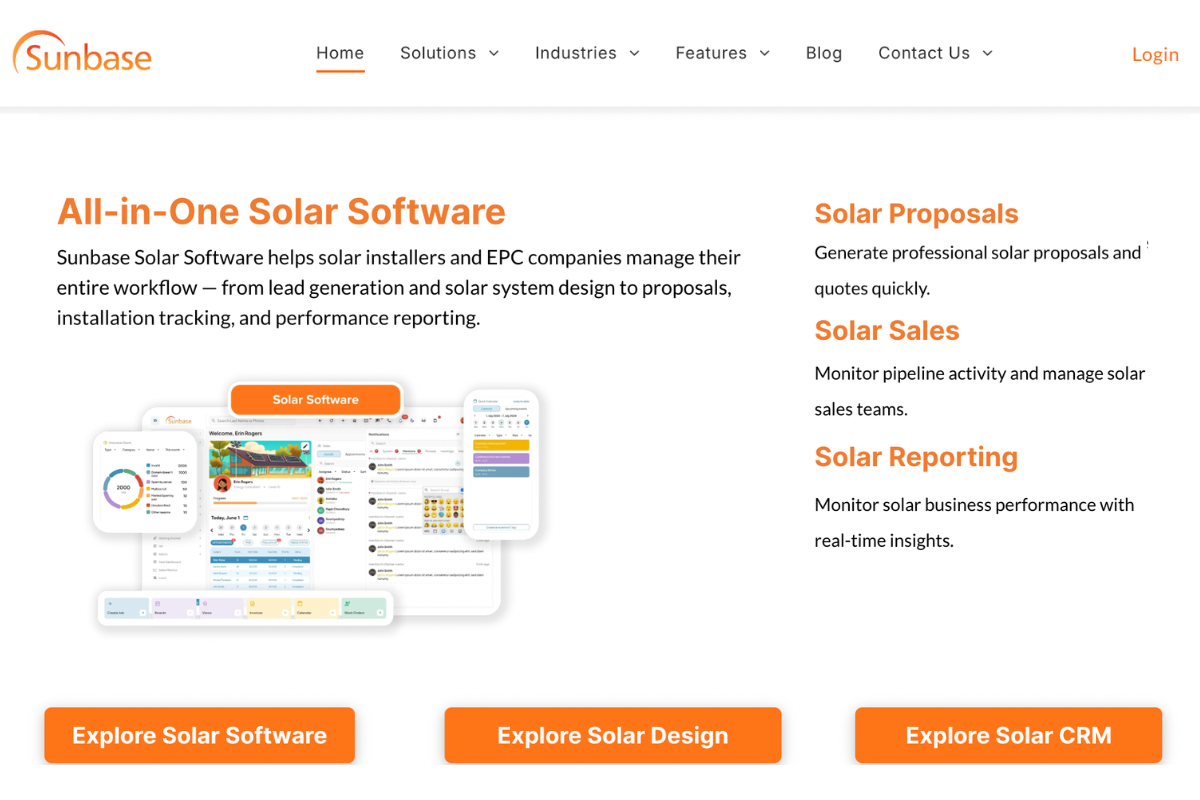
About: It is a cloud-based, all-in-one automation software designed to streamline sales and operational efficiency.
Key Capabilities:
- Automated Lead Capture: Collects lead information directly from multiple sources and integrates it seamlessly into the CRM.
- Automated Follow-ups and Notifications: Uses AI to send instant responses to leads and executes customized strategic follow-ups.
- Analytical Dashboards: Enable asset managers to make data-driven decisions using visual reports on sales performance metrics and operational outcomes.
- Centralized Storage: Stores project documentation such as sales proposals, contracts, inspection reports, compliance documents, permit approvals, and design blueprints in a secure central repository.
- Financial Processing: Triggers alerts for outstanding invoices and sends timely payment reminders, supporting online processing through ACH and card payments to maintain healthy cash flow.
- Workforce Management: Optimizes assignment of installation crews based on workforce availability across multiple job sites, with live tracking across different locations.
- Project Orchestration: Manages all project tasks from solar design to PTO, including site inspections, permit approvals, inventory management, and installation, with a real-time collaboration portal to keep all team members in sync.
- Instant Solar Proposals: Creates instant proposals with an in-built digital signature feature to accelerate deal closure, combined with automated follow-ups for prospective clients.
- Client Portal: Keeps customers updated throughout the entire project lifecycle, from initial proposal approval to final installation through notification updates.
- Solar PV Layouts: Uses simulation capture for precise measurements and blueprints, with permit-ready configurations integrated into the CRM, proposals, and project workflow.
Best Fit: Growing solar and EPC companies that need a comprehensive platform that seamlessly integrates CRM, sales, and project management tools to streamline the entire workflow.
Pricing: Starts at $59 per month, with customizable subscription plans based on team size and workflow requirements.
Customer Reviews: "Our company has been using Sunbase data since 2017 and has had exceptional success using their tools and integrating with their team to grow our solar business" (Source: Trustindex.com)
2. Aurora Solar

About: It is an advanced solar design and modeling tool that uses LIDAR scanning to deliver precise, permit-compliant solar designs with 3D models, simulating exact energy production without the need for a site visit.
Key Capabilities:
- Pre-Ready Proposal Generation: Speeds up the sales process by creating ready-to-send proposals.
- LIDAR Scanning: Uses an irradiance engine for precise shade analysis, roof and obstruction detection, and automated panel layouts.
- AI-Assisted Layout Automation: Automatically generates optimized solar designs with auto-routing paths.
- Customized White-Label Proposals: Empowers sales teams to close deals with personalized, interactive 3D visualizations, financing options, and utility bill savings estimates.
- Contract and Plan Service: Generates permit-ready plans for solar panel installation, with a contract management feature that allows sharing, tracking, and e-signatures to finalize approvals efficiently.
Best Fit: Medium and large-scale solar companies seeking fully accurate and customizable solar designs.
Pricing: Overview of Subscription Plan charged monthly per user.
| Plan | Features | Price |
|---|---|---|
| Basic | Sales Proposals, 3D HD imagery design models, and on-demand site models access. | $159 |
| Premium | All features of the basic plan with LIDAR models, shading reports, and solar battery storage backup. | $259 |
Customer Reviews: "I love that its design system is super easy to use, very professional, and seems to have a lot more accuracy than other design tools I've used" (Source: G2.com)
3. Scoop Solar
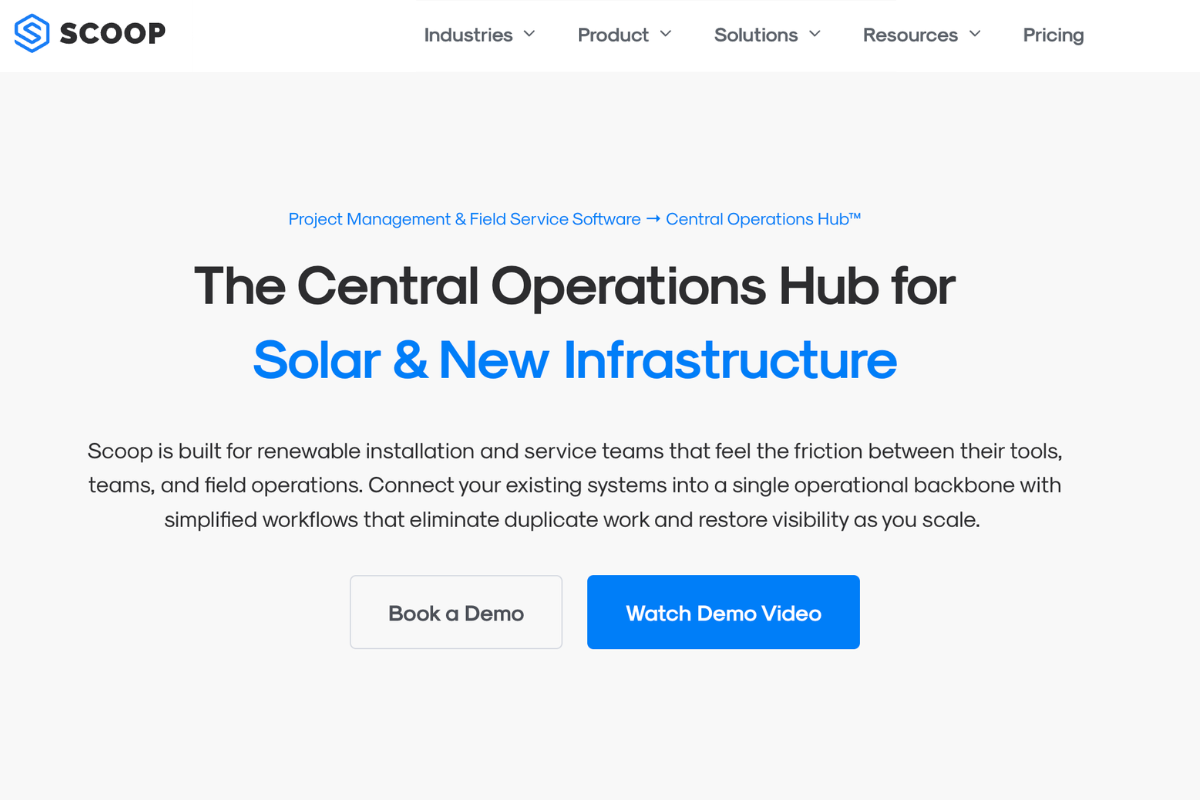
About: It is a field service management solution that handles lead management, tracks project progress, and streamlines the sales process by connecting field crews with office teams to optimize the entire workflow.
Key Capabilities:
- Centralized Project Management: Real-time tracking of project milestones, permits, and installations through a centralized dashboard.
- Mobile App Access: Enables office and field teams to track and upload job progress, and access updates via photos, documents, and videos.
- Actionable Insights: Custom dashboards provide clear visibility into the performance of sales teams and individual team members.
- Inventory Forecasting and Tracking: Reduces wastage with tracking and predicts material requirements based on market needs.
- Automated Notifications and Alerts: Sends timely updates via email, SMS, and in-app notifications based on configurable project checklists.
Best Fit: Built for EPC and Solar Company looking for visibility and a streamlined workflow to oversee project installations and maintenance.
Pricing: Connect with the Sales team for tailored pricing based on usage.
Customer Reviews: "Scoop has greatly improved our team's efficiency and clarity in both field reporting and project management". (Source: Softwareadvice.com)
4. JobNimbus

About: It is a cloud-based CRM and Project Management Software designed to support solar pros to track leads and manage the entire solar installation cycle.
Key Capabilities:
- Software Board View feature: Captures leads from multiple sources and tracks them through the sales funnel, providing a clean dashboard that displays all active leads to accelerate conversions and clearly shows project stages.
- Real-Time Job Tracking: Monitors projects in real time to detect permit issues, material shortages, or design delays, while allowing teams to upload photos, documents, work orders, and videos.
- Mobile-First Design: Enables office and field teams to access data from anywhere and update project progress directly from job sites.
- Automated Client Follow-Ups: Sends automated emails and text messages to keep prospects engaged, while clients can also send and receive messages within the same platform.
- Streamlined Billing: Speeds up billing with a single click using built-in payment tools for card, ACH, and financing options, with synchronization to third-party accounting software like QuickBooks.
Best Fit: Built for solar installers looking to automate lead management, automate billing, and coordinate crews using a mobile app.
Pricing: You need to connect with the sales team to choose the plan that best fits your workflow needs.
Customer Reviews: "I like that invoicing is easy with JobNimbus, and having access to all jobs in one place is really convenient." (Source: G2.com)
5. OpenSolar

About: It is a free end-to-end solar design and sales software built to aid solar professionals globally for solar system design, sales, and installation.
Key Capabilities:
- Free Solar Design: Creates high-accuracy designs with shading analysis, tilt angle calculations, and both 2D and 3D models.
- Digital Proposals: Builds branded, interactive, and visually compelling proposals with e-signature functionality for instant approval.
- Built-In CRM: Organizes all leads and customer information in a centralized storage system.
- Cross-Platform Access: Includes a mobile app and desktop tool, giving field sales and office teams access to features anytime and anywhere.
Best Fit: SME firms in the solar business who are looking for cost-effective design options.
Pricing: Free for all of its core capabilities
Customer Reviews: "Open Solar is a very useful online application for the design, presentation, sale, and financial management of photovoltaic energy (solar energy systems with panels)" (Source: G2.com)
A Quick Comparison of Solar Business Management Software Features
Decisions made incorrectly can turn into major setbacks, stalling work across both office operations and job sites.
It is not about an exhaustive feature list, but about choosing the functionalities that truly fit your workflow purpose.
Here's a quick comparison of the best-fit software to support every stage of the solar project lifecycle from lead capture to PTO.
| Platform | Lead | Design | Permitting | Installation | Inspection/PTO |
|---|---|---|---|---|---|
| Sunbase | Strong: CRM, design, and lead management | Strong: Built-in design tools and proposal creation | Strong: Compliance-ready tracking | Strong: End-to-end visibility | Strong: Alerts across stages of the project lifecycle |
| Aurora Solar | Strong: AI-driven capture for instant 3D design with CRM integration | Strong: Advanced design tools | Strong: Automated fire code and CAD quality permits | Moderate: Basic workflow management | Moderate: Compliance via AHJ updates |
| Scoop Solar | Moderate: Basic lead tracking | Moderate: Limited design capabilities | Strong: Centralized compliance | Strong: Real-time tracking of entire lifecycle | Strong: All stages of PTO visibility |
| JobNimbus | Moderate: CRM-focused platform | Limited: No built-in design tools | Moderate: Custom workflows with limited compliance automation | Moderate: A collaboration tool to sync all members | Moderate: No PTO tracking feature |
| OpenSolar | Strong: Free lead capture with updates | Strong: 3D aerial design | Strong: Fast permit approvals integration | Moderate: Basic installation tracking | Moderate: Limited PTO tracking of entire lifecycle |
The Platform Match by Company Stage
1. Early-Stage Solar Companies:
Ideal Choice: OpenSolar
Rationale: Suitable for startups as it offers a free and user-friendly platform for lead capture, quick proposal creation, and basic permitting.
2. Growing Residential Solar Installers:
Ideal Choice: JobNimbus or Scoop Solar
Rationale: Strong project tracking and team communication keep field and office teams aligned, ensuring visibility and control to help growing teams generate more leads and positive reviews for more referral jobs.
3. Scaling as a Multi-Market Operator:
Ideal Choice: Sunbase
Rationale: Growing firms with multiple operations teams require end-to-end visibility, automation, and seamless collaboration across regions from lead capture to PTO to ensure cross-functional efficiency, maintain favorable profit margins, and enhance customer satisfaction within an affordable range.
4. Large-Scale Solar Companies Focused on High-Precision Designs
Ideal Choice: Aurora Solar
Rationale: Suited for solar teams that prioritize automation of high-volume, accurate system designs, with 3D modeling and AHJ-compliant plan generation.
Implementing Solar Project Management Software Without Disrupting Active Jobs
The easiest path to follow is the 4Ps for implementing solar project management software with minimal downtime and a secure transition that does not hamper your current workflow.
The Four-Step Implementation Framework

Step 1: Plan: Mapping the Current Workflow Before Using the Software (Week 1)
You need to document the entire solar panel installation journey from the leap capture to the PTO journey. It acts as a blueprint to customize your software as per business operations and needs.
Step 2: Prepare: Configuration and Customization of Stage Templates Before Migrating Data (Weeks 2–3)
This stage involves consulting every department, from the office teams to the field crews, to identify the bottlenecks in the current workflow.
Fill out the customizable forms for solar project data before migrating to the new software to ensure a consistent, clean, and optimized workflow.
Step 3: Pilot: Run Your New System in Parallel to the Active One For Phased Activities (Weeks 4–5)
This is the real test drive of your new solar project management software, without disrupting ongoing operations.
Select three to five active workflows across different project stages, such as proposal creation, permit compliance documentation, and CRM integration, to test the system before a complete switch.
If each stage runs smoothly within the software and performance metrics meet expectations, the remaining processes can be migrated with minimal risk and maximum efficiency.
Step 4: Perform: Migration to Complete Automation (Week 6)
It is the final stage to phase out the old system and replace it with the new project management software by migrating all active pipeline project data and historical records to the new platform.
Activate automation alerts and notifications, and integrate with CRM and other tools to streamline activities.
Why Sunbase Solar Software Must Be The First Choice For Smooth PTO Workflow?
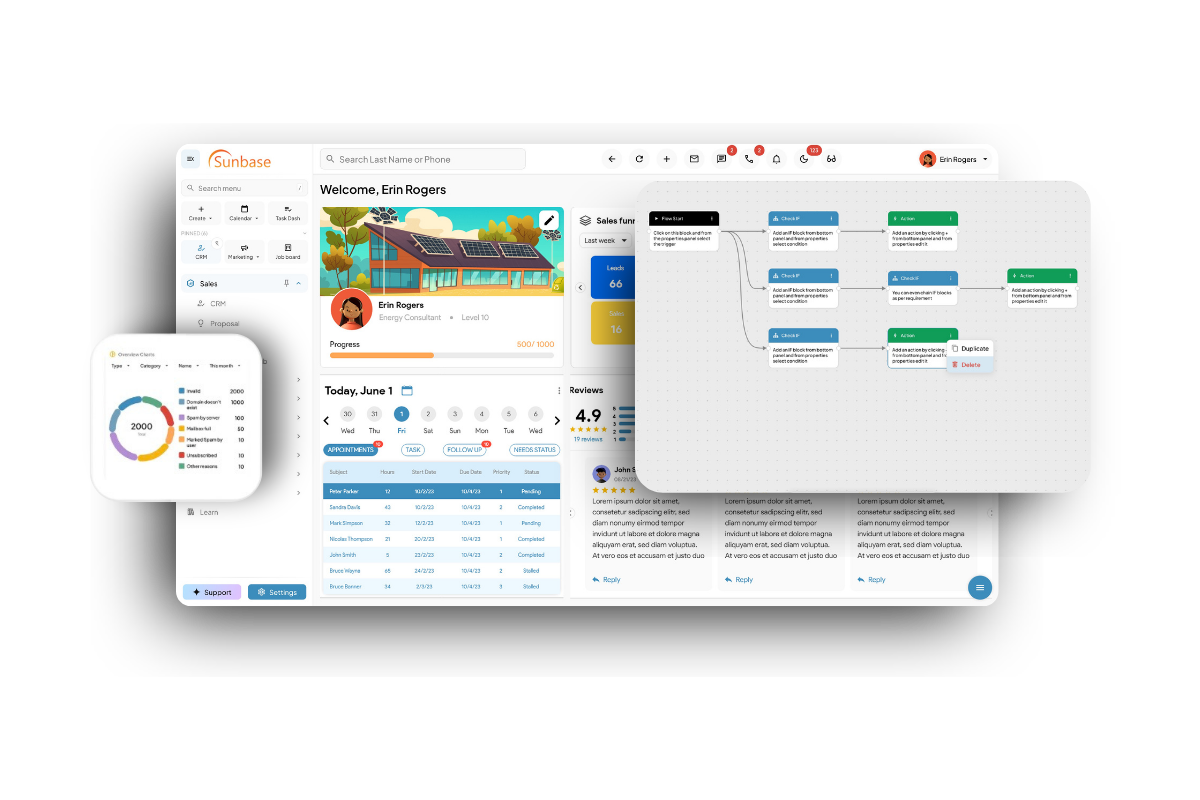
Sunbase is a specialized platform designed for residential and commercial solar and EPC companies to manage their entire workflow. But is it the perfect pick for all? Let us evaluate it against key factors:
| Business Goal | What to Ask | How Sunbase Delivers |
|---|---|---|
| Control costs | Do I need multiple tools to run my operations? | Replaces multiple tools for CRM, accounting, inventory, and PM with one unified platform with a single subscription |
| Keep data secure | Who can access what, and how secure is the system? | Role-based access ensures controlled data visibility, while managers retain full oversight |
| Get reliable support | Will I get proper onboarding and ongoing help? | Structured 4–8 week implementation with continuous onboarding, setup, and training support |
| Maximize ROI | Will the software actually pay for itself over time? | Higher conversion rates and improved efficiency help generate revenue that outweighs subscription costs |
Conclusion
Solar companies operate in an increasingly competitive market where speed, clarity, and streamlined operations define success, just as contractors do when they revolutionize projects with construction software.
From capturing high-quality leads and customizing proposals to obtaining permits efficiently, enabling faster installations, and ultimately achieving Permission to Operate (PTO), every step must be executed with precision and agility.
Fasten Your Seatbelt for a Seamless and Superfast Lead-to-PTO Journey
Cover the entire sales journey with a purpose-built, intelligent solar software designed to give you a competitive edge.
Move seamlessly through every phase of the solar lifecycle with a smarter workflow by connecting with our support today for a quick 15-minute Expert-Guided Demo and see how you can fix and optimize your workflow, right from the first step!
Frequently Asked Questions
Q1: What is The Best Solar Project Management Software in 2026?
The best platforms are specialized project management tools built for solar projects to carry out admin tasks and field operations smoothly, ranging from solar sales, designing, installation, tracking, and final project handover to enhance project performance and help growing solar businesses scale efficiently. The best option depends on your business size, the complexity of projects, the required feature sets, and your budget. Sunbase, Aurora Solar, Scoop Solar, Open Solar, and JobNimbus are some of the top-rated and most popular platforms.
Q2: How Does Solar Project Management Software Reduce Installation Time for Renewable Energy Projects?
Solar project management software can help reduce installation time by streamlining workflows for a faster transition from design to installation of solar panels. Key features include instant proposal generation and digital signature approvals, automated designs with accuracy, quick compliance checks, centralized document management, optimized job scheduling, and task tracking with real-time visibility
Q3: What is the Difference Between Solar CRM Software and Solar Project Management Software?
Solar CRM software is used by sales managers to manage leads from multiple sources and handle customer communications with automated follow-ups.
Solar project management tools are preferred by solar project managers for post-sale activities to successfully implement solar projects by managing site designs and optimizing crew scheduling.
Q4: How Long Does it Take to Implement Solar Project Management Software?
The implementation of the solar project management software takes only a few weeks to a month, depending on company size and system complexity.
Q5: What is Sunbase Solar Software, and How Does it compare to Other Platforms?
It is a comprehensive and all-in-one cloud-based solar software designed to handle both solar sales and operational activities, managing the entire solar lifecycle from initial lead prospect engagement to final installation. In comparison to other specialized software, Sunbase is suitable for small to medium-sized EPC companies looking for a comprehensive solution within an affordable range to scale effectively using a highly intuitive system that requires minimal technical training.
Q6: Can Solar Project Management Software Handle Both Residential and Commercial Projects?
Yes, the Modern Solar Project management Software is designed to handle both residential and commercial projects within a single platform.
One Platform.
Zero Chaos.
Run Your Entire Business in One Platform
Sunbase replaces your CRM, proposals, scheduling, job tracking, and reporting tools — all inside one clean, connected platform.
About Sunbase
The All-In-One Platform to Run Your Entire Business
Sunbase helps you organize operations, streamline daily workflows, and manage everything - from first customer contact to final project deliver- in one connected system.
Our Mission
- Organize your business.
- Optimize your workflow.
- Automate your dailytasks
Why Businesses Choose Sunbase
One Connected Workflow
Replace scattered tools and manual processes with a single platform that brings together your team, tasks, customers, jobs, and performance data.
🌎 Global Presence
Serving the United States, Canada, India, LATAM, Australia, and 10+ international markets.
👥 11,000+ Users
Trusted by contractors, installers, project managers, sales teams, and field technicians.
🏗️ Built for All Sizes
From small contracting teams to fast-growing enterprises, Sunbase adapts to your workflow.
Stop Managing Your Business Manually. Automate It.
Sunbase automates workflows, reduces mistakes, and helps your team get more done - without hiring extra staff or juggling multiple tools.
Still Managing Your Business Across Multiple Tools?
Bring your CRM, proposals, projects, and operations into one platform built for contractors.