
Running a solar installation business in India today is not what it used to be, even a few years ago. Rooftops are more crowded, client expectations are higher, and margins are tighter.
And competition is everywhere. One small design mistake can turn into a costly site correction that eats into profits and delays the entire project.
This is where solar design software India installers rely on is quietly changing how work gets done. From early site planning to final installation, the right solar design software helps teams work faster and with fewer errors.
It reduces confusion, improves accuracy, and saves installers from painful rework that drains time, money, and customer trust.
Let us take a closer look at how Indian installers are using smarter design software to improve results across solar projects of all sizes.
Why Indian Solar Installers Need Smarter Solar Design Software to Avoid Rework and Costly Design Mistakes?
Indian solar projects come with their own set of challenges. One rooftop might have water tanks, dish antennas, staircases, and uneven surfaces. Another may face constant shadowing from nearby buildings.
Seasonal weather changes can affect generation projections. And site data is often inconsistent when gathered manually.
Many installers still rely on hand-drawn layouts, spreadsheets, or generic tools that are not built for Indian conditions. That is where repeated corrections, site delays, and profit leakage begin.
This is exactly why India-ready solar design software is becoming essential. When layouts, shading, generation, and approvals are handled in one connected system, installers gain control before construction even begins.
Key Takeaways
- Indian solar layouts fail due to shading miscalculations and terrace complexities
- Manual designs cause approvals to fail and rework to spike
- India-ready solar design software reduces errors before installation starts
- Design accuracy directly impacts project margins, timelines, and customer trust
- Sunbase enables installers to design, revise, and approve faster with India-aligned tools
See how India-ready solar design software helps you design right the first time, reduce rework, and protect margins across every project.
Book a quick Sunbase demo and experience smarter solar design built for real Indian conditions.
Why Solar Design Errors Are Costing Indian Installers More Than They Realize?
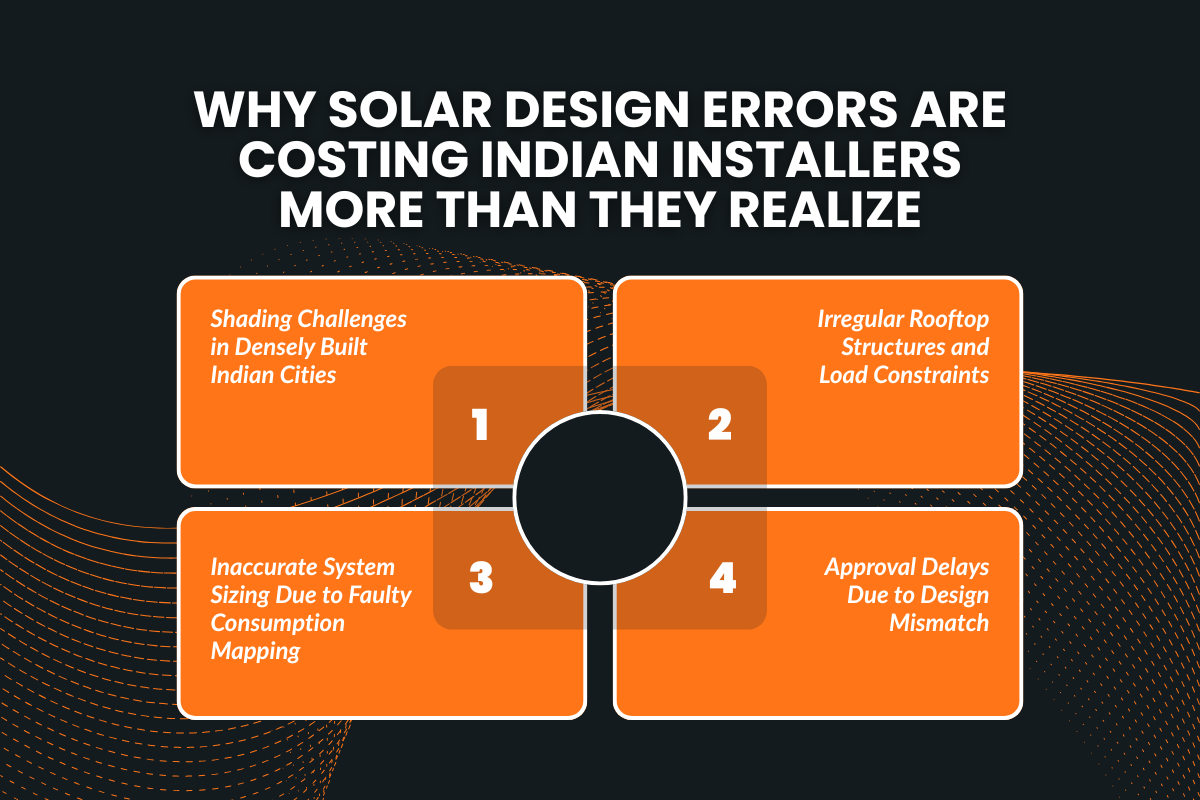
Many installers realize the true cost of a design mistake only after the damage is done. A shifted panel row, a wrongly sized inverter, or a shadow that was never factored in. All of these lead to lost time and money.
1. Shading Challenges in Densely Built Indian Cities
In cities, rooftops are surrounded by:
- Trees
- Water tanks
- Neighboring buildings
- Staircases and terrace structures
Manual layouts rarely capture how shadows move in real time across these obstacles. Seasonal sun angles drastically change generation patterns. When these micro-shading issues are ignored, the solar system underperforms. That leads to unhappy clients and performance disputes.
2. Irregular Rooftop Structures and Load Constraints
Indian rooftops are rarely uniform. You often deal with:
- Non-uniform slab designs
- Mixed waterproofing layers
- Varying tile and concrete conditions
When these are ignored during early solar design, structural risks increase. Mounting systems may not distribute weight evenly, posing safety concerns and risking future damage.
3. Inaccurate System Sizing Due to Faulty Consumption Mapping
Many installers still rely on rough estimates rather than actual consumption data. The result is:
- Wrong load assumptions
- No seasonal consumption modeling
- Overdesign or underutilization of systems
This affects both energy output and return on investment. Customers either feel overcharged or underpowered.
4. Approval Delays Due to Design Mismatch
Approval failures happen when:
- Site layout differs from sanctioned drawings
- String plans do not match the actual roof
- Inverter capacity is misaligned
DISCOM and net-metering rejections slow down the solar project lifecycle. Redesign cycles add weeks to timelines.
How Solar Design Software Fixes These Accuracy Gaps?
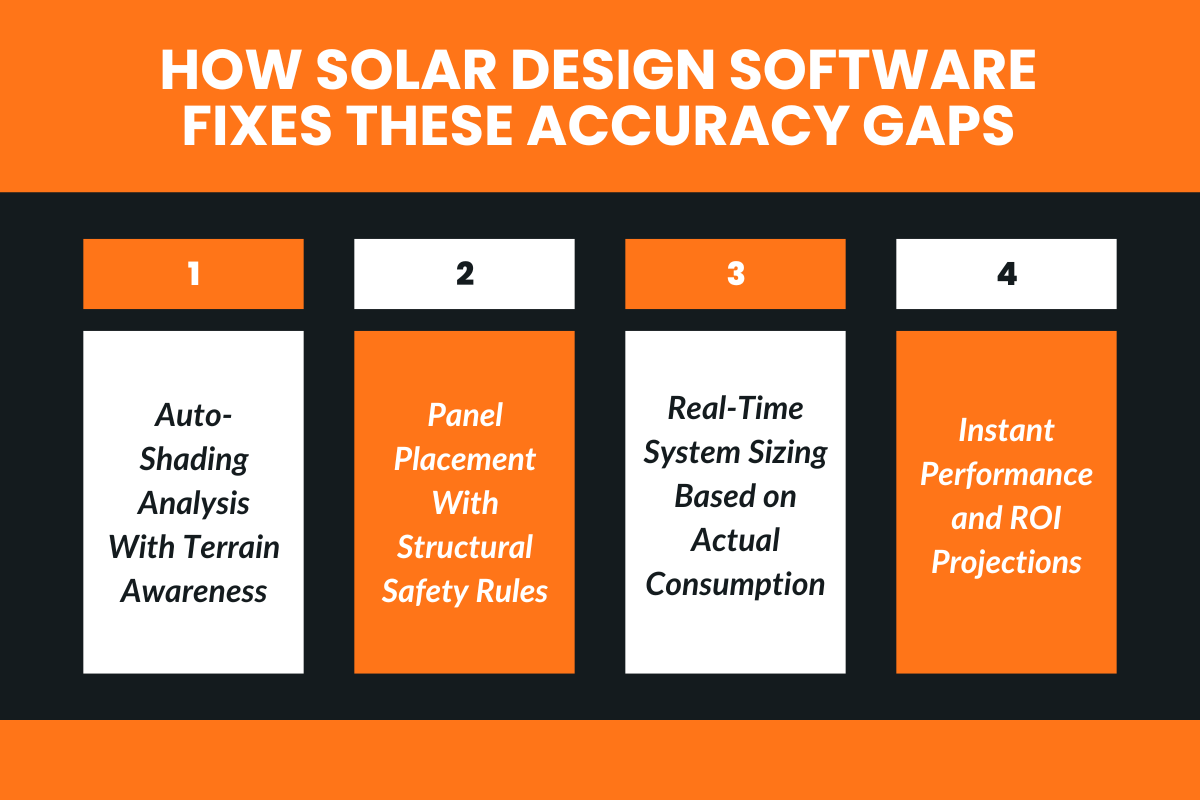
This is where a modern design tool truly changes the game. Instead of relying on rough estimates, installers can now make decisions based on real-world data and precise simulations.
A. Auto-Shading Analysis With Terrain Awareness
Advanced solar design software performs:
- Shadow simulation across different times of the year
This helps predict seasonal performance and prevents surprises after installation. - Building-height sensitivity
Taller structures nearby are analyzed to help installers avoid long-term shading issues. - Obstacle-aware energy estimation
Water tanks, parapets, and dish antennas are included in the model to provide a more realistic output estimate.
This ensures your solar panels are placed to maximize generation and avoid preventable losses.
B. Panel Placement With Structural Safety Rules
Instead of guesswork, the software provides:
- Auto-spacing for wind and maintenance clearance
Panels are spaced correctly to handle strong winds and allow technicians to move safely. - Optimized racking alignment
This ensures that racking systems fit the rooftop structure without unnecessary adjustments. - Load distribution planning
The system helps prevent overloading fragile roof areas and supports long-term stability.
This protects both the rooftop and the solar system's long-term health.
C. Real-Time System Sizing Based on Actual Consumption
Modern platforms use:
- Bill-based system sizing
This prevents overselling or undersizing by matching the design to real consumption patterns. - Seasonal load behavior
Consumption peaks and dips are considered, so customers receive a system that truly meets their needs year-round. - Export and import balancing
This ensures customers get the best possible value, whether they consume or export excess energy.
This makes sure your solar system fits the customer perfectly from day one.
D. Instant Performance and ROI Projections
Installers can now show:
- Real output projections
Customers see expected generation in real-world conditions rather than theoretical numbers. - Accurate financial analysis
This helps them understand actual savings, not inflated claims that later lead to disputes. - Payback calculations aligned with Indian tariffs
Local tariff structures and subsidies are factored in to give clear, transparent timelines.
Customers see clarity instead of inflated promises, which builds trust and helps close sales faster.
How Design Accuracy Directly Impacts Profitability for Installers?
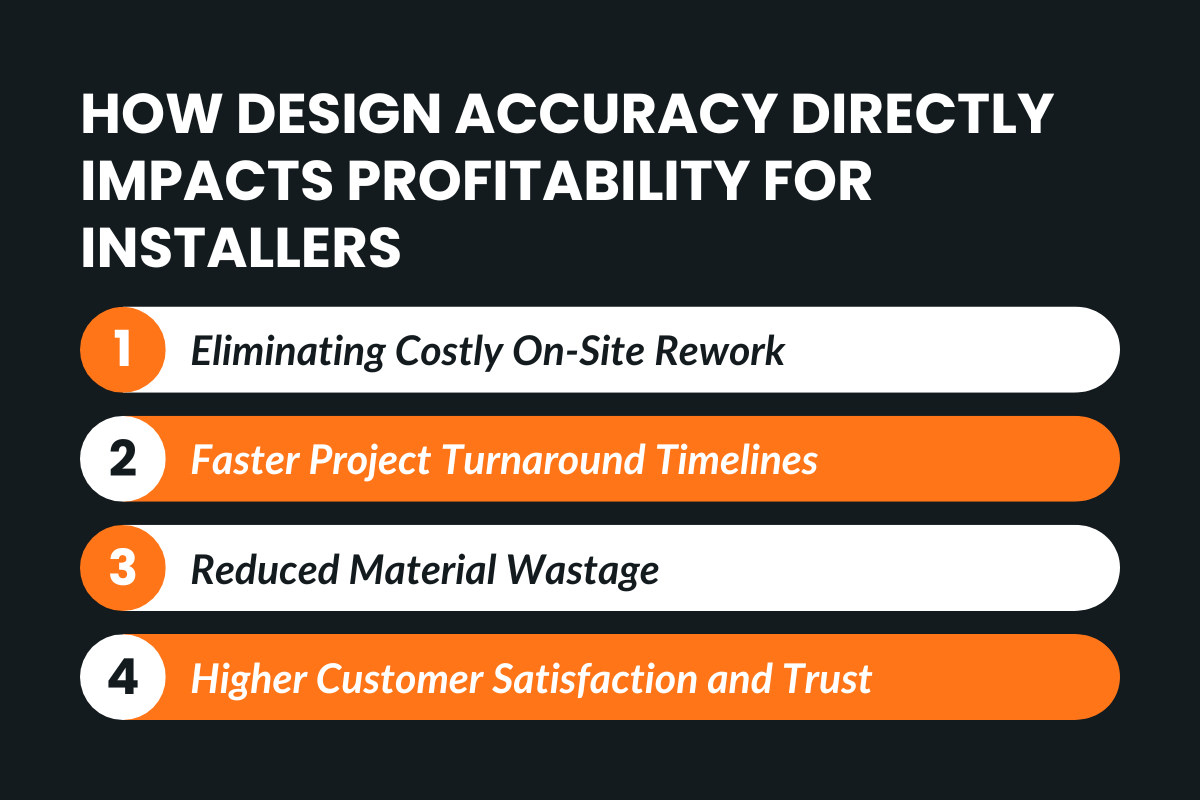
Better solar design is not just about neat layouts. It directly protects profits, smooths out operations, and helps installers deliver consistently successful projects.
1. Eliminating Costly On-Site Rework
Accurate designs remove many of the issues that typically surface only after crews are already on the roof.
- Correct inverter sizing avoids last-minute component swaps that delay installations.
- Proper measurements prevent mounting rail adjustments that force technicians to cut or reposition hardware mid-job.
- Well-planned cable routing ensures lengths are calculated correctly, eliminating wasted materials and unnecessary rework.
Together, these factors save labor hours, reduce material waste, and protect your reputation, especially when timelines are tight.
2. Faster Project Turnaround Timelines
When layouts are accurate, projects move forward without friction.
- Clean, consistent drawings speed up approvals with inspectors and utilities, reducing back-and-forth. Redesign cycles disappear because installers can move straight from planning to execution.
- Field teams follow a clear, predictable plan instead of improvising on-site.
Faster installs mean projects close sooner, improving cash flow and allowing teams to take on more work.
3. Reduced Material Wastage
Design accuracy also plays a major role in controlling material costs.
- Design precision leads to exact bill of materials generation, giving teams clarity on every component required.
- Installers order only what is needed, avoiding overstock and unnecessary “just in case” purchases.
- With precise quantities, procurement becomes more strategic, allowing better supplier negotiations and tighter inventory control.
Over time, these small savings across panels, mounts, and cabling add up to noticeably stronger margins.
4. Higher Customer Satisfaction and Trust
Perhaps most importantly, accurate designs build trust with customers.
- When system performance aligns closely with what was promised during the sales process, disputes become rare and confidence grows.
- Satisfied customers are more likely to recommend the installer to others and are more open to long-term service or maintenance contracts.
That trust turns into a quiet but powerful growth engine, creating repeat business and referrals without additional sales pressure.
Real-World Examples: Where Indian Installers Save the Most Time

Sometimes the impact of solar design software is easiest to see on real job sites. Here are a few common scenarios where it makes daily work faster and smoother.
Rooftop Projects in Crowded Urban Areas
In dense cities, rooftops are packed with tanks, parapets, and nearby buildings. Design software helps installers map shadows, use space more efficiently, and avoid layout changes after installation begins.
By accurately mapping shadows and modeling available space, teams can finalize panel placement upfront instead of making adjustments mid-installation.
Industrial Sheds with High Variability in Roof Angles
Sloped and uneven shed roofs affect the generation if not planned correctly. Design software allows installers to analyze roof geometry in advance, plan correct tilt and orientation, and optimize string design across large areas.
Rural Installations with No Clear Structural Drawings
When drawings are missing, virtual rooftop modeling allows installers to visualize layouts quickly and move forward without long delays.
This speeds up planning and significantly reduces uncertainty on-site, allowing teams to move forward confidently instead of improvising during installation.
High-Capacity Projects Needing Precise Stringing and Load Calculations
Large commercial and high-capacity installations leave little room for error. Incorrect stringing or unbalanced loads can lead to rework during commissioning, costing both time and money.
Solar design software helps installers plan string-level configurations accurately and balance inverter loads before equipment ever reaches the site.
What is the Future of Solar Design in India?
The future of solar design software that Indian installers rely on is already taking shape. What once felt advanced is quickly becoming the new normal. Design is moving faster, getting smarter, and becoming more connected to approvals and execution.
1. AI-Driven Auto Layout Optimization
Soon, layouts will no longer need constant manual tweaking. Software will automatically adjust designs based on roof shape, obstacles, and shading patterns.
- Smarter panel placement with less trial and error: This helps installers avoid redesigning the layout, which usually occurs after the first site visit.
- Faster design finalization for sales and execution teams: With quicker layouts, teams can close deals faster and move projects into installation sooner.
2. Drone and Satellite-Based Site Modeling
Remote surveys are becoming a practical reality, especially for large or hard-to-access rooftops.
- Faster project feasibility checks: Installers can assess site conditions without waiting days for on-site measurements.
- Reduced dependence on repeated site visits: This cuts travel time and helps teams prioritize active installations instead of routine inspections.
3. Direct Integration With Government Approval Portals
Approval workflows are also moving closer to automation.
- One-click design uploads for DISCOM approvals: This eliminates manual document handling that often leads to errors or missing files.
- Faster net-metering and inspection processing: Streamlined submissions help reduce approval bottlenecks and speed up final commissioning.
Conclusion
Design accuracy is not a luxury in Indian solar projects. It is the foundation of profitability, reputation, and scale. Solar design software built for India removes guesswork, prevents rework, and gives installers the confidence to grow without operational chaos.
When your layouts are precise, approvals are smoother. When approvals are smoother, installations move faster. And when everything flows together, your solar business becomes easier to run, easier to scale, and far more profitable.
Start Reducing Rework and Improving Profitability Today with Sunbase
Sunbase has been created with Indian installers in mind, not adapted from overseas tools. Every feature reflects how solar work actually happens across Indian rooftops, weather zones, and regulatory systems.
If you are ready to reduce site mistakes, speed up approvals, and protect margins on every project, it is time to switch to solar design software built for Indian installers.
FAQs
1. What is design software for solar projects, and why do installers need it?
Design software for solar helps installers create accurate system layouts and performance estimates. You need to use a reliable design tool to avoid rework, improve shading analysis, and deliver precise plans for your solar projects.
2. How does solar design software improve layout and system performance?
Solar design software generates accurate layout and placement options based on roof size, obstacles, and sunlight patterns. This helps ensure your solar system performs as expected without guesswork or manual errors.
3. What features should a design tool include for your solar installation business?
A strong design tool should offer shading analysis, rooftop modeling, BOM generation, and real-time performance forecasting for your solar projects. These features allow installers to plan systems faster and with greater accuracy.
4. Why do Indian installers need to use design software explicitly built for solar?
Indian rooftops often have terrace structures, limited space, and irregular shading. You need design software tailored to India's solar conditions to address these challenges and produce realistic, approval-ready plans.
5. How does design and layout software reduce rework on solar sites?
By generating precise layout and wiring plans, design and analysis software helps installers avoid mismatched components, shading issues, and costly mistakes. This means your solar installations run smoothly and require fewer corrections on-site.
One Platform.
Zero Chaos.
Run Your Entire Business in One Platform
Sunbase replaces your CRM, proposals, scheduling, job tracking, and reporting tools — all inside one clean, connected platform.
About Sunbase
The All-In-One Platform to Run Your Entire Business
Sunbase helps you organize operations, streamline daily workflows, and manage everything - from first customer contact to final project deliver- in one connected system.
Our Mission
- Organize your business.
- Optimize your workflow.
- Automate your dailytasks
Why Businesses Choose Sunbase
One Connected Workflow
Replace scattered tools and manual processes with a single platform that brings together your team, tasks, customers, jobs, and performance data.
🌎 Global Presence
Serving the United States, Canada, India, LATAM, Australia, and 10+ international markets.
👥 11,000+ Users
Trusted by contractors, installers, project managers, sales teams, and field technicians.
🏗️ Built for All Sizes
From small contracting teams to fast-growing enterprises, Sunbase adapts to your workflow.
Stop Managing Your Business Manually. Automate It.
Sunbase automates workflows, reduces mistakes, and helps your team get more done - without hiring extra staff or juggling multiple tools.
Still Managing Your Business Across Multiple Tools?
Bring your CRM, proposals, projects, and operations into one platform built for contractors.