
“One wrong setback measurement can wipe out a full week. And one failed inspection can cost you the customer.”
If you have worked in solar long enough, you know that it is not unusual. Most projects do not fall apart because teams are careless. They fall apart because solar design is full of tiny details that are easy to overlook.
A roof plane that is slightly misread. A shading issue that looks minor on paper but crushes production. A fire code rule that varies by county. One small miss can trigger permit delays, AHJ rejections, and frustrating redesign cycles.
That is why solar design accuracy matters more than ever. When accuracy improves, it permits speed up, truck rolls drop, crews stay productive, and profit stays protected.
Solar Design Software: Reduce Rework, Avoid Site Rejections, and Speed Up Installations
Modern solar design software improves accuracy, helping teams prevent rework and pass inspections the first time.
In today’s solar market, speed and precision are everything. A single layout error or overlooked code requirement can stall permits, delay crews, and frustrate homeowners. Most of these problems do not start in the field; they begin in the design phase.
The solar design software brings structure and clarity to this process, reducing site rejections, cutting costly redesign cycles, and keeping installations on schedule.
You’ll understand how small design errors lead to rework, permit delays, and site rejections—and how software eliminates these risks early in the process.
It also explains how improving solar design accuracy directly impacts installation speed, inspection success, and overall project profitability.
Key takeaways
- Most rework in solar comes from small design errors that snowball into permit delays, inspection failures, and extra site visits.
- Solar design accuracy is not just about measurements. It includes shading, production modeling, compliance, and documentation quality.
- Software-driven system design reduces human error by using accurate data, measured data inputs, and consistent validation checks.
- Built-in compliance rules and automated documentation can dramatically reduce AHJ rejection rates.
- High-accuracy solar design software is one of the fastest ways to improve energy efficiency, protect system performance, and shorten the payback period for your business operations.
The Hidden Cost of Design Errors And What “Rework” Actually Looks Like in Solar

Most people imagine “rework” as something dramatic, like ripping off installed panels and starting again. Sometimes that happens. But most of the time, rework is quieter. It is the constant back-and-forth that eats away at your schedule.
Here is what rework actually looks like in the real world:
1. Redesigning array layouts
It is one of the most common pain points. You design a solar system layout based on the roof measurements you have, then you realize the vent pipe is in the wrong spot, the roof plane is slightly different from what was expected, or the setback rules were applied incorrectly.
Now you are rebuilding the design, adjusting components, and rerunning calculations. Not hard, but time-consuming. And when you do this across multiple solar projects every week, it becomes expensive.
2. Re-submitting permits
This is where the real delays start. A permit rejection often sends you into a frustrating cycle of edits, re-uploads, and waiting.
In many jurisdictions, the process is not fast. Some AHJs take days to respond. Others take weeks. That means your project timeline starts slipping before the crew even steps on-site.
3. Failed AHJ inspections
This one hurts because it happens late in the process. The system is built, the crew is scheduled, and the homeowner is expecting completion.
Then the inspector fails it due to setbacks, labeling issues, conduit sizing, or structural concerns. Now you have a half-finished install, rescheduling headaches, and client dissatisfaction.
4. Additional site visits
When the design is off, someone has to go back to the site to fix it. It could be a survey guy checking measurements again, a project manager figuring out what went wrong, or the install lead trying to adjust things on the spot.
Either way, that truck roll costs money. It also burns time and drains your team’s energy. The frustrating part is that most of these issues could have been prevented with better measurements, stronger analysis, and a cleaner design process from the start.
For your team to avoid such reworks, explore:
Creating A Solar Design: Step-by-Step Guide
for solar professionals.
What Is Solar Design Accuracy And Why Does It Matter?
Solar design accuracy means creating a system that closely matches real-world site conditions, local codes, and expected energy output. It ensures that what’s designed on paper actually works the same way once installed on-site.
This includes accurate roof measurements, realistic shading analysis, and an electrical layout that fits the actual load requirements. It also means your energy estimates align with local solar conditions and your permit documents are complete enough to pass without delays.
In simple terms, a good design is one you can trust from planning to installation. It reduces guesswork and keeps the project stable from the start.
Why Accuracy Is Crucial While Designing Solar Systems
Accuracy matters because every stage of the project depends on it. A small mistake in design can quickly impact installation, performance, and inspections.
Your design directly impacts how materials are ordered and how smoothly installation happens. It also influences system performance, inspection outcomes, and overall energy efficiency.
Beyond execution, it shapes customer experience and business outcomes. From ROI projections to payback timelines, everything relies on how accurate the design is.
When the design is off, the entire workflow becomes unstable. Even small fixes later can slow down the project and create unnecessary complications.
Solar projects are already complex, with varying roof structures, environmental factors, and strict regulations. That’s why accuracy isn’t optional—it’s essential for keeping everything on track.
Why Site Rejections Happen
Site rejections happen for a few predictable reasons:
- Strict AHJ enforcement
- State-by-state fire codes
- HOA restrictions
- Fire setback non-compliance
- Shading misjudgment
- Structural load misestimation
And most of these are connected to inaccurate data or incomplete documentation.
Mini Example:
A residential installer in Texas failed inspection because the ridge setback was off by just a few inches. That small mistake led to a 10-day delay and roughly $1,800 in additional costs, including rescheduled labor and another trip to the site.
And this is not some isolated case. Situations like this play out across the industry every single day. When you look closely, most of these headaches point back to the same root cause: weak solar design accuracy.
How Does Solar Design Software Improve Solar Design Accuracy?
If you are still relying heavily on manual steps, spreadsheets, and eyeballing roof images, you are basically betting your profit margin on perfection. And perfection is not realistic when you are juggling 15 projects at once.
The design software strengthens accuracy by reducing human error and improving how the design process handles data, measurements, and compliance.
Let us break down the big accuracy drivers:
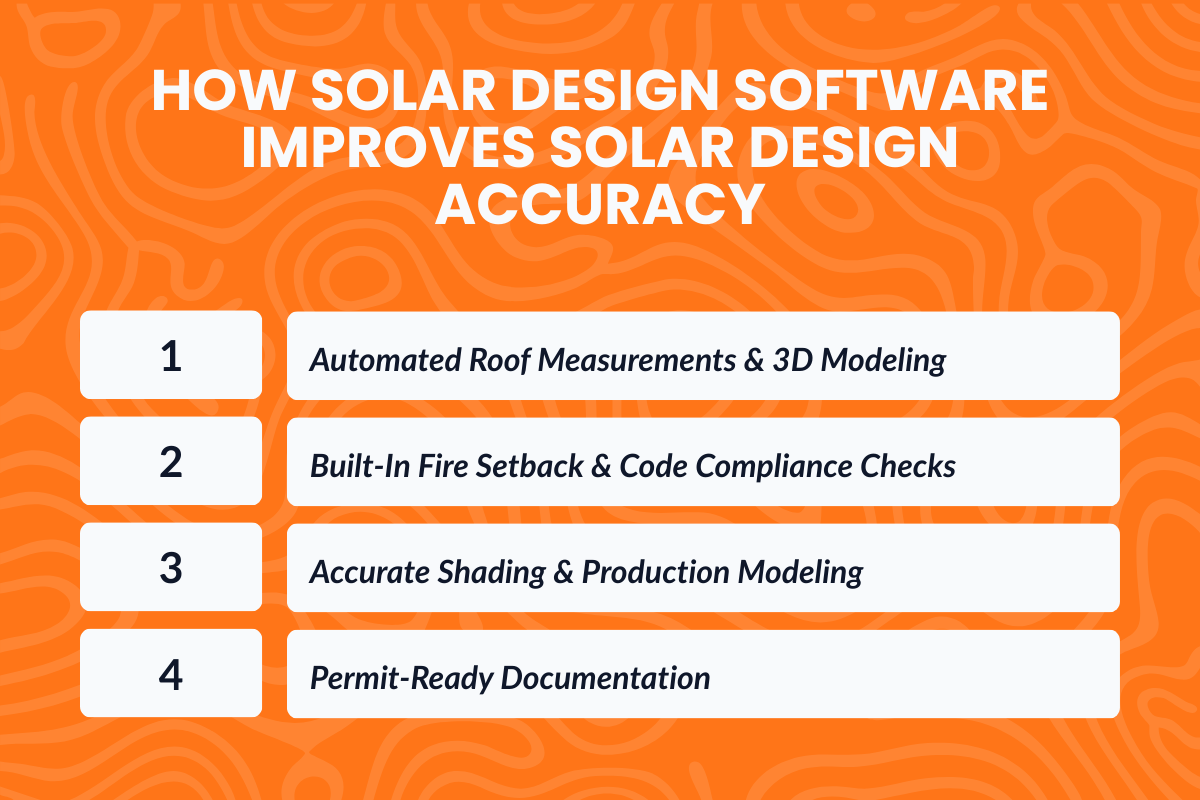
1. Automated Roof Measurements & 3D Modeling
This is the first step where most design errors begin. Traditionally, a designer pulls satellite imagery, uses basic measurement tools, estimates roof pitch, and tries to build a system layout. It works, but it is easy to get wrong.
Modern solar design tools improve this using:
- Satellite + LIDAR integration
- Auto roof pitch detection
- Obstacle recognition
- 3D roof modeling
The big advantage here is consistency. The software generates models based on high-quality data and measured data sets. Some systems even incorporate ray tracing to map roof geometry and shading angles more precisely.
That is especially useful in dense neighborhoods where trees and adjacent buildings can create unpredictable shading.
Impact: Reduces human measurement errors.
When measurements are accurate from the start, the rest of the system design becomes far more reliable, reducing the chances of redesign and correction later.
Before moving ahead, take a look at the
Complete Guide on Solar Design Software.
2. Built-In Fire Setback & Code Compliance Checks
If you have ever dealt with AHJs across multiple counties, you know how chaotic compliance can feel. One town wants a 36-inch setback. Another wants 18 inches. Some inspectors are strict about pathways. Others focus heavily on labeling, conduit runs, or NEC details.
Solar design software reduces site rejection risk by embedding compliance into the design tools. This includes:
- Auto setback rules
- NEC voltage checks
- Conduit sizing validation
Instead of manually checking code details, you can validate the design before you submit it.
Benefit: Prevents inspection failures before submission.
This is where accuracy matters in ways that are not always visible. Even if your panels fit perfectly on the roof, a single code issue can cause the entire permit to be rejected. And once you are in the rejection loop, everything slows down.
3. Accurate Shading & Production Modeling
Shading is often underestimated during design, but it plays a major role. A lot of designers still treat shading as a quick checkbox, but it is actually one of the biggest drivers of system performance and customer satisfaction.
A quick assumption about shading can lead to inaccurate production estimates and dissatisfied customers later.
Modern software improves this by using:
- Hour-by-hour shade simulation
- Obstruction mapping
- Seasonal adjustment
- Solar irradiance mapping
This is where energy simulation and energy modeling become critical. You are not just estimating output, you are analyzing how the sun interacts with the roof, the panels, and the environment throughout the year.
Many platforms use advanced algorithms to model solar radiation patterns and solar irradiance more realistically.
Some even align with the research approaches used by the National Renewable Energy Laboratory (NREL), one of the most cited national laboratory sources for solar energy production modeling and performance metrics.
Case Insight:
A California installer reduced redesign rates by 35% after adopting advanced shading analysis.
That makes sense. When your shading analysis is accurate, your layout decisions become more reliable. Your energy production estimates become more defensible. And your customers stop calling six months later, saying, “Why is my power output lower than expected?”
4. Permit-Ready Documentation
Many people assume that AHJs reject permits mainly because of inaccurate designs. But in many cases, the rejection happens because the package is incomplete or inconsistent.
Permit reviewers do not have time to interpret missing details. If the line diagram is unclear or the structural report is missing, it gets kicked back.
Modern solar design software solves this by generating:
- One-click permit packages
- Electrical line diagrams
- Structural load reports
This removes the need for manual compilation and ensures that every submission follows a consistent format, which improves clarity and reduces delays.
Why it matters: AHJs reject incomplete documents more than inaccurate designs. When documentation is complete and easy to review, approvals happen faster, fewer revisions are required, and projects stay on schedule without unnecessary back-and-forth.
Before vs After: Manual Design vs Software-Driven Accuracy
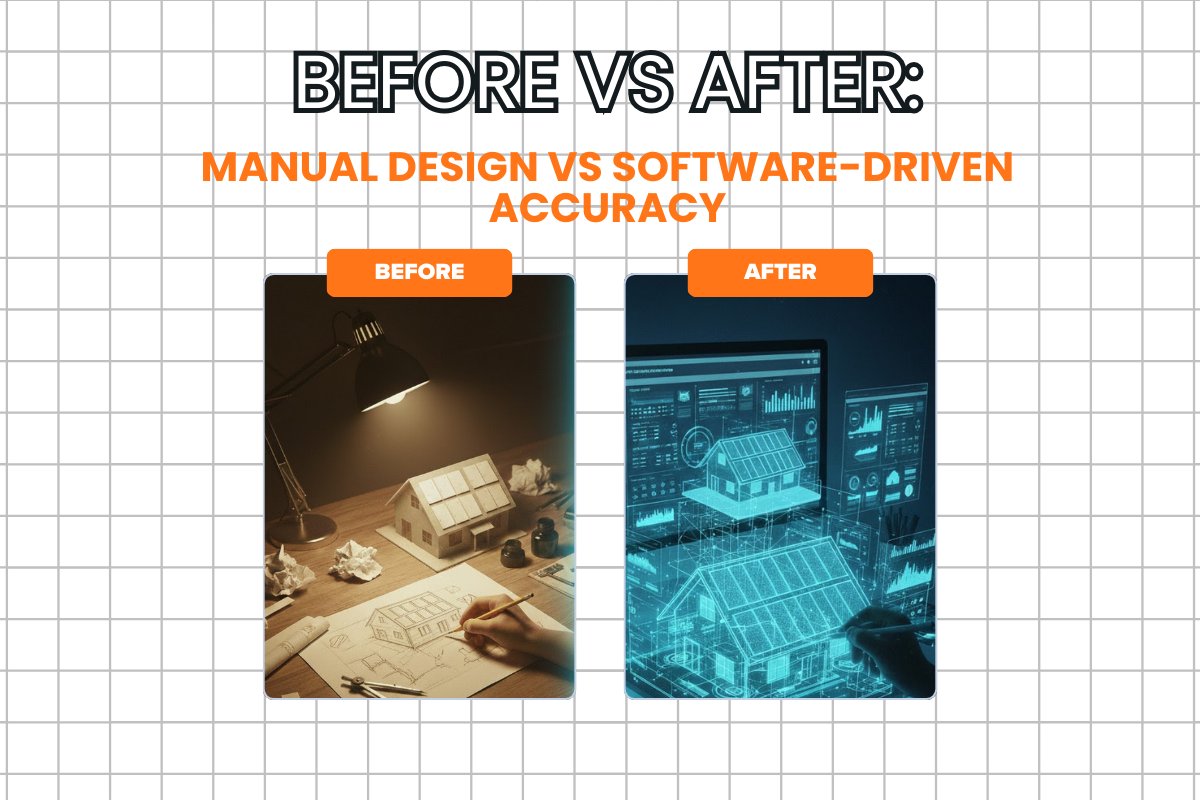
The gap between manual design and software-driven accuracy is not small; it directly affects rework, inspections, and timelines. Here is a quick side-by-side comparison of how both approaches perform in real solar projects.
| Metric | Manual Design | Software-Based Design |
|---|---|---|
| Roof measurement error rate | High variability | <5% deviation |
| Permit rejection rate | Often double-digit | Significantly reduced |
| Redesign frequency | Common | Occasional |
| Inspection pass rate | Moderate | High |
| Project timeline predictability | Inconsistent | Stable |
These numbers vary by company, but the trend is consistent. When you rely heavily on manual tools, errors compound.
When you rely on accurate data, validated design tools, and simulations, your process becomes stable. And stability is what allows you to scale solar projects without chaos.
How To Reduce Site Rejections with Solar Design Software: A Step-by-Step Workflow
If your team is getting hit with too many redesign loops, it is usually not because your designers are bad. It is because your workflow does not protect them from risk.
A tighter process looks like this:
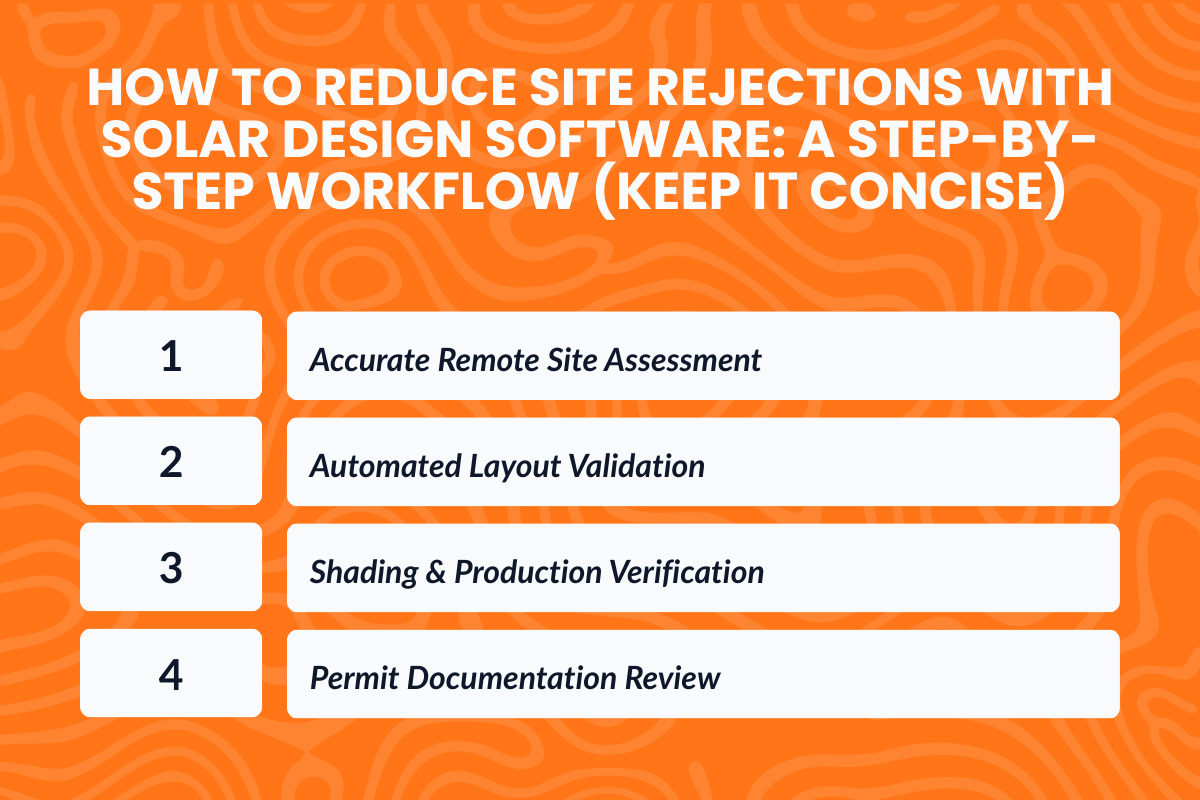
Step 1 – Accurate Remote Site Assessment
Start with a strong site assessment. Use LIDAR + 3D imagery to create a roof model before you ever schedule a visit.
This reduces wasted trips and gives your team a cleaner foundation.
Step 2 – Automated Layout Validation
Once the roof model is built, apply automated code checks. Confirm setbacks, pathways, and spacing requirements.
This step is essential because code compliance errors are the fastest way to get rejected.
Step 3 – Shading & Production Verification
Run shading simulations and energy simulation modeling. Validate solar irradiance, solar radiation patterns, and the impacts of obstructions. This protects your performance projections and keeps your estimated savings realistic.
Step 4 – Permit Documentation Review
Generate the full permit package and review it as an inspector would. Look for missing labels, inconsistent line diagrams, or unclear component specs.
The goal is simple: submit clean, complete documents the first time. That is how you reduce site rejections before they happen.
How Solar Design Accuracy Protects Your Profit Margins?
There’s a reason experienced EPC owners focus heavily on accuracy and it’s not just about direct expenses, but also the lost time and missed opportunities that could have gone into new installs, sales, or improving customer experience.
When a single project goes wrong, the impact spreads across multiple areas, slowing down operations and affecting overall efficiency.
What seems like a minor mistake early on can quickly turn into a chain reaction of delays and additional effort.
Cost of One Failed Inspection
Here is what a single failed inspection can realistically trigger:
| Cost Factor | Estimated Impact |
|---|---|
| Extra truck roll | $500–$900 |
| Labor rescheduling | $700–$1,200 |
| Client dissatisfaction | Reputation risk |
| Permit re-submission | $300–$600 |
Total Potential Impact: $1,500–$3,000 per error.
And that is just the obvious cost. It does not include the damage to scheduling, the stress on your install team, or the delay in final payment.
When these issues repeat across projects, they start affecting overall business performance. That’s why solar design accuracy is not just a technical detail; it’s a strategy to protect margins and maintain smooth operations.
Better accuracy leads to fewer disruptions, faster execution, and more predictable outcomes.
And when operations run efficiently, profitability naturally improves
Who Benefits Most from High-Accuracy Solar Design Software?
Some companies start seeing the impact almost immediately, especially as project volume increases and small inefficiencies begin to compound.
High-accuracy software is especially valuable for:
- Residential installers scaling beyond 10 installs/month
- Multi-state EPCs dealing with varying AHJ rules
- Design teams are struggling with redesign loops
- Companies facing inspection failure trends
Once you are doing volume, even a small rejection rate becomes expensive. A 10% permit rejection rate might not feel like a disaster until you realize it means dozens of delayed projects per year. That is where software becomes essential.
What are the Common Mistakes That Cause Solar Design Rejections?
Most rejections are not caused by “big mistakes.” They are caused by shortcuts.
Here are some of the most common ones.
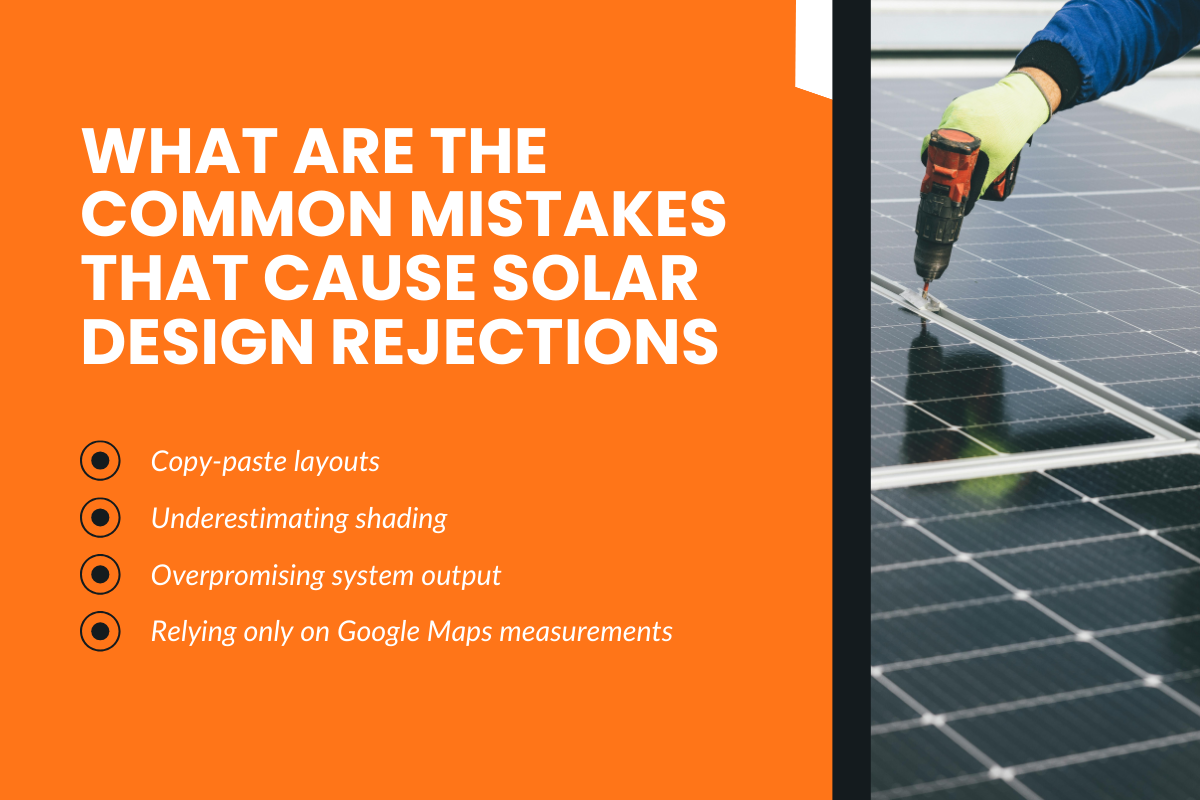
1. Copy-paste layouts
This is extremely common when teams are moving fast. A designer reuses a layout from another project and adjusts it slightly.
But every roof is different. Even small differences in roof planes, ridge locations, or fire pathways can cause a rejection.
2. Underestimating shading
Shading is tricky because it changes with seasons, sun angle, and tree growth. If your analysis does not account for variations in solar irradiance and real solar radiation patterns, your energy modeling will be inaccurate. That impacts system performance and customer trust.
3. Overpromising system output
If your performance estimate is based on ideal assumptions instead of reliable measured data, you risk selling unrealistic production.
When production comes in lower than expected, customers blame your system design, even if the equipment is fine.
4. Relying only on Google Maps measurements
Google Maps is useful, but it is not accurate enough for serious system design. Roof edges, pitch, and obstructions can easily be misread. This is where high-quality data and 3D modeling tools matter. If you are building solar projects at scale, guessing measurements is not a sustainable strategy.
How Sunbase Solar Design Software Improves Solar Design Accuracy for US Installers?

Many design tools focus only on layouts. But real solar operations need something more connected. Sunbase is built around the idea that solar design is not separate from execution; it is part of the same workflow.
Here is how Sunbase supports solar design accuracy in practical ways.
1. Built-In Accuracy Checks Before You Submit
Sunbase helps teams catch issues early by validating system design details before submission. That includes layout consistency, documentation completeness, and compliance alignment. Instead of waiting for the AHJ to reject your package, you can spot errors up front.
2. Design + Proposal + CRM + Execution Alignment
One of the biggest reasons rework happens is that teams are disconnected. Sales promises one system. Design delivers another. Ops schedules installs based on the wrong assumptions. Then the project manager is stuck fixing the mess.
Sunbase helps unify the process by keeping design, customer data, and project execution aligned in one system. This reduces confusion, miscommunication, and costly redesign loops.
3. Permit-Ready Documentation Generation
Sunbase supports faster permitting by helping generate clean permit packages with the right form structure, diagrams, and project details.
That means fewer missing items, fewer corrections, and better reliability in the permit submission workflow. In other words, it reduces the risk of rejection by making the documentation process more consistent.
Final Takeaway: Accuracy Is a Revenue Strategy
Many solar companies treat accuracy as a technical issue. But once you are running real volume, accuracy becomes a business strategy.
Solar design software isn’t just a design tool.
- It’s a compliance shield.
- It’s a profit protector.
- It’s a scale enabler.
When your solar design accuracy improves, your entire process becomes smoother. Your crews install faster. Your energy simulation models become more trustworthy. Your performance metrics look better. Your customers get what they were promised. Your system performance becomes predictable.
And most importantly, you stop bleeding money from preventable mistakes.
The solar industry is growing fast, but it is also becoming stricter. AHJs are tightening enforcement. Homeowners are getting more educated. Competition is rising. If you want to win in the long term, you cannot afford sloppy design work. Accuracy is essential.
Stop Losing Weeks to Rework - See How Sunbase Improves Solar Design Accuracy from Day One
Every rejected permit and failed inspection eats into your margins and slows your installs.
Book a demo of Sunbase and see how tighter design accuracy, built-in compliance checks, and permit-ready documentation can help you pass faster and protect your profit on every project.
FAQs:
What is solar design accuracy?
Solar design accuracy is the ability to create a solar system design that matches real roof measurements, shading conditions, code requirements, and expected energy production with minimal error.
Why do solar permits get rejected?
Solar permits are commonly rejected due to fire setback violations, incomplete documentation, shading miscalculations, incorrect electrical diagrams, or structural load concerns.
How does solar design software reduce rework?
Solar design software reduces rework by using accurate data, automated measurements, shading simulations, and built-in compliance checks that catch errors before permits are submitted or installs begin.
What causes failed solar inspections?
Failed inspections usually result from setback noncompliance, incorrect labeling, conduit sizing issues, inaccurate system design, or missing permit documentation.
How does shading affect solar energy production?
Shading reduces the amount of solar irradiance reaching the panels, lowering energy production and system performance. Accurate shading simulations help predict realistic output and avoid overpromising estimated savings.
One Platform.
Zero Chaos.
Run Your Entire Business in One Platform
Sunbase replaces your CRM, proposals, scheduling, job tracking, and reporting tools — all inside one clean, connected platform.
About Sunbase
The All-In-One Platform to Run Your Entire Business
Sunbase helps you organize operations, streamline daily workflows, and manage everything - from first customer contact to final project deliver- in one connected system.
Our Mission
- Organize your business.
- Optimize your workflow.
- Automate your dailytasks
Why Businesses Choose Sunbase
One Connected Workflow
Replace scattered tools and manual processes with a single platform that brings together your team, tasks, customers, jobs, and performance data.
🌎 Global Presence
Serving the United States, Canada, India, LATAM, Australia, and 10+ international markets.
👥 11,000+ Users
Trusted by contractors, installers, project managers, sales teams, and field technicians.
🏗️ Built for All Sizes
From small contracting teams to fast-growing enterprises, Sunbase adapts to your workflow.
Stop Managing Your Business Manually. Automate It.
Sunbase automates workflows, reduces mistakes, and helps your team get more done - without hiring extra staff or juggling multiple tools.
Still Managing Your Business Across Multiple Tools?
Bring your CRM, proposals, projects, and operations into one platform built for contractors.