
Best Solar Proposal Software UK Installers Can Use
Key Takeaways
- UK-specific modeling, SEG income, battery ROI under the VAT exemption, and MCS-compliant yield calculations are now a baseline requirement, not a differentiator.
- Proposal transparency reduces price objections more than lower pricing does; customers question the how, not just the number.
- Manual quoting (1-2 hours per proposal) creates inconsistency across a team as lead volume grows, not just slower turnaround.
- Platform choice depends on priority: Sunbase and Aurora for speed/precision balance, OpenSolar/Pylon for cost, PV*SOL/Enact/Reonic for engineering depth.
- Battery storage visibility has become part of the credibility test, not an optional add-on, given current VAT treatment.
The best solar proposal software for UK installers in 2026 handles three things generic tools don't: Smart Export Guarantee (SEG) income modeling, battery storage ROI that accounts for the VAT exemption running through 2027, and MCS-compliant energy yield calculations.
UK homeowners have gotten more financially cautious, not less interested; they're comparing 2-4 installers, scrutinizing SEG rates and payback periods, and reading Trustpilot reviews before committing.
In that environment, the proposal itself has become the trust test: a generic PDF with vague yield assumptions raises doubt even when the price is competitive.
This guide compares the leading solar proposal software platforms UK installers actually use, breaks down the UK-specific modeling that separates a defensible investment case from an optimistic estimate, and gives a clear framework for choosing between them based on your priorities, speed, engineering depth, or cost.
Why Proposal Quality Directly Impacts Conversion Rates in the UK
The UK solar market has evolved rapidly over the past two decades. As renewable energy adoption accelerates, competition among installers has intensified. For solar installers, this means proposals are no longer administrative documents but commercial conversion tools.
The proposal has become the stage where trust is either built or lost because, in a competitive solar business environment, homeowners evaluate more than just system size or total costs. They assess credibility, financial logic, and clarity.
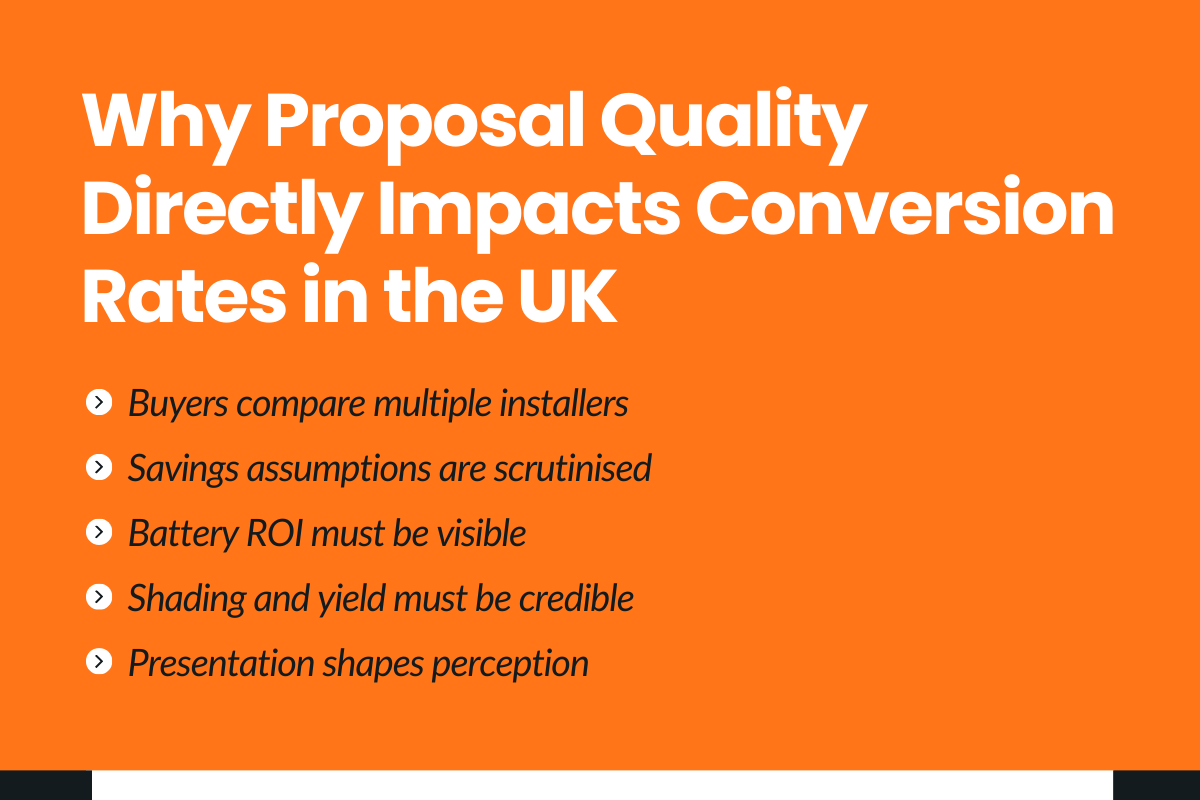
1. The UK Buyer Mindset
UK homeowners approach solar purchases cautiously. Several factors influence this:
- They typically compare 2–4 installers before making a decision
- They question savings projections, particularly payback periods
- They research installer reviews on Trustpilot and Google
- They are highly price-sensitive due to energy bill volatility
As government incentives, VAT exemptions on battery storage, and falling solar panel costs make solar more accessible, buyers are asking sharper questions.
They want to understand:
- How the solar panel layout was designed
- What assumptions drive the financial analysis
- How battery storage affects ROI
- Whether projections account for realistic energy price changes
If customer proposals lack detail around export income, tariff assumptions, or battery performance, it raises doubt, even if your pricing is competitive.
2. Where Installers Lose Trust in the Sales Process
Common issues at the proposal stage include overestimated energy yield assumptions, unclear system designs without shading transparency, and generic PDFs that fail to reflect engineering accuracy.
Manual financial calculations can also create inconsistencies, especially when modelling storage or long-term system performance.
When a proposal feels templated, customers assume the underlying solar project may be equally standardized.
However, in contrast, structured proposal software allows installers to present conservative solar energy projections, transparent financial analysis, and clear system designs that reflect site-specific engineering.
The result is not necessarily a lower price, but a stronger perception of professionalism and control, and in a competitive solar business, perception influences conversion.
Case Insight
A regional UK installer improved close rates by presenting structured proposals that clearly separated:
- Self-consumption savings
- Smart Export Guarantee income
- Battery storage contribution
- Long-term system performance
The price did not change, but the presentation did.
What Is Solar Proposal Software (And Why UK Installers Need It)?
Solar proposal software is a specialized platform that enables installers to design, model, and present solar systems with integrated financial analysis in a single workflow.
Unlike basic quoting tools, modern proposal software combines solar design software, performance modeling, and commercial documentation into one platform. It supports the full design process from project design and system sizing to branded customer proposals.
For UK solar installers, this matters because proposal accuracy now directly influences trust.
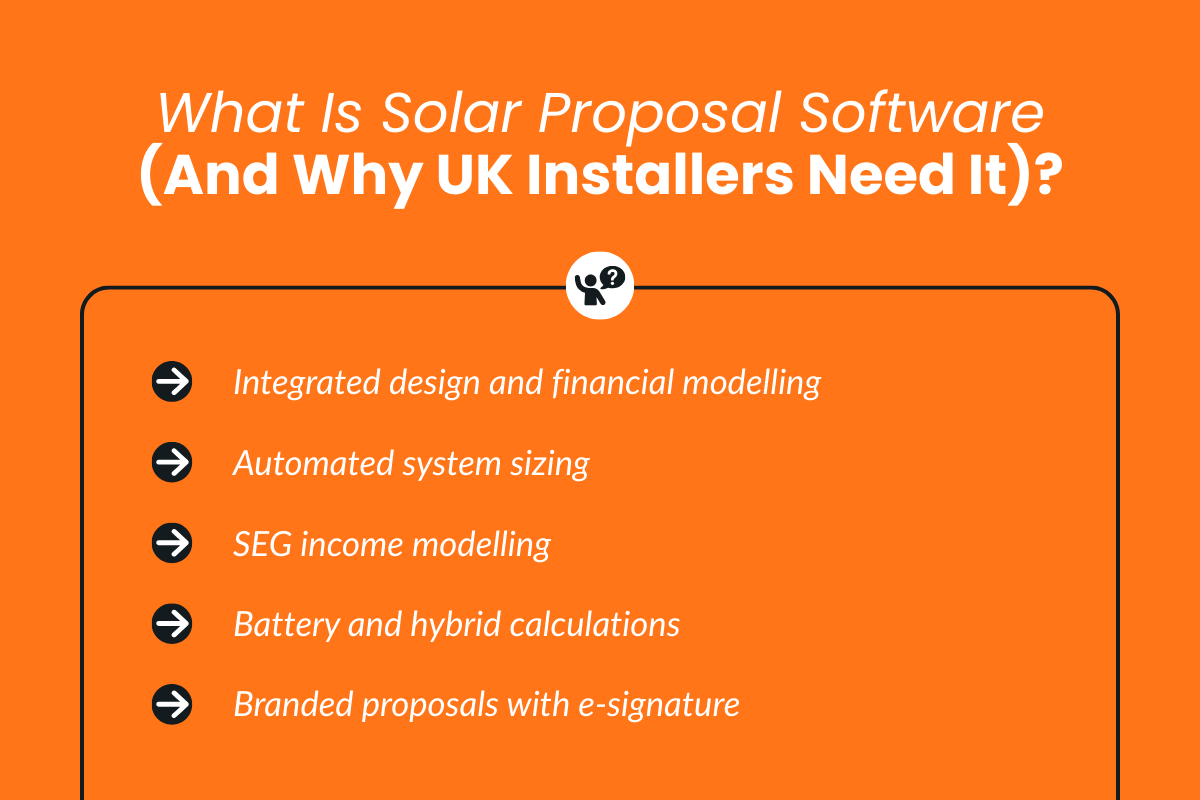
A robust solar proposal software UK solution typically includes:
- Automated system sizing based on roof layout and usage data
- Integrated solar savings projection tool with UK tariff assumptions
- Battery storage and hybrid modeling
- Detailed financial analysis, including ROI and long-term savings
- Instant, branded PDF proposals with e-signature capability
Advanced tools also support:
- 3D roof modeling with UK shading analysis
- MCS-compliant energy yield calculations
- High-resolution irradiation data
- Interactive customer proposals where homeowners can explore storage or EV options
By combining automated design with financial modeling, installers reduce design time while improving efficiency across the sales process.
For a deeper look into mastering site analysis, PV layouts, system sizing, compliance, and proposal generation, check out the complete step-by-step guide to
creating a solar design.
The result is faster proposal turnaround, clearer documentation, and stronger customer confidence.
Why Generic Quoting Tools Fall Short
Basic quoting systems were built for simple price estimation, not for today’s competitive UK solar market.
They often lack:
- UK tariff alignment and Smart Export Guarantee modeling
- Accurate solar ROI calculator assumptions tailored to local conditions
- Conservative energy yield calculations based on UK weather data
- Transparent breakdown of battery storage performance
Without integrated solar design software and engineering-grade modeling, proposals rely heavily on manual inputs. That increases the risk of inconsistencies across projects and exposes the solar business to avoidable objections.
In a market where homeowners compare multiple installers, inaccurate projections do more than weaken credibility; they delay decisions, and in a high-volume solar business, delayed decisions reduce conversion efficiency.
What are the Must-Have Features in Solar Proposal Software in the UK?
With residential and commercial solar projects reaching record installation levels, proposals must reflect both engineering credibility and financial realism.
But not all proposal software is built for this level of maturity. The strongest platforms combine solar design software, financial modelling, compliance automation, and customer-facing documentation into a single platform.
Here’s what genuinely matters for solar professionals in the UK:
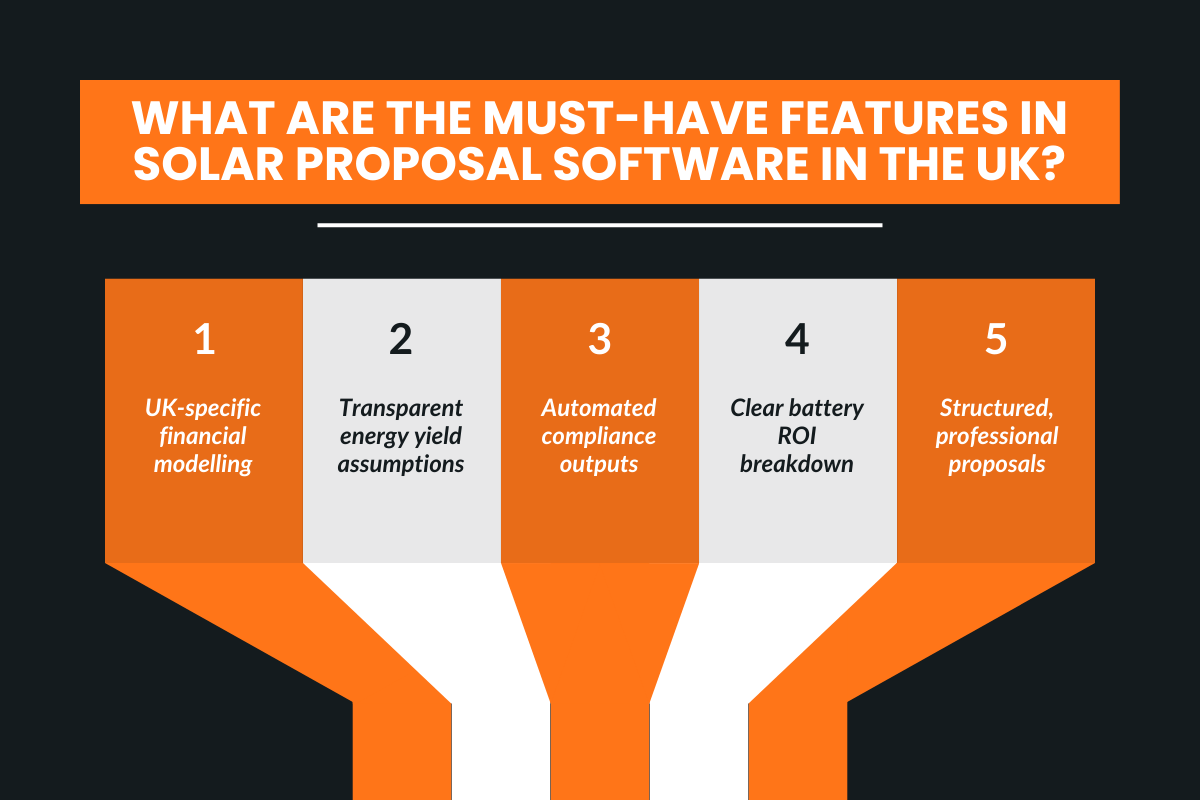
1. Accurate UK-Specific Financial Modelling
Solar proposal software should support detailed financial analysis aligned with UK tariff structures. That includes Smart Export Guarantee (SEG) income modelling, energy price inflation assumptions, battery storage savings projections, and realistic payback calculations.
Given the temporary VAT exemption on domestic battery energy storage systems through 2027, storage modelling has become even more important in residential solar designs.
Customers increasingly expect to see battery ROI presented clearly within long-term projections and without UK-aligned modelling, proposals risk becoming generic estimates rather than defensible investment cases.
2. Transparent Energy Yield and System Design Accuracy
Strong solar designs begin with accurate modeling. Platforms that automate obstacle detection and identify chimney heights, roof pitch, and azimuth angles significantly reduce design time while improving engineering accuracy.
When solar system performance assumptions are transparent, customers can make informed decisions, but when they are unclear, doubt slows the sales process.
3. Integrated Compliance and Documentation Automation
As the industry grows, compliance requirements remain strict. Cutting-edge software should automate documentation, such as DNO application forms and MCS certification outputs, directly within the proposal workflow. This reduces manual errors across projects and improves internal efficiency.
Installers managing multiple solar projects benefit from having proposal generation, system designs, and compliance documentation aligned within one platform. This integration improves consistency across the team and supports scalable solar development.
4. Professional Customer Proposals That Reflect Engineering Depth
The proposal software should translate technical solar designs into clear, structured documentation. This means showing panel placement, system configuration, storage integration, and projected energy output in a way that is easy to follow but grounded in engineering logic.
The proposal should also clearly separate system costs, projected savings, export income, and battery contribution over time.
When financial analysis and system designs are presented together, the document reads as a cohesive investment case rather than a sales brochure.
Modern platforms generate instant, editable PDF proposals with e-signature capability, ensuring consistency across projects and reducing back-and-forth during the sales stage. More importantly, they standardise how a team communicates complex solar development decisions to customers.
In a competitive solar business, presentation influences perception as much as engineering accuracy.
Before vs After: Manual Quotes vs Software-Generated Proposals
| Area | Manual Proposal Process | Proposal Software Workflow |
|---|---|---|
| Design Process | Solar designs that are built separately from pricing models | Integrated solar design software with automated design |
| Financial Modelling | Manual ROI calculations in spreadsheets | UK-aligned financial analysis with SEG and storage modelling |
| Design Time | 1–2 hours per proposal | Minutes with pre-configured system designs |
| Consistency Across Projects | Varies by rep | Standardised across the team |
| Documentation | Generic PDFs assembled manually | Instant, branded proposals with structured outputs |
| Efficiency | Fragmented across other tools | Centralised on one platform |
That contrast usually looks familiar to teams still quoting manually; the inconsistency isn't a training problem; it's a process one.
What Are the Limitations of Manual Solar Quotes?
Manual solar quotes rely on spreadsheets, standalone solar design software, and manually assembled documentation. While workable for small volumes, this approach introduces operational friction as the number of projects increases.
The most common limitations include:
- Financial modelling that is calculated separately from system designs
- Inconsistent battery storage assumptions across proposals
- Repetitive formatting and documentation work
- Longer design time per project
- Increased risk of outdated tariff inputs
Because the design process and financial analysis are separate, errors can appear between solar designs and projected savings.
Manual quoting may offer flexibility, but it reduces efficiency as teams grow.
In a competitive renewable energy market, delays and inconsistencies often translate into lower close rates.
Why Are Software-Generated Solar Proposals Better for UK Installers?
Software-generated proposals centralise solar design software, financial modelling, and documentation into one platform. This integration improves consistency, reduces manual error, and accelerates the sales process.
For UK installers, the advantages are structural:
- System designs and financial analysis are generated from the same data model
- Smart Export Guarantee (SEG) modelling is aligned with current UK tariffs
- Automated design reduces repetitive inputs and saves time
- Instant, branded proposals improve professionalism
- Documentation and compliance outputs are standardised
There are onboarding considerations, including training and process adjustment. However, once implemented, proposal software supports scalable solar development and improves consistency across residential and commercial projects.
Comparing the Top 7 Solar Proposal Software Options for UK Installers
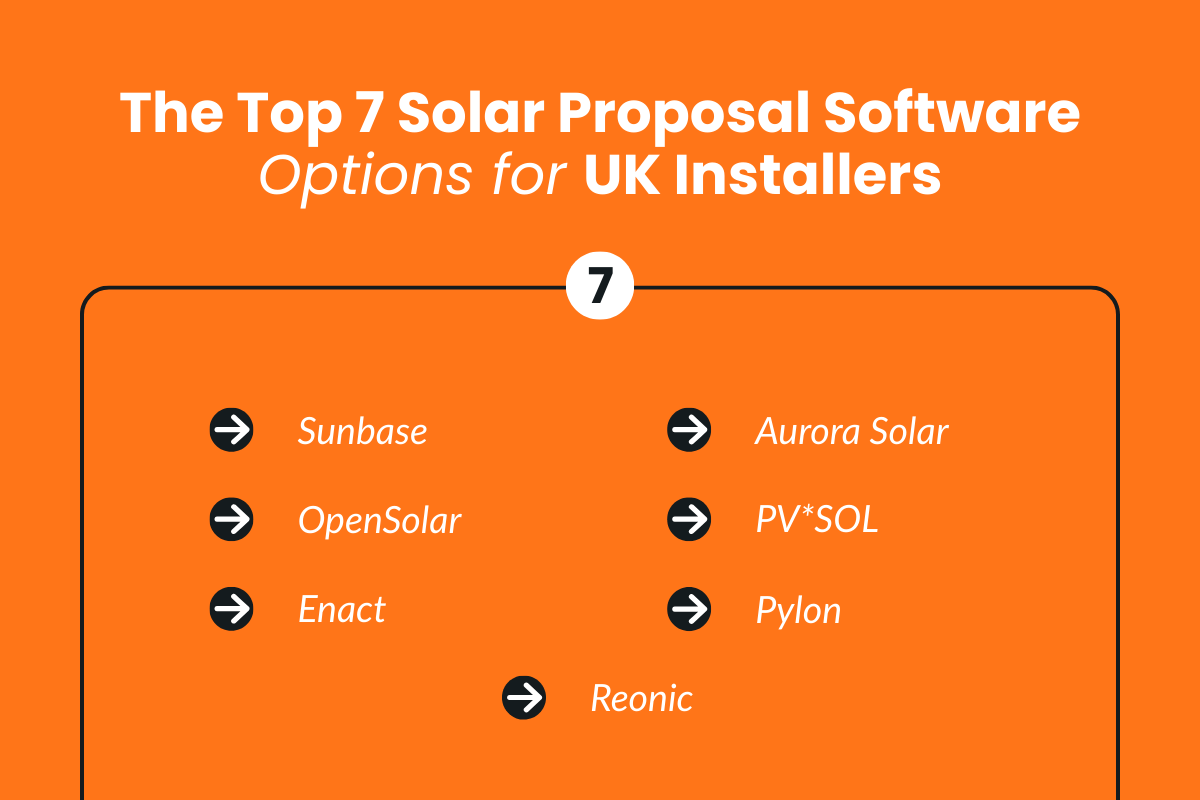
UK installers evaluating solar proposal software typically compare platforms based on financial modeling accuracy, 3D solar designs, workflow efficiency, and pricing structure.
Below is a structured overview of leading tools used across residential and commercial solar projects.
1. What Is Sunbase Solar Software Best For?
Best for: UK installers seeking speed with UK-configured financial modeling.
Sunbase is a proposal software platform designed to integrate solar designs, financial analysis, and documentation into one workflow. It focuses on reducing design time while maintaining UK tariff alignment.
Key Features
- UK-specific financial modeling, including Smart Export Guarantee (SEG) integration: Automatically calculates savings, export income, and payback based on UK tariffs like SEG.
- Structured solar designs with integrated shading: Creates system layouts while factoring in shading and real roof conditions.
- Fast proposal generation for residential projects: Converts system designs into complete proposals within minutes.
- CRM and workflow integration: Connects customer data, project stages, and team communication in one system.
- Instant branded customer proposals: Generates professional proposals with company branding and system details instantly.
Considerations
Sunbase is positioned for installers prioritizing structured processes and scalable proposal workflows. Teams transitioning from manual quoting may require short onboarding and training to align processes.
Pricing: Starts at $59/user/month
2. What Is Aurora Solar Known For?
Best for: Installers requiring advanced 3D modeling and high-precision solar designs.
Aurora Solar is widely recognized as a market leader for complex commercial project design. It uses LiDAR data to deliver highly accurate shading simulation and engineering-grade system designs.
Key Features
- Industry-leading 3D roof modeling: Creates highly detailed 3D models of rooftops using advanced design tools
- Precise shading analysis (up to 95% accuracy using LiDAR): Uses LiDAR data to simulate shading with very high accuracy across different times of the year.
- Automated financial reports: Generate detailed financial breakdowns, including savings, ROI, and payback periods, automatically.
- High-resolution irradiation modeling: Analyzes how sunlight interacts with the roof throughout the year using detailed solar data.
Considerations
Aurora’s depth comes with a steeper learning curve. For smaller teams focused on rapid proposal turnaround, workflow speed may feel slower compared to lighter platforms.
Pricing: Basic: $159/user/month; Premium: $259/user/month (monthly); 15% off annual; Enterprise: custom; add-ons from $9.99/project
Compare
Aurora Solar and Sunbase Software
side-by-side.
3. What Is OpenSolar Best For?
Best for: Cost-conscious installers seeking free access to solar design software.
OpenSolar provides solar designs and proposal generation tools at no upfront cost. It offers class-leading solar design accuracy and integrated customer proposals.
Key Features
- Free solar design software access: Provides full access to solar design and proposal tools without upfront software costs.
- Automated mounting configuration: Automatically suggests mounting systems based on roof type and layout.
- End-to-end tools for managing a solar business: Covers design, proposals, sales, and project tracking within a single platform.
- Integration: Connects directly with Segen to access real-time product availability and pricing.
Considerations
While strong on design and accessibility, UK-specific financial modeling depth may require closer validation, particularly for detailed storage ROI calculations.
Pricing: Free core platform; fees for API access and app connectors
4. Is PV*SOL Suitable for Engineering-Focused Installers?
Best for: Detailed performance simulations and technical modeling.
PV*SOL is widely used for in-depth solar energy simulations, including battery storage and EV charging integration. It is particularly strong for engineering-heavy solar projects.
Key Features
- Advanced energy simulation: Simulates system performance using detailed environmental and technical data.
- Detailed battery storage modeling: Models battery behavior, storage efficiency, and energy usage scenarios. This is useful for projects involving storage and EV integration
- Strong engineering outputs: Provides technical reports and system calculations for in-depth analysis.
- Accurate performance forecasting: Forecasts energy generation based on real-world conditions and inputs.
Considerations
PV*SOL is less focused on fast, sales-ready customer proposals. Installers prioritizing speed and streamlined sales workflows may find it more technical than necessary.
Pricing: Custom quotes via sales, no public rates listed.
5. What Does Enact Offer UK Installers?
Best for: Installers looking for an all-in-one cloud platform across the sales and installation process.
Enact for Installers is positioned as an integrated platform supporting system designs, proposal generation, and project management.
Key Features
- Automated roof analysis: Detects roof pitch, height, and azimuth automatically during design. This reduces manual input and speeds up system creation.
- Shade detection: Identifies shading issues early in the design process.
- Metric and imperial measurement flexibility: Supports both measurement systems based on user preference.
- Streamlined installation workflow: Connects design outputs directly with installation processes.
Considerations
While comprehensive, installers focused primarily on advanced financial modeling may compare its modeling depth against more engineering-heavy tools.
Pricing: Custom quotes via sales, no public rates listed.
6. Who Should Consider Pylon?
Best for: Installers seeking basic proposal generation with minimal complexity.
Pylon focuses on simplifying proposal creation for smaller teams or early-stage solar businesses.
Key Features
- Simple interface: Offers an easy-to-use platform with a minimal learning curve.
- Fast quoting functionality: Generates basic solar quotes within minutes, which helps speed up early-stage customer interactions.
- Accessible workflow: Keeps the process simple from design to proposal. This is ideal for teams that do not need advanced features.
Considerations
Performance transparency and advanced solar designs may be limited compared to larger platforms.
Pricing: Standard: £4/project; Pro: £10/project
7. What Is Reonic Designed For?
Best for: Installers exploring advanced energy scenario analytics.
Reonic focuses on modeling complex energy scenarios and evaluating long-term performance across multiple system configurations.
Key Features
- Energy scenario analysis: Evaluates different energy setups and usage scenarios.
- Advanced modeling tools: Provides tools to simulate system behavior under various conditions.
- Comparative system evaluation: Compares multiple system designs side by side.
Considerations
The platform may require a moderate learning curve and is often better suited to teams comfortable with analytical tools.
Pricing: Custom quotes via sales, no public rates listed.
How Should UK Installers Choose Between These Platforms?
When comparing solar proposal software UK options, installers should evaluate:
- Financial modeling accuracy aligned with UK tariffs
- 3D solar design precision
- Storage modeling capabilities
- Integration with CRM or other tools
- Workflow efficiency and team scalability
The best platform depends on whether the priority is engineering depth, speed, cost control, or structured proposal consistency.
Quick Feature Comparison: Top 7 Solar Proposal Tools in the UK
| Platform | Proposal Accuracy | Speed | Shading | Ease of Use |
|---|---|---|---|---|
| Sunbase | High (UK config) | Fast | Integrated | Easy |
| Aurora | Very High | Moderate | Best-in-class | Intermediate |
| OpenSolar | Basic–Moderate | Fast | Standard | Easy |
| PV*SOL | High | Moderate | Strong | Moderate |
| Enact | Basic–Moderate | Fast | Limited | Easy |
| Pylon | Basic | Fast | Limited | Very Easy |
| Reonic | High | Moderate | Advanced | Moderate |
How Proposal Transparency Reduces Price Objections?
In the UK solar market, most price objections are not about the number itself. They arise when customers do not fully understand how that number was calculated.
When savings projections, storage assumptions, or system performance feel unclear, hesitation increases. Transparent proposals reduce that hesitation by replacing estimates with structured, defensible financial analysis.
How Does a Clear Savings Breakdown Reduce Price Objections?
Price objections decrease when the cost is separated from the value it creates.
A proposal that simply presents a “£18,000 solar system” frames the conversation around expense. A proposal that breaks that figure into annual bill reduction, Smart Export Guarantee income, projected payback timeline, and 20-year net savings reframes the conversation around return.
In the UK, where homeowners increasingly scrutinise export tariffs and long-term energy price trends, this breakdown matters.
When financial analysis clearly separates self-consumption savings from export income and storage contribution, customers can see how the solar system performs over time rather than judging it purely on upfront costs.
Clarity shifts the conversation from “Is this expensive?” to “Does this make financial sense?”
Why Is Battery ROI Visibility Critical in the UK?
Battery storage has moved from an optional upgrade to a strategic component, particularly following VAT exemptions for domestic storage systems through 2027.
Buyers now expect to understand how storage affects day-versus-night consumption, how it reduces grid reliance, and how it protects against future tariff changes. If storage modelling is simplified or vaguely described, customers often delay decisions.
When proposal software models battery behaviour transparently, showing realistic charge and discharge patterns alongside projected savings, hesitation decreases.
In residential solar projects, battery ROI visibility has become part of the credibility test.
What Visual Elements Strengthen Trust in Solar Proposals?
Financial clarity alone is not always sufficient. Visual confirmation reinforces trust.
Energy production charts help customers see how their solar panel system will generate electricity across seasons. Roof layout diagrams demonstrate that the system design is site-specific rather than generic. Installation timelines provide operational context.
When solar designs, performance projections, and documentation are aligned visually, the proposal communicates engineering depth and organizational maturity.
As competition among installers increases, that perception reduces perceived risk.
Case Insight
A Manchester-based installer reported reducing price objections by approximately 30 percent after restructuring proposals to include detailed annual savings projections, transparent battery storage modelling, and conservative long-term assumptions. The system cost remained similar.
Who Should Invest in Solar Proposal Software Now?
Solar proposal software becomes strategically important when proposal complexity, lead volume, or operational scale increases. It shifts from being a convenience tool to a control system for managing projects, pricing accuracy, and documentation consistency.
The following business profiles typically see a measurable impact from adopting structured proposal software.
1. Installers Generating 60+ Leads per Month
At higher lead volumes, manual quoting increases design time and creates inconsistencies across solar projects.
Automated design, integrated financial analysis, and standardized customer proposals reduce turnaround time while maintaining accuracy. Faster delivery supports sales momentum and improves close rates in competitive regional markets.
2. Teams Struggling With Price Objections
Frequent objections often indicate unclear savings projections or inconsistent battery storage modeling rather than pricing alone.
Proposal software that aligns solar designs with transparent financial analysis, SEG income modeling, and long-term savings projections reduces hesitation. When projections are structured and conservative, customers evaluate return instead of questioning assumptions.
3. Growing EPCs Expanding Regionally
As EPCs expand across regions, maintaining consistency across system designs, tariff assumptions, and compliance documentation becomes more complex.
Centralizing solar design software, proposal generation, project management, and documentation within one platform reduces variation across teams. This improves operational efficiency and supports scalable solar development.
4. Businesses Prioritizing Brand and Process Consistency
Professional, structured customer proposals strengthen perceived engineering depth and organizational maturity.
When solar designs, performance modeling, and financial outputs follow a consistent framework, the business presents itself as controlled and reliable. In competitive residential and commercial solar markets, that consistency influences final decisions.
Final Takeaway
In the UK market, the best solar proposal software isn't the one with the most features; it's the one whose financial modeling actually reflects SEG rates, VAT-exempt battery economics, and MCS compliance without manual adjustment.
Proposal software is no longer an administrative layer in the sales process. It is a system that standardizes financial analysis, strengthens trust, and supports scalable solar development.
Engineering-heavy platforms like Aurora or PV*SOL suit teams prioritizing design precision over speed; free or low-cost tools suit early-stage installers with lower volume.
Sunbase is built for the installer in between, needing UK-configured accuracy and fast turnaround without a separate CRM and design tool bolted on, running proposal generation on the same platform as lead tracking and system design.
See how effortless proposal creation can be when everything is automated for you. Hop into Sunbase solar proposal software and take a look behind the scenes.
FAQs
1. Which is the best solar proposal software UK installers can use?
The best option depends on business size and needs, but installers typically choose platforms that offer UK-specific financial modelling, accurate savings projections, and fast proposal generation.
2. How accurate are solar proposal savings calculations?
Accuracy depends on the assumptions used. Tools that integrate SEG rates, conservative energy yield modelling, and realistic inflation projections provide the most reliable estimates.
3. Does solar proposal software integrate with CRM systems?
Many modern platforms integrate with CRM systems to streamline lead tracking, follow-up, and proposal management.
4. How much does solar proposal software cost in the UK?
Pricing varies widely depending on features, modelling depth, and user seats. Costs typically range from entry-level plans to enterprise subscriptions.
5. Do UK solar proposals need to be MCS compliant?
Yes. For residential installations in the UK, proposals and energy yield calculations must align with MCS standards to ensure compliance and eligibility for export payments. Solar proposal software that supports MCS-compliant modelling helps installers avoid documentation errors and protects long-term credibility.
6. Can solar proposal software model battery storage savings accurately?
Yes, if the platform includes UK-specific tariff assumptions and realistic charge-discharge modelling. Accurate battery storage projections should separate self-consumption savings, export income impacts, and long-term degradation to provide a defensible ROI estimate.
7. Is free solar design software enough for UK installers?
Free tools can be sufficient for early-stage installers with low project volume. However, as lead volume increases, integrated proposal software improves consistency, reduces design time, and standardises financial analysis across projects.
One Platform.
Zero Chaos.
Run Your Entire Business in One Platform
Sunbase replaces your CRM, proposals, scheduling, job tracking, and reporting tools — all inside one clean, connected platform.
About Sunbase
The All-In-One Platform to Run Your Entire Business
Sunbase helps you organize operations, streamline daily workflows, and manage everything - from first customer contact to final project deliver- in one connected system.
Our Mission
- Organize your business.
- Optimize your workflow.
- Automate your dailytasks
Why Businesses Choose Sunbase
One Connected Workflow
Replace scattered tools and manual processes with a single platform that brings together your team, tasks, customers, jobs, and performance data.
🌎 Global Presence
Serving the United States, Canada, India, LATAM, Australia, and 10+ international markets.
👥 11,000+ Users
Trusted by contractors, installers, project managers, sales teams, and field technicians.
🏗️ Built for All Sizes
From small contracting teams to fast-growing enterprises, Sunbase adapts to your workflow.
Stop Managing Your Business Manually. Automate It.
Sunbase automates workflows, reduces mistakes, and helps your team get more done - without hiring extra staff or juggling multiple tools.
Still Managing Your Business Across Multiple Tools?
Bring your CRM, proposals, projects, and operations into one platform built for contractors.