
Most Solar Software can help design solar panels with 3D models and accurate shading analysis.
But if you have to operate in the Indian Region and the digital tool fails to submit accurate technical layouts aligned to state-specific subsidy structures, DISCOM forms, and net-metering electrical requirements, it is the wrong choice!
The Indian solar market is growing rapidly, and the launch of the PM Surya Ghar initiative in 2024–25, with a substantial budget allocation for rooftop solar plants, is expected to accelerate growth.
You need to make the right choice in specialized solar software that helps you scale at the pace of the growing industry without breaking your bank or operations.
Best Solar Software For Indian EPC in 2026: CRM, Design, Sales, and Operations
Handling a solar business in the Indian ecosystem comes with its own set of complexities. Success in the solar EPC space is not just about designing panels, generating proposals, or executing installations. An EPC can run smoothly if it complies with every regulatory and procedural requirement.
Solutions with built-in Indian compliance checklists and workflows aligned to local architectural and policy requirements should be your first choice.
In this blog, we will walk you through the top four solar software options that are best aligned with the needs of the Indian solar industry.
Key Takeaways
- Solar EPC companies are gaining rapid growth, but outdated tools that cannot keep up with the local ecosystem fail to deliver results.
- Indian EPC companies can benefit from software that aligns with local regulations and compliance requirements for subsidies and the electric grid.
- Modern EPC Solar Software must have built-in CRM, accurate energy design, faster proposal generation, and financial analysis aligned with local permits and regulations to deliver efficient outputs.
- The top solar software used by Indian EPCs includes Sunbase, Solar Ladder, and ARKA 360.
How a Typical Indian EPC Workflow Actually Looks?
Let us understand the four main stages that every Solar EPC company operating in the Indian Region must follow for project completion. It usually takes 2 to 3 months to complete the multi-stage operational process.
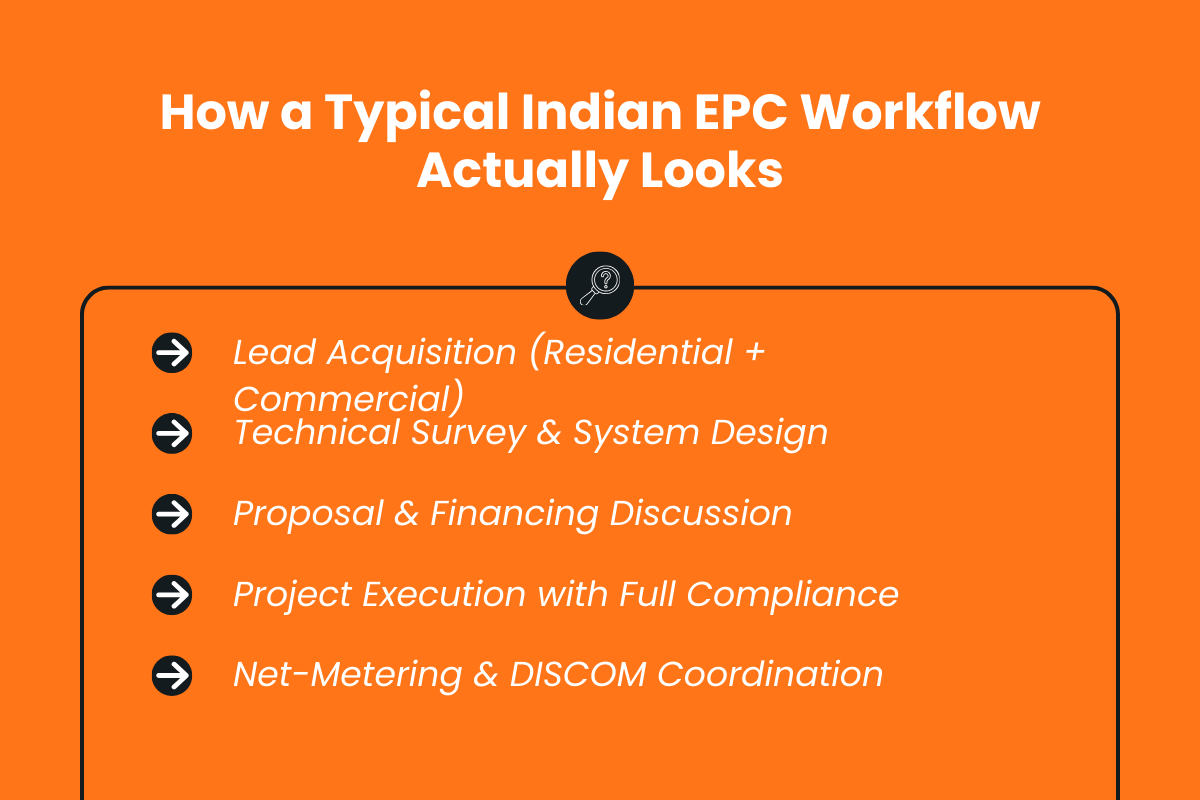
Stage 1 – Lead Acquisition (Residential + Commercial)
The first stage involves capturing leads for residential and commercial projects from multiple channels, such as website forms, phone calls, WhatsApp messages, or social media direct messages.
The sales team then connects with prospects to set up a visit and personalized follow-ups to book the sales deal.
Stage 2 – Technical Survey & System Design
The technical team evaluates rooftops for solar projects to assess roof space, conduct shadow analysis, assess structural integrity, and evaluate electrical infrastructure to ensure an efficient PV system aligned with Indian permits and compliance requirements.
Stage 3 – Proposal & Financing Discussion
EPC contractors submit bids based on real-time material and labour pricing with detailed technical specifications and project schedules. The financial details showcase subsidy structures as per different state rules.
It also shows customers the varied rooftop loan options, with interest rates ranging from 9.5% to 10.5% for commercial projects and 7% to 15% for residential projects, along with different payback periods from leading providers such as SBI, NBFCs, and government subsidies.
Stage 4 – Project Execution with Full Compliance
Once customer approval is obtained, the project enters execution in accordance with Indian Solar EPC practices. The material is dispatched from the warehouse or suppliers to sites based on approval of the Bill of Materials.
Stage 5- Net-Metering & DISCOM Coordination
Indian activities are initiated for mounting, earthing, and electrical grid work, aligned to Indian safety conditions as per the Ministry of New and Renewable Energy and the local DISCOM.
The technical team coordinates with the local DISCOM for net-metering approvals by filing forms and inspection reports to obtain government incentives and approval.
After the inspection and approval are completed, the completion is submitted to customers with warranty and maintenance guidelines.
Built To Solve Indian Solar Challenges
Design accuracy alone isn’t enough when approvals, subsidies, and compliance drive your entire project timeline.
You need software that connects design, finance, and execution with real Indian requirements. See how you can run faster, cleaner, and more predictable projects with
solar software
designed for Indian problems.
What does a Complete Solar Software actually look like for Indian Workflows?
A complete solar software that would be ideal for the Indian ecosystem must fulfill the basic checklist:
- Unified Platform: A single, integrated platform with a mobile app that supports both iOS and Android devices.
- Intuitive Interface: Easy-to-use design that is smooth to operate for non-tech-savvy users.
- AI-Powered 3D Solar Design: Advanced 3D solar design models for accurate layouts and planning.
- Pre-Construction Quality Checks: Built-in checks aligned with BOM requirements and electrical grid metering standards.
- DISCOM Compliance: Safety and feasibility checks aligned with DISCOM regulations.
- State-Wise Subsidy Validation: Automated financial checks based on state-specific subsidy rules.
- Automated Lead Generation: Capture and generate leads across multiple digital and offline channels.
- Material Inspection Approvals: Inspection and approval workflows aligned with ITP and QAP standards.
The checklist ensures maximum efficiency and zero interruptions in your solar business.
The 4 Pillars of Modern EPC Solar Software
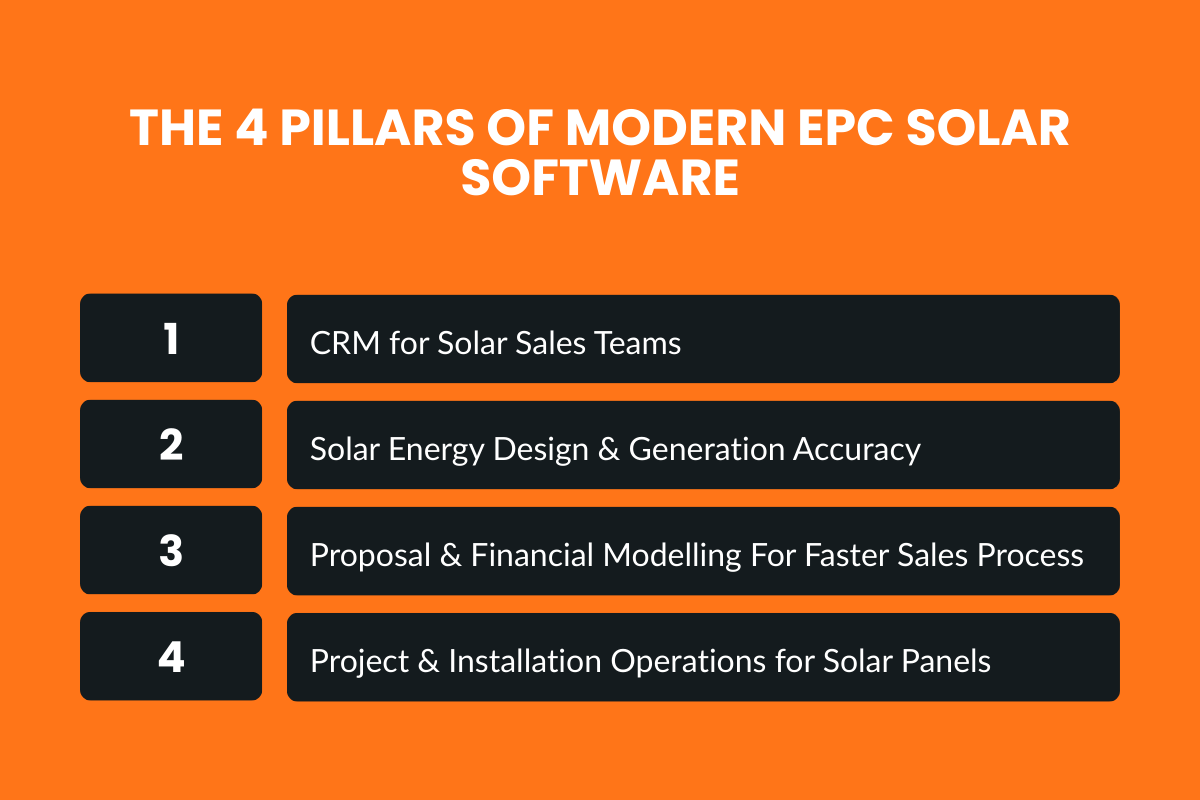
Let us explore the four main pillars of an ideal solar workflow digital tool to bring success to every project:
1. CRM for Solar Sales Teams
Solar software simplifies customer relationship management and boosts sales performance in the solar industry.
It enables real-time sales tracking, smooth design-to-proposal workflows, and optimized lead management to maximize conversions. Captures leads from multiple sources like Facebook, websites, and dealer networks while keeping everything organized in one place.
Integrated WhatsApp, email, and phone communication ensures seamless collaboration across the entire team.
2. Solar Energy Design & Generation Accuracy
Advanced solar design software creates accurate 3D models and detailed shading analysis to determine optimal panel placement.
It uses satellite imagery to estimate annual energy generation and combines local weather data to clearly show system efficiency, cost savings, and measurable ROI. The software also automates structural load calculations to ensure compliance with local regulations.
3. Proposal & Financial Modeling For Faster Sales Process
The software delivers customized, branded, and visually detailed proposals that clearly present the total cost after applying local, state-specific subsidies.
It also includes EMI options with interest rate details from leading Indian banks and payback period calculations, helping customers understand the financial benefits of each and quicken decision-making.
4. Project & Installation Operations for Solar Panels
The project management software automates site survey reporting by capturing property details, structural measurements, and electrical assessments in a clear, standardized format.
It helps determine material requirements and supports net-metering applications to initiate the installation process.
The system also automatically generates optimised inventory orders based on project needs and provides live status updates to clients and team members throughout the project lifecycle.
Why Solar Installers Switch to Solar Software Over Manual Processes?
| Stage | Manual Process | With Solar Software |
|---|---|---|
| Lead capture | Handwritten notes, WhatsApp messages, and Excel Sheet records. | Centralised Customer Relationship Management. |
| Design | Separate tools for 3D modelling. panel layout, shading analysis, and financial ROI. | Integrated tool for all design aspects. |
| Proposal | Manually create proposal templates using PowerPoint or graphic design tools. | Auto-generated using the tool that captures data from satellite imagery. |
| Ops tracking | Phone calls or WhatsApp updates | An in-built communication tool for quick updates on the app |
Top Solar Software Options for Indian EPCs (2026)
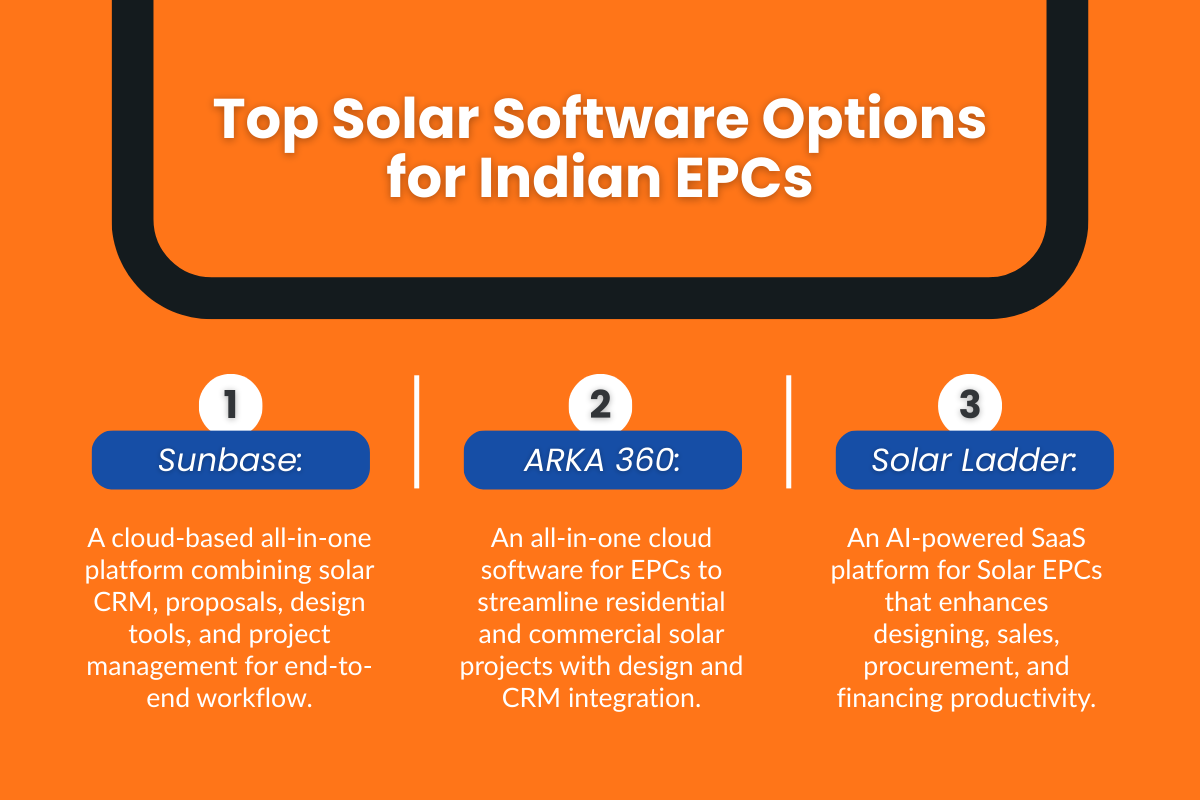
1. Sunbase Solar Software
About:
Sunbase is an all-in-one cloud-based platform that integrates solar CRM, proposals, design tools, and project management for a seamless workflow from first lead capture to complete solar installation.
Pros:
- Unified All-in-One Platform: A single solution that includes built-in CRM, project management, solar design tools, proposal generation, and financial reporting.
- India-Aligned Solar Design: It offers solar design tools tailored to Indian market requirements, factoring in subsidies, DISCOM approvals, and net-metering documentation, and automatically generating solar system layouts that comply with regulatory requirements.
- Highly Intuitive User Interface for Desktop and Mobile App: A highly intuitive user interface that makes the platform easy to use for team members, even without IT expertise, with a minimal learning curve and a mobile-first workflow
- Flexible API Configuration: API configuration makes it easier to add more users and manage additional projects with ease, without hidden complexity.
- Transparent Upfront Pricing: Upfront pricing based on subscription plans, with no hidden costs or add-on charges for additional features or users
Cons:
- Suitable Only for Small Enterprises: The platform is primarily suitable for small to mid-size enterprises, as it lacks many advanced features required for very large commercial or utility-scale projects.
- Complex Initial Setup: The setup and configuration can be complex, often requiring vendor support to make the system ready for operational use.
Review: "Sunbase offers a comprehensive range of features and functionalities that cover all aspects of our business operations. From sales and training to HR, operations, automation, customer portal, inventory management, and even financial tools, SunBase has it all." (Source: Trustindex)
2. ARKA 360
About:
It is an all-in-one cloud-based software platform designed for solar professionals in EPC to streamline residential and commercial solar projects for detailed solar designing and CRM integration.
Pros:
- Friendly User-Interface: The software has a very friendly user interface that makes it easy to use for carrying out multiple tasks without IT expertise.
- Advanced AI-Powered Solar Design Software: It delivers detailed 3D models, advanced shading analysis, and performance simulations of solar systems, enabling accurate energy production estimates, precise designs, and reliable measurements.
Cons:
- Steep Learning Curve: Users find it challenging to use the software with a complex interface, and it can be time-consuming to undertake training for smoother onboarding.
Review: "CRM, property listings, inventory, site visits, follow‑ups, and marketing tools are integrated, so you don’t have to juggle multiple apps" (Source: G2.com)
3. Solar Ladder
About:
It is an AI-enabled AI SaaS platform built for Solar EPC, designed for solar installers for designing, sales, procurement, and financing to boost productivity.
Pros:
- Customisation Features for Proposals: It enables the creation of stunning, fully branded, high-quality proposals in minutes, without the need for manual edits.
- 3D Design Modules: It includes built-in, solar-specific 3D roof design features that ensure high precision and greater accuracy in proposals.
- Centralised System: It offers real-time synchronisation for lead tracking, payments, and project updates, all managed from a single, centralised platform.
- Specialised for Solar Services: It is purpose-built to meet the specific needs of the solar industry workflow, which makes operations more efficient.
Cons:
Complex Interface: It requires more time and training to master the features of the software to optimise the usage of the digital tool.
Higher Subscription Fees: Some users report that the subscription costs can be relatively high, making it less affordable for startups and smaller firms.
Review: "Site surveys, and procurement in one place is just more efficient for an EPC. It’s not perfect, but it beats juggling five different apps that don’t talk to each other". (Source: Reddit.com)
4. OpenSolar
About:
It is a cloud-based digital platform ideal for start-ups and small companies for solar design and sales applications, known for its free plans to streamline workflow with integrated CRM, invoice processing, and lead generation.
Pros:
- Interactive Customer Proposals: Interactive customer proposals with digital e-signatures enable faster sales closure for solar energy projects.
- White-Label Branding: White-label branding allows solar EPC companies to rebrand third-party tool outputs with their own logo and colour scheme, enhancing brand credibility.
- Intuitive User Interface: An intuitive interface requires minimal training time to learn and correctly use the solar software.
- No Cost for usage: It is free and ideal for start-ups and small firms without subscription fees or seat limits.
Cons:
- Not Aligned with Indian Industry Standards: The design tool is validated by a U.S. government agency and does not fully align with Indian solar industry standards and regulatory requirements.
- Heavy Dependence on Google Maps: The platform relies heavily on Google Maps for resolution imagery and 3D modelling when creating designs for remote solar system installations.
Review: "It is a user-friendly program, which, in addition to being sequential, is highly interactive: it is very easy to use" (Source: G2.com)
Before you choose your solar business software, ensure it is fully compatible with your workflow!
Best Solar EPC Software: Quick Comparison To Fit Indian Solar Industry
| Platform | CRM | Design | Proposal | Operations | India-Focused? |
|---|---|---|---|---|---|
| Sunbase Solar Software | ✓ | ✓ | ✓ | ✓ | ✓ |
| ARKA 360 | ✓ | ✓ | ✓ | ✓ | ✓ |
| Solar Ladder | ✓ | ✓ | ✓ | ✓ | ✓ |
| OpenSolar | ✓ | ✓ | ✓ | ❌ | ❌ |
Buying Checklist for Indian EPCs: Six- Step Buying Framework
Let us explore the six-step checklist you must review before purchasing solar software for Indian solar installation projects, so it delivers real on-field value rather than remaining just a theoretical concept.
1. Map your EPC Project Management Workflow
You need to clearly define your project scope, budget parameters, and compatibility with Indian solar ecosystem regulations to narrow down and refine the best options available in the market.
You also need to understand the complete solar workflow from lead to PTO so the software you choose supports every stage, from lead capture and system design to permitting, installation, and final grid approval.
2. Identify Bottlenecks in Operations
Early diagnosis of the problems prevents further escalation in operational hiccups and costs.
Proactive leadership from managers is essential for identifying areas where errors, cost overruns, and process discrepancies become major obstacles from the initial stage to completion.
Some questions to ask before you buy the subscription plan are:
- Does the software comply with Indian financial regulations and net-metering rules?
- Do its technical standards align with local and state-level regulatory requirements?
- Does the software vendor have proven experience handling Indian EPC projects?
- Is the subscription pricing sustainable without creating budget constraints?
3. Compare to India-Ready Features
The Software needs to match the EPC workflow of the Indian region, which includes subsidy structure, DISCOM process, and net-metering guidelines to deliver precise designs and proposal plans without hiccups.
4. Ask for a live demo of Your Workflow
Action speaks louder than words, and only scanning the features of a software may not land you at the right place.
You must ask your vendor for a free demo to showcase all essential features and their adaptation to Indian systems.
5. Calculate ROI
The software must bring long-term measurable returns. The generic formula to calculate ROI (Return on Investment) is:
Software ROI = (Actual or Estimated Gains – Actual or Estimated Costs)/Actual or Estimated Costs
You need to compare the total cost of ownership (TCO) of the software, including licensing, implementation, training, and maintenance, against the actual profit it generates.
Key metrics must also consider intangible benefits like smoother workflows, improved staff productivity, and reduced operational errors.
Let's see it in action with an example:
A Solar Software Company, which expanded its operations into India, invested in solar software and evaluated its ROI to renew the annual policy.
The total gains from the software were ₹3,00,000 annual profit.
Total cost of ownership which included subscription + implementation + training + maintenance costs: ₹1,00,000
Applying the ROI formula: 3,00,000 - 1,00,000/ 1,00,000 * 100 = 200%
The investment yielded a 2x return and immeasurable benefits like staff productivity, faster Government approvals, and smoother workflow.
6. Check Onboarding & Support
The vendor needs to provide on-site implementation support and personalised training for all users with regular updates aligned to new updates in Indian taxation, subsidy, and metering needs. Choosing the right software is synonymous with growth and success.
Final Recommendation Matrix for Best Solar Business
| Software | Best For |
|---|---|
| Sunbase | End-to-End Indian Solar EPC Management with AI-powered automation |
| ARKA 360 | 3D Designing Models and Project Management |
| Solar Ladder | Procurement and Financial Analysis for Solar Projects |
| OpenSolar | Ideal for start-up and lean teams for 3D designs and Proposal generation |
Conclusion
The Indian solar business does not operate like the Western market. Installers need to deliver designs, blueprints, implementation plans, invoice creation, and permit compliance as per DISCOM rules, GST billing, state-wise subsidies, and local net metering regulations.
Most Western-made solar software fails to align with the unique Indian challenges and workflows. Indian solar installers need tools that adapt to state-wise regulations.
The best fit would be an all-in-one solar software that supports Indian sales trends, design, and operational workflows.
Switch to Solar Software to Fit Indian Solar EPC
Get the spotlight in the Indian Solar Market by using the software specially designed for the Indian market to gain better control, clear execution, and higher efficiency.
Book a 20-minute quick walkthrough with Sunbase to see how this Indian-adapted tool can act as your local energy expert, helping you align with EPC solar installations across rooftops and fields, making your workflow smooth and seamless!
Frequently Asked Questions (FAQs)
1. Which one is the best all-in-one solar software for Indian EPCs?
The best solar software that fits the needs of Indian Solar EPCs can be Sunbase, which has aligned its features closely to match the Indian protocols in one unified platform, meeting the local policy requirements, such as DISCOM approvals, net metering, and subsidy workflows.
2. Can Global Solar Software Handle Indian Subsidy and DISCOM Workflows?
No, a global software typically comes with standardised features and often fails to align with Indian EPC requirements, such as state-wise subsidies, documentation workflows, net-metering processes, DISCOM forms and approvals, along with load calculations, site surveys, lead-to-design handoff, coordination, and project execution, which creates operational friction.
3. Which Solar Software is Best for Design Accuracy and Sales Proposals?
If you primarily need 3D design tools, GPS-tagged photos, one-tap survey reports, and a shadow analysis checklist with instant proposal generation, the best options can be Aurora Solar, Arka360, and Sunbase, which have excellent design tools with in-built with AI-integration.
One Platform.
Zero Chaos.
Run Your Entire Business in One Platform
Sunbase replaces your CRM, proposals, scheduling, job tracking, and reporting tools — all inside one clean, connected platform.
About Sunbase
The All-In-One Platform to Run Your Entire Business
Sunbase helps you organize operations, streamline daily workflows, and manage everything - from first customer contact to final project deliver- in one connected system.
Our Mission
- Organize your business.
- Optimize your workflow.
- Automate your dailytasks
Why Businesses Choose Sunbase
One Connected Workflow
Replace scattered tools and manual processes with a single platform that brings together your team, tasks, customers, jobs, and performance data.
🌎 Global Presence
Serving the United States, Canada, India, LATAM, Australia, and 10+ international markets.
👥 11,000+ Users
Trusted by contractors, installers, project managers, sales teams, and field technicians.
🏗️ Built for All Sizes
From small contracting teams to fast-growing enterprises, Sunbase adapts to your workflow.
Stop Managing Your Business Manually. Automate It.
Sunbase automates workflows, reduces mistakes, and helps your team get more done - without hiring extra staff or juggling multiple tools.
Still Managing Your Business Across Multiple Tools?
Bring your CRM, proposals, projects, and operations into one platform built for contractors.