
“In Canada, solar sales are not quick transactions. They are long conversations that build trust over time.”
If you run a solar company here, you understand how slow and layered the buying journey can be. A homeowner asks for a quote in early spring, they compare multiple installers, and financing takes time.
Questions come up about batteries, EV chargers, and available rebates, and weeks turn into months, and then one day, they are ready to move forward.
But if your follow-ups were inconsistent, that opportunity quietly slips away.
That is why choosing the right solar CRM system in Canada matters. It should not just store contacts. It should guide every follow-up, organize your pipeline, and help you close deals consistently, even when decisions take time.
Best Solar CRM for Canadian Installers to Manage Long Sales Cycles and Follow-Ups
Canadian solar sales don’t close in days; they move through extended timelines shaped by rebates, financing approvals, and seasonal demand. AI-powered solar CRMs now help installers stay ahead of this complexity by automating follow-ups, prioritizing high-intent leads, and keeping every deal active across long decision cycles.
The best solar CRM for Canadian installers does more than manage contacts. It structures your pipeline, tracks every interaction, and ensures no opportunity is lost while your team focuses on closing more deals consistently.
You will learn how to manage long solar sales cycles in Canada using the right CRM, including strategies for automated follow-ups, lead tracking, and pipeline visibility.
You’ll also understand which solar CRM tools work best for Canadian installers and how they help improve conversions, reduce lead leakage, and close more deals consistently.
Key Takeaways
- Canadian solar sales cycles are longer due to rebates, financing, permits, and seasonal demand.
- Manual follow-ups are the biggest source of lost revenue in the solar industry.
- A true solar CRM software goes beyond contact storage. It manages lead management, project progress, forecasting, and automation.
- Canada-ready CRM platforms must handle incentives, financing workflows, and realistic timelines.
- The best CRM aligns sales, field teams, and office staff.
- Choosing the right CRM solution depends on your team size, marketing strategy, and growth stage.
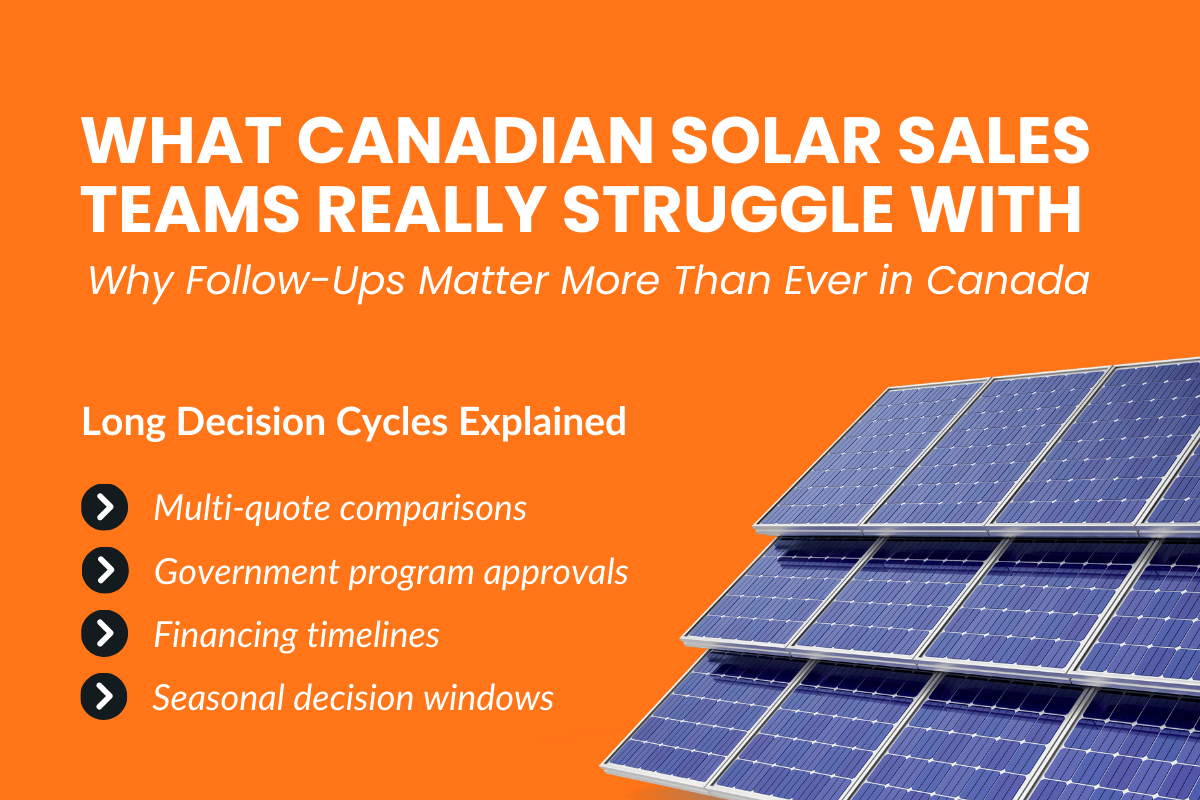
What Canadian Solar Sales Teams Really Struggle With?
Speak to solar company owners anywhere from Ontario to British Columbia, and you’ll hear the same pattern again and again:
“We are generating leads, but we are losing deals somewhere in the middle.”
Not at the start. Not at the final stage. But in that long, unstructured phase between interest and decision.
Why Follow-Ups Matter More Than Ever in Canada
In the Canadian solar industry, timing is everything. Homeowners are not making quick decisions because solar is a long-term investment that requires research, comparison, and financial planning.
When you factor in rebates, energy audits, financing approvals, and seasonal installation windows, the sales process becomes layered and extended.
If your follow-ups are inconsistent during this time, you are not just losing a deal. You are slowly losing the customer’s trust. To understand this better, let’s break down why these sales cycles take longer in Canada.
Long Decision Cycles Explained
1. Multi-quote comparisons
Most homeowners evaluate two or three installers before making a decision. Your proposal often sits alongside competitors while they compare pricing, system design, battery options, and long-term savings.
If your team is not consistently following up, your brand quietly fades from their decision-making process.
2. Government program approvals
Programs like the Canada Greener Homes initiative and various provincial incentives introduce additional steps. Documentation, eligibility checks, and approvals can significantly delay progress.
Without structured tracking inside your CRM, it becomes easy for sales teams to lose momentum during these waiting periods.
3. Financing timelines
Financing adds another layer of delay. Approval processes can take weeks, and during that time, communication often slows down.
If your CRM does not trigger follow-ups based on status changes, leads can easily go cold before a decision is made.
4. Seasonal decision windows
In provinces with harsh winters, many customers wait for spring before moving forward. A lead captured in November might close in April. That is five months of communication required. No spreadsheet handles that cleanly.
The Cost of Manual Follow-Ups
Consider a simple scenario: An Ontario homeowner requests a quote in early summer. They are eligible for a rebate, but the deadline is tight. Your sales rep intends to follow up. They get busy with installations, and a week passes. Then another.
The rebate window closes. The homeowner chooses another company, which is not bad luck. That is a broken system.
Manual follow-ups create:
- High lead aging, where opportunities sit untouched for too long
- Inconsistent communication across different sales reps
- Poor visibility into where deals actually stand
- Continuous revenue leakage from missed opportunities
These are not small issues. They directly impact performance metrics. When follow-up delays exceed 48 hours, conversion rates drop significantly. Lead management becomes reactive instead of proactive, and pipeline control weakens.
The Truth: It’s Not Just CRM, It’s Sales Enablement
Many solar companies say, “We have a CRM.”
But in reality, what they have is just a place to store contacts. A true solar CRM does much more. It actively supports your sales process by guiding next steps, tracking every interaction, and keeping deals moving forward.
It connects sales, marketing, field teams, and operations into one system, ensuring visibility, accountability, and consistency across the entire pipeline.
That is what turns long Canadian sales cycles into predictable revenue.
What Is Solar CRM & What Does It Actually Do?
Solar CRM Defined for Canadian Installers
A solar CRM is a specialized system designed to manage the entire customer journey, from the first inquiry to final installation and beyond.
For Canadian installers dealing with long sales cycles, multiple approvals, and seasonal delays, a solar CRM becomes the central system that keeps everything organized and moving forward.
It helps manage:
- Lead capture from websites, ads, and marketing campaigns, ensuring every inquiry is recorded and tracked
- Lead qualification and segmentation so sales teams focus on high-potential opportunities
- Sales pipeline tracking with clear visibility into every stage of the deal
- Proposal tracking to monitor engagement and follow-up timing
- Financing and rebate status to manage approvals and documentation
- Project visibility from signed deal to installation and completion
- Post-install follow-ups to maintain customer relationships and drive referrals
As your business grows, this system becomes your operational backbone. It connects your sales, operations, and customer communication into one structured workflow.
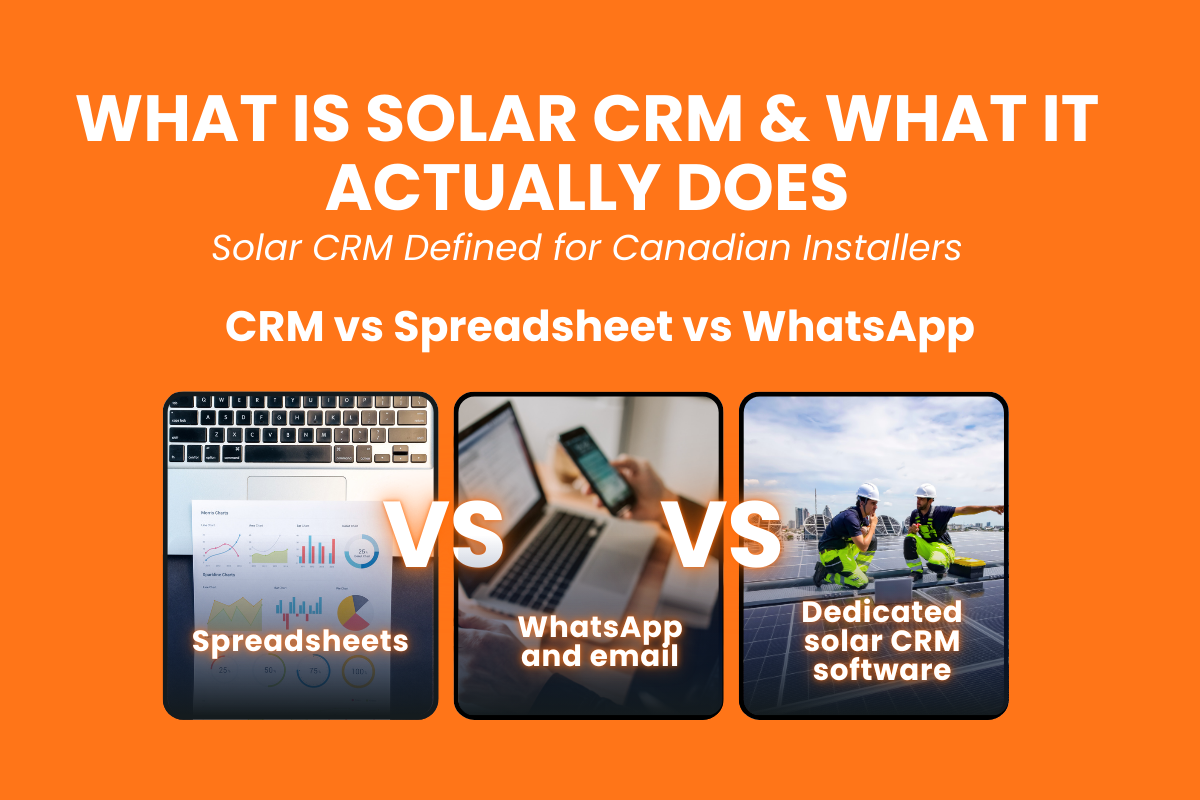
CRM vs Spreadsheet vs WhatsApp
Most solar installers don’t start with a CRM. They begin with tools that are easy and familiar, like spreadsheets, emails, and WhatsApp. At first, it works, but as lead volume increases, these systems start to break.
Spreadsheets
- No automated workflows, so every follow-up depends on manual effort
- No built-in reminders unless someone sets them up individually
- Tasks are easy to forget when multiple deals are active
- Scaling becomes difficult as data grows and teams expand
WhatsApp and email
- Conversations get buried under daily messages and threads
- Customer information is scattered across different platforms
- Managers have no clear visibility into deal progress or team activity
Dedicated solar CRM software
- Automated follow-ups ensure no lead is missed, even during long sales cycles
- Centralized data keeps all customer and project information in one place
- Shared dashboards provide visibility across sales, operations, and management
- Mobile access allows field teams to update information in real time
- Integrations with tools like Google Calendar, design software, and finance systems streamline operations
When demand rises, manual systems collapse under pressure. A proper CRM platform gives your teams structure and security. For a brief, explore How Solar CRM Software Helps Canadian Contractors Streamline Operations
When Does a CRM Actually Improve Conversions?
Installing a CRM does not increase sales on its own. Your team increases conversions when they use it consistently and correctly.
When your team treats the CRM as an active system, not just a database, it improves follow-ups, visibility, and decision-making. This directly drives higher conversions.
Real-World CRM Impact Metrics
The metrics that matter most in solar sales are not vanity numbers. They are operational indicators.
- Follow-up latency: How fast does your team respond? Top-performing solar teams keep this under 24 hours.
- Stage conversion rates: What percentage of qualified leads reach proposal stage? How many proposals convert to signed deals?
- Lead age distribution: How many leads sit idle for more than 30 days?
- Close rate lift: Companies that implement structured follow-ups often see close rates increase by 5 to 10 percentage points.
Mini Case Study
A Vancouver-based solar installer closed deals at a 14% rate. Their team generated leads but failed to maintain consistent follow-ups after sending proposals.
After implementing structured CRM workflows for 90 days, their close rate increased to 21%.
What changed?
- Proposal tracking inside the CRM
- Text and email sequences are triggered automatically
- Clear dashboards showing stalled deals
- Weekly pipeline reviews
Here is a simplified comparison.
| Metric | Manual | With CRM |
|---|---|---|
| Avg Follow-Up Delay | 72h | <24h |
| Lead Leakage | High | Low |
| Close Rate | 12–18% | 20–28% |
| Quote Engagement | 40% | 65% |
The team did not rely on luck or tools alone. They created structure, enforced consistency, and used visibility to drive better decisions.
What Makes a Solar CRM “Canada-Ready”?
Not every CRM works for the Canadian solar market. Installers need systems that match how solar sales actually happen in Canada, with longer decision cycles, rebate dependencies, and seasonal delays.
A Canada-ready solar CRM must do more than manage contacts. It must support complex workflows, maintain consistent follow-ups, and give full visibility across the entire sales and installation process.
Core Features of a Best-in-Class Solar CRM
1. Automated Sequenced Follow-Ups
A strong CRM automates follow-ups across multiple touchpoints, such as Day 1, Day 3, Day 7, weekly, and even seasonal reminders. This ensures no lead gets ignored, while your team stays consistent without relying on manual tracking.
2. Provincial Incentive Tracking
Solar deals in Canada often depend on federal and provincial incentives, including programs in BC, Ontario, and Quebec. Your CRM must track eligibility, application status, and deadlines to prevent missed opportunities and lost deals.
3. Financing & Rebate Status Workflows
A Canada-ready CRM should automatically trigger actions when financing is approved or when documentation is pending. This reduces friction in the sales process.
4. Sales Forecasting With Realistic Canadian Timelines
Sales forecasting must reflect real-world conditions such as weather delays, permit approvals, and seasonal demand shifts. Accurate forecasting helps teams plan better and avoid unrealistic revenue expectations.
List of Must-Have Features
- Solar-ready sales pipeline stages – Clearly structured stages built specifically for the way solar deals progress from inquiry to installation.
- Mobile access for field teams – Real-time access for reps and installers to update leads, notes, and job status directly from the field.
- Task automation – Automated reminders and follow-ups so no lead or action item gets missed.
- Built-in reporting dashboards – Visual insights that show pipeline health, close rates, and team performance at a glance.
- Integration with existing systems – Seamless connection with accounting, design, and financing tools you already use.
- Proposal and quote tracking – Full visibility into sent proposals, revisions, and client approvals.
- Project management visibility – A clear view of each project’s progress from signed contract to final installation.
- Secure customer information storage – Protected and organized storage of sensitive homeowner data with controlled access.
The best CRM connects sales, project management, and installations.
Top Solar CRM Options for Canadian Installers
1. Sunbase
Sunbase is a purpose-built solar CRM designed specifically for solar installers managing long and complex sales cycles. Unlike generic CRMs, it combines lead management, proposal generation, financing tracking, and project visibility into one unified platform.
It is particularly effective for Canadian solar businesses where deals involve multiple stages, such as rebates, financing approvals, and seasonal delays.
Most suitable for:
Small to large solar installers looking for an all-in-one, solar-specific CRM with automation and pipeline visibility.
Key Features:
- Captures leads from multiple channels and organizes them into a structured pipeline for better tracking.
- Automates follow-ups through workflows so no lead goes cold during long decision cycles.
- Tracks proposals, financing status, and project progress in one centralized system.
- Provides real-time dashboards to monitor conversions, pipeline stages, and revenue forecasts.
Pricing: Custom pricing (subscription-based, varies by team size and features).
2. SetShape
About:
SetShape is a solar-specific CRM platform built to streamline both sales and project workflows. It focuses heavily on automation, enabling solar teams to manage leads, communication, and installations within one system.
The platform is particularly useful for companies that want to reduce manual follow-ups and maintain consistent engagement across long sales cycles.
Most suitable for: Teams that want deep automation across sales and project management.
Key Features:
- Automates email and SMS follow-ups to maintain consistent communication with prospects.
- Prioritizes leads based on activity and engagement to help sales reps focus on high-intent opportunities.
- Tracks projects from lead stage to installation with structured workflows.
- Provides reporting tools for pipeline visibility and performance tracking.
Pricing: SetShape does not publicly list pricing. Costs are typically customized based on the number of users, automation features, and workflow requirements. Businesses must request a demo to receive a detailed quote.
3. Salesforce Sales Cloud
About:
Salesforce Sales Cloud is a globally recognized CRM platform known for its flexibility, scalability, and enterprise-grade capabilities. While not solar-specific, it can be customized extensively to support solar sales workflows, including lead tracking, forecasting, and automation.
For Canadian solar companies with complex processes, Salesforce offers the ability to build tailored systems that integrate with design tools, financing platforms, and project management software.
Most suitable for: Mid-sized to enterprise solar companies with complex workflows and customization needs.
Key Features:
- Advanced automation to manage leads, tasks, and follow-ups at scale.
- Customizable pipelines tailored to solar sales stages and project tracking.
- Detailed reporting and forecasting for revenue and performance insights.
- Integration with multiple third-party tools for finance, marketing, and operations.
Pricing:
SalesOps CRM offers tiered pricing based on the number of users, making it suitable for both small teams and growing businesses.
Pricing Plans:
- Starter Suite: $25/user/month
- Pro Suite: $100/user/month
- Enterprise: $175/user/month
- Unlimited: $350/user/month
- Agentforce 1 Sales: $550/user/month
4. Zoho CRM
About:
Zoho CRM is a widely used, cost-effective CRM platform that can be adapted for solar businesses through customization. It offers a balance between affordability and functionality, making it a strong option for growing teams..
Most suitable for: Small to medium solar installers looking for a budget-friendly, customizable CRM.
Key Features:
- Customizable pipelines to match solar sales and installation stages.
- Automation for follow-ups, task reminders, and lead nurturing.
- Integrated reporting dashboards for tracking sales performance.
- Easy integration with accounting, marketing, and communication tools.
Pricing:
Free Edition: Free for up to 3 users (basic features).
- Standard: ~$14–$20/user/month (billed annually).
- Professional: ~$23–$35/user/month (billed annually).
- Enterprise: ~$40–$55/user/month (billed annually).
- Ultimate: ~$52–$65/user/month (billed annually).
5. OpenSolar (Built-in CRM)
About:
OpenSolar is a globally popular solar platform that combines design, proposal generation, and CRM capabilities in one system. It is widely used by installers looking for a cost-effective solution with strong proposal tools.
While its CRM features are not as advanced as dedicated platforms, it provides enough functionality to manage leads and projects alongside design workflows.
Most suitable for: Startups and installers wanting design, proposal, and basic CRM in one platform.
Key Features:
- Combines solar design, proposal generation, and CRM in a single workflow.
- Tracks leads, documents, and project stages without requiring additional tools.
- Supports e-signatures and online payments for faster deal closure.
- Provides basic automation for managing customer communication.
- Enables quick proposal creation, improving speed and professionalism.
Pricing: OpenSolar offers a free core platform, making it highly attractive for smaller teams. Revenue is generated through optional integrations, financing partnerships, and premium tools, which may involve additional costs.
Here is how leading CRM platforms compare for solar companies in Canada:
| Feature / Platform | Sunbase | SetShape | Salesforce | Zoho CRM | OpenSolar |
|---|---|---|---|---|---|
| Solar-Specific Workflow | ✓ Built fully for solar lifecycle | ✓ Solar-focused workflows | ⚠ Requires heavy customization | ⚠ Needs setup | ✓ Solar-integrated |
| Lead Capture & Pipeline Management | ✓ Centralized multi-channel capture | ✓ Strong lead tracking | ✓ Advanced lead management | ✓ Flexible capture | ✓ Basic CRM tracking |
| Automation & Follow-Ups | ✓ Advanced multi-step workflows | ✓ Strong email/SMS automation | ✓ Powerful automation | ✓ Good automation | ⚠ Basic automation |
| Proposal & Quote Tracking | ✓ Built-in proposal tracking | ⚠ Limited | ⚠ Via integrations | ⚠ Custom setup | ✓ Strong proposal tools |
| Financing & Rebate Tracking | ✓ Integrated tracking | ⚠ Limited | ⚠ Custom workflows needed | ⚠ Manual/custom | ⚠ Basic |
| Sales Forecasting & Dashboards | ✓ Solar-specific insights | ✓ Good reporting | ✓ Advanced analytics | ✓ Strong dashboards | ⚠ Basic |
| Project & Installation Tracking | ✓ End-to-end visibility | ✓ Workflow tracking | ⚠ Requires setup | ⚠ Limited | ✓ Basic tracking |
| Ease of Use | ✓ Built for solar teams | ✓ Easy to adopt | ⚠ Complex | ✓ User-friendly | ✓ Very easy |
| Scalability | ✓ Small to enterprise | ✓ Growing teams | ✓ Enterprise-grade | ✓ SMB to mid-size | ⚠ Best for small teams |
| Pricing Transparency | ⚠ Custom pricing | ⚠ Custom pricing | ✓ Public pricing | ✓ Public pricing | ✓ Free + add-ons |
If you are running a fast-growing solar company focused on structured automation, Sunbase Solar Software is often the most aligned with Canadian installers.
If you want a combined design-and-proposal tool with lighter CRM needs, OpenSolar works well.
Marketing-heavy teams often prefer HubSpot CRM. Smaller teams may find Pipedrive simple. Budget-focused companies sometimes lean toward Zoho. Your decision depends on your business model and growth goals.
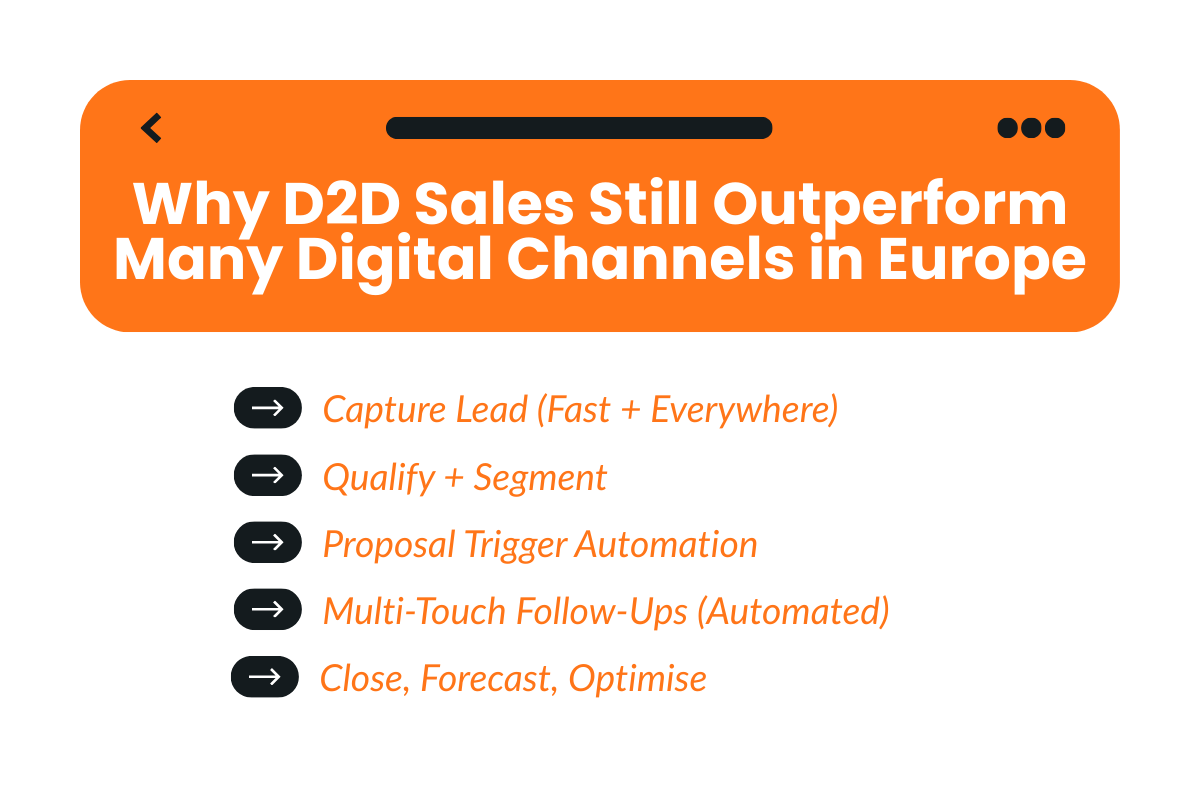
Walkthrough: How to Build a High-Converting Solar Sales Workflow
A high-performing solar CRM workflow in Canada is not complicated. It is intentional, structured, and fast.
Step 1 – Capture Lead (Fast + Everywhere)
Your website forms, Facebook ads, Google Ads, referrals, channel partners, and door-to-door teams should all feed into one system.
Push every lead directly into your CRM in real time. Eliminate manual entry, avoid spreadsheets, and remove delays. Automatically assign leads to sales reps based on territory or availability so your team responds immediately.
Step 2 – Qualify + Segment
Treat leads differently based on intent and potential value. Not every lead deserves the same level of urgency.
Use clear scoring thresholds based on:
- Roof type and size: Larger, solar-ready roofs with fewer obstructions typically signal stronger project viability and higher deal value.
- Budget range or financing intent: Leads who understand pricing or are pre-qualified for financing tend to move faster through the pipeline.
- Interest in battery storage or EV charging: Homeowners interested in add-ons often represent higher lifetime value opportunities.
- Timeline to install: Prospects ready to install within 30 to 60 days should be prioritized over long-term inquiries.
Automatically tag and segment leads into hot, warm, and nurture categories so your team focuses first on high-intent opportunities.
Step 3 – Proposal Trigger Automation
Speed builds trust and increases conversion probability.
Once a lead qualifies, trigger proposal generation within minutes, not hours. Use pre-built templates, pricing rules, and system sizing tools to automate most inputs.
Instant follow-up positions you as professional and reliable while competitors are still drafting emails.
Step 4 – Multi-Touch Follow-Ups (Automated)
Solar deals require consistent communication across multiple touchpoints. Set up automated sequences that include:
- SMS reminders to maintain engagement and reduce drop-offs
- Follow-up emails with proposals, FAQs, and next steps
- Task reminders prompting reps to call or reconnect at the right time
- Appointment confirmations to reduce missed site visits
This keeps communication consistent without overwhelming your sales team. Automation handles persistence. Reps handle conversations.
Step 5 – Close, Forecast, Optimise
Move closed deals directly into execution without delays. Update project milestones, track installation timelines, and align with operations.
Track performance using key metrics:
- Close rates to measure conversion efficiency
- Sales cycle length to identify delays in the pipeline
- Revenue forecasts to predict upcoming business
- Drop-off stages to identify where deals are getting stuck. This visibility helps you fix bottlenecks and continuously improve performance.
Simple Flow
Lead -> CRM -> Qualification -> Proposal -> Touchpoint Sequence -> Forecast -> Close
When structured properly, your solar sales workflow becomes predictable, scalable, and easier to manage, especially in long Canadian sales cycles.
Canadian Installer ROI Example
A Calgary-based installer implemented structured CRM automation and saw measurable results. They reduced over 600 admin hours annually by automating follow-ups and task management. At the same time, their close rate improved, leading to approximately 20% growth in annual revenue.
Simple ROI Formula: Additional Revenue Gained – CRM Cost = Net Impact
In most cases, the return significantly outweighs the cost when efficiency, speed, and consistency improve across the sales process..
Why Sunbase Is the Smart Solar CRM Solution for Canadian Installers?
- All Your Leads in One Centralized Hub: Capture, organize, and track every lead from website, ads, and referrals without losing visibility.
- Automated Follow-Ups That Shorten Sales Cycles: Built-in workflows ensure timely follow-ups so prospects stay engaged through long decision periods.
- Integrated Proposals and Financing Tracking: Create, send, and monitor solar proposals while managing financing and incentive status in one place.
- Real-Time Sales Pipeline and Forecasting Dashboards: Clear dashboards help you track deals, monitor progress, and forecast revenue accurately.
- Built for Solar From Lead to Installation: Sunbase connects sales, project management, and installations in a single solar-focused platform.
Conclusion: From Leads to Lifetime Customers
In Canada, solar sales are not quick wins. They are conversations, follow-ups, paperwork, permits, forecasts, and trust-building.
A well-implemented solar CRM system in Canada turns long cycles into structured progress. It aligns your office, field teams, marketing, and management. It keeps customer relationships warm through seasonal delays. It ensures no opportunity slips through cracks.
If your solar business is growing fast, now is the time to invest in the right tools.
Because in this industry, power is not just what you install on rooftops. It is the power of efficient systems, clear communication, and predictable sales growth.
Turn Long Canadian Sales Cycles Into Predictable, Profitable Growth with Sunbase.
Canadian solar sales are complex, but your systems do not have to be. When every lead is tracked, every follow-up is automated, and every deal is visible in real time, growth stops feeling unpredictable.
Book a demo today with Sunbase and see how the right solar CRM Canada platform can turn long sales cycles into consistent, scalable revenue for your team.
FAQs
1. Which is the best CRM for solar installers in Canada?
The best CRM depends on your size and needs. Installers with long sales cycles often prefer solar-specific platforms like Sunbase, while marketing-driven teams may use HubSpot.
2. Why is solar CRM software important in Canada?
Canadian sales cycles involve rebates, financing, and seasonality. A structured CRM ensures proper lead management and consistent follow-ups.
3. Can CRM software integrate with project management tools?
Yes. Many CRM platforms integrate with project management systems, proposal tools, and calendars like Google Calendar.
4. How quickly can a CRM improve close rates?
Many solar companies see measurable improvement within 60 to 90 days when automation and structured pipeline reviews are implemented.
5. Is CRM only for large solar companies?
No. Even small solar teams benefit from organized lead tracking, automated workflows, and centralized customer information.
One Platform.
Zero Chaos.
Run Your Entire Business in One Platform
Sunbase replaces your CRM, proposals, scheduling, job tracking, and reporting tools — all inside one clean, connected platform.
About Sunbase
The All-In-One Platform to Run Your Entire Business
Sunbase helps you organize operations, streamline daily workflows, and manage everything - from first customer contact to final project deliver- in one connected system.
Our Mission
- Organize your business.
- Optimize your workflow.
- Automate your dailytasks
Why Businesses Choose Sunbase
One Connected Workflow
Replace scattered tools and manual processes with a single platform that brings together your team, tasks, customers, jobs, and performance data.
🌎 Global Presence
Serving the United States, Canada, India, LATAM, Australia, and 10+ international markets.
👥 11,000+ Users
Trusted by contractors, installers, project managers, sales teams, and field technicians.
🏗️ Built for All Sizes
From small contracting teams to fast-growing enterprises, Sunbase adapts to your workflow.
Stop Managing Your Business Manually. Automate It.
Sunbase automates workflows, reduces mistakes, and helps your team get more done - without hiring extra staff or juggling multiple tools.
Still Managing Your Business Across Multiple Tools?
Bring your CRM, proposals, projects, and operations into one platform built for contractors.