
More contractors are running solar and roofing side by side in 2026 than at any point before, often with storm response as the bridge between the two.
What hasn't caught up is the software, because most roofing and solar CRM options are still built for a single trade, which forces multi-trade contractors to stitch together two or three platforms and hope the data lines up.
One CRM for Roofing and Solar: Why Multi-Trade Contractors Are Ditching Separate Tools
Five years ago, many contractors specialized in a single trade. Today, it's increasingly common to see roofing companies adding solar, solar businesses expanding into roofing, and storm restoration contractors coordinating everything from insurance claims to installation.
This piece looks at what that stitching actually costs, what changes when everything sits on a single pipeline instead, and how to tell if your business is ready to consolidate.
Key Takeaways
- Roofing, solar, and storm restoration increasingly share customers, properties, and project stages.
- Separate systems create duplicate records, manual handoffs, and fragmented reporting.
- One CRM works best when trades operate as part of the same business.
- Each trade should keep its own workflow while sharing customer and property data.
- Before consolidating, test migration, reporting, integrations, permissions, and future expansion.
Why Multi-Trade Contracting Is Becoming the New Normal in 2026
The market is ever-changing, and to win in a competitive market, a single business offering multiple services is becoming the new norm.
1. Customers increasingly expect one contractor to manage multiple services
For homeowners, managing separate contractors for roofing, solar, insurance restoration, and exterior repairs can become frustrating. Every additional vendor means another quote, timeline, point of contact, and another opportunity for communication gaps.
Offering complementary services under one company can provide:
- one point of contact throughout the project;
- better coordination between related services;
- fewer scheduling conflicts;
- clearer responsibility when one stage affects another;
- a more consistent customer experience.
This is particularly valuable when the work must happen in a specific order. A roof may need to be replaced before solar can be installed, while an existing solar system may need to be removed and reinstalled during roofing work.
A contractor that can coordinate both parts of the project may have an advantage over companies that leave the homeowner to manage separate providers.
2. Existing customers are becoming more valuable as acquisition costs rise
Winning a new customer requires advertising, lead qualification, inspections, estimates, and follow-up. As the cost of generating new business increases, contractors have more reason to generate additional revenue from relationships they have already earned.
Common opportunities include:
- offering solar to a completed roofing customer;
- replacing an unsuitable roof before a solar installation;
- removing and reinstalling solar panels during roof replacement;
- adding gutters or siding to a storm restoration project;
- identifying roofing needs during a solar site assessment.
Because the contractor already has information about the property and an established relationship with the homeowner, a relevant second service may be easier and less expensive to sell than starting with a new lead.
The opportunity is not simply to offer every service to every customer. Contractors need to identify where the services genuinely overlap and build a clear process for following up at the right time.
3. Diversifying services helps stabilize revenue
Relying on a single service can expose you to seasonal slowdowns, weather patterns, shifts in consumer demand, and broader market conditions.
Adding complementary trades helps create more balanced revenue throughout the year.
For example:
- Storm restoration work may increase after severe weather events.
- Roofing demand can fluctuate seasonally.
- Solar installations may rise when incentives or energy costs make adoption more attractive.
Rather than depending on one line of business, you can spread risk across multiple services while making better use of existing teams, equipment, and customer relationships.
The Hidden Cost of Running Separate Systems for Every Trade
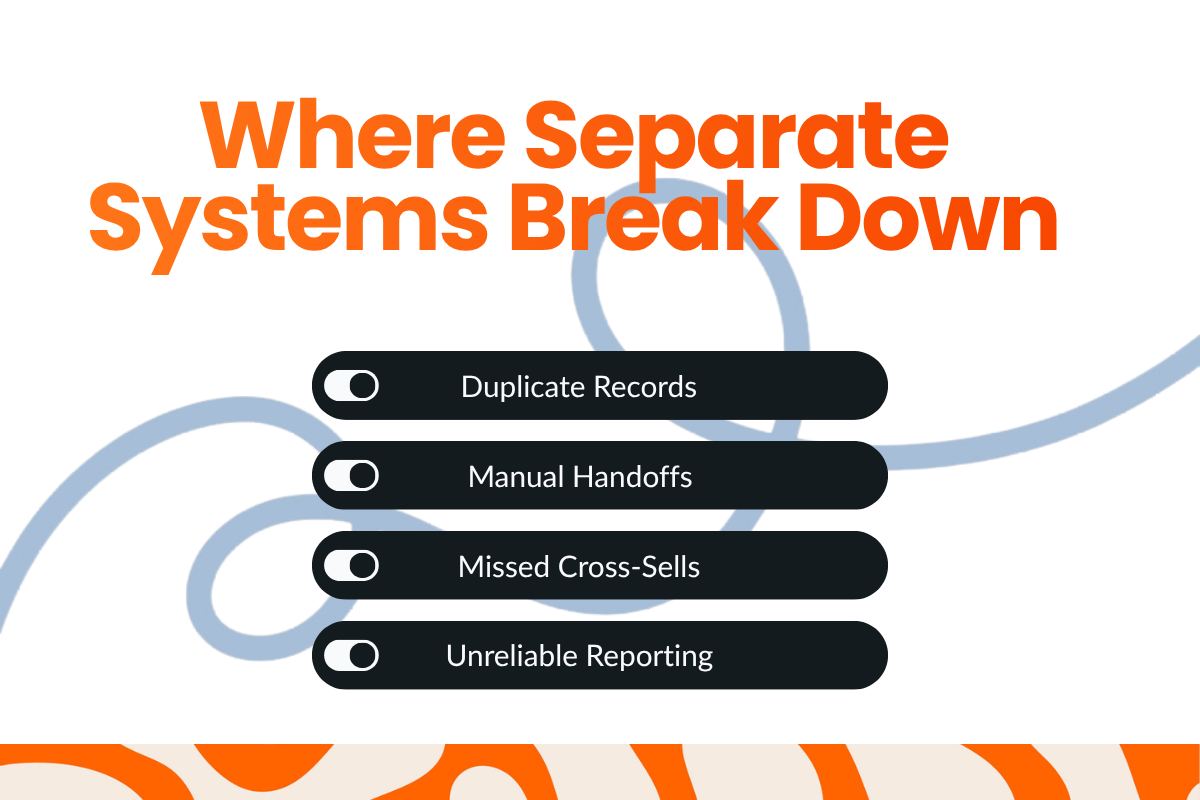
Using separate systems for roofing and solar can work when the two sides of the business operate independently. Problems start when they share customers, employees, documents, schedules, or reporting.
The cost is not limited to software subscriptions. Separate platforms also make it harder to reduce manual data entry as the company adds more jobs and services.
Quick Comparison Table
| Business area | What separate systems can create |
|---|---|
| Customer records | Duplicate profiles, missing notes, and incomplete job history |
| Sales | Limited visibility into previous work and cross-selling opportunities |
| Operations | Manual updates between roofing, solar, and restoration teams |
| Customer service | Different teams giving customers different information |
| Reporting | Separate pipelines, revenue reports, and performance data |
1. Customer information gets duplicated across platforms
A homeowner may first contact your company for storm damage, hire you for a roof replacement, and later purchase solar.
If each trade uses a different CRM, that customer may have:
- one record for the insurance claim;
- another for the roofing job;
- another for the solar proposal;
- separate notes, documents, and communication histories.
This makes it harder to see the full value of the customer, understand what work has already been completed, or identify the next relevant service.
Before choosing separate systems, ask:
- Can both trades access the same customer history?
- Will estimates, contracts, inspection reports, and photos stay attached to one record?
- Can the system prevent the same lead from being entered more than once?
- Can teams see previous jobs before contacting the customer?
2. Projects become harder to coordinate across teams
A combined roofing and solar project may move through several stages:
Lead → Roof inspection → Insurance claim or retail estimate → Roof replacement → Solar design and proposal → Installation → Final payment and warranty
Different employees may own each stage, and all need accurate information.
When those stages live in separate systems, someone has to move the information between them. That may mean:
- creating the customer again in another platform;
- copying measurements, notes, or system details;
- forwarding contracts and inspection files;
- updating job status in more than one place;
- checking with another department before responding to the customer.
The more shared jobs the company handles, the harder this becomes to manage consistently.
3. Separate systems make cross-selling harder to track
A roofing contractor may already have the trust, property information, inspection history, and financing details needed for a solar conversation. But that opportunity is easy to miss when the solar team cannot see the roofing customer base.
Contractors using separate systems should be able to answer:
- How many roofing customers were offered solar?
- How many storm restoration leads became full roof replacements?
- Which completed roofing jobs are suitable for solar follow-up?
- Which services produce the highest total customer value?
- Which sales reps are generating multi-trade jobs?
If these answers require exports from multiple systems, the company does not have a complete view of its sales opportunities.
4. Reporting becomes harder to trust
Separate platforms usually produce separate reports. Roofing may have one pipeline, solar another, and storm restoration a third.
This makes it difficult to answer basic business questions such as:
- What is the total value of the current pipeline?
- How much revenue comes from each trade?
- Which lead sources produce customers who buy more than one service?
- Where are projects being delayed?
- How much work is scheduled across all crews?
- What is the close rate for bundled roofing and solar opportunities?
The issue is not that the data does not exist. It is that leadership has to combine it before it becomes useful.
What Changes When Roofing, Solar, and Storm Teams Share One CRM Software
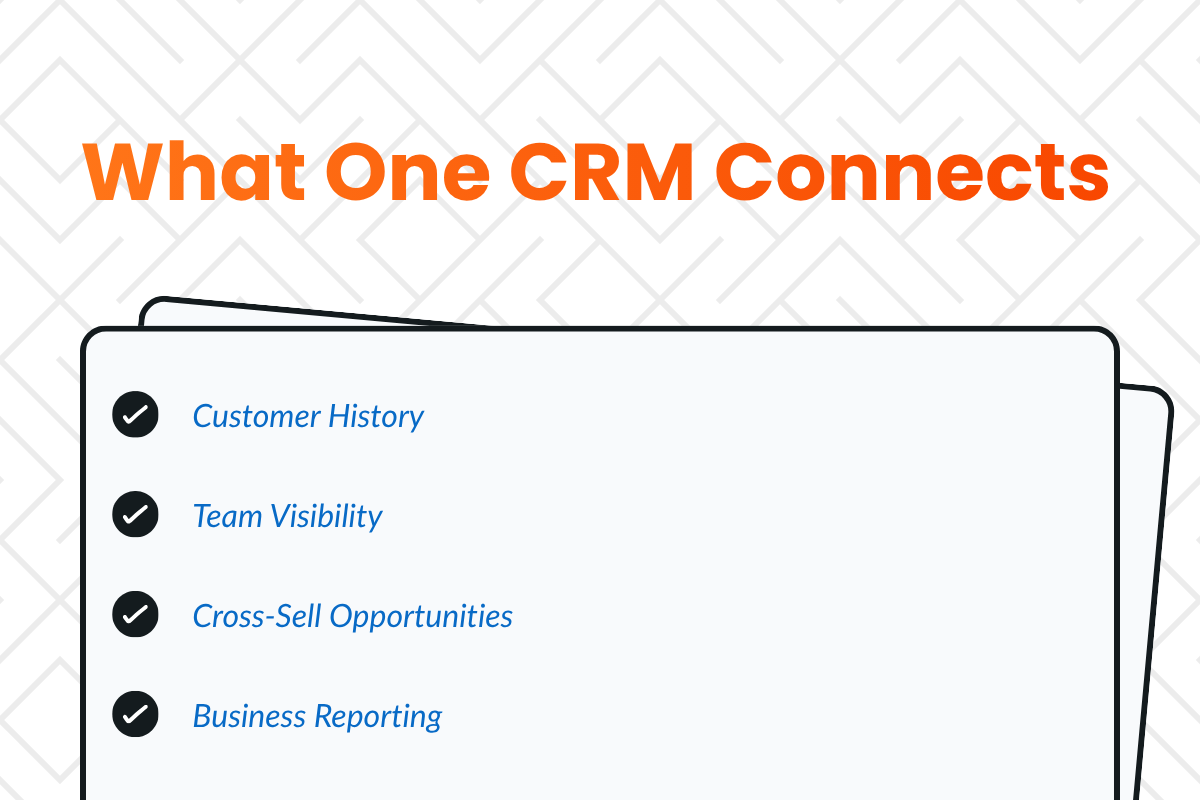
Consolidating roofing, solar, and storm restoration workflows into one system does more than reduce the number of tools a company uses.
A shared customer relationship management system keeps customer, project, and financial information connected from the first inquiry through installation, payment, and future service. It supports broader business operations without forcing every trade into the same process.
1. One customer record across every service
A shared CRM gives each customer one record, even when they purchase more than one service.
That record can include:
- contact and property information;
- lead source and sales history;
- inspection reports, measurements, and photos;
- estimates, proposals, and contracts, etc.
This reduces duplicate records and gives each team the context it needs before speaking with the customer or taking over the next stage of work.
It also preserves the relationship after the first job. A completed roof replacement does not disappear into an old roofing database when the homeowner later asks about solar.
2. Teams gain shared visibility
Shared visibility is useful when it provides each department with the information it needs to do its job without waiting for an internal update.
For example:
- Sales can see whether an inspection has been completed.
- Production can review what was included in the signed proposal.
- Roofing crews can confirm whether solar equipment must be removed or protected.
- Solar teams can see whether the roof is ready for installation.
- Customer service can give an accurate status update without contacting several departments.
- Finance can see which project stages have been completed before invoicing or releasing commissions.
The goal is not to give every employee access to everything. A well-configured CRM should use roles and permissions so each person sees the information relevant to their work.
For example: At a job site, crews can use a mobile app to review roofing estimates, project documents, and the status of each roofing project. That gives office teams current job tracking without calling the field for an update.
3. Cross-selling becomes much easier
Cross-selling is difficult when roofing, solar, and restoration customer lists are stored separately.
With a single customer database, contractors can identify opportunities based on completed work or collected information.
Examples include:
- flagging solar leads that need a roof replacement before installation;
- following up with completed roofing customers who may qualify for solar;
- offering gutters, siding, or other exterior work after a storm claim;
- identifying customers with older roofs during solar consultations;
- tracking how many customers purchase more than one service.
For the sales team, this makes it easier to manage leads across trades because property details and past customer interactions are already documented instead of rebuilding the sales process from the beginning.
4. Leadership gets one view of the business
A consolidated system allows leadership to review performance through detailed reports across roofing, solar, and storm restoration without manually combining.
They can quickly see leads, pipeline value, close rates, and sales cycles across roofing, solar, and restoration. They can also track sold jobs waiting on production, spot delays, review crew schedules, and monitor revenue by service.
It also makes it easy to see where money is coming from and where it’s getting stuck—lead sources, team performance, unpaid invoices, and expected cash flow.
Most importantly, it helps answer a critical question fast: is the problem sales or production? A full pipeline means nothing if jobs aren’t getting installed and invoiced.
5. Faster coordination improves the customer experience
Customers notice the effect of connected systems even when they never see the software.
They experience fewer repeated questions, more accurate updates, and clearer communication between services. Roofing and solar teams are less likely to give conflicting timelines because both are working from the same project record.
This leads to faster response times, more reliable scheduling, and smoother coordination across teams. It also helps reduce delays, makes change orders easier to manage, and limits confusion around billing. Over time, these improvements contribute to stronger reviews, more referrals, and increased repeat business.
When One CRM Makes Sense—and When Separate Tools May Still Work
Not every multi-trade contractor needs one CRM. The right setup depends on whether the trades operate as one business or as separate service lines.
One CRM makes sense when the trades are connected
A unified CRM is usually the better fit when roofing, solar, and storm restoration share customers, projects, teams, or reporting.
This includes businesses where:
- one customer may purchase multiple services;
- one trade affects the timing or scope of another;
- employees work across service lines;
- departments rely on the same customer and project information;
- leadership manages performance across the entire company.
Each trade can still have its own pipeline, stages, documents, and permissions. The benefit comes from keeping shared customer and property information in one system.
Separate tools may still work when the trades are independent
Separate systems can remain practical when the service lines have little operational overlap.
This may apply when:
- the trades operate as separate companies or business units;
- they serve different customers;
- teams and management do not work across services;
- projects rarely move between trades;
- accounting and reporting are kept separate;
- one trade requires software that a broader platform cannot support.
In these cases, consolidation may create more cost and disruption than value.
The key distinction is simple: one CRM is useful when the trades operate together. Separate tools may also be necessary when one trade depends on specialist capabilities that a broader platform cannot match, but even the best roofing CRM software may not support every solar, insurance, or production requirement.
Questions to Ask Before Consolidating Your Tech Stack
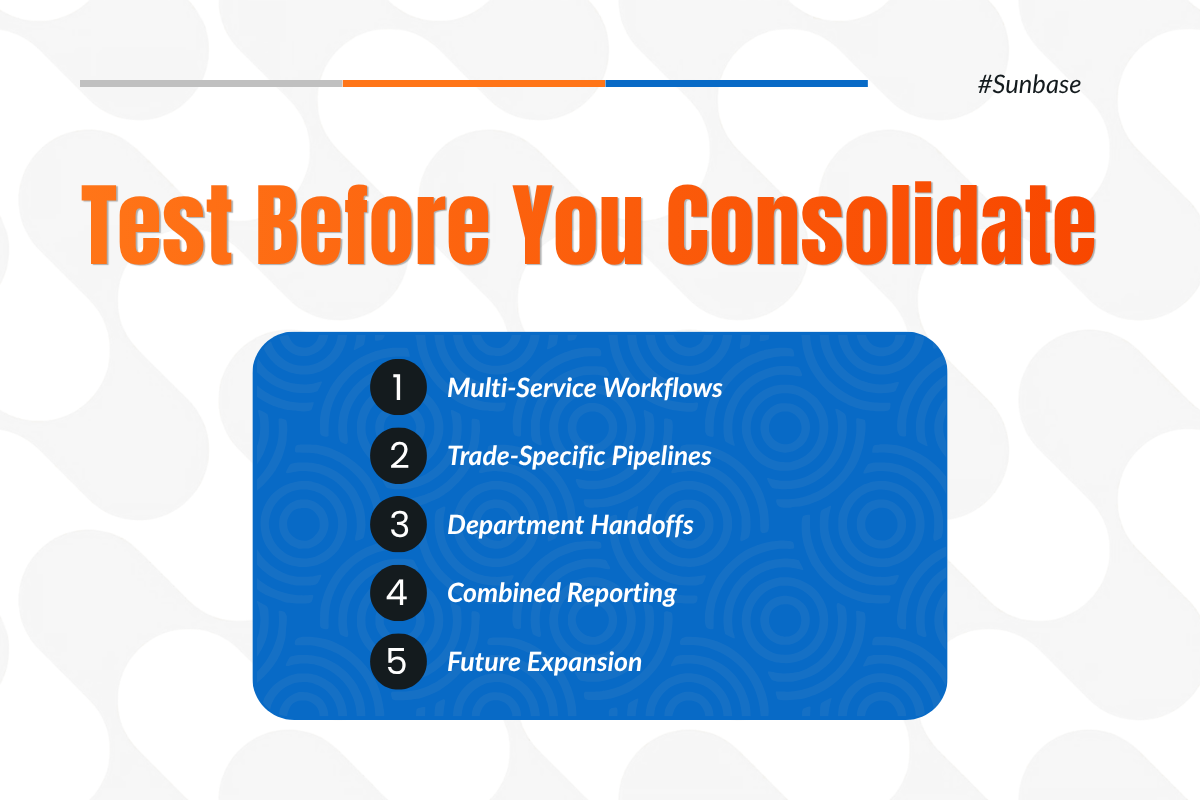
Moving roofing, solar, and storm restoration into one CRM can reduce duplicate work, but only if the platform can handle the differences between those services.
Before replacing existing tools, map how leads, jobs, documents, and payments move through your business today. Then test whether the new system can support those workflows without forcing every department into the same process.
1. Can one customer move through multiple service workflows?
A customer may enter as a storm lead, move into a roofing claim, and later purchase solar or
another exterior service. The CRM should support that progression without creating a new customer record each time.
- Ask the vendor to demonstrate how the platform handles scenarios such as a single customer with multiple properties, a single property with multiple jobs, and roofing and solar opportunities running simultaneously.
- It should also account for dependencies like a roof replacement required before solar installation, as well as separate estimates, contracts, invoices, and warranties for each service.
- The system should support repeat work completed months or years later and allow referrals or additional decision-makers to be attached to the same account.
- The system should preserve the complete customer and property history while allowing each job to follow its own stages and pipeline.
2. Does the platform support different trades without separate databases?
Roofing, solar, storm restoration, and construction do not follow identical workflows.
Look beyond the CRM features shown in the standard demo. The platform should support customizable workflows by trade, keep lead management separate where needed, and automate tasks without forcing the same rules on every team.
- Check whether the CRM allows you to configure separate pipelines and job stages by trade, along with service-specific fields, forms, proposal templates, and contract structures.
- It should also support trade-specific automations, document requirements, task lists, production milestones, commission structures, and service-line reporting.
- The platform should connect trades that need to share information without treating them as the same type of job.
3. Can every department collaborate inside one system?
Consolidation should reduce the number of times information has to be copied, forwarded, or explained again.
- Test a complete handoff during the software evaluation by following a job from lead assignment through inspection, estimate approval, production, scheduling, invoicing, and final warranty or follow-up.
- At each stage, confirm that the next department receives the necessary information automatically, that signed documents and approved scopes are easy to find, and that tasks and deadlines can be assigned clearly.
- You should also verify that changes are tracked with a clear history, internal notes can be added without exposing them to customers, and managers can identify stalled handoffs.
- Field crews should be able to access the system from mobile devices, and access should be adjustable by role, team, branch, or trade.
Sales, operations, production, customer service, and accounting do not need identical access, but they do need to work from the same current information.
4. Can reporting combine every trade into one dashboard?
The platform should help you support reporting across the total pipeline, revenue by trade, lead and conversion metrics, job status, scheduling, and financial performance.
It should also provide visibility into outstanding invoices, expected payments, lead-source performance, team performance, and cross-sell or repeat-customer revenue.
Ask how the system defines each metric, since different platforms may calculate values like revenue differently. Also confirm whether reports update automatically or still depend on manual exports and spreadsheet cleanup.
5. Will the platform support expansion into another service?
Your roofing and solar company may later add gutters, siding, windows, HVAC, electrical work, or another location.
- Before committing, determine whether adding a service would require a new database, another CRM subscription, a separate implementation, custom development, or additional integrations.
- Also, consider whether it would create duplicate customer records or force major changes to existing workflows.
- A scalable platform should allow your company to add new pipelines, fields, templates, teams, permissions, and reports without rebuilding the entire system.
Note: Ask the vendor to demonstrate how an additional service would actually be configured rather than relying on general claims of flexibility.
6. What will happen to your existing data?
Consolidation can fail if the new CRM supports the future workflow but loses important historical information during migration.
Confirm what can be imported and clarify who is responsible for cleaning, mapping, testing, and validating the data, and ensure a sample migration is completed before moving all records.
Note: Historical data does not need to be perfect, but teams need to understand what will transfer, what will remain archived, and what may be lost.
7. Which existing tools will remain connected to the CRM?
Start with a list of the other roofing apps already in use, then decide which the CRM will replace and which should remain connected.
That may include project management software, field service management software, solar design, roof measurement, financing, accounting software, or supplier platforms.
A centralized platform does not need to replace all the tools your teams rely on. It needs to keep the right information moving between them.
For each integration, check what data is shared, how often it updates, and what happens if the connection fails.
How Sunbase Helps Multi-Trade Contractors Operate on One Platform
Sunbase gives multi-trade contractors a single system to manage roofing, solar, storm restoration, and construction without forcing every team into the same workflow.
Here’s what that means for your business:
- One customer record across all trades -
Keep roofing, solar, and restoration jobs tied to the same customer and property without duplicate entries or lost history. - Clear visibility for every team -
Sales, operations, office staff, and field crews can access the same project details, documents, schedules, and updates in real time. - Separate workflows, one system -
Manage different pipelines and job stages for each trade while keeping everything organized in one place. - Better tracking and reporting -
See where every job stands, compare performance by service line, and identify opportunities to offer additional services.
Sunbase helps you run multiple trades on one platform, so your teams stay aligned, your data stays connected, and your operations stay efficient.
The Bottom Line: Multi-Trade Businesses Need Multi-Trade Systems
Separate systems can work when roofing, solar, and storm restoration operate independently. They become harder to justify once those trades begin sharing customers, projects, employees, and reporting.
At that point, the issue is not simply the number of software subscriptions. It is the time spent transferring information, reconciling reports, checking which record is current, and coordinating work between departments.
One CRM will not remove the differences between roofing, solar, and restoration—and it should not try to. Each trade still needs its own stages, documents, and requirements.
The value of consolidation comes from connecting the information those trades share. Contractors can keep separate workflows while giving teams one reliable view of the customer, property, project status, and overall business.
Run Roofing, Solar, and Storm Work From One System
If your teams are already sharing customers, projects, and job information, separate systems may be creating more work than they solve.
See how Sunbase can help you manage every trade from one connected platform without forcing each team into the same workflow. Book a Sunbase demo
Frequently Asked Questions
Should you consolidate your CRM before adding another trade?
Consolidate before expansion when your current setup already requires duplicate entry, manual handoffs, or combined reporting. If the new service is still being tested, define its workflow first. The goal is to avoid building the new trade around another temporary system that later requires migration.
Should a multi-trade CRM be organized around customers, properties, or jobs?
It should connect all three. One customer may own several properties, and each property may have multiple roofing, solar, or restoration jobs. Linking these records prevents duplicate customers while preserving separate scopes, contracts, invoices, schedules, and warranties for every job.
Can one CRM manage both insurance restoration and retail jobs?
Yes, provided it supports separate workflows. Insurance jobs may require adjuster appointments, supplements, depreciation, and multiple payments, while retail jobs follow a simpler estimate-to-payment process. Both can share the same customer and property record without using identical stages.
How should lead ownership and commissions work when one trade creates another job?
The CRM should record the original lead source, referring employee, assigned salesperson, and revenue for each service. Commission rules should distinguish between generating the opportunity and closing or managing the second job, so cross-trade referrals are credited consistently instead of handled manually.
What happens if a specialist tool does not integrate with the CRM?
Determine whether the tool contains information other teams need. If it does, define how that information will be transferred and which system holds the final record. Frequent manual updates may recreate the same coordination problem the company intended to solve through consolidation.
Is one CRM always cheaper than using separate tools?
Not necessarily. Compare subscription, onboarding, migration, integration, training, and support costs against the time spent entering data twice, reconciling reports, correcting errors, and maintaining several systems. The lowest subscription price does not always produce the lowest operating cost.
How can contractors tell whether CRM consolidation is working?
Track whether duplicate records, manual entry, delayed handoffs, and report preparation decrease after launch. Also monitor user adoption, job-cycle time, cross-trade referrals, response time, and reporting accuracy. Consolidation is working when teams rely on the CRM without maintaining parallel spreadsheets or records.
One Platform.
Zero Chaos.
Run Your Entire Business in One Platform
Sunbase replaces your CRM, proposals, scheduling, job tracking, and reporting tools — all inside one clean, connected platform.
About Sunbase
The All-In-One Platform to Run Your Entire Business
Sunbase helps you organize operations, streamline daily workflows, and manage everything - from first customer contact to final project deliver- in one connected system.
Our Mission
- Organize your business.
- Optimize your workflow.
- Automate your dailytasks
Why Businesses Choose Sunbase
One Connected Workflow
Replace scattered tools and manual processes with a single platform that brings together your team, tasks, customers, jobs, and performance data.
🌎 Global Presence
Serving the United States, Canada, India, LATAM, Australia, and 10+ international markets.
👥 11,000+ Users
Trusted by contractors, installers, project managers, sales teams, and field technicians.
🏗️ Built for All Sizes
From small contracting teams to fast-growing enterprises, Sunbase adapts to your workflow.
Stop Managing Your Business Manually. Automate It.
Sunbase automates workflows, reduces mistakes, and helps your team get more done - without hiring extra staff or juggling multiple tools.
Still Managing Your Business Across Multiple Tools?
Bring your CRM, proposals, projects, and operations into one platform built for contractors.