
To sell solar like a pro in today's mature market, you must transition from a high-pressure salesperson into a consultative energy advisor. Modern solar buyers are highly informed, skeptical of generic savings claims, and hyper-focused on long-term financial returns.
Selling solar has become more competitive than ever. Homeowners have access to more information, compare multiple installers before making a decision, and expect personalized solutions instead of generic sales pitches.
That means success depends on more than product knowledge—it requires effective Solar Marketing, strong relationship-building skills, and a structured sales process that keeps prospects engaged from the first conversation to the final installation.
Modern Solar Marketing strategies, combined with the right technology, help solar companies attract qualified leads, nurture customer relationships, and improve conversion rates without increasing acquisition costs. In this guide, you'll learn practical techniques for selling solar panels, building trust, and closing more deals consistently.
Key Takeaways
- Successful solar sales begin with understanding your customer's needs—not leading with a product pitch.
- Trust, education, and consistent follow-up are essential for improving conversion rates.
- Combining multiple marketing channels creates a stronger and more predictable lead pipeline.
- Technology helps streamline sales activities while improving customer communication and efficiency.
Build a Stronger Solar Marketing Strategy
Selling becomes much easier when qualified leads are already coming to your business. Explore Solar Marketing solutions to learn how better marketing can help you generate more opportunities and support long-term business growth.
How to Sell Solar Panels: A Complete Guide to Solar Sales and Marketing Success
Today's buyers spend weeks researching installers, incentives, financing options, and expected savings before they're ready to speak with a salesperson. Companies that consistently outperform their competitors invest in better Solar Marketing, customer education, and sales processes that guide prospects confidently through every stage of the buying journey.
Supported by modern
Solar Marketing practices and the right digital tools, solar businesses can generate higher-quality leads, improve follow-ups, and create a smoother customer experience from initial interest to signed contract.
How To Sell Solar Panels?
The following is a guide on how to sell a solar system. Solar panel sales have grown significantly in recent years due to the increase in public awareness of the environmental and economic benefits of solar energy.
If you are selling solar panels, there are a few things you need to keep in mind to be successful:
Understanding the solar industry
Educate yourself about solar energy and the different types of solar panels available on the market. There are many resources available online and at your local library that can help you learn about solar energy and the different types of solar panels available.
It is important to be knowledgeable about the products you are selling so that you can answer any questions potential buyers may have.
Determine your target audience
Determine what type of customer you want to sell to. Solar panels can be used for a variety of applications, so it is important to know your target market.
Are you selling to homeowners who want to reduce their electricity bills? Are you selling to businesses that are interested in going green?
Once you know your target market, you can tailor your sales pitch and marketing materials accordingly.
Find out where your target audience is located
Find a good location to sell your solar panels. If you are selling to homeowners, consider setting up a display at a local home improvement store or green fair.
If you are selling to businesses, consider exhibiting at trade shows or business expositions that focus on environmentally friendly products and services.
Pricing
Price your solar panels competitively. Solar panel prices have come down significantly in recent years, so it is important to price your products competitively to attract buyers.
Use online resources to research the prices of similar products so that you can price your solar panels accordingly.
Offer Incentives
Offer incentives to buyers. Many people are interested in solar energy but are hesitant to invest because of the upfront cost.
Offering incentives, such as rebates or tax credits, can help increase sales by making the initial investment more affordable for potential buyers.
Use Solar software
Use Solar software for business efficiency. Solar software can help you manage and monitor your day-to-day operations more efficiently. A solar CRM helps sales teams organize leads, automate follow-ups, manage customer interactions, and keep every opportunity moving through the sales pipeline.
Invest in solar marketing
Promote your solar panel business through word-of-mouth marketing, online advertising, and traditional marketing techniques.
Make sure potential buyers are aware of your products and the benefits of solar energy so they can make an informed decision about whether or not to purchase your products.
By following these tips, you can increase your chances of success when selling solar panels. Solar energy is a rapidly growing industry, so there is plenty of opportunity for those who are willing to invest the time and effort into selling solar panels.
Learn how technology is improving the solar proposal experience for both installers and homeowners.
What is the importance of Solar Marketing?
Marketing is an important component of any business, and the solar industry is no exception.
The goal of marketing in the solar sector is to raise awareness about the benefits of using clean energy resources, such as solar panels and other products.
Here are some reasons why solar marketing is worth investing in:
Marketing Channels in the Solar Industry:
Solar businesses leverage a diverse array of marketing channels, encompassing traditional avenues like advertising and public relations campaigns, as well as contemporary platforms such as trade shows, social media, and email newsletters. This multifaceted approach ensures comprehensive outreach to a varied audience.
Building Brand Recognition:
Effective marketing strategies play a pivotal role in establishing and enhancing brand recognition for solar products and services in the solar panel market.
Consistent and strategic communication through various channels contributes to the formation of a distinctive brand identity in the minds of potential customers.
Customer Engagement:
Beyond mere promotion, marketing in the solar industry creates valuable opportunities for customer engagement.
Through interactive campaigns, businesses can connect with their audience personally, fostering a sense of understanding and trust.
Growth and Demand:
Investing time and resources into robust marketing initiatives is a catalyst for business growth.
By effectively communicating the benefits of solar offerings, businesses not only grow their customer base but also stimulate demand for clean energy solutions.
Expanding Reach:
Digital media and other marketing channels serve as powerful tools for expanding the reach of solar businesses.
Reaching new customers through online platforms broadens the sphere of influence, allowing solar power companies to tap into a wider audience.
Deepening Connections with Existing Customers:
Marketing is not only about attracting new customers but also about deepening connections with existing ones.
Tailored promotions, discounts, and personalized communication strategies incentivize repeat business, contributing to enhanced customer loyalty and satisfaction.
For more proposal best practices, check out this guide on
avoiding common solar proposal mistakes.
Where to sell solar products and services?
There are several ways to market and sell solar products and services. Some of the most common methods include door-to-door sales, direct mail campaigns, telemarketing, online marketing, and participating in solar trade shows and events.
It is important to choose the marketing strategy that best suits your company's needs.
1. Door-to-door sales
Going door to door to do solar sales pitch to sell your products and services is called door to door sales process.
This is one of the most effective ways to sell solar products. It is also one of the most difficult and time-consuming methods but can be very rewarding.
You will need to have a good knowledge of solar products and be able to effectively sell the benefits to potential customers. Many door-to-door sales companies specialize in selling solar products.
These companies generally have a team of salespeople who go door to door in residential areas, trying to sell solar products.
2. Direct mail campaigns
Direct mail is a tried and true method of marketing that can be very effective for solar companies.
You will need to design a compelling direct mail piece that highlights topics like the benefits of your solar products and services and how going solar will reduce their electric bill.
Then, you will need to target a specific list of homeowners in your area who are likely to be interested in solar. You can either purchase a mailing list or generate your own through public records.
3. Telemarketing
Telemarketing can be an effective way to reach out to potential customers and sell solar products.
You will need to have a good script and be able to effectively communicate the benefits of your products.
It is also important to make sure that you are complying with all state and federal telemarketing laws. The only drawback is that telemarketing can be quite expensive.
4. Online Marketing
Online marketing is one of the most cost-effective ways to reach out to potential customers.
There are several different online marketing strategies that you can use, such as search engine optimization (SEO), pay-per-click (PPC) advertising, social media marketing, and email marketing.
It is important to make sure that your website is designed effectively and that it contains compelling content that will encourage people to buy your solar products.
5. Solar trade shows and events
Solar trade shows and events can be a great way to sell solar products. This is because you will have the opportunity to meet with potential customers face-to-face and show them your products.
Solar trade shows are usually held in major cities around the country. You can also participate in solar events, such as solar home tours, where potential customers can come and see your products in action.
6. Social Media Marketing
Social Media Marketing is a form of online marketing that uses social media platforms, such as Facebook, Twitter, and LinkedIn, to market and sell products or services.
While selling solar panels and installations, this type of marketing can be very effective because it allows you to reach out to a large number of potential customers for very little cost.
It is important to make sure that you are creating interesting and engaging content that will encourage people to buy more solar panels.
You should also make sure to use relevant keywords so that your content can be found by potential customers who are searching for solar products online.
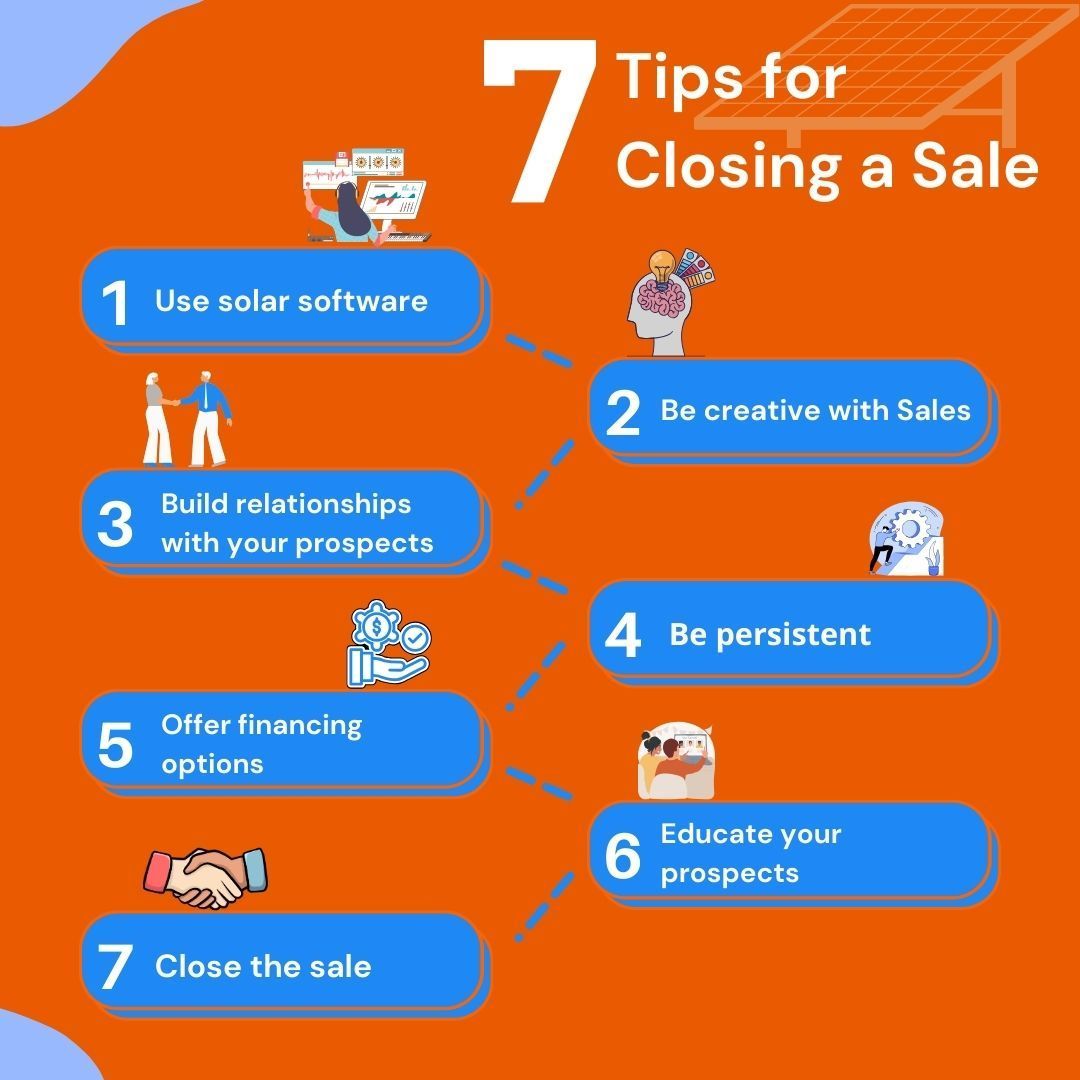
7 Tips for Closing a Solar Sale
The solar industry is one of the most competitive industries out there. To be successful, you need to know how to close a sale. Here are 7 tips for closing a sale in the solar industry:
1. Maintain efficiency using solar software
The first step to success is having and maintaining an efficient workflow. In the solar industry, time is money. The less time you spend on a project, the more projects you can take on and the more money you can make.
To do this, you need to use solar software. Solar software will help you manage your leads, proposals, contracts, payments, etc., all in one place. This way, you can focus on selling, not administrative tasks.
2. Get creative with your sales process
The second tip is to get creative with your sales process. There are many ways to close a sale, so don’t be afraid to try something new.
For example, you could offer a free consultation to potential customers. This allows you to learn about their needs and see if your product is a good fit. If it is, you can close the sale on the spot.
3. Build relationships with your prospects
The third tip is to build relationships with your prospects. In the solar industry, people do business with people they know and trust.
So, take the time to get to know your prospects and for them to get to know about you and what you offer. Find out about their businesses and their needs. The more you know about them, the more likely they are to do business with you.
4. Be persistent
The fourth tip is to be persistent. If a prospect is hesitant, don’t give up yet. Follow up with them and see if there’s anything you can do to change their mind.
5. Offer financing options
The fifth tip is to offer financing options. Many people are interested in solar but are hesitant because of the upfront cost.
If you can offer to finance, it will make it much easier for people to say yes to your proposal.
Types of financing options available for solar installation are leases, power purchase agreements, and loans. Additionally, educate people about the federal solar tax credit and other factors.
6. Educate your prospects
The sixth tip is to educate your prospects. People are more likely to buy from you if they understand what they’re buying.
So, take the time to explain the benefits of your solar product or service and how it can be valuable to them. This will ensure more solar sales!
7. Close the sale
The seventh and final tip is to close the sale. Once you’ve done everything else, it’s time to ask for the sale.
Remember, the key to closing is being confident and persuasive. If you believe in what you’re selling, your prospects will too.
If you follow these tips, you’ll be well on your way to success in the solar industry. Just remember to always be creative, persistent, and confident when closing a sale.
Conclusion
In conclusion, selling solar products and services requires a deep understanding of the solar industry and a strategic approach. With the solar industry's rapid growth and increasing awareness of the benefits of clean energy, there are abundant opportunities for certified energy practitioners and solar distributors.
By leveraging effective marketing strategies, embracing solar software for efficiency, and offering incentives, businesses can successfully market and sell solar systems.
Remember that building relationships, educating prospects, and being persistent is key to closing more solar panel sales. As solar continues to shine, those who master these techniques will find themselves at the forefront of a renewable energy revolution.
Generating more sales starts with generating better opportunities. Explore how Sunbase Solar Marketing helps solar companies attract qualified leads, strengthen customer relationships, and support sustainable business growth. Book a demo today!
FAQs
How do solar sales representatives generate more leads?
Successful reps generate leads through referrals, door-to-door outreach, SEO, paid advertising, social media, local events, partnerships, and educational content.
Why do homeowners hesitate to buy solar?
Common concerns include installation costs, financing, roof suitability, maintenance, warranties, and uncertainty about long-term savings.
What makes a successful solar sales pitch?
A strong sales pitch focuses on the homeowner's needs, explains financial and environmental benefits, answers objections clearly, and demonstrates long-term value instead of relying on pressure tactics.
How can solar companies improve their close rate?
Businesses can improve close rates by qualifying leads effectively, educating customers, providing personalized proposals, following up consistently, and simplifying the buying process.
One Platform.
Zero Chaos.
Run Your Entire Business in One Platform
Sunbase replaces your CRM, proposals, scheduling, job tracking, and reporting tools — all inside one clean, connected platform.
About Sunbase
The All-In-One Platform to Run Your Entire Business
Sunbase helps you organize operations, streamline daily workflows, and manage everything - from first customer contact to final project deliver- in one connected system.
Our Mission
- Organize your business.
- Optimize your workflow.
- Automate your dailytasks
Why Businesses Choose Sunbase
One Connected Workflow
Replace scattered tools and manual processes with a single platform that brings together your team, tasks, customers, jobs, and performance data.
🌎 Global Presence
Serving the United States, Canada, India, LATAM, Australia, and 10+ international markets.
👥 11,000+ Users
Trusted by contractors, installers, project managers, sales teams, and field technicians.
🏗️ Built for All Sizes
From small contracting teams to fast-growing enterprises, Sunbase adapts to your workflow.
Stop Managing Your Business Manually. Automate It.
Sunbase automates workflows, reduces mistakes, and helps your team get more done - without hiring extra staff or juggling multiple tools.
Still Managing Your Business Across Multiple Tools?
Bring your CRM, proposals, projects, and operations into one platform built for contractors.

