
Commercial Solar Proposal Software: What Changes When the Deal Isn't Residential
Key Takeaways:
- Commercial proposals need NPV, depreciation (MACRS), and demand-charge modeling, simple payback-period math, common in residential tools, isn't sufficient.
- Larger, more variable system sizes raise the cost of design or estimation errors significantly compared to residential projects.
- Commercial sales cycles involve multiple stakeholders, so proposals need to support a longer review process, not just a single-sitting decision.
- Remote site assessment matters even more for commercial properties, where physical site visits are costlier and more time-consuming to arrange.
- Not every proposal tool marketed broadly as "solar software" is built for commercial-scale financial modeling; this is worth verifying directly, not assuming.
Commercial solar proposal software automates the same core functions as residential tools: system design, energy production estimates, financial modeling, and branded proposal delivery, but needs to handle commercial-specific complexity: larger and more variable system sizes, NPV and depreciation-based financial analysis (not just simple payback), and proposals built for multiple stakeholders rather than a single homeowner decision-maker.
The right platform reduces manual calculation errors and speeds up the multi-week commercial sales cycle, but not every "solar proposal software" is actually built to handle commercial-scale modeling; that's the distinction worth checking before assuming a residential-first tool will fit.
Commercial solar deals move slower and involve more people than residential ones: a facilities manager, a CFO, sometimes a board, and a proposal built for a homeowner's kitchen-table decision doesn't hold up under that scrutiny.
Larger system sizes and site variability also raise the cost of a design or financial error, since a miscalculation on a 500kW rooftop system is a very different problem than one on a 6kW residential array.
This guide breaks down what commercial solar proposal software actually needs to do differently, the features that matter most for commercial-scale projects, and what separates a tool built for this complexity from a residential-first platform stretched to cover it.
What is Commercial Solar Proposal Software?
Commercial Solar Proposal Software refers to software that generates business proposals for a particular solar company/ individual.
The most basic function of this type of software is the generation of new business/proposals. Some advanced commercial solar proposal software systems can analyze ongoing data, generate reports, and display all relevant business details in one place.
Solar Proposal software is focused on converting proposals into sales, especially for those in the commercial solar industry. Often integrated with solar design software, the two combine to convert proposals by turning the manual process of drafting proposals, creating designs, and making edits into a virtual workflow.
The main goal of commercial proposal software is to make the solar project easier for the solar business owner and team.
A commercial solar proposal tool takes into account factors such as energy prices and costs to generate accurate quotes for a client's specific installation requirements, allowing solar businesses to quote on any products or services they choose. It can also help determine the costs involved in producing a certain product, such as an electricity bill.
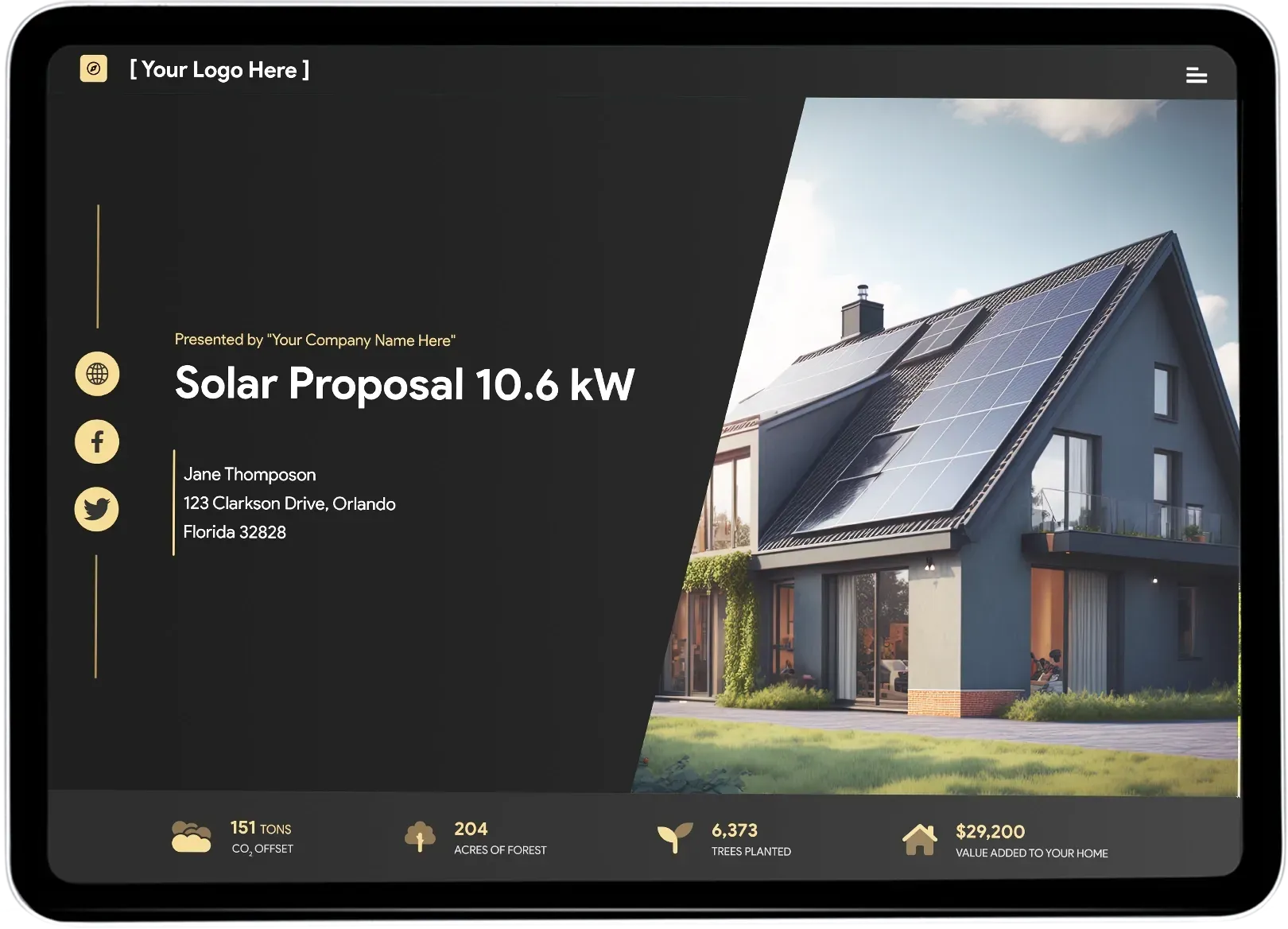
Important features of commercial solar proposal software
If you're a company or individual in the solar and engineering industry, then solar proposal software is one of the most important solar design and CRM tools that you'll use in your solar projects. The main aim of the tool is to simplify the design process undertaken by solar companies when they deal with their customer projects.
Commercial Solar proposal software caters to a wide range of processes, including:
1. Solar Design Tools
Purpose: Solar system design software is essential for accurately planning the layout of solar panels on a client's property or facility. They help optimize the system's performance by considering factors like roof size, orientation, shading, and local climate data.
Functionality: Users typically input specific project details, and the software generates a visual representation of the solar array's placement. It should allow for adjustments and fine-tuning to optimize energy generation.
Benefits: These tools enable solar professionals to design systems that maximize energy production and return on investment. Clients can visually see how the solar panels will be positioned on their property, which helps in decision-making.
2. Energy Production Estimates
Purpose: Energy production estimates provide clients with a clear understanding of the expected energy output of the proposed solar system.
Functionality: The software uses the system design, location data, and historical weather information to estimate energy production. It may also consider factors like panel efficiency and degradation over time.
Benefits: Accurate energy production estimates help clients assess potential savings and make informed decisions about their solar energy system. It also aids in sizing the system correctly to meet their energy needs.
3. Financial Analysis
Purpose: Financial management software helps users estimate the costs, financial incentives, tax benefits, and payback periods associated with the solar energy project.
Functionality: Users input project costs, financing options, and incentives, and the software calculates financial metrics such as return on investment (ROI), net present value (NPV), and payback period.
Benefits: These tools empower clients to evaluate the financial viability of solar projects. Solar professionals can present compelling financial data to support their proposals, making it easier for clients to commit to solar systems.
This is usually the feature worth testing directly rather than taking at face value. Sunbase's commercial proposal modeling runs NPV and payback calculations alongside the system design, so the numbers a facilities manager sees are tied to the actual site data, not a generic template.
4. Customization
Purpose: Customization features allow users to personalize proposals with their company branding, logos, and contact information.
Functionality: Users can modify proposal templates to reflect their unique brand identity and tailor content to match the client's needs and preferences.
Benefits: Customization enhances the professionalism of proposals and fosters brand recognition. Personalized proposals also create a more engaging and persuasive client experience.
5. Remote Site Assessment
Purpose: Remote site assessment tools streamline the initial assessment process by using satellite imagery and other data sources.
Functionality: Users can access remote site assessment features to gather essential data about the client's property, including roof dimensions, shading, and geographical orientation.
Benefits: This feature accelerates the proposal creation process, reducing the need for physical site visits. It also helps solar professionals quickly identify suitable properties for solar installations.
Why is Proposal Software Important for Solar Projects?
Solar Proposal software plays a vital role in the solar industry by enhancing efficiency, reducing errors, and improving collaboration and presentation quality.
These benefits ultimately contribute to the successful planning and execution of more solar projects while also making it easier for clients to understand the advantages of adopting solar energy solutions.
1. Efficiency and Automation
Solar proposal software streamlines the process of creating detailed proposals for commercial solar projects. It automates various tasks, such as designing solar arrays, calculating energy production, and estimating the costs of solar energy systems.
By automating these tasks, solar professionals can generate proposals more quickly and efficiently. This efficiency is especially valuable in an industry where time is often of the essence, as it allows for faster responses to client inquiries and competitive bids.
2. Accuracy and Error Reduction
Solar sales involve complex calculations, including energy production estimates, financial modeling, and incentive calculations. Human error in these calculations can lead to inaccurate proposals and financial projections.
Proposal software significantly reduces the risk of errors by performing calculations consistently and accurately. This ensures that clients receive reliable and precise information about the expected benefits and costs of their solar installations.
3. Collaboration and Presentation Improvement
Solar energy projects often require collaboration among team members, including designers, engineers, and salespeople. Proposal software facilitates this collaboration by providing a centralized platform where team members can work together on proposals.
Furthermore, proposal software typically offers tools for creating visually appealing and professional presentations. This improves the overall quality of proposals and helps solar professionals make a compelling case for their projects to clients.
What Are The Best Commercial Solar Proposal Tools Available in the Market?
| Platform | Best For | Consideration |
|---|---|---|
| Sunbase | Commercial teams needing NPV/depreciation modeling and remote assessment on one platform with CRM and design | Best value once financial modeling and design run on shared data |
| Aurora Solar | Residential-to-light-commercial teams wanting AI design plus proposal generation in one tool | Commercial depth drops off at larger scale; owns HelioScope for that segment instead |
| HelioScope (Aurora-owned) | C&I and utility-scale engineering teams needing fast, precise layout and 8,760-hour yield simulation | No native proposal generation or financial modeling — design/engineering tool only |
| OpenSolar | Cost-conscious, lower-volume installers | Commercial-scale modeling and support depth are lighter than paid platforms |
Conclusion
Commercial solar proposal software earns its place when it handles what residential-first tools typically don't: NPV-based financial modeling, larger and more variable system designs, and a proposal built to survive a multi-stakeholder review rather than a single conversation.
The efficiency and error-reduction benefits are real, but only if the underlying modeling is actually built for commercial complexity rather than residential math with bigger numbers plugged in.
Sunbase solar proposal software runs commercial-grade financial analysis on the same platform as design and CRM, so a proposal reflects the same site and pricing data used everywhere else in the deal, not a separately maintained spreadsheet.
FAQ's
1. How is commercial solar proposal software different from residential tools?
Commercial tools need to model NPV, depreciation, and demand-charge savings, not just simple payback — and handle larger, more variable system designs that carry higher error costs if miscalculated.
2. Does commercial proposal software still need remote site assessment?
Yes, often more so — commercial properties are costlier and slower to visit in person, so accurate remote assessment via satellite imagery matters even more at this scale.
3. Can one platform handle both residential and commercial proposals?
Some can, but it's worth confirming the financial modeling specifically supports commercial-grade calculations (NPV, depreciation) rather than assuming residential-level payback math scales up automatically.
One Platform.
Zero Chaos.
Run Your Entire Business in One Platform
Sunbase replaces your CRM, proposals, scheduling, job tracking, and reporting tools — all inside one clean, connected platform.
About Sunbase
The All-In-One Platform to Run Your Entire Business
Sunbase helps you organize operations, streamline daily workflows, and manage everything - from first customer contact to final project deliver- in one connected system.
Our Mission
- Organize your business.
- Optimize your workflow.
- Automate your dailytasks
Why Businesses Choose Sunbase
One Connected Workflow
Replace scattered tools and manual processes with a single platform that brings together your team, tasks, customers, jobs, and performance data.
🌎 Global Presence
Serving the United States, Canada, India, LATAM, Australia, and 10+ international markets.
👥 11,000+ Users
Trusted by contractors, installers, project managers, sales teams, and field technicians.
🏗️ Built for All Sizes
From small contracting teams to fast-growing enterprises, Sunbase adapts to your workflow.
Stop Managing Your Business Manually. Automate It.
Sunbase automates workflows, reduces mistakes, and helps your team get more done - without hiring extra staff or juggling multiple tools.
Still Managing Your Business Across Multiple Tools?
Bring your CRM, proposals, projects, and operations into one platform built for contractors.