
There's a question solar company owners ask themselves more than they'd like to admit: Why did we lose that deal?
Sometimes it's price. Sometimes it's the competitor's reputation. But increasingly, and this is the one that stings, it's speed. The other company sent a proposal while yours was still being built.
The teams winning this race aren't bigger. They're not hiring more designers or working longer hours. They've changed how PV design work actually gets done.
Manual PV design- pulling satellite images into CAD tools, hand-calculating shading, building proposals in PowerPoint- was workable when competition was thinner, and project volumes were lower. It's not workable at the pace the market is moving now.
Solar design software doesn't just make design faster. It changes the operational relationship between your sales team and your design team, between proposal turnaround time and close rate, between the number of designers you employ and the number of projects you can actually handle.
This article explains how not at a feature level, but at a workflow level. What actually changes, where the time gets saved, and what it means for a solar business trying to grow without the design team becoming the permanent ceiling on capacity.
Key Takeaways
- As project volume grows, satellite downloads, CAD layouts, and hand calculations become the primary bottleneck between a qualified lead and a closed deal.
- The company that delivers a complete, accurate proposal first wins more often, and solar design software cuts that turnaround from days to hours.
- Incorrect sizing, shading miscalculations, and inaccurate production estimates create costly redesigns and post-installation disputes that automated tools prevent.
- Automated layout and proposal tools let sales reps run preliminary designs independently, bringing engineering in only when genuinely needed.
- Manual estimates are frequently wrong. Purpose-built software uses sun path modeling and 3D terrain data to produce results that hold up post-installation.
Step Inside a Modern, Spreadsheet-Free Solar Design Workflow
If you're qualifying more leads than your current design workflow can handle, or if proposal turnaround time has become a competitive liability, the answer isn't adding headcount. It's changing how the work gets done.
No commitment. No pressure. Get a clear look at what the design process could actually look like for your team → Request a live walkthrough
Understanding Solar Design Software
Solar design software is a digital platform built specifically for designing, modeling, and simulating photovoltaic systems. It handles system sizing, equipment selection, shading analysis, production estimation, and financial calculations all within a single workflow.
Unlike general-purpose CAD tools or spreadsheet-based processes, solar design software is built around the actual stages of a solar project.
From initial site assessment through layout, proposal generation, and post-installation performance monitoring, these platforms are designed to reduce the manual work at each stage while improving the accuracy of every output.
For solar installers, EPC firms, and growing solar businesses, the practical effect is that design work that once required experienced engineers spending several hours per project can be completed in a fraction of the time with fewer errors and a more professional output reaching the customer.
Why is efficient PV design the make-or-break factor for solar growth?
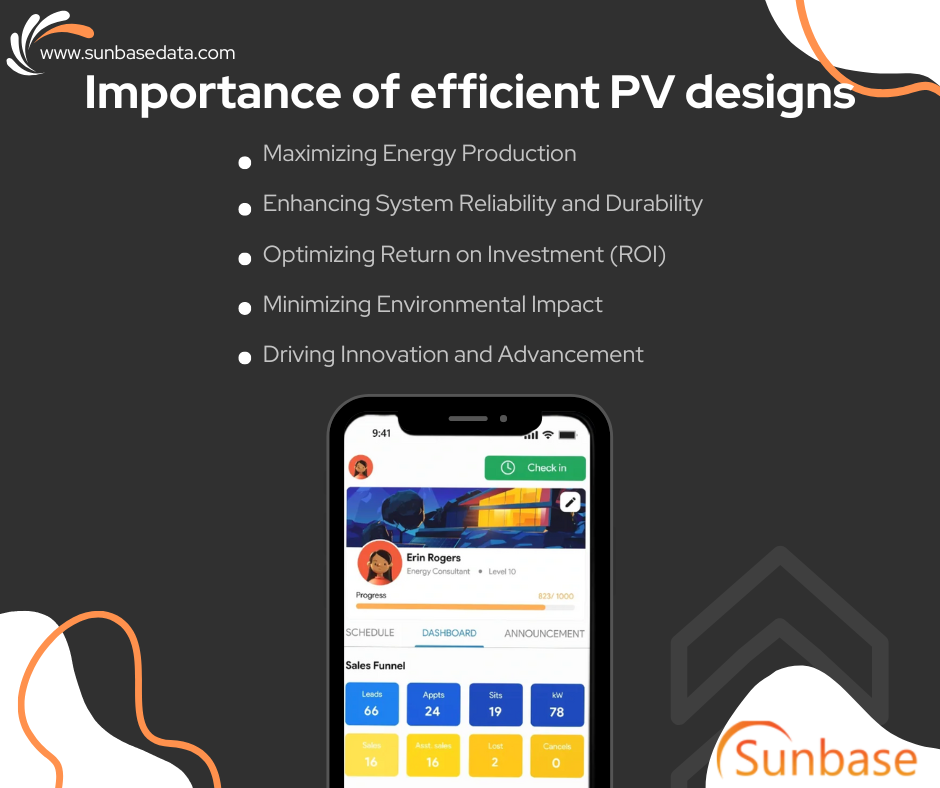
Efficient PV design sits at the intersection of every major business outcome in a solar company: close rate, project margin, installation speed, customer satisfaction, and referral volume. Getting the design right the first time is not just good engineering; it is good business.
1. Maximizing Energy Production Through Accurate Layout
Efficient PV designs are engineered to harness the maximum sunlight and convert it into usable electricity. By optimizing panel orientation, tilt angles, and layout, these designs ensure that solar panels capture as much sunlight as possible throughout the day, thereby maximizing energy production.
2. Return on Investment Across the Project Lifetime
Over-designed systems waste materials and eat into the margin. Under-designed systems leave customers disappointed when their bills don't drop as expected.
The right design, properly sized, accurately laid out, and realistically estimated, produces the best outcome for both sides. The customer gets the savings they were sold on. The contractor delivers within the margin they quoted. That's the deal that generates referrals.
3. Driving Innovation in Design Practice
Modern design tools make advanced capabilities, such as shading simulation, production modeling, and financial analysis, accessible to designers at every experience level.
As the tools improve, so does the quality of designs across the industry. Customer outcomes get better, and the bar for what a professional solar proposal looks like gets higher.
Common Challenges in Manual PV Design Workflows
Every solar company running manual design processes hits the same ceiling at some point. The workflow that managed 15 projects a month starts breaking down at 40. Here is where it breaks first.
1. Time-Consuming Site Assessments
Manual site assessments require designers to collect roof measurements, evaluate shading, identify obstructions, and document site conditions. This process can take over an hour per project and often produces inconsistent results, leading to design errors and additional revisions.
2. Revision Cycles That Stack Up Against New Project Work
Changes to system size, panel layout, financing options, or customer preferences often require designers to revisit calculations and update proposals manually. As revision requests increase, they compete with new project work and slow overall productivity. The more projects in the pipeline, the worse this compression becomes.
3. Inaccurate Production Estimates
The most expensive design mistakes don't appear during the proposal stage. They appear six months after installation, when a customer's energy bills haven't dropped as projected. The root cause is almost always a shading miscalculation or system sizing error present in the original design, but undetectable with manual estimation methods.
These post-installation conversations are expensive in time, trust, and sometimes money. They are also almost entirely preventable with the right design tools.
4. Data Transfer Friction Between Disconnected Tools
Many solar companies rely on multiple tools for measurements, system layouts, calculations, and proposal creation. Moving data between platforms manually increases the risk of errors, creates inefficiencies, and adds unnecessary administrative work to the design process.
What Are the Benefits of Using Solar Design Software?
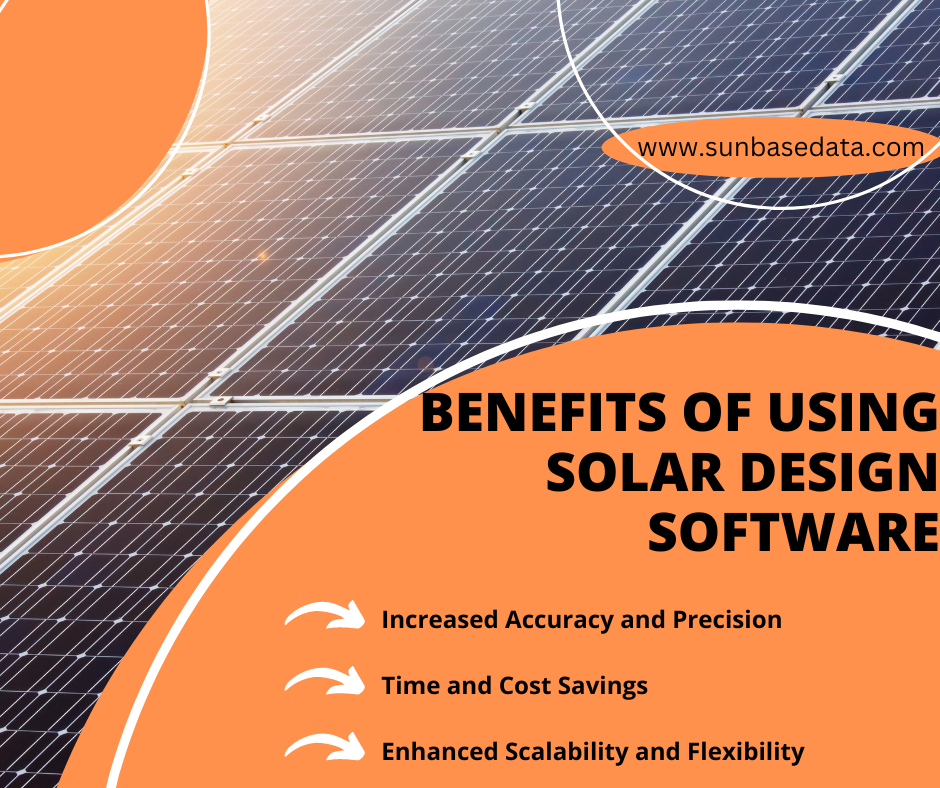
Solar design software helps companies create PV designs faster, improve accuracy, and manage a growing number of projects more efficiently. Industry analysis shows that modern solar design platforms can generate solar layouts, production estimates, and customer proposals in minutes rather than days, helping installers respond faster and improve sales efficiency.
1. Designs that don't come back for revision
Solar design software uses site-specific data, shading analysis, and energy production modeling to create more accurate system designs and performance estimates. This reduces the risk of sizing errors, unrealistic production forecasts, and costly design revisions later in the project.
2. Proposals that go out the same day
Site assessment, layout, production calculation, and proposal generation run in one workflow. What used to take two to three days gets done in a few hours. The customer gets a proposal while the conversation is still live, which is when decisions get made.
3. Lower Operational Costs
By automating repetitive design tasks, solar companies can reduce the time spent on manual calculations, data entry, and proposal updates. Fewer errors and revisions impact the cost of solar installation throughout the project lifecycle.
4. More projects without more designers
The bottleneck in most growing solar companies isn't leads; it's design capacity. Software breaks that ceiling. The same team handles significantly more volume because the repetitive work is automated.
5. Better Customer Experience
Accurate designs and faster proposal delivery help build customer confidence early in the sales process. Clear production estimates and professional proposals also improve communication and support more informed purchasing decisions.
6. Improved Team Collaboration
Solar design software empowers project managers, designers, and sales teams to work from the same project data, reducing communication gaps and ensuring everyone has visibility into project requirements, updates, and timelines.
Real-World Scenarios Where Solar Design Software Makes a Difference
Scenario 1: A Homeowner Wants a Solar Proposal Before the Weekend
Without Solar Design Software:
The sales rep visits the property, takes photos and measurements, and sends everything to the design team. The designer manually creates the layout, runs production calculations, and builds the proposal. By the time the proposal reaches the customer, several days have passed, and the homeowner is already reviewing quotes from competitors.
With Solar Design Software:
The sales rep uses satellite imagery and automated design tools to generate a preliminary system layout during the consultation. Production estimates, savings projections, and financing options are calculated automatically, and a professional proposal is delivered the same day.
The customer gets answers while their interest is highest, significantly improving the chances of winning the project.
Scenario 2: A Customer Questions Their Projected Energy Savings
Without Solar Design Software:
Production estimates were based on basic calculations and limited shading analysis. After installation, actual performance falls below expectations, leading to customer complaints and lengthy investigations.
With Solar Design Software:
The system uses site-specific shading analysis, historical irradiance data, equipment specifications, and performance modeling to generate realistic production forecasts.
Expectations are set accurately from the beginning, reducing disputes after installation. Customers trust the projections because they're backed by data rather than assumptions.
How Solar Design Software Simplifies PV Designs?
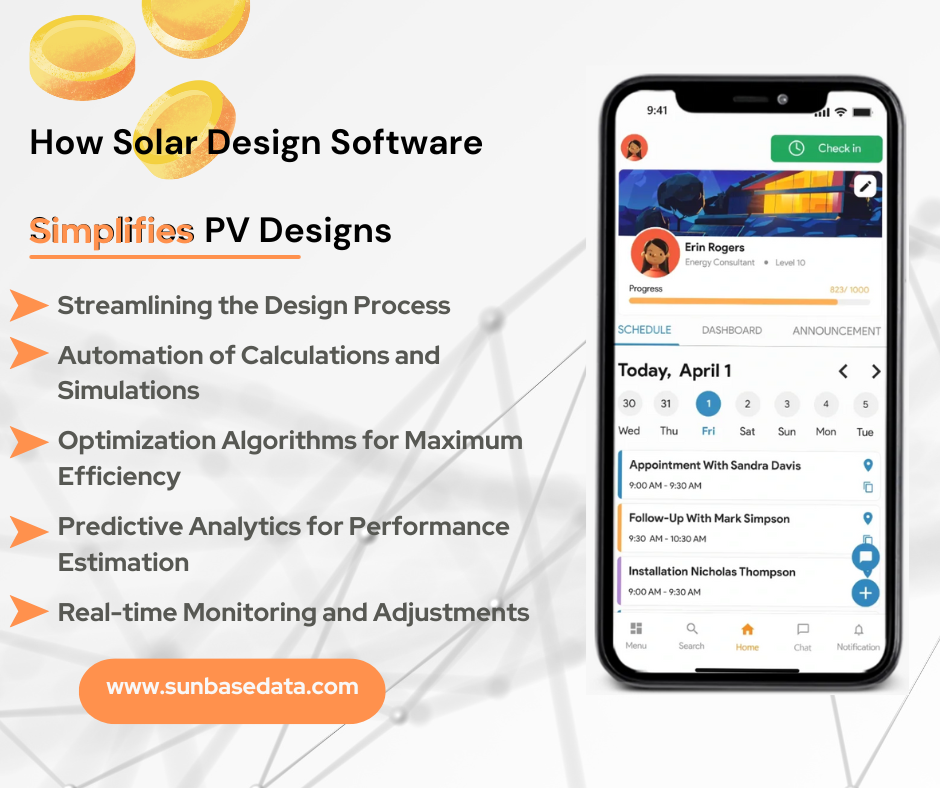
Here's what actually changes at each stage of the design and proposal workflow, not a feature list, but a walkthrough of the process.
Streamlining the Design Process From Site to Proposal
Instead of jumping between satellite imagery, CAD tools, spreadsheets, and proposal templates, everything runs in one platform. Roof measurement feeds into layout. Layout feeds into production calculations. Production calculations feed into the proposal. No manual transfers, no version mismatches, no hunting for the right file.
The practical result: a complete, accurate proposal can go out the same day as the site assessment while the customer is still engaged and the conversation is still fresh.
Automation of Calculations, Simulations, and System Sizing
Solar calculations involve a lot of variables, including panel efficiency, tilt angle, azimuth, shading factors, temperature coefficients, inverter efficiency, and system losses. Done manually, it's slow and easy to get wrong.
Software handles all of it automatically, pulling from actual site data and equipment specs rather than rule-of-thumb estimates. The output reflects what the system will actually do at that specific site, not what a similar system might do somewhere else.
Optimization Algorithms for Maximum System Efficiency
Finding the best panel configuration for a given site isn't something a designer can evaluate exhaustively by hand. There are too many variables.
Software evaluates multiple configurations simultaneously, orientation, tilt, shading impact, equipment selection, and surfaces the highest-performing layout automatically. What would take a designer hours of manual comparison happens in seconds, before the design is finalized.
Predictive Analytics for Reliable Performance Estimation
A credible production estimate is what closes deals and prevents post-installation disputes. Software generates performance projections from historical irradiance data, equipment specs, and the completed shading analysis, not from industry averages or rough calculations.
Customers see inputs they can understand. Solar companies reduce the risk of performance gaps that damage trust later.
Real-Time Monitoring and Post-Installation Performance Tracking
The best solar design software doesn't stop being useful after the proposal is signed. They integrate with monitoring systems that track installed performance against the original design estimates.
When output drops below projected thresholds, the system flags it.
That means proactive outreach to the customer before a performance gap becomes a complaint and performance data that feeds back into future designs, making estimates progressively more accurate over time.
What Changes Operationally When a Solar Company Adopts Design Software?
The shift isn't just about speed. It changes how work is distributed across the team and how the company looks to the customer.
For the sales team, preliminary design tasks move to the front of the process. With automated roof measurement and quick-layout tools, a rep can show a customer a visual of their actual roof panels on it, system-sized, production estimated during or right after the site visit. That's a different conversation than "we'll send something over in a few days."
For the design team, the lowest-value tasks disappear from the queue. Roof measurements, standard shading analysis, and initial layouts are generated automatically. What lands on the designer's desk is a partially built project that needs review and refinement, not a blank file. The expertise gets applied where it actually matters: complex shading scenarios, non-standard roofs, edge cases.
For the customer, receiving a detailed, professional proposal the same day as the site visit stands out. Most competitors are still delivering a PDF several days later. That first impression shapes how the customer thinks about the rest of the project.
Signs Your Solar Company Has Outgrown Its Current Design Process
Most solar companies don't switch to design software after reading an article. They switch because something broke. These are the signals worth paying attention to before that happens.
1. Your design team is the ceiling on sales capacity: Qualified leads are waiting on proposals because the design queue is backed up. Adding designers to a manual process costs more without fixing the throughput problem.
2. Proposal turnaround has crept past 48 hours: Companies that deliver complete proposals within 24 to 48 hours consistently outperform those that take longer. If the average is approaching two days, deals are going to competitors who've automated the process.
3. Post-installation performance complaints are becoming a pattern: One customer with lower-than-projected output is a data point. Three or more is a design process problem, usually shading or sizing errors that software catches automatically.
4. Revisions are taking more time than new designs: If a significant portion of the design team's week goes to reworking existing projects rather than building new ones, the initial designs aren't accurate enough, or the revision workflow is too slow.
5. Sales and design run on completely separate systems: When project data has to be manually transferred between the sales pipeline and the design workflow, that handoff is where deals stall, and errors get introduced.
What to Look for When Evaluating Solar Design Software?
Most solar design platforms claim the same things- faster proposals, better accuracy, easier workflows. Here's what actually separates them when you look closer.
1. Shading analysis depth
Some tools run a basic shading overlay. Others run a time-series sun path simulation across every hour of the year for every panel position. The difference shows up six months post-installation when your production estimates either hold up or they don't. Ask specifically how the platform models shading and what data it uses.
2. Where the workflow starts and ends
A tool that only handles layout still requires manual transfer to your proposal and CRM. A platform that connects design to proposal to project record eliminates that transfer entirely. Know exactly which steps in your current workflow the software replaces versus which ones you're still doing manually.
3. How it handles revisions
Revisions are inevitable. The question is whether changing a system size, panel count, or financing option updates the full proposal automatically or requires someone to manually redo sections. That difference alone can save hours per week.
4. Integration with your existing stack
Native integrations are faster and more reliable than middleware connections. Ask which tools it integrates with natively- specifically, your CRM and project management system — and whether data flows both ways or only one direction.
5. What onboarding actually looks like
A platform that takes three months to implement is a liability, not an asset. Ask for a realistic timeline, what support is included, and whether there are references from companies of similar size who've been through it.
How Does Sunbase Support Faster and More Accurate Solar Design Workflows?
Sunbase is built specifically for solar, not adapted from a generic CAD tool or a general proposal platform. It handles the full design-to-proposal workflow in one connected system, whether the company is a small residential solar installer or a scaling EPC operation.
Key Features of Sunbase Solar Design Software
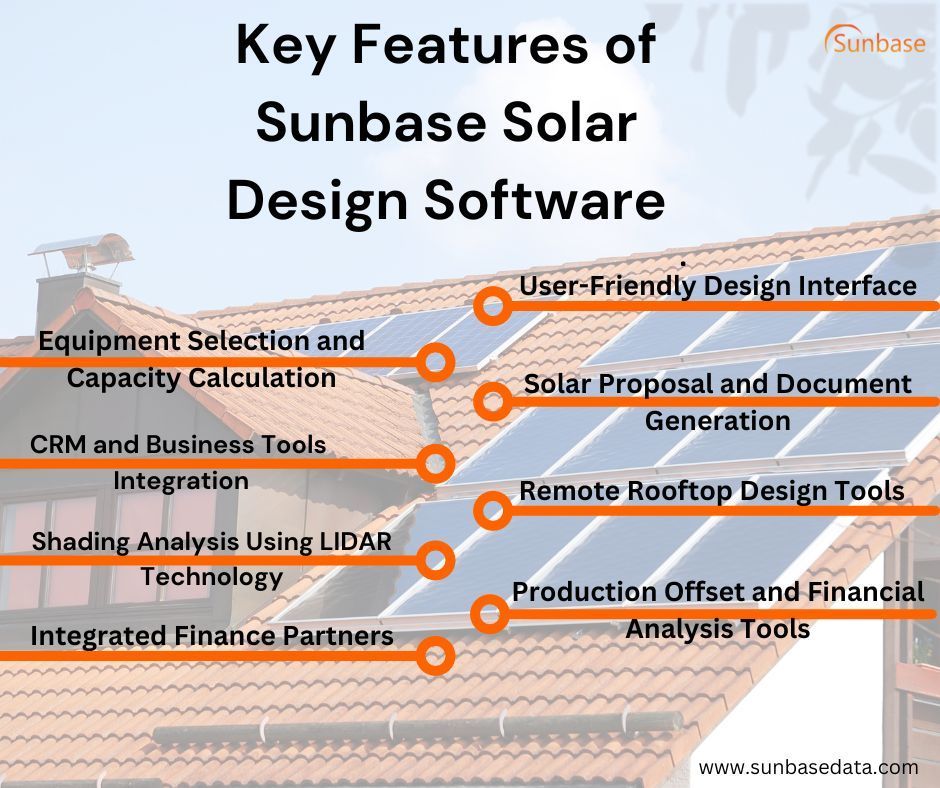
User-Friendly Interface Built for Fast Onboarding
Every step from site assessment to completed proposal follows a linear, guided workflow. No extensive training required. New team members get up to speed quickly, and experienced designers move faster because there's no unnecessary friction built into the process.
Remote Rooftop Design Without an On-Site Visit
Using satellite imagery, Sunbase lets users map the installation area and identify the right installation site based on roof pitch, orientation, and azimuth without a physical visit. For high-volume operations, this cuts the cost per proposal and compresses the sales cycle significantly.
Equipment Selection and System Capacity Calculation
Designers select equipment from a maintained library and calculate available capacity from the site's actual surface area, shading data, and customer consumption figures. Sizing comes from real inputs, not estimates, which means production projections that hold up after installation.
Production Offset and Financial Analysis Tools
Sunbase calculates monthly kWh consumption, utility rates, price per watt, isolation values, and installation direction, then uses those figures to determine the right panel count and system wattage. Financial projections and ROI calculations are built into the platform and flow straight into the proposal.
Solar Proposal and Document Generation in One Workflow
Equipment specs, production estimates, financial projections, and 3D system renderings populate into branded proposal templates automatically. Contracts and project documents are generated from the same platform. No manual formatting, no version control problems, no attachment juggling.
Shading Analysis Using LIDAR Technology
Sunbase uses LIDAR-based shading analysis to calculate shade impact across every panel position on the site, accounting for terrain and obstructions, regardless of how complex the layout is. It runs automatically as part of the standard workflow, removing the guesswork that leads to post-installation performance gaps.
Integrated Finance Partners for Streamlined Customer Financing
Financing options are embedded directly into the proposal. Customers see system cost, projected savings, and available terms in one document, which reduces the back-and-forth between proposal acceptance and financing approval that stalls deals at the final stage.
CRM and Business Tools Integration
Design data flows into the sales pipeline without manual re-entry. Project records carry through to project management, installation scheduling, and customer communication. The full workflow stays connected from first contact to final installation.
Conclusion
As project volumes increase and customer expectations rise, manual design processes can quickly become a bottleneck, slowing proposal delivery, increasing errors, and limiting scalability.
By automating site assessments, production calculations, system sizing, and proposal generation, solar design software helps teams work faster without compromising accuracy. It reduces repetitive tasks, improves collaboration between sales and design teams, and gives customers the confidence that comes from receiving detailed, data-driven proposals.
Ultimately, the companies that scale successfully are not necessarily the ones with the largest teams. They're the ones with workflows that allow them to deliver accurate designs, respond quickly to opportunities, and manage growing demand without adding unnecessary complexity.
As the solar market continues to evolve, investing in a more efficient PV design process can help solar companies improve productivity and position themselves for sustainable growth.
Your Design Team Shouldn't Be the Reason You're Turning Down Work
If you're qualifying more leads than your current design workflow can handle, or if proposal turnaround time has become a competitive liability, the answer isn't adding headcount. It's changing how the work gets done.
Sunbase Solar Design Software is built for solar companies growing faster than their manual processes can keep up with.
See how Sunbase works for your team
FAQs
What happens to our existing project data when we switch?
Most solar design platforms, including Sunbase, support data migration during onboarding. Your existing customer records, project files, and proposal history can be imported. It's the most time-intensive part of the switch, but it's a one-time cost, not an ongoing one.
What features should I look for in solar design software?
Key features include automated system sizing, shading analysis, production forecasting, proposal generation, equipment libraries, CRM integrations, and project collaboration tools.
Does solar design software integrate with CRM systems?
Most solar design platforms integrate with CRM, project management, and business management software. This reduces manual data entry and keeps sales, design, and operations teams aligned.
Is solar design software suitable for small solar businesses?
Absolutely. Solar design software helps small teams handle more projects, improve proposal turnaround times, and scale operations without immediately hiring additional designers or engineers.
One Platform.
Zero Chaos.
Run Your Entire Business in One Platform
Sunbase replaces your CRM, proposals, scheduling, job tracking, and reporting tools — all inside one clean, connected platform.
About Sunbase
The All-In-One Platform to Run Your Entire Business
Sunbase helps you organize operations, streamline daily workflows, and manage everything - from first customer contact to final project deliver- in one connected system.
Our Mission
- Organize your business.
- Optimize your workflow.
- Automate your dailytasks
Why Businesses Choose Sunbase
One Connected Workflow
Replace scattered tools and manual processes with a single platform that brings together your team, tasks, customers, jobs, and performance data.
🌎 Global Presence
Serving the United States, Canada, India, LATAM, Australia, and 10+ international markets.
👥 11,000+ Users
Trusted by contractors, installers, project managers, sales teams, and field technicians.
🏗️ Built for All Sizes
From small contracting teams to fast-growing enterprises, Sunbase adapts to your workflow.
Stop Managing Your Business Manually. Automate It.
Sunbase automates workflows, reduces mistakes, and helps your team get more done - without hiring extra staff or juggling multiple tools.
Still Managing Your Business Across Multiple Tools?
Bring your CRM, proposals, projects, and operations into one platform built for contractors.

