
The solar industry is growing rapidly, but with that growth comes an increasingly complex regulatory landscape. Solar businesses must comply with a wide range of state and federal policies, including net metering changes, tax credits, tariffs, and permitting requirements. Failure to comply can result in fines, project delays, and lost revenue.
This is where Solar CRM (Customer Relationship Management) software plays a vital role. A compliance-focused solar CRM helps businesses stay updated on policy changes, automate documentation processes, and streamline compliance workflows.
How Solar CRM Software Helps You Stay Compliant with Regulatory Requirements
Solar CRM software can help your solar business stay compliant by organizing regulatory documents, tracking approvals, and standardizing workflows throughout the project lifecycle.
It centralizes permits, subsidy paperwork, customer agreements, and inspection records, while automated reminders and audit trails reduce missed deadlines and errors.
By maintaining accurate, up-to-date records and compliance visibility, a solar CRM simplifies regulatory management and lowers the risk of delays or penalties for your solar business.
Key Takeaways
- The Compliance Challenge in the Solar Industry: Frequent regulatory changes, documentation burdens, and financial risks of non-compliance.
- How Solar CRM Helps Businesses Stay Compliant: Automated policy tracking, seamless documentation, workflow automation.
- Future-Proofing Your Business - The Role of AI & Data Analytics: AI-powered predictive compliance, data-driven decision-making, automated risk assessment.
- Key Features to Look for in a Compliance-Focused Solar CRM: Regulatory tracking, customizable workflows, automated reporting, seamless integration with financing and permitting tools.
Want to Stop Chasing Compliance, Finally?
When compliance is built into your CRM, approvals, documentation, and updates stay organized automatically without constant follow-ups or manual tracking.
You can see how Sunbase keeps regulatory requirements visible and manageable at every stage. Book your personalized demo to see it in action today.
The Compliance Challenge in the Solar Industry

1. Constantly Changing Regulations
The solar industry is subject to frequent regulatory changes, which vary across states and even local jurisdictions. Net metering policies, tariffs, tax credits, and permitting rules are frequently updated, making it difficult for solar companies to keep up. For instance:
- Net metering reforms are reducing the compensation solar owners receive for excess electricity sent to the grid.
- Utility companies are implementing new tariffs and grid access charges that impact solar project feasibility.
- Federal incentives like the Inflation Reduction Act continue to provide tax credits, but eligibility criteria change over time.
Staying informed about these changes is critical for solar sales teams and project managers to make accurate project estimates and financial projections.
2. Documentation and Reporting Burdens
Solar companies must maintain extensive records to comply with regulations. This includes permits, contracts, financing documents, and interconnection agreements. Inefficient project management and manual document handling increase the risk of errors and non-compliance, leading to delays in project approvals.
Moreover, regulatory bodies often conduct audits to ensure solar projects meet compliance standards.
Without an efficient document management system, retrieving necessary paperwork for audits becomes a major challenge.
3. The Risk of Financial Penalties and Project Delays
Non-compliance with regulatory requirements can have serious consequences. Fines, penalties, and project cancellations can erode profitability and damage a company’s reputation.
For instance, failing to adhere to new interconnection rules can result in solar installations being denied access to the grid, leading to substantial financial losses.
To mitigate these risks, solar businesses need an advanced CRM platform that simplifies compliance management and provides real-time policy tracking.
For a simple breakdown of how Solar CRMs work, read this next: Understanding Solar CRM: A Beginner’s Guide
How Solar CRM Helps Businesses Stay Compliant
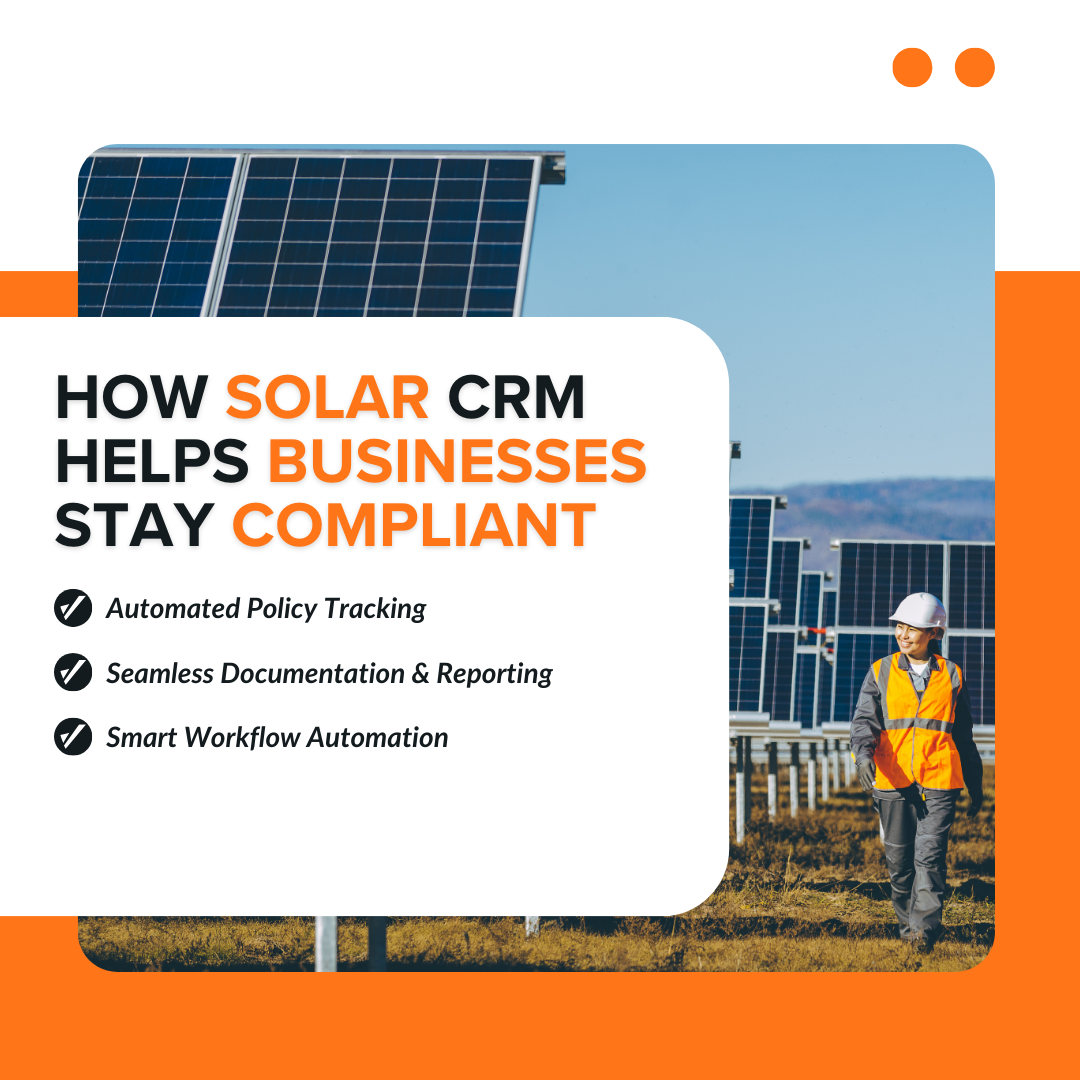
A powerful solar CRM software automates compliance processes, reducing the burden on sales reps, project managers, and finance teams. Here’s how a solar CRM solution can help:
1. Automated Policy Tracking
- Stay updated on net metering rules, tax incentives, and utility rate changes.
- Receive real-time alerts on policy shifts and new compliance mandates while enhancing lead management.
- Avoid costly mistakes by ensuring accurate financial projections for solar installations.
2. Seamless Documentation & Reporting
- Automatically store and organize permits, contracts, and regulatory documents.
- Enable easy access to compliance paperwork for audits and inspections.
- Improve efficiency by reducing manual data entry and document errors.
3. Smart Workflow Automation
- Ensure all projects follow state and federal compliance guidelines with a structured sales process that minimizes regulatory risks.
- Reduce human error with automated approval processes.
- Standardize customer communication and reporting for regulatory bodies.
For a practical look at improving solar workflows end to end, check out: 10 Ways a Solar CRM Can Revolutionize Your Business Workflow
Future-Proofing Your Business: The Role of AI & Data Analytics in Solar Compliance

1. AI-Powered Predictive Compliance
AI-driven tools can analyze historical policy changes and predict future regulatory shifts, allowing solar businesses to adapt their strategies proactively.
By integrating AI-powered compliance tools within a solar CRM platform, companies can stay ahead of the curve and minimize risks.
2. Data-Driven Decision Making
Leveraging real-time insights from compliance data helps businesses optimize their strategies. By analyzing solar project trends, policy updates, and market fluctuations, companies can make informed decisions that improve project success rates, even in complex sales cycles.
3. Automated Risk Assessment
Using AI-based risk assessment tools, solar businesses can identify potential compliance risks before they become costly issues. These tools flag discrepancies in project documentation, track regulatory deadlines, and provide proactive recommendations for compliance management.
Integrating AI-driven tools in your Solar CRM ensures long-term success in a rapidly evolving industry.
To see how AI improves scheduling, coordination, and on-site execution, read: Streamline Solar Installations with AI Solar Software
Key Features to Look for in a Compliance-Focused Solar CRM

To effectively manage compliance, solar companies should invest in CRM software that includes:
- Regulatory updates & tracking integration – Stay informed about changes in net metering, tariffs, and tax credits to optimize your sales pipeline.
- Customizable compliance workflows – Adapt CRM functionality to your company’s specific compliance needs.
- Automated reporting & document management – Ensure seamless audits and regulatory filings.
- Seamless integration with financing platforms & permitting tools – Connect seamlessly with third-party software to streamline the approval process.
Why Sunbase’s Solar CRM is Your Compliance Solution
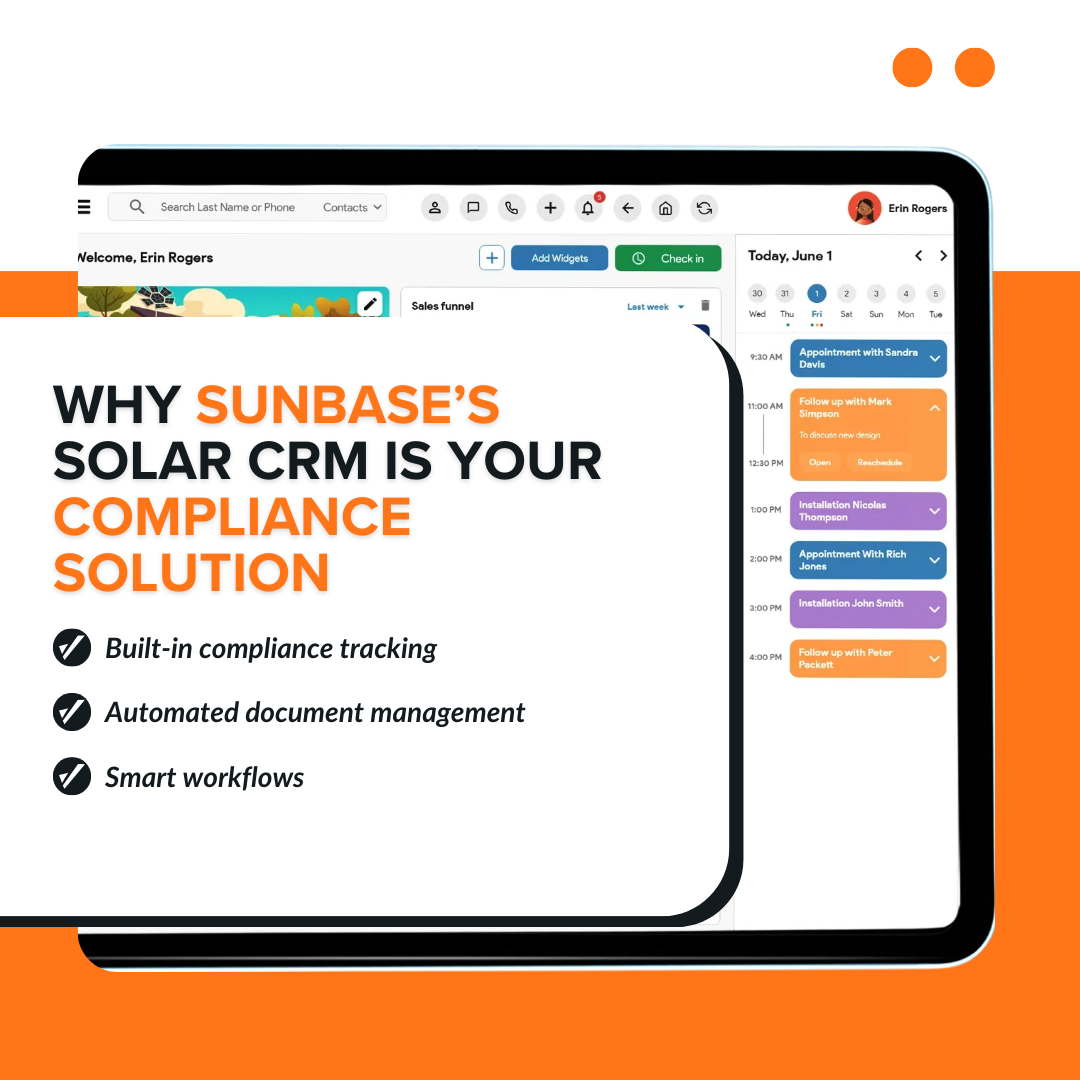
At Sunbase, we understand the unique compliance challenges faced by solar businesses. Our best solar CRM offers:
- Built-in compliance tracking – Stay ahead of solar policy changes and regulatory updates.
- Automated document management – Simplify audits with easy access to compliance documents through solar software integration.
- Smart workflows – Ensure that all solar projects meet legal requirements effortlessly.
By leveraging Sunbase’s solar CRM solution, solar companies can improve efficiency, save time, and grow their business without worrying about regulatory hurdles.
Conclusion
Compliance is one of the most critical challenges in the solar industry today. As regulations evolve, solar companies must adapt quickly to remain competitive and avoid financial risks.
Solar CRM software that is compliance-focused provides the right tools to track regulations, automate documentation, and optimize workflows. By investing in Solar CRM software, you can ensure compliance, enhance operational efficiency, and drive growth.
Compliance Shouldn’t Slow You Down
Solar CRM software can help you keep documentation, approvals, and regulatory updates organized in one place.
If you’d like to see how this works in real workflows, Sunbase brings it all together in a single platform. Book a demo to see it in action.
FAQs
1. What does regulatory compliance mean for solar businesses?
Regulatory compliance in the solar industry means following local, state, and national rules related to permits, safety standards, utility approvals, documentation, and customer data handling throughout the sales and installation process.
2. How does Solar CRM software help with regulatory compliance?
Solar CRM software centralizes compliance documents, approval statuses, and regulatory workflows in one system. This helps solar businesses track requirements, avoid missed steps, and maintain accurate records across every project.
3. Can Solar CRM help manage permits and approvals?
Yes. Solar CRM software tracks permit applications, utility approvals, inspections, and their current status, ensuring teams know exactly where each project stands and what action is required next.
4. How does Solar CRM reduce compliance errors?
Solar CRM reduces compliance errors by using standardized workflows, checklists, and mandatory fields. This prevents incomplete documentation, missed approvals, and inconsistent data entry.
5. Can Solar CRM store compliance and regulatory documents?
Yes. Solar CRM securely stores permits, contracts, inspection reports, approval letters, and compliance-related files, making them easy to access during audits or reviews.
6. Does Solar CRM help with data protection and customer privacy compliance?
Yes. Solar CRM software helps manage customer data securely with controlled access, activity logs, and standardized data handling processes that support privacy and data protection requirements.
7. Who benefits most from using Solar CRM for compliance?
Solar installers, EPCs, sales teams, project managers, and operations teams all benefit from Solar CRM by staying aligned, reducing compliance risks, and keeping projects moving smoothly.
One Platform.
Zero Chaos.
Run Your Entire Business in One Platform
Sunbase replaces your CRM, proposals, scheduling, job tracking, and reporting tools — all inside one clean, connected platform.
About Sunbase
The All-In-One Platform to Run Your Entire Business
Sunbase helps you organize operations, streamline daily workflows, and manage everything - from first customer contact to final project deliver- in one connected system.
Our Mission
- Organize your business.
- Optimize your workflow.
- Automate your dailytasks
Why Businesses Choose Sunbase
One Connected Workflow
Replace scattered tools and manual processes with a single platform that brings together your team, tasks, customers, jobs, and performance data.
🌎 Global Presence
Serving the United States, Canada, India, LATAM, Australia, and 10+ international markets.
👥 11,000+ Users
Trusted by contractors, installers, project managers, sales teams, and field technicians.
🏗️ Built for All Sizes
From small contracting teams to fast-growing enterprises, Sunbase adapts to your workflow.
Stop Managing Your Business Manually. Automate It.
Sunbase automates workflows, reduces mistakes, and helps your team get more done - without hiring extra staff or juggling multiple tools.
Still Managing Your Business Across Multiple Tools?
Bring your CRM, proposals, projects, and operations into one platform built for contractors.

